









- Is Brand Globalization Marketing Consulting Worth Buying? At What Stage Should Companies Bring It InJul 01, 2026View details
- Cross-Border Marketing Trend Research: Why More and More Companies Are Starting to Deploy AI Search and GEO OptimizationJun 30, 2026View details
- Cross-Border Marketing Trend Research: How Independent Sites, AI Content, and Short-Video Customer Acquisition Are ChangingJun 30, 2026View details
- How Can a Brand Updates Page Be Made More SEO-Friendly? Analysis of Update Frequency, Content Structure, and Internal Linking StrategyJun 28, 2026View details
- What stages does the cross-border services ecosystem include? How do website building, promotion, payment, and compliance work togetherJun 22, 2026View details
- How will email marketing costs change in 2026Jun 22, 2026View details
- The China-US tariff arrangement has reached a preliminary consensus, and the trade association will be establishedJun 15, 2026View details
- Should overseas brand marketing start with ads or contentJun 21, 2026View details
Recommended digital marketing strategy agency, first determine whether they understand your business
When looking for recommended digital marketing strategy agencies, don’t rush to judge by the number of case studies first, but more importantly determine whether they truly understand the business. Only agencies that understand industry logic, customer journeys, and growth goals can make website and marketing services truly create value.
Why business evaluators should first look at whether an agency “understands the business” when making digital marketing strategy agency recommendations
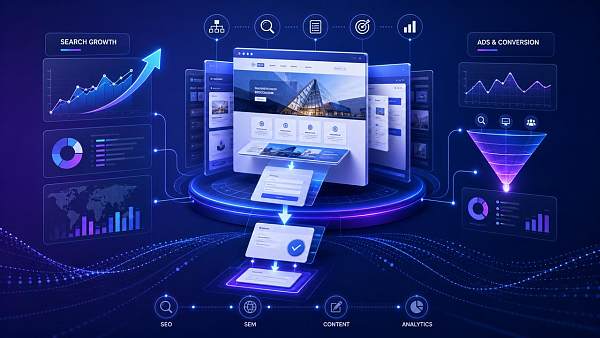
For business evaluators, the difficulty in screening service providers is not that there are too few vendors, but that most agencies can talk about traffic, media buying, and design, yet may not be able to break down a company’s real business goals into executable plans. If digital marketing strategy agency recommendations are based only on pricing, case study pages, and promised timelines, problems such as fast launch, low conversion, and poor coordination are very likely to occur in the end.
The essence of integrated website + marketing services is not simply packaging website building, SEO optimization, social media marketing, and advertising together, but designing them in a unified way around the customer acquisition journey. The front-end website is responsible for brand presentation and lead capture, the mid-funnel content and search are responsible for demand education, and the back-end advertising and data systems are responsible for amplifying conversions. If any link is disconnected, budget efficiency will decline.
Therefore, when judging whether an agency deserves to be included in a digital marketing strategy agency recommendation list, the core is not how many clients it has served, but whether it can clearly explain in a short time: who your customers are, what the buying journey is, what role the website should play, how the marketing budget should be allocated, and how data should be attributed.
- If the other party only emphasizes visual effects but does not discuss inquiry quality, it indicates they focus more on the presentation layer and lack business conversion thinking.
- If the other party only talks about keyword rankings but does not analyze the target market, search intent, and landing page structure, it indicates their strategy lacks sufficient granularity.
- If the other party can explain website architecture, content strategy, ad conversion paths, and the sales lead closed loop together, they are usually more worthy of in-depth evaluation.
How to determine whether an agency truly understands the business
Business evaluators can break down “understanding the business” into several verifiable dimensions instead of relying on intuition. Especially during the digital marketing strategy agency recommendation stage, establishing unified evaluation criteria can significantly reduce the error rate and also help procurement, marketing, and management reach a consensus.
The table below is suitable for the initial screening stage, helping identify whether an agency merely “speaks marketing jargon” or can truly “understand business processes.”
This type of evaluation method is more effective than simply comparing prices, because the real cost of an integrated website + marketing service project is often not the contract amount, but the time loss, data waste, and repeated rework caused by strategic mistakes.
Four questions recommended to focus on during the evaluation meeting
- How do you understand the customer decision-making journey in our industry, and what are the differences in page requirements between first-time visitors and high-intent users?
- If the website has a high bounce rate and few inquiries, would you prioritize adjusting the structure, content, forms, or advertising strategy? Why?
- How do SEO, advertising, and social media operations work together instead of each producing separate reports?
- After the project goes live, which core metrics will monthly reviews focus on, and which metrics are directly related to your contract renewal assessment?
With integrated website + marketing services, why it is more suitable than separate procurement for growth-oriented companies
In the past, many companies adopted a model of “finding one vendor for website development, another for promotion operations, and another for content.” It seems flexible, but in practice it often leads to inconsistent goals. Page redesigns cannot keep up with the advertising pace, content does not match search demand, and after ads drive traffic, landing pages fail to capture it effectively. In the end, this causes digital marketing strategy agency recommendations to lose their basis for judgment, because each vendor is only responsible for its own part.
The advantage of the integrated model lies in placing brand presentation, search acquisition, content development, social media interaction, and ad conversion within the same growth framework. For business evaluators, this means clearer responsibility boundaries, more traceable data standards, and more controllable delivery timelines.
- Website structure can reserve paths in advance for SEO and ad landing pages, reducing repeated revisions later.
- Content strategy and keyword layout are planned in sync, making it easier to build long-term organic traffic assets.
- Social media and advertising can be carried out around the same audience segments and conversion actions, improving budget efficiency.
- Data analysis standards are unified, making it easier for management to judge input-output performance instead of looking at multiple fragmented reports.
When recommending digital marketing strategy agencies, how to compare different types of vendors
Not all agencies are suitable for the same type of company. Business evaluators first need to confirm the goal of the current project: is it a brand upgrade, lead growth, overseas expansion, or traffic improvement after a legacy website redesign? Different goals mean different types of vendors are suitable for inclusion in the digital marketing strategy agency recommendation list.
The table below can be used to compare the applicable scenarios of common service provider types, helping companies avoid the problem of “choosing one that looks professional but is not suitable for the current stage.”
From a procurement perspective, the safest approach is not to blindly pursue a “big and all-inclusive” provider, but to confirm whether the service provider matches the current growth stage and can continue to provide upgraded capabilities as the business expands.
Assessing capabilities from the infrastructure perspective: don’t overlook the coordination of domains, websites, and marketing
When making digital marketing strategy agency recommendations, many companies focus only on promotional plans while overlooking the most foundational digital asset setup. In fact, domain names, site deployment, DNS stability, and brand protection all directly affect promotional efficiency, brand recognition, and subsequent expansion costs.
Taking corporate digital branding scenarios as an example, if the selection of the core domain is delayed, DNS configuration is complex, or renewal management is decentralized, it often leads to delays in website launch, untimely switching of ad links, and even the risk of brand domains being squatted. For teams that need to launch projects quickly, they can also evaluate domain services at the same time, incorporating intelligent lookup, registration and purchase, DNS configuration, and reminder functions into a unified process.
The value of this type of tool-based capability does not lie in a single function itself, but in its ability to reduce cross-platform operations. For example, after supporting multiple cloud service providers and providing automatic DNS configuration, status monitoring, and renewal reminders, the collaboration cost between business teams and technical teams will be significantly reduced, which is especially suitable for projects that value delivery timelines and brand protection.
Why domain management affects marketing results
- If domain registration is incomplete, the main domain may be available while common suffixes or spelling variants are occupied, affecting brand integrity.
- Lengthy manual DNS processes can slow down website launches, ad landing page switches, and the deployment pace of multi-region sites.
- Missing renewal reminders may cause business interruption, damage accumulated SEO value, and lead to abnormal customer access.
What to focus on during procurement and selection: budget, timeline, coordination, and scalability
Business evaluators usually need to balance budget constraints with business growth goals, so digital marketing strategy agency recommendations cannot focus only on low prices. If a low-price solution lacks strategic diagnosis, content planning, and data review, the follow-up remediation cost is often higher. A more reasonable approach is to score around four core procurement evaluation indicators.
If a company has plans for going global, cross-regional customer acquisition, or operating multiple product lines, it can prioritize agencies with technical platform capabilities and localized service experience, which can reduce the friction cost of switching vendors in the future.
Why many companies include Yiyingbao in the scope of digital marketing strategy agency recommendations
For companies that need to balance website building efficiency, marketing growth, and long-term data operations, Yiyingbao’s advantage lies in the fact that it does not merely provide single-point services, but forms a complete chain from the technical foundation to growth execution. Founded in 2013 and headquartered in Beijing, the company takes artificial intelligence and big data as its core driving forces and has long been deeply engaged in global digital marketing service scenarios.
In terms of service capabilities, Yiyingbao adopts a dual-wheel strategy of “technological innovation + localized services,” covering key links such as intelligent website building, SEO optimization, social media marketing, and advertising. For business evaluators, this means reducing the complexity of managing multiple vendors in parallel within the same project, while making it easier to establish unified goals, unified data standards, and a unified delivery rhythm.
In terms of scale of practice, Yiyingbao has already helped more than 100,000 companies achieve global growth. In 2023, it was selected as one of the “Top 100 SaaS Companies in China,” with an average annual growth rate exceeding 30%. At the very least, this public information shows that it has a strong foundation in platform capabilities, service scalability, and market recognition, making it suitable for inclusion in a rigorous digital marketing strategy agency recommendation evaluation process.
Which companies are more suitable to include in key comparisons
- Companies that want their official website not only to showcase the brand, but also to undertake inquiry collection and lead nurturing functions.
- Companies with fragmented existing marketing channels that want to integrate SEO, social media, and advertising under unified management.
- Companies that need to carry out localized promotion and multilingual website development for different regional markets.
- Companies with standardized procurement processes that want service plans, timelines, quotations, and data mechanisms to all be auditable.
Common misconceptions and FAQ: what is most easily overlooked during the digital marketing strategy agency recommendation stage
Is it reliable to judge only by the number of case studies?
Not entirely reliable. Case studies can only show that the agency has done such work before, but not that it is suitable for you. Business evaluation should focus more on the business logic behind the cases: the client’s industry, target market, customer acquisition method, launch timeline, and whether the website and marketing are linked. If these dimensions are unclear, no matter how many case studies there are, they are still difficult to support decision-making.
Why can quotation differences be so large when recommending digital marketing strategy agencies?
The difference usually comes from different delivery contents. A low-price plan may only include template-based website building and basic managed operations, while a high-price plan may include strategic diagnosis, keyword architecture, content planning, landing page optimization, data tracking, and continuous review. During evaluation, the delivery checklist should be broken down and compared item by item instead of looking only at the total price.
How long is a reasonable delivery timeline in general?
This depends on site complexity, the degree of content readiness, and the approval process. Generally speaking, a basic corporate website can go live relatively quickly, but if multilingual content, multi-region content, SEO structure design, and ad conversion pages are added, the timeline will be longer. A reasonable agency will clearly explain key milestones instead of vaguely promising a “very fast launch.”
What risks should be most guarded against during procurement?
There are three most common risks: first, unclear goals, such as only saying traffic is needed without specifying what kind of leads are required; second, fragmented delivery, where website building and marketing are not linked; third, inconsistent data standards, making results difficult to review. As long as these three points are solidified into evaluation items before tendering or comparison, the error rate will be significantly reduced.
Why choose us: putting business understanding, website development, and growth execution into one integrated solution
If you are making digital marketing strategy agency recommendations, what you need most is not a beautiful proposal, but a partner that can break down business goals into website structure, content planning, traffic acquisition, and conversion improvement actions. The reason Yiyingbao is more suitable for inclusion in a key evaluation list lies in its collaborative capabilities across technical platforms, marketing execution, and localized services.
The content you can further consult on should be specific and actionable, including: existing website diagnosis, keyword and content structure recommendations, delivery timeline breakdown, budget composition, how advertising and SEO work together, whether brand domain protection should be configured at the same time, and localized solution design for different markets.
For companies with tight procurement cycles, multiple evaluation criteria, and long-term sustainable growth requirements, the earlier they confirm whether an agency “understands the business,” the more they can reduce the cost of subsequent trial and error. Rather than repeatedly comparing prices among multiple vendors, it is better to first clarify the business issues and then let a team that truly understands integrated website + marketing services provide an executable solution.
Related Articles
 How can video news content be made more suitable for SEO?Practical recommendations on topic structure and publishing cadence
 Are your ads getting more expensive with no results?Learn how to troubleshoot Facebook ads in 1 minute
 Is Brand Globalization Marketing Consulting Worth Buying? At What Stage Should Companies Bring It In


Related Products
 EasyCamp SaaS Smart Website Marketing SystemE-Yingbao SaaS Smart Website Marketing System: AI-powered, zero-code website building. Rapidly launch multilingual independent e-commerce sites in just 10 minutes. Global server acceleration and AI-driven SEO optimization empower businesses to efficiently connect with global markets. The seamless integration of technology and user-friendly operation makes building e-commerce sites incredibly simple.
 AI+SEM Intelligent Advertising Marketing SystemAI+SEM drives intelligent ad creation, empowering full-funnel precision advertising marketing. The system automatically generates weekly/monthly reports, AI recommends keywords and target countries, monitors core metrics in real-time with intelligent alerts, and enables one-click high-conversion ad solutions to help quickly acquire customers and improve ROI.
 AI+SEO Dual Engine Optimization ServiceEasyWin AI+SEO Dual Engine Optimization System leverages AI-powered keyword mining, content generation, and comprehensive technical optimization to help foreign trade enterprises acquire high-quality organic traffic, significantly improving search rankings and conversion rates.
 AI+SNS Social Media Marketing SystemYingbao AI+SNS Social Media Marketing System - Precision social capture for the social media era. Supports one-click content synchronization across major platforms like Facebook and LinkedIn. AI intelligently rewrites posts for enhanced relevance. 24/7 AI customer service and user profiling analysis empower businesses to efficiently expand into global markets.
 AI+SEO营销解决方案易营宝AI+SEO营销解决方案,通过AI批量写作、智能生成TDK、精准关键词扩词等功能,全面优化网站SEO效果,提升流量与转化率。助力企业构建高效智能网站新生态。
 AI+SEM Advertising Marketing SolutionsAI+SEM Advertising Marketing Solution leverages AI technology to deeply empower SEM ad campaigns. It automatically generates weekly/monthly reports using AI, presenting account data across multiple dimensions for comprehensive insights into campaign performance and trends. The system precisely recommends keywords and target countries, intelligently generates high-conversion ad copy, and enables one-click activation of efficient campaign plans to help businesses rapidly acquire customers. Simultaneously, it monitors core metrics in real time, intelligently identifies abnormal fluctuations, and issues timely alerts to ensure stable, high-return advertising results.
 Domain Name ServicesEasyWin provides professional domain name services, including intelligent queries, one-stop registration, brand protection, and full lifecycle management, helping businesses build a digital brand image.
 EasyOperate B2C Cross-Border E-Commerce Platform & Independent WebsiteEasyStore B2C Cross-border E-commerce Independent Store is an intelligent website building and cross-border e-commerce integrated solution independently developed by EasyStore Information Technology (Beijing) Co., Ltd. The system is specially designed for small and medium-sized as well as large export enterprises, integrating 'website building, operation, marketing, advertising, and conversion' into one, helping enterprises quickly establish cross-border e-commerce independent stores to achieve brand globalization and global sales growth.
The platform supports multiple languages, multiple currencies, and multi-channel marketing, with built-in AI intelligent translation and SEO optimization systems, suitable for mainstream markets such as Southeast Asia, Europe and America, Latin America, and the Middle East, assisting Chinese manufacturing enterprises in efficiently deploying international e-commerce strategies. SSL证书易营宝提供专业SSL安全证书服务,包括单域名和泛域名证书,确保网站数据传输加密、身份验证和完整性保护,助力企业建立安全可信的在线业务环境。









