


I. The Industry Definition of Technological Innovation in Integrated Website + Marketing Services
In the integrated website + marketing services sector, technological innovation is not just about launching new features, but about connecting website building, content, media buying, data analysis, and customer management into a growth system that can be continuously optimized. It focuses not only on the advancement of tools, but also on business efficiency and commercial outcomes.
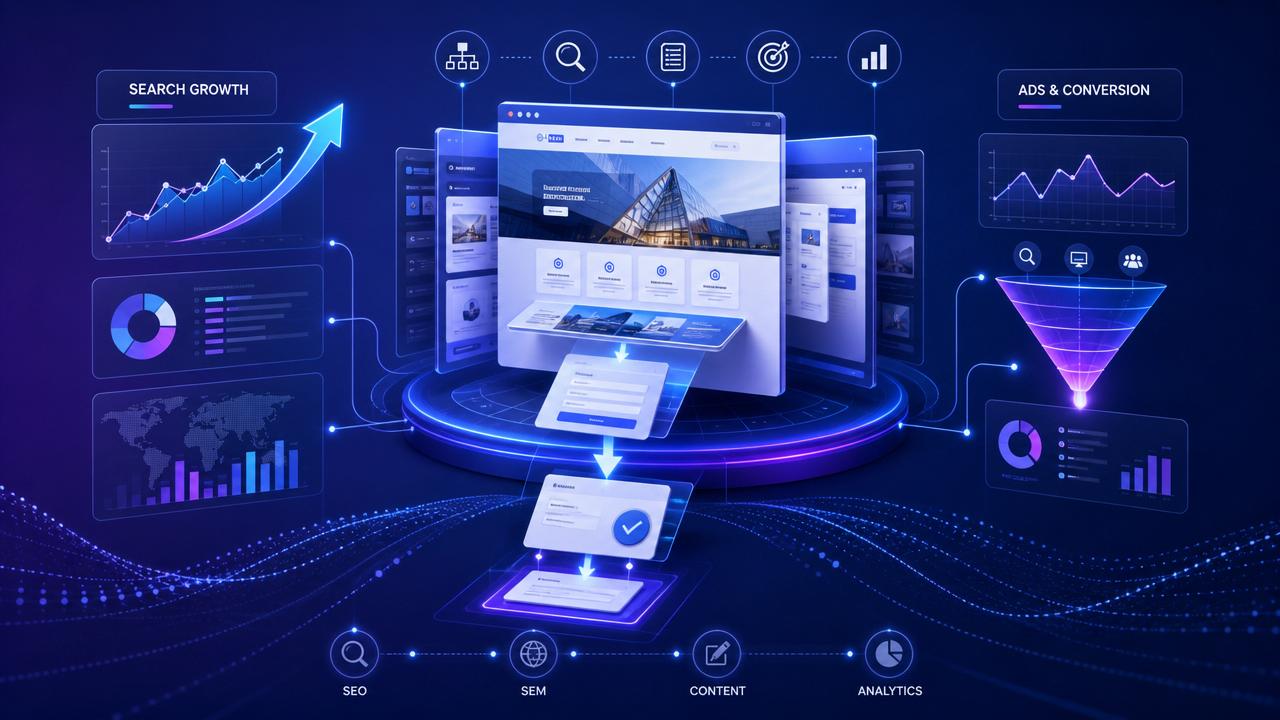
In traditional models, websites, advertising, content, and lead management are often executed separately by different teams or vendors, which easily creates data silos. The core value of technological innovation lies in using a unified architecture to connect the full chain of brand presentation, customer acquisition, conversion, review, and remarketing.
From an industry perspective, technological innovation usually includes modules such as responsive website building, marketing automation, generative content support, global access acceleration, multilingual capabilities, data security, and permission management. When making procurement decisions, companies should prioritize collaborative capability rather than a stack of isolated features.
For foreign trade and B2B companies, technological innovation also means faster entry into new markets, more stable handling of overseas traffic, and lower trial-and-error costs. This is also why integrated solutions are gradually replacing fragmented service procurement.
II. How Technological Innovation Drives Customer Acquisition, Conversion, and Brand Growth
The direct impact of technological innovation on customer acquisition is improving the efficiency with which a company gets seen. When website structures are clearer, pages load faster, and content better matches search demand, both search engine crawling and user access experience improve at the same time, leading to more traffic entry points.
At the conversion stage, technological innovation can optimize the path from browsing to lead submission. For example, mobile adaptation, simplified forms, improved page response speed, and intelligent content recommendations can all reduce bounce rates and increase the proportion of valid inquiries.
Brand growth does not rely only on exposure volume, but more on the consistent delivery of professional information and a unified brand experience. Through a unified website system, content strategy, and data feedback mechanism, companies can gradually build a trustworthy image rather than relying on short-term fluctuations in ad spending.
Taking Yiyingbao as an example, its responsive architecture, generative content capabilities, and global node acceleration are better suited for companies that need to balance domestic and international access experience, content update efficiency, and lead handling across multiple regions. The value of this type of technological innovation is often reflected in long-term conversion rates and the accumulation of brand assets.
III. Technical Principles and Mainstream Categories: What Underlying Capabilities Should Companies Understand
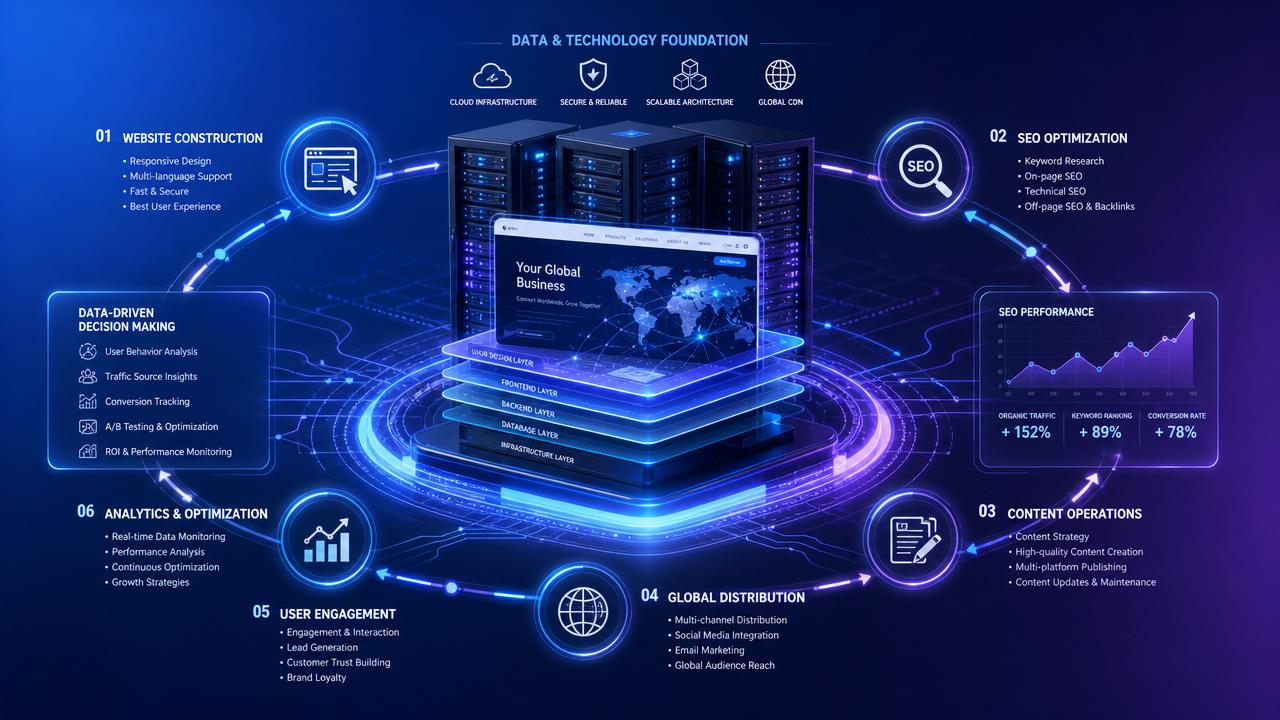
From the perspective of technical principles, technological innovation in integrated website + marketing services is usually built on the front-end presentation layer, content generation layer, data analysis layer, and infrastructure layer. The front end determines the access experience, the content layer affects communication efficiency, the data layer determines the quality of operational decision-making, and the infrastructure determines stability.
The first category is experience-driven technological innovation, including responsive design, page compression, interaction optimization, and access acceleration. These capabilities directly affect the loading speed, reading comfort, and time on site for users on different devices and in different regions.
The second category is content-driven technological innovation, including multilingual management, content templates, intelligent writing assistance, and bulk page generation. For companies with many products, many markets, and frequent updates, these capabilities can significantly reduce the labor required for content maintenance.
The third category is operations-driven technological innovation, including lead distribution, data tracking, advertising coordination, visitor behavior analysis, and remarketing strategy support. The fourth category is security and deployment capability, including cloud nodes, permission control, backup, and system version iteration, which determine whether the platform is suitable for medium- and long-term operations.
IV. Who Should Prioritize Deploying Technological Innovation: Target Companies and Typical Application Scenarios
The companies most suitable for prioritizing technological innovation are usually B2B enterprises that rely on online channels for inquiries, have high product technical barriers, cover multiple regional markets, or have long sales cycles. These companies need their websites to undertake multiple tasks including presentation, education, screening, and trust building.
For example, industries such as laser engraving machines, steel, chemicals, heavy trucks, machinery, and new energy often have long customer decision-making cycles and complex procurement information search paths. If website content is updated slowly, loading speed is unstable, or page logic is confusing, lead opportunities are often lost directly.
At the same time, industries such as tourism, catering, education, healthcare, furniture, and agriculture are also placing increasing importance on brand expression and multi-channel coordination. Technological innovation enables companies to form unified collaboration across their official websites, content, advertising, and data, rather than fighting separate battles.
From service experience, Yiyingbao has already covered multiple industries such as laser engraving machines, machinery, new energy, the internet, and automobiles, and has served client types including Haier, Okenma, Shandong Airlines, Yuanhe Power Station, Xiaoya Group, and Sinotruk. This shows that integrated technological innovation is suitable for business scenarios that value both branding and customer acquisition efficiency.
V. Enterprise Selection Criteria: How to Judge Whether a Solution Is Truly Usable
When evaluating a technological innovation solution, first look at whether the architecture is complete. A truly usable platform should simultaneously cover website building, content, promotion support, data tracking, and subsequent operations, rather than solving only one single link. Otherwise, companies still need multi-party coordination, and management costs will not decrease.
Second, look at performance and compatibility. Responsive capability, mobile experience, access speed, and overseas loading stability directly affect lead conversion. For overseas business, global node deployment and low-latency access capability are especially important, as they affect the effectiveness of ad landing pages and the handling of organic traffic.
Third, look at content production and maintenance efficiency. If a company has many products and many language versions, it should focus on AI-assisted generation, multilingual management, page reuse, and bulk update capabilities. The efficiency of ongoing operations often has a greater impact on final input-output performance than the initial launch cost.
Fourth, look at the vendor's version iteration, team experience, and industry understanding. In recent years, Yiyingbao has continuously released versions related to cloud intelligent website building, multilingual website building, and AI foreign trade independent websites. Its core team has extensive experience in search algorithms and SaaS development, and this kind of continuous update capability is usually more worthy of attention than one-time delivery.
VI. Implementation and Quality Control: Key Steps from Launch to Continuous Growth
The implementation of technological innovation should not be judged only by website building speed, but more importantly by whether the implementation process is controllable. Companies are usually advised to proceed through seven steps: “goal clarification, information architecture, page production, content deployment, data tagging, testing and launch, review and optimization”, to avoid situations where the website becomes difficult to operate, analyze, and iterate after completion.
In terms of quality control, focus should be placed on three types of indicators: the first is access quality, such as loading time, device compatibility, and form usability; the second is content quality, such as information accuracy, industry relevance, and multilingual consistency; the third is conversion quality, such as the clarity of inquiry paths and lead traceability.
If a company relies on overseas traffic, it should also focus on testing access performance in different countries and regions. Relying on the global acceleration capabilities of node resources from Alibaba Cloud, AWS, Huawei Cloud, Tencent Cloud, Baidu Cloud, and others can help companies reduce traffic waste and customer loss caused by network fluctuations.
In addition, although generative content tools can improve efficiency, they should still be combined with manual review to ensure that product parameters, industry terminology, delivery capability, and brand messaging are accurate and consistent. The ideal state of technological innovation is not to completely replace people, but to amplify the execution capability and response speed of the team.
VII. Total Cost of Ownership and Return on Investment: How Procurement Should Calculate Them
From a procurement perspective, the cost of technological innovation should not be judged only by the initial website building fee, but also by the total cost of ownership. This usually includes system deployment, content development, daily maintenance, version upgrades, advertising coordination, team training, and data migration, among other components. A low-quotation solution does not necessarily mean it is more economical in the long run.
The real key factor affecting ROI is whether it can reduce repetitive communication, shorten page launch cycles, improve content production speed, and increase the valid inquiry rate. If the platform can reduce switching between multiple systems and avoid repeated rework, even a slightly higher initial investment may show better overall returns within one year.
When calculating, companies can focus on four indicators: cost per lead, lead conversion rate, page update efficiency, and overseas access stability. These indicators are closely related to the maturity of technological innovation and also best reflect whether the solution is suitable for long-term business expansion.
If a company is in the stage of expanding its brand overseas, revamping an old website, or improving advertising efficiency, prioritizing an integrated platform is usually more beneficial for controlling hidden costs. The reason is that data, content, and pages are all centralized within the same system, making the management chain shorter and iterative decision-making faster.
VIII. Future Trends: How Technological Innovation Will Continue Reshaping the Industry
In the next few years, technological innovation in the integrated website + marketing services industry will show three clear directions. The first is deeper intelligence: content generation, page building, media buying coordination, and data analysis will become further automated, but at the same time, companies' requirements for strategic control and content review will also increase.
The second is the parallel development of globalization and localization. Companies need not only to solve multilingual presentation, but also to address differences in access speed, search habits, conversion paths, and content expression across different regions. Therefore, technological innovation will increasingly emphasize global node capabilities and flexible local operational support.
The third is data assetization. In the future, companies will place greater importance on reusable data accumulated from websites, including visitor behavior, content performance, channel quality, and inquiry profiling. Whoever can use this data for decision-making earlier will be more likely to build a replicable growth mechanism.
For companies that hope to simultaneously improve customer acquisition efficiency, conversion quality, and brand credibility, technological innovation is no longer an optional add-on, but part of the growth infrastructure. Choosing a continuously iterating integrated service provider like Yiyingbao is more conducive to maintaining response speed and operational resilience in a changing market.
 Innovation is reshaping how businesses acquire customersThe innovation engine is reshaping how businesses acquire customers, helping companies improve lead quality and conversion efficiency through website development, SEO optimization, content marketing, advertising, and data collaboration, creating a more stable growth loop.
 How Technological Innovation Impacts Website Conversion and Customer Acquisition EfficiencyHow does technological innovation impact website conversion and customer acquisition efficiency? This article focuses on three key scenarios: new website cold start, low-conversion optimization, and multi-channel campaign deployment, analyzing the growth impact of SEO, intelligent website building, data analytics, and automated operations to help businesses improve lead quality and customer acquisition efficiency.
 What growth losses can poor localization services causeWhat growth losses can poor localization services cause? From lead loss and declining conversions to damaged channel trust, this article analyzes the key breakdown points in an integrated website and marketing service scenario, and provides practical methods to improve customer acquisition and deal-closing efficiency.
 What should be prioritized when comparing localization service optionsWhat should be prioritized when comparing localization service options? Don’t just look at price, but also evaluate delivery capabilities, industry experience, technical support, and ongoing operational performance to help businesses identify a truly integrated service provider that can improve website traffic, inquiry conversion, and long-term growth.
 Recommended digital marketing strategy agency, first determine whether they understand your businessWhen choosing a digital marketing strategy agency, first see whether they truly understand your business. This article shows you how to efficiently evaluate integrated website + marketing service providers from the perspectives of customer journey, website planning, SEO and advertising coordination, and data attribution, so as to reduce trial-and-error costs.
 Which internet marketing consulting company is good? Start by looking at the methodologyWhich internet marketing consulting company is good? First see whether it has a replicable methodology and integrated execution capability. This article shows you how to systematically evaluate service providers from website building, SEO, content, advertising placement to data review, reducing trial-and-error costs.
 How Multilingual Digital Marketing Websites Can Balance Conversion and SEOHow can multilingual digital marketing websites balance conversion and SEO? This article focuses on website architecture, content optimization, localization strategies, and data tracking, analyzing integrated website building and marketing solutions to help businesses improve indexing, inquiry conversion, and global growth efficiency.
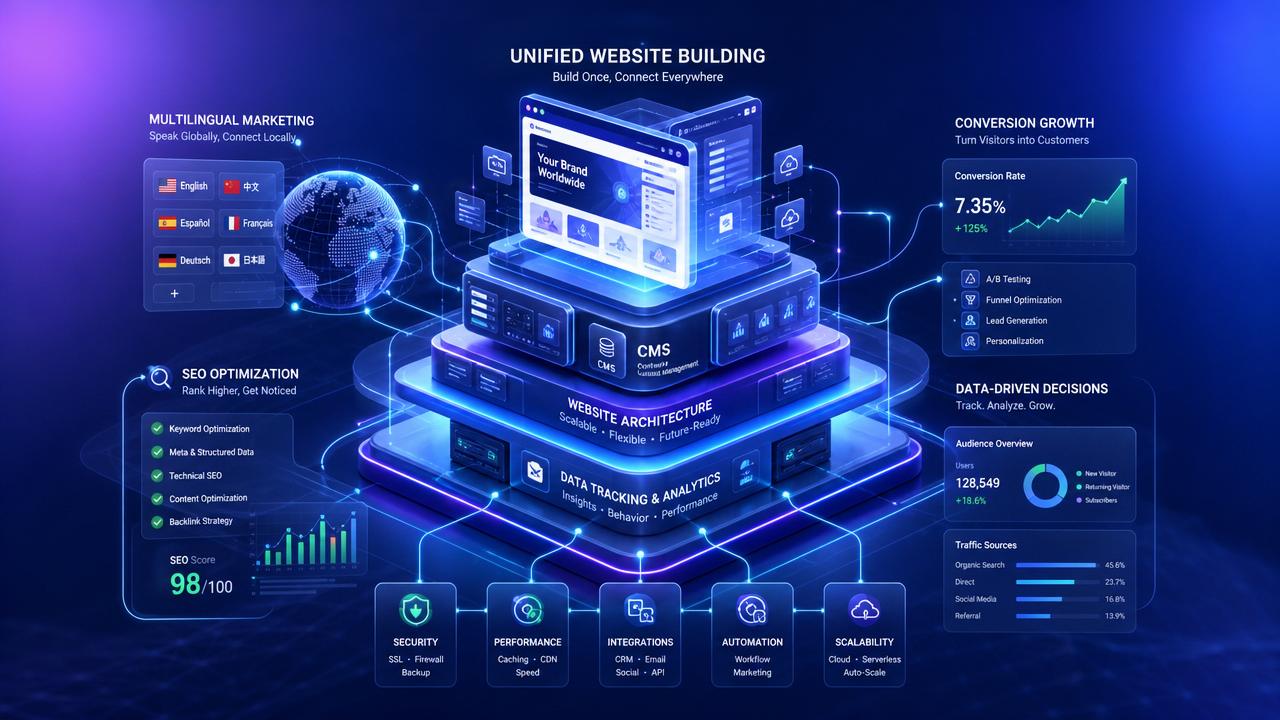
 What core modules are included in the one-stop marketing platform service?The one-stop marketing platform service covers five core modules: intelligent website building, SEO optimization, social media operations, advertising, and data analytics, helping enterprises build a closed loop for customer acquisition, conversion, and growth, while enhancing brand influence and global marketing efficiency.