









- What Does a Global Traffic Ecosystem Service Provider Do? What Are the Differences from a Single Advertising AgencyJul 16, 2026View details
- What should you focus on in the latest enterprise SaaS report? From renewal rates and delivery costs to overseas growth opportunitiesJul 12, 2026View details
- What signals are worth paying attention to in a cross-border marketing trend report? B2B companies should look at these 6 signalsJul 11, 2026View details
- How to Read a Cross-Border Marketing Trends Report? Five Key Dimensions for Evaluating Channel OpportunitiesJul 11, 2026View details
- Which channel has the highest ROI in the global traffic ecosystem? Comparative analysis of search, social media, and advertisingJul 10, 2026View details
- What multilingual website services are available in Sanya? Which model is more suitable for local businesses going global?Jul 08, 2026View details
- How to view the complete list of China SaaS companies in the top 100? Practical methods for screening website-building and marketing service providersJul 08, 2026View details
- How to view pricing in the global traffic ecosystem? Cost comparison of search, social media, and content channel advertisingJul 06, 2026View details
How Multilingual Digital Marketing Websites Can Balance Conversion and SEO
A multilingual digital marketing website must not only meet the technical evaluation requirements for performance, architecture, and scalability, but also balance SEO indexing and conversion efficiency. This article will analyze how to achieve a win-win for growth and search from the perspectives of website strategy, content optimization, and localization practices.
Why technical evaluators pay more attention to the underlying capabilities of multilingual digital marketing websites
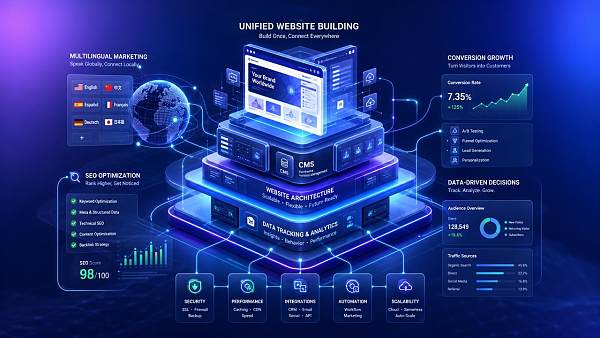
For technical evaluators, a multilingual digital marketing website is not simply about adding several language pages, but a systematic project involving architecture, content, data, campaign delivery, and conversion pathways. If the early stage focuses only on page presentation while ignoring underlying capabilities, problems such as fragmented indexing, duplicate pages, low publishing efficiency, and high cross-regional operation and maintenance costs will often arise later.
In the integrated website + marketing services industry, a truly valuable solution should simultaneously support website building, SEO optimization, social media collaboration, and ad landing page management. Only in this way can technical teams reduce interface fragmentation, while enabling marketing teams to achieve unified management, unified tracking, and unified optimization across different countries and channels.
Yiyingbao Information Technology (Beijing) Co., Ltd. has long provided full-chain services around intelligent website building, search optimization, social media marketing, and advertising delivery. Its advantage lies not in a single-point tool, but in using technological innovation and localized services to move multilingual digital marketing websites from “being able to go live” to “being able to grow.”
- Unified site architecture, reducing multilingual content silos and making it easier for search engines to understand page relationships.
- Unified data tracking, helping technical evaluators quickly assess traffic quality, inquiry sources, and conversion paths.
- Unified publishing and permission system, reducing repetitive operations and manual errors in cross-team collaboration.
- Unified localization strategy, allowing pages in different countries to maintain brand consistency while aligning with local search habits.
How to design a multilingual digital marketing website architecture that balances SEO and conversion
What technical evaluations look at first is often not the copy, but the architecture. If a multilingual digital marketing website lacks a clear information hierarchy, issues such as confused language versions, duplicate templates, and inconsistent URL strategies will arise, ultimately affecting crawl efficiency and conversion experience.
Four architectural dimensions recommended for priority evaluation
- Whether the URL strategy is clear, for example, dividing directories by language or region to avoid competition from multiple entry points for the same content.
- Whether templates are componentized, supporting shared modules across multiple languages while independently adjusting titles, descriptions, and conversion elements.
- Whether content management supports batch publishing, version rollback, and multi-role collaboration to adapt to high-frequency update needs.
- Whether the data system can connect with analytics, forms, and advertising platforms to reduce later integration costs.
The table below is more suitable for technical evaluators to quickly compare during the selection stage and determine whether a multilingual digital marketing website solution has long-term operational value rather than merely meeting short-term launch needs.
From a technical perspective, the greatest value of an integrated architecture is reducing duplicate construction. Especially when enterprises simultaneously deploy organic search, advertising campaigns, and social media landing scenarios, a unified foundation will directly affect launch speed, operation and maintenance efficiency, and room for subsequent optimization.
Which page strategies can better improve indexing, dwell time, and inquiry conversion
A common misconception about multilingual digital marketing websites is turning all language pages into mechanically translated versions. Although this increases the number of pages, search intent is not truly covered, and users also find it difficult to form consultations, downloads, or submit requests after entering the page.
Page combinations more suitable for growth-oriented websites
- Core product or service pages: targeting high-commercial-intent keywords, highlighting value propositions, capability scope, and contact entry points.
- Scenario solution pages: broken down around industries, regions, channels, or business objectives to capture more precise search demand.
- Educational content pages: explaining implementation processes, technical parameters, selection recommendations, and risk points to support technical evaluation and procurement communication.
- Case study and trust pages: showcasing methodology, service processes, and execution logic to reduce decision-making resistance before conversion.
For example, when technical evaluators search for multilingual digital marketing websites, they are often concerned about system compatibility, expansion methods, deployment collaboration, and the efficiency of subsequent content maintenance. If a page emphasizes only visual design while lacking architectural explanations, delivery cadence, and data tracking logic, conversion efficiency is usually far from ideal.
In content organization, it is recommended to present technical explanations and marketing messaging in layers. The first screen answers “what problems can be solved,” the middle section explains “how it is achieved,” and the bottom then presents “how to evaluate delivery and budget.” This structure better matches the reading path of technical evaluators.
What to focus on during procurement: selection criteria from performance and scalability to collaborative workflows
If an enterprise is preparing to procure multilingual digital marketing website services, looking only at quotations can easily lead to misjudgment. What truly determines total cost is often the later redesign frequency, the difficulty of adding languages, the complexity of data integration, and the communication cost across departments.
To help technical evaluators make decisions faster, a selection checklist is compiled below, suitable for direct use when communicating with suppliers or comparing solutions.
In actual projects, Yiyingbao Information Technology (Beijing) Co., Ltd. is more suitable for enterprises that value both the technical foundation and the website’s direct role in customer acquisition goals. For technical evaluators, this service model can reduce the coordination friction of separately procuring website building, SEO, campaign delivery, and social media tools.
Localization is not translation: how multilingual digital marketing websites can avoid inefficient investment
Many companies invest in multilingual digital marketing websites yet still fail to see effective inquiries for a long time. The reason is usually not “lack of traffic,” but insufficient localization depth. If search terms, expressions, trust elements, and contact methods are not aligned with local user habits, even a complete page will still struggle to generate conversions.
Localization implementation can be advanced from three levels
- Search-level localization: rebuild the keyword system according to the target market rather than directly copying the Chinese semantic intent.
- Content-level localization: adjust titles, selling points, case study expressions, and form fields to reduce cultural mismatches.
- Conversion-level localization: set up commonly used local communication methods, time zone prompts, response commitments, and page trust elements.
This approach is not only applicable to B2C, B2B also needs it. Technical procurement users care more about whether the page clearly explains delivery methods, system interfaces, service boundaries, and follow-up maintenance mechanisms. Without this content, even if the page has traffic, it is still difficult to move into the business opportunity stage.
In building knowledge-based content, some companies also include industry research and institutional framework materials in the content matrix to strengthen professional entry points and long-tail coverage. For example, relevant scenario pages can naturally extend to specialized resources such as Exploration of development strategies for building internal control systems in public institutions, but the premise is that the content logic remains consistent with the needs of target users, avoiding awkward stitching.
Common misconceptions and FAQ: which issues are most easily overlooked during the technical evaluation stage
Must a multilingual digital marketing website launch all languages at once?
Not necessarily. A more prudent approach is to first build the main site structure and core languages around high-potential markets, and then expand gradually. This can control the budget while also making it easier to verify whether keywords, page templates, and inquiry paths are effective before replicating them to other markets.
What technical item is most easily overlooked during procurement?
The most commonly overlooked item is data tracking and attribution design. Many websites only discover after launch that lead sources cannot be distinguished, making it difficult to compare the effectiveness of SEO, advertising, and social media. During the technical evaluation stage, event tracking, form identifiers, channel parameters, and reporting standards should be confirmed in advance.
What types of companies are multilingual digital marketing websites suitable for?
They are suitable for companies planning to expand overseas, already operating in multiple overseas markets, needing unified brand expression, or hoping to upgrade their official website from a display window into a customer acquisition entry point. In particular, companies with complex product lines, scattered country markets, and long sales cycles need structured content and refined conversion design even more to improve efficiency.
What factors generally affect the delivery timeline?
It is mainly affected by the number of pages, language scale, complexity of data integration, completeness of content preparation, and whether localized rewriting is required. If the company can clarify keyword strategy, page lists, and permission workflows in the early stage, the overall delivery will be significantly more controllable.
Why choose us: collaborative support from solution evaluation to implemented growth
For technical evaluators, choosing a service provider is not only about website building capability, but whether it can truly connect multilingual digital marketing websites with SEO, social media, advertising, and data analytics. Driven by artificial intelligence and big data as core forces, Yiyingbao Information Technology (Beijing) Co., Ltd. has long served global growth scenarios and is better suited for enterprises that need long-term operations rather than one-time delivery.
- If you need to confirm whether the multilingual site architecture is reasonable, you can discuss directory design, page templates, and expansion strategies.
- If you are comparing solutions from different suppliers, you can focus on consulting about performance metrics, tracking methods, delivery timelines, and collaboration workflows.
- If you are concerned about a limited budget, you can also first discuss a phased construction plan, prioritizing the launch of high-value languages and key conversion pages.
- If you need industry content support, you can combine specialized resource planning with site strategy, including ways to embed knowledge-based content such as Exploration of development strategies for building internal control systems in public institutions.
It is recommended to complete parameter confirmation, language planning, conversion goal clarification, and the data integration checklist before project launch. This not only shortens communication time, but also enables the multilingual digital marketing website to enter a stable stage of being indexable, campaign-ready, and convertible more quickly.
Related Articles
Related Products
 EasyCamp SaaS Smart Website Marketing SystemE-Yingbao SaaS Smart Website Marketing System: AI-powered, zero-code website building. Rapidly launch multilingual independent e-commerce sites in just 10 minutes. Global server acceleration and AI-driven SEO optimization empower businesses to efficiently connect with global markets. The seamless integration of technology and user-friendly operation makes building e-commerce sites incredibly simple.
 AI+SEM Intelligent Advertising Marketing SystemAI+SEM drives intelligent ad creation, empowering full-funnel precision advertising marketing. The system automatically generates weekly/monthly reports, AI recommends keywords and target countries, monitors core metrics in real-time with intelligent alerts, and enables one-click high-conversion ad solutions to help quickly acquire customers and improve ROI.
 AI+SEO Dual Engine Optimization ServiceEasyWin AI+SEO Dual Engine Optimization System leverages AI-powered keyword mining, content generation, and comprehensive technical optimization to help foreign trade enterprises acquire high-quality organic traffic, significantly improving search rankings and conversion rates.
 AI+SNS Social Media Marketing SystemYingbao AI+SNS Social Media Marketing System - Precision social capture for the social media era. Supports one-click content synchronization across major platforms like Facebook and LinkedIn. AI intelligently rewrites posts for enhanced relevance. 24/7 AI customer service and user profiling analysis empower businesses to efficiently expand into global markets.
 AI+SEO营销解决方案易营宝AI+SEO营销解决方案,通过AI批量写作、智能生成TDK、精准关键词扩词等功能,全面优化网站SEO效果,提升流量与转化率。助力企业构建高效智能网站新生态。
 AI+SEM Advertising Marketing SolutionsAI+SEM Advertising Marketing Solution leverages AI technology to deeply empower SEM ad campaigns. It automatically generates weekly/monthly reports using AI, presenting account data across multiple dimensions for comprehensive insights into campaign performance and trends. The system precisely recommends keywords and target countries, intelligently generates high-conversion ad copy, and enables one-click activation of efficient campaign plans to help businesses rapidly acquire customers. Simultaneously, it monitors core metrics in real time, intelligently identifies abnormal fluctuations, and issues timely alerts to ensure stable, high-return advertising results.
 Domain Name ServicesEasyWin provides professional domain name services, including intelligent queries, one-stop registration, brand protection, and full lifecycle management, helping businesses build a digital brand image.
 EasyOperate B2C Cross-Border E-Commerce Platform & Independent WebsiteEasyStore B2C Cross-border E-commerce Independent Store is an intelligent website building and cross-border e-commerce integrated solution independently developed by EasyStore Information Technology (Beijing) Co., Ltd. The system is specially designed for small and medium-sized as well as large export enterprises, integrating 'website building, operation, marketing, advertising, and conversion' into one, helping enterprises quickly establish cross-border e-commerce independent stores to achieve brand globalization and global sales growth.
The platform supports multiple languages, multiple currencies, and multi-channel marketing, with built-in AI intelligent translation and SEO optimization systems, suitable for mainstream markets such as Southeast Asia, Europe and America, Latin America, and the Middle East, assisting Chinese manufacturing enterprises in efficiently deploying international e-commerce strategies. SSL证书易营宝提供专业SSL安全证书服务,包括单域名和泛域名证书,确保网站数据传输加密、身份验证和完整性保护,助力企业建立安全可信的在线业务环境。









