









- Is Brand Globalization Marketing Consulting Worth Buying? At What Stage Should Companies Bring It InJul 01, 2026View details
- Cross-Border Marketing Trend Research: Why More and More Companies Are Starting to Deploy AI Search and GEO OptimizationJun 30, 2026View details
- Cross-Border Marketing Trend Research: How Independent Sites, AI Content, and Short-Video Customer Acquisition Are ChangingJun 30, 2026View details
- How Can a Brand Updates Page Be Made More SEO-Friendly? Analysis of Update Frequency, Content Structure, and Internal Linking StrategyJun 28, 2026View details
- What stages does the cross-border services ecosystem include? How do website building, promotion, payment, and compliance work togetherJun 22, 2026View details
- How will email marketing costs change in 2026Jun 22, 2026View details
- The China-US tariff arrangement has reached a preliminary consensus, and the trade association will be establishedJun 15, 2026View details
- Should overseas brand marketing start with ads or contentJun 21, 2026View details
Why International Digital Agencies Place Greater Emphasis on Topic Architecture in Content Marketing
Against the backdrop of intensifying global competition, international digital agencies are placing increasing emphasis on topic frameworks in content marketing. For business decision-makers, scientific topic selection not only determines content distribution efficiency, but also directly affects brand growth, lead quality, and the long-term return on marketing investment.
For the integrated website + marketing services industry, content is never simply “finished once it is written,” but must serve website conversion, search visibility, lead qualification, and sales alignment. Especially in cross-market campaigns, under the same budget, different topic selection logic often leads to differences in organic traffic, opportunity quality, and brand awareness that are rapidly amplified within 3–6 months.
Since its establishment in 2013, Easy Marketing Information Technology (Beijing) Co., Ltd. has continuously built end-to-end service capabilities around intelligent website building, SEO optimization, social media marketing, and advertising placement. For business decision-makers, what is truly worth focusing on is not whether content volume reaches 10 or 20 pieces per month, but whether a scalable topic framework has been established so that content assets can continue compounding alongside business growth.
Why International Digital Agencies Put Topic Frameworks First in Content Marketing
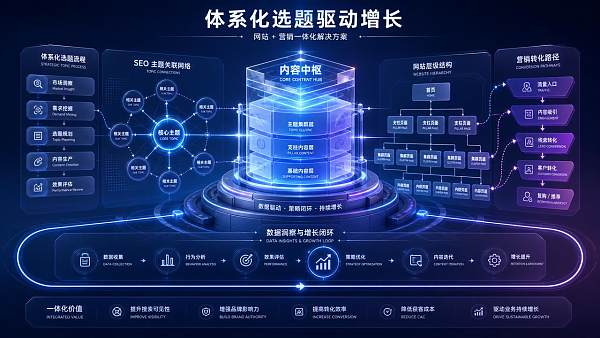
Many companies understand content marketing as creative execution, but international digital agency content marketing places greater emphasis on underlying methodology. The reason is straightforward: users in global markets have different search habits, different purchasing cycles, and longer decision-making chains. Without systematic topic selection, content is likely to face 3 types of problems—imprecise traffic, unstable conversion, and insufficient campaign coordination.
In B2B scenarios, a typical project often goes through 4 stages from initial touchpoint to inquiry conversion: awareness, comparison, validation, and decision-making. If content is concentrated only on the brand promotion layer, companies can cover only top-of-funnel exposure; only when topics also cover solutions, implementation processes, cost evaluation, and common risks can content truly enter the procurement discussion stage.
A Topic Framework Is Not a “Content Calendar,” but a Growth Structure
A high-quality topic framework usually includes 3 dimensions: search demand, business goals, and sales questions. The first determines whether users can find it, the second determines whether the content serves phased growth, and the third determines whether the content can help sales reduce repetitive explanations. If any one of the three is missing, the return on content investment will decline.
Three Common Mistakes Companies Make
- Focusing only on hot topics, not on target customers’ search intent, resulting in high traffic but few inquiries.
- Writing only brand news, not procurement concerns, resulting in content that cannot enter the comparison stage.
- Doing only single-language duplication, not localized restructuring, resulting in high bounce rates on overseas pages.
The table below is more suitable for management teams to quickly judge why, although all are doing content, some teams are still chasing data after 3 months, while others have already formed a stable source of leads.
From a management perspective, the reason international digital agency content marketing values topic frameworks is essentially that front-end content design is used to reduce back-end customer acquisition costs. Usually, after a company accumulates 30–50 structured articles in its content library, search coverage and conversion paths become more stable than during the stage of random updates.
How Business Decision-Makers Can Build an Executable Topic Framework
For companies, a topic framework does not need to pursue complexity at the very beginning, but should first be implemented around “business priority + market stage + site structure.” It is usually recommended to first complete 4 steps: define target markets, sort out customer questions, map keyword hierarchies, and establish a content publishing cadence. This can form the first verifiable content matrix within 6–8 weeks.
Step One: Define the Market First, Not the Topic First
International business often involves multiple regions, and the search expressions and decision-making priorities in Southeast Asia, the Middle East, and Europe are not the same. If a company does not distinguish market priorities before building the site, information overlap is likely to appear on the homepage, category pages, and article pages. It is recommended to first lock in 1–2 key target markets and establish about 20 core topic pools for each market.
Step Two: Turn High-Frequency Sales Questions into Content Topics
Content that truly drives conversion often comes from the questions the sales team is asked every day, such as: how long is the delivery cycle, how soon can traffic be visible after website launch, which industries is SEO suitable for, and how advertising and content should work together. These questions naturally correspond to the procurement decision stage and are closer to orders than general industry information.
For example, when some companies create digital content in the management category, they also use cross-topic case studies to strengthen professionalism. If targeting clients in education, government and public institutions, or large organizations, appropriately referencing the structural thinking of research-oriented content such as Research on the Industry-Finance Integration Strategy for Full Lifecycle Management of Fixed Assets in Universities can help enhance an article’s decision-making reference value, but it must be restructured in combination with website and marketing scenarios rather than simply pieced together.
Step Three: Design Keyword Hierarchies by Conversion Stage
International digital agency content marketing usually does not focus only on core head terms, but instead divides keywords into 3 layers. The first layer is brand and service terms, the second layer is scenario and solution terms, and the third layer is question and comparison terms. Once the three layers work together, the website can not only capture organic exposure, but also cover high-intent searches in the middle and later stages of decision-making.
The table below is suitable for planning the topic structure in integrated website + marketing service projects, and is especially useful for management when making quarterly content budget references.
If a company publishes 8–12 pieces of content per month, it is recommended that 40% cover the awareness stage, 35% cover the comparison stage, and 25% cover the decision stage. This proportion is more aligned with the long-cycle conversion logic of B2B and can also avoid content remaining for a long time in a state of “having readership but no business opportunities.”
How Topic Frameworks Work in Integrated Coordination with Website Building, SEO, and Advertising
The value of international digital agency content marketing does not lie in individual articles, but in full-chain coordination. For integrated website + marketing service projects, content topics must synchronously take into account page architecture, keyword entry points, form conversion points, and advertising remarketing paths. Otherwise, no matter how much content there is, it may still remain at the traffic level and fail to form stable business opportunities.
Coordinating with Website Structure: Content Determines Page Carrying Capacity
A mature website system usually includes 5 types of core pages: homepage, service pages, industry pages, case study pages, and article pages. If the topic framework is introduced in advance, it can avoid article topics and service pages competing for the same keywords, and can also allow category pages to form clear topic clusters. It is generally recommended that each core service be supported by at least 5–8 articles to improve topical relevance.
Coordinating with SEO: Shifting from Single-Keyword Rankings to Topic Coverage
In the past, many companies focused only on a few primary keywords, but now more attention needs to be paid to search topic clusters. For example, behind “overseas website building,” there are actually many subtopics such as page speed, language structure, content localization, conversion paths, and technical maintenance. The more complete the topic framework, the greater the website’s chances of gaining sustained exposure on the search side.
Coordinating with Advertising Placement: Content Can Reduce Upfront Customer Acquisition Costs
When cost per ad click continues to fluctuate, content is an important tool for stabilizing front-end education costs. Companies can remarket visitors brought in through ads according to the topics they focus on. For example, for users who browse “solution comparison” content, push case studies or consultation pages within 7 days; for users who browse “budget evaluation” content, trigger form guidance within 3 days, and conversion efficiency is usually higher.
5 Key Points for Integrated Execution
- Clarify quarterly goals, whether to increase brand exposure or high-intent inquiries.
- Build a keyword pool, distinguishing at least 3 categories: core terms, scenario terms, and question terms.
- Plan website categories and landing pages simultaneously to avoid content without supporting pages.
- Set a CTA for each key piece of content, such as consultation, demo booking, or solution download.
- Review bounce rate, dwell time, and inquiry conversion paths once every 30 days.
Teams like Easy Marketing that simultaneously provide intelligent website building, SEO optimization, social media marketing, and advertising placement services are better suited to promote this coordination model. The reason is that if the content team, technical team, and media buying team work separately, it often takes 2–3 rounds of communication to correct page issues; integrated services, by contrast, can close the loop on strategy, pages, content, and conversion goals within the same cycle.
Common Misunderstandings and Decision-Making Recommendations When Companies Advance Topic Frameworks
When building a content system, the most common misunderstanding for companies is not “doing too little,” but “doing it too scattered.” Especially in international business, if decision-makers look only at short-term traffic, it is easy to misjudge content value, causing projects to be forced to shrink in the 2nd or 3rd month and miss the search accumulation window.
Misunderstanding One: Treating Content as a Low-Priority Supporting Item
If there is no continuous content supplementation within 3 months after a website goes live, search engines will have a weaker understanding of the site’s themes, and users will also find it difficult to build trust in the depth of services through articles. For B2B projects with a relatively high customer unit price, content is usually not an add-on, but a core part of improving inquiry quality.
Misunderstanding Two: Looking Only at Readership, Not Sales-Related Metrics
For business decision-makers, at least 4 metrics should be observed simultaneously: organic traffic growth, average dwell time, form conversion rate, and lead match quality based on sales feedback. If an article has high traffic but low consultation quality, it indicates the topic may lean toward general information; if traffic is moderate but conversion is stable, it is often more worth expanding investment.
Misunderstanding Three: Ignoring Cross-Department Knowledge Accumulation
High-quality topics usually come from multiple departments: sales provides question banks, customer service provides objection points, technical teams provide implementation boundaries, and marketing provides keywords and competitor observations. It is recommended to organize at least 1 cross-department topic review every month to form 10–15 continuously expandable themes and avoid the content team “creating topics behind closed doors” over the long term.
If a company hopes to extend the methodology to more complex management content scenarios, it can also refer to content frameworks such as Research on the Industry-Finance Integration Strategy for Full Lifecycle Management of Fixed Assets in Universities, which emphasize system design and process coordination, and then convert them into topic models suitable for marketing service scenarios.
Decision-Making Recommendation: Start Small and Steady, Then Expand Broadly and Deeply
A more prudent way to move forward is to use 90 days to establish a basic closed-loop content system: complete the sorting of the website’s topic structure, publish 20–30 pieces of core content, support them with 2–4 key landing pages, and form the first round of data review. After the model is running smoothly, then expand into more languages, markets, and channels. Overall risk will be more controllable, and budget utilization will also be higher.
The reason international digital agency content marketing is placing increasing importance on topic frameworks is essentially that content is no longer just a communication tool, but a front-end decision-making system in a company’s global growth. For business decision-makers, whoever can establish earlier a content structure centered on markets, search, conversion, and sales coordination will have a better chance of forming more stable brand visibility and higher-quality inquiry sources within 6–12 months.
If you are evaluating an integrated solution for overseas website building, SEO optimization, social media marketing, and advertising placement, it is recommended to start with the topic framework and reassess whether your existing website content truly serves business growth. If you want an execution path that better fits your company’s stage, feel free to contact us now to obtain a customized solution and learn more about available solutions.
Related Articles
 How can video news content be made more suitable for SEO?Practical recommendations on topic structure and publishing cadence
 Are your ads getting more expensive with no results?Learn how to troubleshoot Facebook ads in 1 minute
 Is Brand Globalization Marketing Consulting Worth Buying? At What Stage Should Companies Bring It In


Related Products
 EasyCamp SaaS Smart Website Marketing SystemE-Yingbao SaaS Smart Website Marketing System: AI-powered, zero-code website building. Rapidly launch multilingual independent e-commerce sites in just 10 minutes. Global server acceleration and AI-driven SEO optimization empower businesses to efficiently connect with global markets. The seamless integration of technology and user-friendly operation makes building e-commerce sites incredibly simple.
 AI+SEM Intelligent Advertising Marketing SystemAI+SEM drives intelligent ad creation, empowering full-funnel precision advertising marketing. The system automatically generates weekly/monthly reports, AI recommends keywords and target countries, monitors core metrics in real-time with intelligent alerts, and enables one-click high-conversion ad solutions to help quickly acquire customers and improve ROI.
 AI+SEO Dual Engine Optimization ServiceEasyWin AI+SEO Dual Engine Optimization System leverages AI-powered keyword mining, content generation, and comprehensive technical optimization to help foreign trade enterprises acquire high-quality organic traffic, significantly improving search rankings and conversion rates.
 AI+SNS Social Media Marketing SystemYingbao AI+SNS Social Media Marketing System - Precision social capture for the social media era. Supports one-click content synchronization across major platforms like Facebook and LinkedIn. AI intelligently rewrites posts for enhanced relevance. 24/7 AI customer service and user profiling analysis empower businesses to efficiently expand into global markets.
 AI+SEO营销解决方案易营宝AI+SEO营销解决方案,通过AI批量写作、智能生成TDK、精准关键词扩词等功能,全面优化网站SEO效果,提升流量与转化率。助力企业构建高效智能网站新生态。
 AI+SEM Advertising Marketing SolutionsAI+SEM Advertising Marketing Solution leverages AI technology to deeply empower SEM ad campaigns. It automatically generates weekly/monthly reports using AI, presenting account data across multiple dimensions for comprehensive insights into campaign performance and trends. The system precisely recommends keywords and target countries, intelligently generates high-conversion ad copy, and enables one-click activation of efficient campaign plans to help businesses rapidly acquire customers. Simultaneously, it monitors core metrics in real time, intelligently identifies abnormal fluctuations, and issues timely alerts to ensure stable, high-return advertising results.
 Domain Name ServicesEasyWin provides professional domain name services, including intelligent queries, one-stop registration, brand protection, and full lifecycle management, helping businesses build a digital brand image.
 EasyOperate B2C Cross-Border E-Commerce Platform & Independent WebsiteEasyStore B2C Cross-border E-commerce Independent Store is an intelligent website building and cross-border e-commerce integrated solution independently developed by EasyStore Information Technology (Beijing) Co., Ltd. The system is specially designed for small and medium-sized as well as large export enterprises, integrating 'website building, operation, marketing, advertising, and conversion' into one, helping enterprises quickly establish cross-border e-commerce independent stores to achieve brand globalization and global sales growth.
The platform supports multiple languages, multiple currencies, and multi-channel marketing, with built-in AI intelligent translation and SEO optimization systems, suitable for mainstream markets such as Southeast Asia, Europe and America, Latin America, and the Middle East, assisting Chinese manufacturing enterprises in efficiently deploying international e-commerce strategies. SSL证书易营宝提供专业SSL安全证书服务,包括单域名和泛域名证书,确保网站数据传输加密、身份验证和完整性保护,助力企业建立安全可信的在线业务环境。









