









- How to assess foreign trade website development trends?Looking at 2026 changes from multilingual,AI content to conversion pathsJul 04, 2026View details
- What are the new trends in multilingual marketing data analytics tools in 2026? Focus on attribution、automation and complianceJul 04, 2026View details
- Is Brand Globalization Marketing Consulting Worth Buying? At What Stage Should Companies Bring It InJul 01, 2026View details
- Cross-Border Marketing Trend Research: Why More and More Companies Are Starting to Deploy AI Search and GEO OptimizationJun 30, 2026View details
- Cross-Border Marketing Trend Research: How Independent Sites, AI Content, and Short-Video Customer Acquisition Are ChangingJun 30, 2026View details
- How Can a Brand Updates Page Be Made More SEO-Friendly? Analysis of Update Frequency, Content Structure, and Internal Linking StrategyJun 28, 2026View details
- What stages does the cross-border services ecosystem include? How do website building, promotion, payment, and compliance work togetherJun 22, 2026View details
- How will email marketing costs change in 2026Jun 22, 2026View details
Which pages should a mobile digital marketing website prioritize for optimization
To improve conversions and rankings for a mobile digital marketing website, it is crucial to prioritize which pages to optimize first. This article will combine real operational scenarios to help users and operators quickly sort out the optimization order of core pages and the key strategic priorities.
Why a mobile digital marketing website cannot be "redone all at once" across the entire site
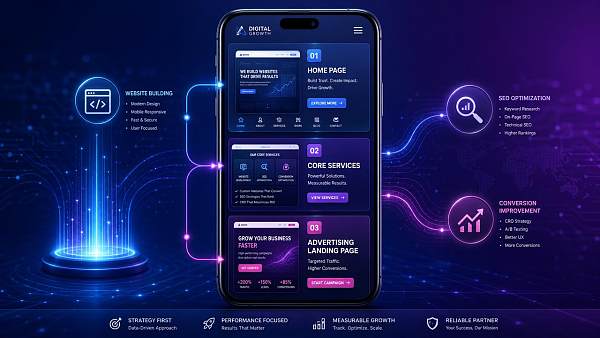
When many operators take over a mobile digital marketing website, the most common problem is not that they do not know how to optimize, but that they do not know where to start first. With many pages, limited resources, and urgent launch timelines, if there is no prioritization, it often leads to repeated revisions, major data fluctuations, and no improvement in conversions.
For integrated website + marketing service projects, mobile pages not only carry a display function, but also directly affect customer acquisition cost, ad traffic acceptance efficiency, search crawling effectiveness, and sales lead quality. Therefore, page optimization should revolve around three dimensions: traffic entry points, conversion nodes, and trust building.
Yiyingbao Information Technology (Beijing) Co., Ltd. has long served enterprises across multiple industries. Relying on artificial intelligence and big data capabilities, the company places greater emphasis on an execution path of "key pages first, supporting pages later" within the integrated coordination of intelligent website building, SEO optimization, social media marketing, and advertising placement, so that time and budget can be invested where returns are highest.
- First, look at where traffic enters, with a focus on the homepage, landing pages, and core service pages.
- Then, look at where users drop off, with a focus on optimizing form pages, consultation pages, and case study pages.
- Finally, look at how search engines understand the website structure, and then handle category pages, content pages, and technical detail pages.
Which pages should be prioritized for optimization on a mobile digital marketing website
If ranked by actual operational value, priorities for a mobile digital marketing website are usually not distributed evenly, but follow the logic of "entry first, conversion second, expansion third". The table below is suitable for helping users and operators quickly judge the order of page priorities.
The principle behind the table is very clear: what truly affects short-term results is the homepage, service pages, and landing pages; what determines long-term growth is case study pages and content pages. If operators want to see changes within a limited cycle, they should first focus on high-priority pages.
1. Why the homepage is always in the first batch of optimization targets
The homepage is the page on a mobile digital marketing website that is most likely to be visited and also most likely to be misjudged. Many website homepages are visually complex, but the first screen does not clearly tell users "what problems you can solve, what types of businesses you are suitable for, and where they should click next", resulting in a high bounce rate.
Homepage optimization priorities should include: the first-screen headline and subheadline should match search intent, the number of navigation items should not be too large, service entry points should be clear, and at least one highly visible conversion method such as phone, form, or online consultation should be retained. At the same time, images should be compressed, blocking scripts should be reduced, and overly slow loading on mobile should be avoided.
2. Core service pages determine whether you can capture precise searches
When users search for terms such as "mobile digital marketing website development", "marketing website optimization", or "SEO and advertising integration", the most suitable page to receive that traffic is not the homepage, but the corresponding core service page. What a service page needs to answer are the two questions: "Why should I choose you" and "How exactly do you do it".
Usually, one page focusing on one core topic is more effective. For example, a website building page can focus on structure, speed, forms, and conversion; an SEO page can focus on indexing, rankings, content, and technology; an advertising placement page can focus on landing page matching, lead attribution, and placement efficiency. The clearer the structure, the easier it is to improve both search performance and conversions at the same time.
3. Ad landing pages are the pages most likely to produce results quickly
If your mobile digital marketing website is running feed ads, search ads, or social media ads, landing pages must be optimized independently. They should not simply copy the official website content, but should be designed around a single campaign, a single audience, and a single conversion goal. It is not accurate to say that the shorter the page, the better; the key is that the information progression should be smooth.
The first screen should deliver on the ad promise, the middle section should explain the solution and the applicable audience, and the bottom should arrange low-threshold conversion actions, such as getting a diagnostic review, booking a consultation, or receiving a solution framework. For teams with limited budgets, landing pages are often the optimization target with the fastest return on investment.
Which mobile optimization metrics should be tracked for different pages
Many teams clearly carry out page optimization, yet find it difficult to review the reasons afterward, and the problem often lies in choosing the wrong metrics. On a mobile digital marketing website, not all pages should be evaluated using the same set of data; different types of pages should adopt different assessment criteria.
At the operational level, it is recommended not to focus only on rankings. For a mobile digital marketing website, page speed, click depth, consultation clicks, and form completion rate often reflect page quality better than rankings alone. Especially in integrated website + marketing service scenarios, the ultimate goal is effective leads, not isolated traffic.
Page details most easily overlooked by users and operators
Many projects fail to improve for a long time not because the direction is wrong, but because details are not handled well enough. The reading rhythm of a mobile digital marketing website on phones is completely different from that on desktop, and any small problem that hinders clicking or understanding will be amplified into conversion loss.
Commonly overlooked issue checklist
- The core business does not appear directly on the first screen, so users need to scroll down before knowing what you do.
- Button copy is too vague, using only "Submit" or "Learn More", making it impossible to drive clear action.
- There are too many form fields, the input cost on mobile is high, and as a result many users exit midway.
- The service page does not explain the applicable audience and delivery process, leaving buyers without a basis for judgment.
- Article pages contain only content but no conversion entry points, so traffic does not flow into service inquiries.
If you are organizing a resource center or knowledge section, you can also draw on information architecture methods. Some topic-based resource pages are similar to research-style product showcase pages in content organization, such as Comprehensive Budget Management Research for Public Institutions and Government-affiliated Entities links like this as informational nodes, where the focus is not on stacking up text, but on enabling users to quickly find the topic, value points, and next action.
This way of thinking also applies to building content pages on marketing websites: content pages do not exist in isolation, but should form a closed loop among topic clusters, internal links, and consultation guidance, thereby improving the overall usability of the mobile digital marketing website.
How to arrange the optimization sequence and avoid repeated rework
For teams facing tight delivery requirements and limited budgets, the most practical method is not a one-time major overhaul, but phased advancement. This makes it easier to observe data changes and also facilitates collaboration among different roles, including designers, developers, operators, and media buyers.
- In the first phase, handle the homepage, core service pages, and main landing pages first, with the goal of stabilizing consultation entry points and the first batch of conversions.
- In the second phase, optimize case study pages, solution pages, and FAQ modules to improve user decision-making efficiency and trust.
- In the third phase, expand article pages, topic pages, and the internal linking system to improve the organic traffic coverage of the mobile digital marketing website.
- In the fourth phase, then handle structured data, page compression, tracking tags, and A/B testing to continuously improve refined operational capabilities.
In project execution, Yiyingbao Information Technology (Beijing) Co., Ltd. usually views website building, SEO, content, and campaign data in a unified way rather than handling them separately. The benefit of doing so is that the search intent of service pages, the conversion path of landing pages, and the lead quality on the advertising side can mutually validate one another, reducing ineffective revisions.
FAQ: Several of the most common questions when optimizing a mobile digital marketing website
Between the homepage and service pages, which one should be done first?
If brand traffic is high and users often visit the official website first, prioritize the homepage; if search traffic mainly comes from specific service keywords, prioritize the service pages. Most companies are better suited to working on both in parallel, but first ensure that the homepage first screen communicates correctly, and then focus on optimizing 1 to 3 core service pages.
How short should the form on a mobile digital marketing website be?
There is no fixed standard length, but for the first conversion it is recommended to keep it within 3 to 5 fields, such as name, phone number, company, and brief description of needs. If the business is complex, step-by-step submission can be adopted: collect the lead first, and then have sales or consultants conduct a second round of communication.
Are content article pages worth investing in?
Yes, but they should be placed after high-priority pages. Article pages are suitable for capturing long-tail searches, educating the market, and building professional awareness. The premise is that each piece of content must serve a specific business topic and connect through internal links to service pages, case study pages, and consultation pages.
What should be the focus when procuring or outsourcing optimization services?
The focus should be on whether the provider has coordinated capabilities in website development, search optimization, content planning, and media placement, rather than only being able to revise page copy. A service team truly suited to mobile digital marketing websites should be able to explain the basis for priority decisions, delivery cycles, data tracking methods, and the follow-up iteration mechanism.
Why choose us
If you are responsible for revamping, customer acquisition, or lead conversion for a mobile digital marketing website, but are facing issues such as unclear page priorities, weak ad traffic acceptance, or disconnects between SEO and website development, you can leave judgment and execution to a more mature integrated team.
Since its establishment in 2013, Yiyingbao Information Technology (Beijing) Co., Ltd. has continuously provided full-chain services around intelligent website building, SEO optimization, social media marketing, and advertising placement. For users and operators, we can not only help sort out which pages on a mobile digital marketing website should be optimized first, but also further support parameter confirmation, page diagnosis, section planning, delivery cycle evaluation, customized solution design, and quotation communication.
If you hope to quickly clarify the optimization order for the homepage, service pages, landing pages, and content pages, or need to formulate an execution checklist based on your actual budget, it is recommended to directly discuss your current website structure, target market, and media placement plan, so that a practical optimization solution can be formed more quickly.
Related Articles
 How can video news production be made more efficient?Breaking down the standard process from topic selection to editing
 How to assess foreign trade website development trends?Looking at 2026 changes from multilingual,AI content to conversion paths
 What are the new trends in multilingual marketing data analytics tools in 2026? Focus on attribution、automation and compliance

Related Products
 EasyCamp SaaS Smart Website Marketing SystemE-Yingbao SaaS Smart Website Marketing System: AI-powered, zero-code website building. Rapidly launch multilingual independent e-commerce sites in just 10 minutes. Global server acceleration and AI-driven SEO optimization empower businesses to efficiently connect with global markets. The seamless integration of technology and user-friendly operation makes building e-commerce sites incredibly simple.
 AI+SEM Intelligent Advertising Marketing SystemAI+SEM drives intelligent ad creation, empowering full-funnel precision advertising marketing. The system automatically generates weekly/monthly reports, AI recommends keywords and target countries, monitors core metrics in real-time with intelligent alerts, and enables one-click high-conversion ad solutions to help quickly acquire customers and improve ROI.
 AI+SEO Dual Engine Optimization ServiceEasyWin AI+SEO Dual Engine Optimization System leverages AI-powered keyword mining, content generation, and comprehensive technical optimization to help foreign trade enterprises acquire high-quality organic traffic, significantly improving search rankings and conversion rates.
 AI+SNS Social Media Marketing SystemYingbao AI+SNS Social Media Marketing System - Precision social capture for the social media era. Supports one-click content synchronization across major platforms like Facebook and LinkedIn. AI intelligently rewrites posts for enhanced relevance. 24/7 AI customer service and user profiling analysis empower businesses to efficiently expand into global markets.
 AI+SEO营销解决方案易营宝AI+SEO营销解决方案,通过AI批量写作、智能生成TDK、精准关键词扩词等功能,全面优化网站SEO效果,提升流量与转化率。助力企业构建高效智能网站新生态。
 AI+SEM Advertising Marketing SolutionsAI+SEM Advertising Marketing Solution leverages AI technology to deeply empower SEM ad campaigns. It automatically generates weekly/monthly reports using AI, presenting account data across multiple dimensions for comprehensive insights into campaign performance and trends. The system precisely recommends keywords and target countries, intelligently generates high-conversion ad copy, and enables one-click activation of efficient campaign plans to help businesses rapidly acquire customers. Simultaneously, it monitors core metrics in real time, intelligently identifies abnormal fluctuations, and issues timely alerts to ensure stable, high-return advertising results.
 Domain Name ServicesEasyWin provides professional domain name services, including intelligent queries, one-stop registration, brand protection, and full lifecycle management, helping businesses build a digital brand image.
 EasyOperate B2C Cross-Border E-Commerce Platform & Independent WebsiteEasyStore B2C Cross-border E-commerce Independent Store is an intelligent website building and cross-border e-commerce integrated solution independently developed by EasyStore Information Technology (Beijing) Co., Ltd. The system is specially designed for small and medium-sized as well as large export enterprises, integrating 'website building, operation, marketing, advertising, and conversion' into one, helping enterprises quickly establish cross-border e-commerce independent stores to achieve brand globalization and global sales growth.
The platform supports multiple languages, multiple currencies, and multi-channel marketing, with built-in AI intelligent translation and SEO optimization systems, suitable for mainstream markets such as Southeast Asia, Europe and America, Latin America, and the Middle East, assisting Chinese manufacturing enterprises in efficiently deploying international e-commerce strategies. SSL证书易营宝提供专业SSL安全证书服务,包括单域名和泛域名证书,确保网站数据传输加密、身份验证和完整性保护,助力企业建立安全可信的在线业务环境。









