









- How to assess foreign trade website development trends?Looking at 2026 changes from multilingual,AI content to conversion pathsJul 04, 2026View details
- What are the new trends in multilingual marketing data analytics tools in 2026? Focus on attribution、automation and complianceJul 04, 2026View details
- Is Brand Globalization Marketing Consulting Worth Buying? At What Stage Should Companies Bring It InJul 01, 2026View details
- Cross-Border Marketing Trend Research: Why More and More Companies Are Starting to Deploy AI Search and GEO OptimizationJun 30, 2026View details
- Cross-Border Marketing Trend Research: How Independent Sites, AI Content, and Short-Video Customer Acquisition Are ChangingJun 30, 2026View details
- How Can a Brand Updates Page Be Made More SEO-Friendly? Analysis of Update Frequency, Content Structure, and Internal Linking StrategyJun 28, 2026View details
- What stages does the cross-border services ecosystem include? How do website building, promotion, payment, and compliance work togetherJun 22, 2026View details
- How will email marketing costs change in 2026Jun 22, 2026View details
How to Evaluate the Delivery Capability of Foreign Trade Marketing System Suppliers
When selecting a foreign trade marketing system vendor, what procurement teams care about most is often not the feature list, but the actual delivery capability. Whether the delivery timeline is controllable, whether the system is stable, and whether the service can be effectively implemented directly affect project success and subsequent growth.
From a procurement perspective, the core demand behind searching for a "foreign trade marketing system vendor" is actually to find a partner that can deliver results on time, within budget, and against objectives, rather than just a sales team that is good at giving presentations.
Therefore, evaluating a vendor should not rely only on pricing and case study pages, but also on its project management mechanism, technical execution capability, cross-department collaboration efficiency, and ongoing operational support capability after launch.
What procurement teams really want to judge is not "whether it can be done," but "whether it can be delivered stably"
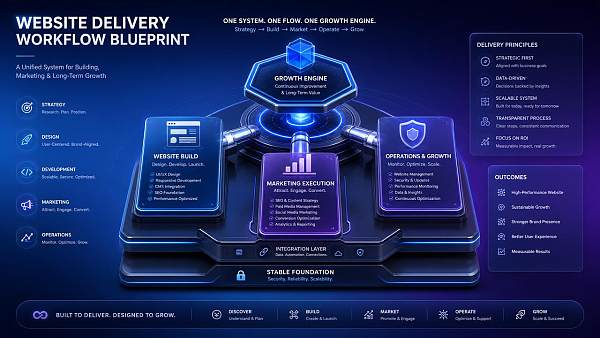
When many foreign trade companies screen foreign trade marketing system vendors, on the surface they compare functions such as website building, SEO, advertising placement, and CRM integration, but what they are actually worried about is projects going out of control midway, delayed launches, and results that are difficult to implement.
These concerns are very realistic. Because a marketing system is not a single software purchase, but a combined delivery of website, content, traffic, data, and service systems, if any one link is weak, it will ultimately affect business conversion.
Therefore, the focus of procurement evaluation should be on whether the vendor has a closed-loop capability of "solution capability + implementation capability + operations capability," rather than simply looking at whether a feature list is written richly enough.
First check whether the delivery scope is clear, as this is the first step in filtering out unreliable vendors
A mature vendor will usually clarify the delivery scope during the pre-sales stage, including the number of pages, language versions, functional modules, basic SEO configuration, data tracking setup, number of training sessions, and after-sales response standards.
If the other party only emphasizes "everything can be done" and "full customization is supported," but does not clearly specify what belongs to standard delivery, what belongs to secondary development, and what will incur additional charges, disputes are highly likely to arise later.
During procurement, it is recommended to focus on confirming three things: whether there is a formal SOW document, whether there are milestone acceptance checkpoints, and whether there is a change management process. The clearer the scope, the more controllable the delivery risk.
Checking whether the project process is mature is more important than listening to sales promises
To judge whether a foreign trade marketing system vendor truly has real delivery capability, the most intuitive method is to ask it to show a complete project process, rather than just listening to sales introduce successful experience.
A mature team will usually divide the process into several stages such as requirements research, information architecture, visual design, front-end and back-end development, testing and launch, data deployment, training handover, and operational optimization, and assign corresponding persons in charge.
If a vendor cannot clearly explain what is delivered at each stage, who is responsible, how long it takes to complete, and how acceptance is conducted, then even if the proposal looks good, actual execution may still depend on temporary coordination and have poor stability.
In particular, foreign trade projects often involve multilingual websites, overseas access speed, form conversion paths, and search optimization logic. When the process is immature, problems usually surface intensively after launch, and the rework cost is very high.
Technical capability should be judged by "system stability" and "scalability," not just by whether the interface looks good
Procurement is often attracted by page design, but what truly determines long-term value is whether the system architecture is stable and whether it supports subsequent content expansion, market expansion, and marketing tool integration.
For example, whether the vendor supports multilingual SEO rule configuration, whether it is compatible with overseas CDN acceleration, whether it supports form lead management, and whether it can connect with advertising, social media, and data analytics tools are all more critical than visuals.
For integrated website and marketing service projects, technology does not exist in isolation. It needs to support subsequent customer acquisition, conversion, and review, rather than merely completing a one-time launch task.
Some industry websites also need to highlight product quality perception and content expression. For example, agricultural brand websites targeting overseas buyers often need page structures that balance display and inquiry conversion. Solutions like Agriculture, agricultural products, food place greater emphasis on responsive display, product grid categorization, and custom form handling capabilities.
When reviewing case studies, focus on the "reusability of similar projects," not just brand reputation
Many vendors showcase well-known client case studies, but what procurement should further ask is: whether these cases are similar to your business scenario, what specific work the vendor undertook in them, and what the final results were.
A case study truly worth referencing should at least explain the industry background, project goals, delivery content, launch cycle, cooperation model, and subsequent results, rather than just a few screenshots and client logos.
For example, if your company needs to build a content marketing system for overseas markets, then whether the vendor has worked on multilingual websites, whether it has SEO content planning experience, and whether it understands the B2B inquiry funnel will make the reference more meaningful.
Procurement can also ask the other party to demonstrate the review logic of failed projects. A team that can honestly explain risks, adjustment processes, and improvement mechanisms is often more trustworthy than a team that only reports good news and not bad news.
Whether the delivery team setup is complete determines whether the project can truly be implemented
Whether a foreign trade marketing system vendor is reliable does not depend on how beautifully the company profile is written, but on whether there is a complete team supporting delivery. Procurement should focus on whether the project manager, design, development, SEO, and operations form a fixed collaborative team.
If the people presenting the proposal in pre-sales are very professional, but delivery is later handed over to an outsourced team or part-time personnel, project quality is often difficult to guarantee. Especially for projects involving extensive cross-department communication, team stability is more important than individual ability.
It is recommended that procurement directly ask vendors during the comparison stage to introduce the proposed team to be assigned, including role division, years of experience, communication mechanisms, and issue escalation paths. This is more valuable for evaluation than listening to general promises.
Service capability should not be judged only before launch, but also by whether continuous support is possible after launch
A foreign trade marketing system does not end once delivery is completed. After launch, there will still be long-term work such as content updates, data monitoring, conversion optimization, page iteration, and technical maintenance, all of which test the vendor's service capability.
Some vendors cooperate actively in the early stage, but after launch they respond slowly, schedule modifications far out, and have weak issue closure, causing the company internally to bear more communication and maintenance costs. The money saved during procurement may later have to be paid back multiple times over.
Therefore, after-sales service content should be confirmed at the contract stage, such as response timeliness, BUG fixing mechanisms, training support, monthly review, and the frequency of optimization recommendation outputs. The clearer the service standards, the easier the subsequent management.
To judge delivery capability, ultimately return to "results management" rather than "process performance"
A truly excellent foreign trade marketing system vendor does not just build the website, but also designs metrics around business goals, such as indexing status, traffic quality, form conversion rate, and channel data traceability.
Procurement can set several core acceptance metrics before project initiation: whether the launch is on schedule, whether the feature list is met, whether the basic SEO deployment is completed, whether data analytics capability is in place, and whether subsequent operational growth is supported.
If a vendor can only promise that "results depend on the market," but cannot take responsibility for delivery quality, then this kind of cooperation is more about completing tasks than truly helping the company build sustainable overseas marketing infrastructure.
For industries that emphasize brand content expression, system delivery must also take into account visual storytelling, service commitment presentation, and cooperation conversion paths. For example, agricultural enterprise websites often need to enhance trust through natural layouts, high-quality visual and text content, and news/blog modules. This design and marketing coordination capability is likewise part of delivery strength.
In practical procurement, these 5 questions can be used to quickly judge a vendor's level
First, how many similar projects have you delivered in the past year, what was the average cycle, and what are the usual reasons for delays? This can help judge its real delivery capacity and project management maturity.
Second, what stages will the project go through from signing to launch, who is responsible for each stage, and what documents are produced? This can quickly identify whether the other party is a process-driven team or a temporarily assembled team.
Third, which functions belong to standard delivery, which require custom development, and is later expansion convenient? This relates to budget control and future iteration efficiency.
Fourth, who is responsible for maintenance and optimization after launch, what is the service response timeliness, and is there a fixed review mechanism? This determines whether the cooperation can remain stable in the long term.
Fifth, if deep expression is required for a segmented industry, is there corresponding solution experience? For example, for businesses like Agriculture, agricultural products, food, whether the vendor understands the coordinated relationship among product presentation, brand trust, and inquiry forms.
Conclusion: what procurement should choose is not "people who can sell proposals," but "a team that can stably deliver results"
Judging the delivery capability of a foreign trade marketing system vendor is essentially judging whether it has the ability to translate business goals into executable results. Functions, price, and case studies are all important, but none of them can replace delivery itself.
For procurement personnel, the most effective approach is not to be led by demos and sales talk, but to verify one by one around delivery scope, team setup, process mechanisms, technical stability, and after-sales support.
When you shift your focus from "whether it sounds good" to "whether it can actually be done," the screening result is usually much clearer. A vendor truly worth working with is often not the one that makes the most promises, but the one that can best prove itself to be controllable, reliable, and capable of sustainable delivery.
Related Articles
 How can video news production be made more efficient?Breaking down the standard process from topic selection to editing
 How to assess foreign trade website development trends?Looking at 2026 changes from multilingual,AI content to conversion paths
 What are the new trends in multilingual marketing data analytics tools in 2026? Focus on attribution、automation and compliance



Related Products
 EasyCamp SaaS Smart Website Marketing SystemE-Yingbao SaaS Smart Website Marketing System: AI-powered, zero-code website building. Rapidly launch multilingual independent e-commerce sites in just 10 minutes. Global server acceleration and AI-driven SEO optimization empower businesses to efficiently connect with global markets. The seamless integration of technology and user-friendly operation makes building e-commerce sites incredibly simple.
 AI+SEM Intelligent Advertising Marketing SystemAI+SEM drives intelligent ad creation, empowering full-funnel precision advertising marketing. The system automatically generates weekly/monthly reports, AI recommends keywords and target countries, monitors core metrics in real-time with intelligent alerts, and enables one-click high-conversion ad solutions to help quickly acquire customers and improve ROI.
 AI+SEO Dual Engine Optimization ServiceEasyWin AI+SEO Dual Engine Optimization System leverages AI-powered keyword mining, content generation, and comprehensive technical optimization to help foreign trade enterprises acquire high-quality organic traffic, significantly improving search rankings and conversion rates.
 AI+SNS Social Media Marketing SystemYingbao AI+SNS Social Media Marketing System - Precision social capture for the social media era. Supports one-click content synchronization across major platforms like Facebook and LinkedIn. AI intelligently rewrites posts for enhanced relevance. 24/7 AI customer service and user profiling analysis empower businesses to efficiently expand into global markets.
 AI+SEO营销解决方案易营宝AI+SEO营销解决方案,通过AI批量写作、智能生成TDK、精准关键词扩词等功能,全面优化网站SEO效果,提升流量与转化率。助力企业构建高效智能网站新生态。
 AI+SEM Advertising Marketing SolutionsAI+SEM Advertising Marketing Solution leverages AI technology to deeply empower SEM ad campaigns. It automatically generates weekly/monthly reports using AI, presenting account data across multiple dimensions for comprehensive insights into campaign performance and trends. The system precisely recommends keywords and target countries, intelligently generates high-conversion ad copy, and enables one-click activation of efficient campaign plans to help businesses rapidly acquire customers. Simultaneously, it monitors core metrics in real time, intelligently identifies abnormal fluctuations, and issues timely alerts to ensure stable, high-return advertising results.
 Domain Name ServicesEasyWin provides professional domain name services, including intelligent queries, one-stop registration, brand protection, and full lifecycle management, helping businesses build a digital brand image.
 EasyOperate B2C Cross-Border E-Commerce Platform & Independent WebsiteEasyStore B2C Cross-border E-commerce Independent Store is an intelligent website building and cross-border e-commerce integrated solution independently developed by EasyStore Information Technology (Beijing) Co., Ltd. The system is specially designed for small and medium-sized as well as large export enterprises, integrating 'website building, operation, marketing, advertising, and conversion' into one, helping enterprises quickly establish cross-border e-commerce independent stores to achieve brand globalization and global sales growth.
The platform supports multiple languages, multiple currencies, and multi-channel marketing, with built-in AI intelligent translation and SEO optimization systems, suitable for mainstream markets such as Southeast Asia, Europe and America, Latin America, and the Middle East, assisting Chinese manufacturing enterprises in efficiently deploying international e-commerce strategies. SSL证书易营宝提供专业SSL安全证书服务,包括单域名和泛域名证书,确保网站数据传输加密、身份验证和完整性保护,助力企业建立安全可信的在线业务环境。









