









- What stages does the cross-border services ecosystem include? How do website building, promotion, payment, and compliance work togetherJun 22, 2026View details
- How will email marketing costs change in 2026Jun 22, 2026View details
- The China-US tariff arrangement has reached a preliminary consensus, and the trade association will be establishedJun 15, 2026View details
- Should overseas brand marketing start with ads or contentJun 21, 2026View details
- What determines B2C cross-border e-commerce website development costs? A breakdown of features, interfaces, and deployment methodsJun 17, 2026View details
- China-Morocco zero-tariff access, a breakthrough in the cost of Moroccan goods exports to ChinaJun 11, 2026View details
- What signal should be released for the suspension of exports to JapanJun 10, 2026View details
- China's May LNG imports rebounded, with increased volumes from Russia and Canada filling the Middle East supply gapJun 10, 2026View details
How will email marketing costs change in 2026
By 2026, the way email marketing costs are calculated will change significantly. What truly widens the gap is no longer just bulk-send pricing, but list quality, automation maturity, content relevance, and the leads, repeat purchases, and conversions ultimately generated by email.
For businesses built around independent websites and overseas customer acquisition, this shift is especially worth paying attention to. Website delivery capability, data accumulation capability, and the degree of coordination within the marketing system will directly affect whether email marketing is worth the spend, and even determine whether the budget is being consumed or amplified.
Why email marketing costs are even more worth evaluating separately in 2026
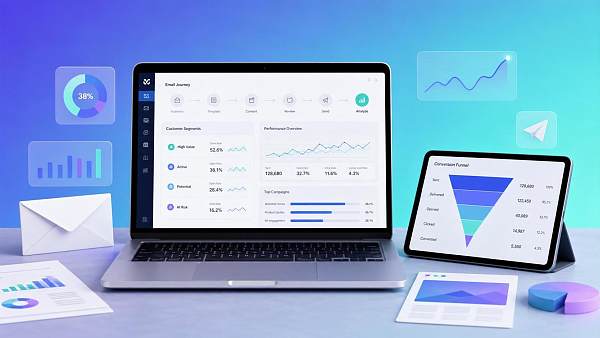
In the past, discussions about email marketing costs often focused only on platform annual fees, per-send charges, and design/production fees. That perspective will be insufficient in 2026, because the market environment has already shifted from “whether it can be sent” to “whether it can be seen, clicked, and converted.”
On the one hand, overseas traffic costs continue to rise, ad clicks are getting more expensive, and companies will place more value on the cost-effectiveness of private-domain touchpoints. On the other hand, mailbox service providers have higher requirements for sender reputation, domain health, and user engagement, and low-quality sending can instead drive overall email marketing costs up.
In other words, for the same budget, whether you have a trackable website, a clear form path, and customer data that can be segmented automatically has already become a key variable in determining whether costs are high or low.
Cost changes in 2026 are reflected in more than just the per-send price
Structurally, email marketing costs will increasingly look like a “system cost” rather than a single procurement item. On the surface, it may seem like email system expenses, but behind the scenes they are tied to website development, customer data management, content operations, and conversion analysis.
Common cost components will be reordered
Simply put, in 2026 email marketing costs will no longer be judged only by “how many emails were sent,” but more by “whether each email entered the correct workflow.”
Website and marketing integration will reshape the cost investment logic
Many companies used to separate email marketing from website management, and the common result was that emails were opened, but the page loaded slowly, the language did not match, the form was too complicated, and the resulting click cost was wasted. In this situation, the email marketing cost appears controllable, but the actual conversion cost is too high.
The value of integrating website + marketing services lies in connecting traffic entry points, content touchpoints, behavioral tracking, and business opportunity accumulation. Email is not an isolated channel; it is one link in an independent website growth system.
From Yiyingbao's informatization capabilities, its long-term layout is not limited to a website-building tool, but connects intelligent website building, SEO optimization, advertising, social media operations, and AI-driven data capabilities. For businesses that need multilingual lead generation for North American, European, Southeast Asian, and other markets, this synergy will directly affect the efficiency of email marketing costs.
If the website can automatically accommodate users from different sources, and the email system can then push content based on page behavior, budget allocation will be more accurate, and repeated sending and low-efficiency touchpoints will be reduced.
What factors truly raise or lower email marketing costs
To assess 2026 email marketing costs, you cannot just look at the quotation sheet; you must also see where the hidden costs come from.
- Whether the lead source is compliant. Low-quality lead collection may seem cheap, but in practice it brings unsubscribes, complaints, and damaged domain reputation.
- Whether there is automated segmentation. Without a tagging system, you can only send in bulk, and the cost per conversion is usually higher.
- Whether the content is consistent with the website pages. A disconnect between email promises and landing pages will magnify drop-offs and raise email marketing costs.
- Whether attribution is clear. If you cannot see the paths to inquiries, transactions, and repeat purchases, it is hard to judge whether the budget should be increased or reduced.
- Whether regional operating capabilities are in place. Different markets have very different sending times, content preferences, and compliance requirements.
What is more worth noting is that artificial intelligence will further change the cost structure in 2026. Tasks that used to rely on manpower for segmentation, topic writing, and version testing can now be assisted by intelligent systems, provided the enterprise itself has a relatively complete data foundation.
Cost assessment methods differ in typical business scenarios
Different business types should also distinguish their understanding of email marketing costs; you cannot apply one budget standard to all scenarios.
Key points for judging several common scenarios
- B2B inquiry websites place more emphasis on lead quality, follow-up cycles, and automated nurturing costs.
- Cross-border ecommerce stores place more emphasis on repeat purchase reminders, win-back campaigns, and customer lifetime value.
- Brand overseas official websites place more emphasis on content consistency, brand touch frequency, and multilingual adaptation efficiency.
- Ad landing pages paired with email place more emphasis on triggering and closing the conversion loop as soon as possible after customer acquisition.
In actual management, some teams treat email marketing as a supplementary action after advertising, while others treat it as the main channel for customer relationship nurturing. Different positioning naturally leads to different ways of evaluating email marketing costs.
Similarly, when doing budget analysis, it is also necessary to establish a full-lifecycle perspective. This point is very common in many management studies; for example, the strategy emphasized in research on business-finance integration in fixed-asset full-lifecycle management at universities is to view front-end investment and back-end returns on the same chain. The same applies to email marketing.
A more practical budgeting approach for 2026
If you want to keep email marketing costs within a reasonable range, you can first establish a budget framework that is closer to business results, rather than purchasing purely based on send volume.
Four indicators should be prioritized
For businesses that have already deployed an independent website, email marketing costs are best considered together with SEO, advertising, and social media traffic, rather than each operating separately. Because the real cost changes often happen at the channel handoff points.
What should be prepared in advance starting now
In 2026, email marketing costs will not suddenly rise or fall; instead, they will increasingly reflect a company’s operational maturity. The earlier you prepare, the easier it is to turn cost pressure into a growth lever.
A more stable approach is to first review whether the existing website has form tracking, multilingual landing pages, user tagging, and automated trigger capabilities, and then evaluate whether the email system can be connected with advertising, SEO, and social media data.
If the budget is still in the planning stage, you may as well break it down into four parts and evaluate them separately: basic sending, data management, automation configuration, and page handoff. This way, you will not only see how high email marketing costs are, but also why they are high, whether they are worth it, and what to optimize first next.
When email is placed back into a complete growth chain, cost is no longer just an expense item; it becomes a mirror for judging whether the website and marketing system is operating efficiently.
Related Articles



Related Products
 EasyCamp SaaS Smart Website Marketing SystemE-Yingbao SaaS Smart Website Marketing System: AI-powered, zero-code website building. Rapidly launch multilingual independent e-commerce sites in just 10 minutes. Global server acceleration and AI-driven SEO optimization empower businesses to efficiently connect with global markets. The seamless integration of technology and user-friendly operation makes building e-commerce sites incredibly simple.
 AI+SEM Intelligent Advertising Marketing SystemAI+SEM drives intelligent ad creation, empowering full-funnel precision advertising marketing. The system automatically generates weekly/monthly reports, AI recommends keywords and target countries, monitors core metrics in real-time with intelligent alerts, and enables one-click high-conversion ad solutions to help quickly acquire customers and improve ROI.
 AI+SEO Dual Engine Optimization ServiceEasyWin AI+SEO Dual Engine Optimization System leverages AI-powered keyword mining, content generation, and comprehensive technical optimization to help foreign trade enterprises acquire high-quality organic traffic, significantly improving search rankings and conversion rates.
 AI+SNS Social Media Marketing SystemYingbao AI+SNS Social Media Marketing System - Precision social capture for the social media era. Supports one-click content synchronization across major platforms like Facebook and LinkedIn. AI intelligently rewrites posts for enhanced relevance. 24/7 AI customer service and user profiling analysis empower businesses to efficiently expand into global markets.
 AI+SEO营销解决方案易营宝AI+SEO营销解决方案,通过AI批量写作、智能生成TDK、精准关键词扩词等功能,全面优化网站SEO效果,提升流量与转化率。助力企业构建高效智能网站新生态。
 AI+SEM Advertising Marketing SolutionsAI+SEM Advertising Marketing Solution leverages AI technology to deeply empower SEM ad campaigns. It automatically generates weekly/monthly reports using AI, presenting account data across multiple dimensions for comprehensive insights into campaign performance and trends. The system precisely recommends keywords and target countries, intelligently generates high-conversion ad copy, and enables one-click activation of efficient campaign plans to help businesses rapidly acquire customers. Simultaneously, it monitors core metrics in real time, intelligently identifies abnormal fluctuations, and issues timely alerts to ensure stable, high-return advertising results.
 Domain Name ServicesEasyWin provides professional domain name services, including intelligent queries, one-stop registration, brand protection, and full lifecycle management, helping businesses build a digital brand image.
 EasyOperate B2C Cross-Border E-Commerce Platform & Independent WebsiteEasyStore B2C Cross-border E-commerce Independent Store is an intelligent website building and cross-border e-commerce integrated solution independently developed by EasyStore Information Technology (Beijing) Co., Ltd. The system is specially designed for small and medium-sized as well as large export enterprises, integrating 'website building, operation, marketing, advertising, and conversion' into one, helping enterprises quickly establish cross-border e-commerce independent stores to achieve brand globalization and global sales growth.
The platform supports multiple languages, multiple currencies, and multi-channel marketing, with built-in AI intelligent translation and SEO optimization systems, suitable for mainstream markets such as Southeast Asia, Europe and America, Latin America, and the Middle East, assisting Chinese manufacturing enterprises in efficiently deploying international e-commerce strategies. SSL证书易营宝提供专业SSL安全证书服务,包括单域名和泛域名证书,确保网站数据传输加密、身份验证和完整性保护,助力企业建立安全可信的在线业务环境。









