









- What stages does the cross-border services ecosystem include? How do website building, promotion, payment, and compliance work togetherJun 22, 2026View details
- The China-US tariff arrangement has reached a preliminary consensus, and the trade association will be establishedJun 15, 2026View details
- Should overseas brand marketing start with ads or contentJun 21, 2026View details
- What determines B2C cross-border e-commerce website development costs? A breakdown of features, interfaces, and deployment methodsJun 17, 2026View details
- China-Morocco zero-tariff access, a breakthrough in the cost of Moroccan goods exports to ChinaJun 11, 2026View details
- What signal should be released for the suspension of exports to JapanJun 10, 2026View details
How can PPC advertising control costs and generate leads? Keyword grouping and landing page matching techniques
PPC campaigns should control costs, not rush to cut bids
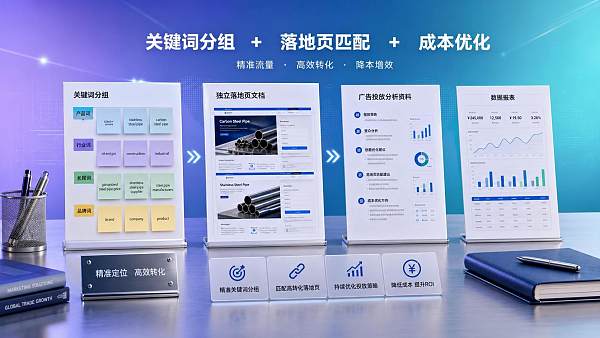
When PPC campaigns aim to lower customer acquisition costs, a common mistake is to focus all attention on CPC. In actual execution, what more often affects lead quality is whether the keyword grouping is clear and whether the landing page truly matches search intent.
With the same budget, if the grouping is too broad, ads will mix traffic from “information gathering” and “ready to inquire” users. On the surface, clicks may be high, but the leads generated are unstable. On the contrary, as long as PPC campaigns streamline keyword structure and page alignment, wasted budget usually drops significantly.
In a website-and-marketing-service-integrated scenario, this is even more important. Ads are not standalone actions; frontend traffic, site structure, form paths, multilingual content, and data tracking should all be designed together. When Easyyingbao serves overseas market projects long term, it usually places website building, advertising, and SEO data within the same logic to avoid channels working in isolation.
At different business stages, the grouping logic for PPC campaigns is not the same
Many account performance issues are not caused by too few keywords, but by using the same keyword grouping method at different business stages. New websites in cold start, mature websites expanding traffic, and independent sites refocusing on conversions all require very different judgment criteria.
New websites need to validate search intent first. At this stage, PPC campaigns should not cast too wide a net at once; instead, they should prioritize extracting high-commercial-intent terms, brand comparison terms, and clear demand terms. The page should also reduce distractions and place the core value proposition, trust signals, and conversion entry points as far forward as possible.
The difficulty for mature websites is usually not a lack of traffic, but that incremental traffic is becoming more and more expensive. At this stage, it is necessary to see whether keywords are competing with each other and whether one landing page is trying to handle multiple types of demand. If the page theme is too broad, PPC campaigns can still have decent CTR, but the lead cost will easily rise.
If you are redesigning a site or adding multilingual pages, you also need to align search terms with regional pages one by one. Users in North America, Europe, and Southeast Asia express themselves differently, and their inquiry habits are different as well. You cannot just translate the page; you must also redesign the keyword structure.
In high-frequency scenarios, how should keyword grouping be split
The more common way to judge is not to split terms by broad product categories, but by “search intent.” The advantage of doing this is that landing pages are easier to keep consistent, and subsequent optimization can locate problems more quickly.
- Solution-type terms: focus on application scenarios, delivery capability, case studies, and process.
- Product specification-type terms: focus on parameters, model numbers, compatibility, and quotation methods.
- Brand alternative-type terms: focus on differences, service response, and risk explanations.
- Regional demand-type terms: focus on localized pages, language trust, and contact methods.
For example, when promoting an export website, searches for “custom solutions” and searches for “price” have completely different mindsets. The former requires a clear explanation of capability boundaries in the content, while the latter cares more about quotation logic, minimum order requirements, and lead time. If both are directed to the same page, PPC data will become confusing, and it will be difficult to tell whether the keyword is inaccurate or the page failed to connect.
The value of an integrated platform like Easyyingbao lies in the coordinated adjustment of pages, campaigns, and data tracking. This is especially true when multilingual websites, ad landing pages, and cross-border stores run in parallel; if the page structure is designed in advance based on campaign scenarios, later cost control becomes much easier.
Even similar keywords can hide very different underlying demands
In practical applications, what is most easily overlooked is not click fluctuations, but changes in lead structure. Being able to submit forms does not mean the subsequent closing opportunity is the same. If PPC campaigns only focus on the number of forms submitted, they often misread low-quality traffic as expansion results.
For example, the landing page goals for B2B inquiry sites and B2C independent stores are not the same. The former places more emphasis on the completeness of lead information and demand descriptions, while the latter values checkout path, promotional information, and payment trust more. If both conversion standards are evaluated within the same account, optimization direction will drift.
Sometimes it is also necessary to learn from other industries’ ideas about process control. Content like research on the optimization strategy of finance and supervision systems in administrative public institutions is not about the subject matter itself; the core inspiration lies in emphasizing process nodes, responsibility allocation, and results tracking. In PPC campaign management, the same applies to budget allocation, page validation, and lead follow-up.
Several judgment points that are easily ignored before landing pages go live
Many accounts do not have obvious errors in the early site setup stage, but after entering stable ad delivery, costs still slowly creep up. The problem is often hidden in a few underestimated details.
- Negative keyword updates are too slow, and search term reports are not cleaned up continuously.
- The same business is assigned to multiple pages, and attribution for the data is unclear.
- Mobile forms are too long, and slow page loading affects conversion.
- Ad promises are inconsistent with page content, creating a gap after the click.
- Only first-round conversions are tracked, without looking at the effective rate of subsequent leads and the closing cycle.
These issues may not seem major on their own, but when combined, PPC campaigns will show typical symptoms of “CTR is not bad, cost is too high, and leads are unstable.” Especially when multiple channels run in parallel, if the website does not have a unified data entry point, it is very hard to know whether the problem lies in the keyword grouping or the page.
A more stable adaptation method is to first establish keyword and page standards
If you are preparing to optimize an existing account, there is no need to overhaul the entire structure first. A more effective approach is to first identify the few keyword groups with high conversion share and large cost volatility, then check whether the pages corresponding to them each have only one clear target and whether the ad copy accurately conveys the page value.
The execution can be compressed into three steps. First, reorganize keyword groups based on search intent; second, configure dedicated landing pages for high-value groups; finally, include form quality, dwell time, and valid inquiries in the evaluation. After this adjustment, PPC campaign optimization will be much closer to real business outcomes.
For projects that need long-term overseas growth, it is even more worthwhile to synchronize website building, SEO, advertising, and GEO content planning. Pages should not only serve advertising; they must also take into account indexing, reuse, and future scaling potential. This can reduce repetitive production costs and also make each campaign test accumulate into long-term assets.
If your current pain points are high lead prices, cluttered pages, and scattered channel data, the next step may be to first organize the existing keyword groups, review the page alignment logic one by one, and then evaluate which scenarios need independent landing pages. By making this step solid, you will usually have much stronger control over PPC campaign costs and lead generation.
Related Articles
 Finland low-cost small-package tax-included landing, independent site pricing strategy pressure
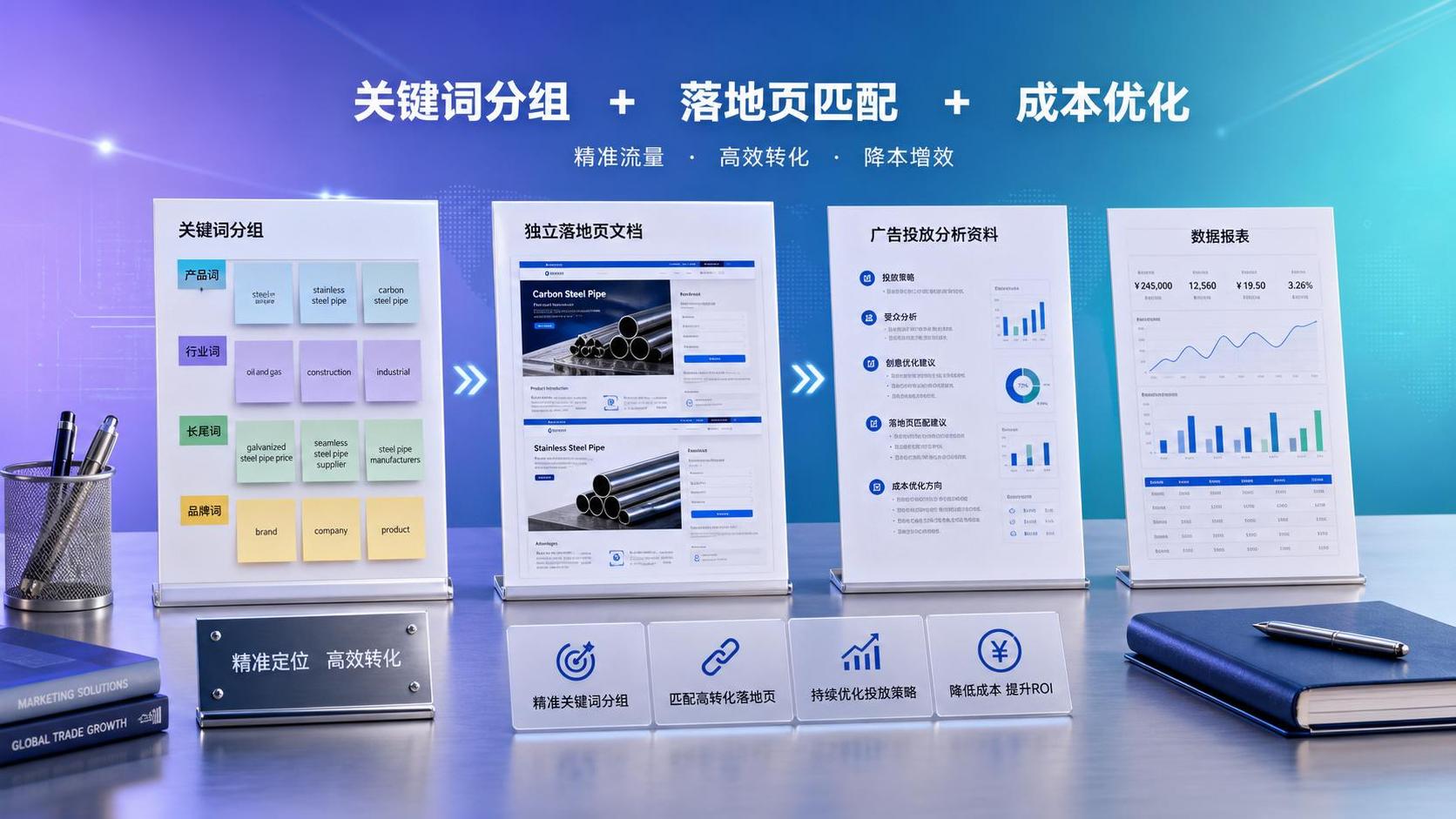
 How can PPC advertising control costs and generate leads? Keyword grouping and landing page matching techniques
 How should the foreign trade advertising budget be allocated? Recommended combination of search ads, display ads, and remarketing

Related Products
 EasyCamp SaaS Smart Website Marketing SystemE-Yingbao SaaS Smart Website Marketing System: AI-powered, zero-code website building. Rapidly launch multilingual independent e-commerce sites in just 10 minutes. Global server acceleration and AI-driven SEO optimization empower businesses to efficiently connect with global markets. The seamless integration of technology and user-friendly operation makes building e-commerce sites incredibly simple.
 AI+SEM Intelligent Advertising Marketing SystemAI+SEM drives intelligent ad creation, empowering full-funnel precision advertising marketing. The system automatically generates weekly/monthly reports, AI recommends keywords and target countries, monitors core metrics in real-time with intelligent alerts, and enables one-click high-conversion ad solutions to help quickly acquire customers and improve ROI.
 AI+SEO Dual Engine Optimization ServiceEasyWin AI+SEO Dual Engine Optimization System leverages AI-powered keyword mining, content generation, and comprehensive technical optimization to help foreign trade enterprises acquire high-quality organic traffic, significantly improving search rankings and conversion rates.
 AI+SNS Social Media Marketing SystemYingbao AI+SNS Social Media Marketing System - Precision social capture for the social media era. Supports one-click content synchronization across major platforms like Facebook and LinkedIn. AI intelligently rewrites posts for enhanced relevance. 24/7 AI customer service and user profiling analysis empower businesses to efficiently expand into global markets.
 AI+SEO营销解决方案易营宝AI+SEO营销解决方案,通过AI批量写作、智能生成TDK、精准关键词扩词等功能,全面优化网站SEO效果,提升流量与转化率。助力企业构建高效智能网站新生态。
 AI+SEM Advertising Marketing SolutionsAI+SEM Advertising Marketing Solution leverages AI technology to deeply empower SEM ad campaigns. It automatically generates weekly/monthly reports using AI, presenting account data across multiple dimensions for comprehensive insights into campaign performance and trends. The system precisely recommends keywords and target countries, intelligently generates high-conversion ad copy, and enables one-click activation of efficient campaign plans to help businesses rapidly acquire customers. Simultaneously, it monitors core metrics in real time, intelligently identifies abnormal fluctuations, and issues timely alerts to ensure stable, high-return advertising results.
 Domain Name ServicesEasyWin provides professional domain name services, including intelligent queries, one-stop registration, brand protection, and full lifecycle management, helping businesses build a digital brand image.
 EasyOperate B2C Cross-Border E-Commerce Platform & Independent WebsiteEasyStore B2C Cross-border E-commerce Independent Store is an intelligent website building and cross-border e-commerce integrated solution independently developed by EasyStore Information Technology (Beijing) Co., Ltd. The system is specially designed for small and medium-sized as well as large export enterprises, integrating 'website building, operation, marketing, advertising, and conversion' into one, helping enterprises quickly establish cross-border e-commerce independent stores to achieve brand globalization and global sales growth.
The platform supports multiple languages, multiple currencies, and multi-channel marketing, with built-in AI intelligent translation and SEO optimization systems, suitable for mainstream markets such as Southeast Asia, Europe and America, Latin America, and the Middle East, assisting Chinese manufacturing enterprises in efficiently deploying international e-commerce strategies. SSL证书易营宝提供专业SSL安全证书服务,包括单域名和泛域名证书,确保网站数据传输加密、身份验证和完整性保护,助力企业建立安全可信的在线业务环境。









