









- What Does a Global Traffic Ecosystem Service Provider Do? What Are the Differences from a Single Advertising AgencyJul 16, 2026View details
- What should you focus on in the latest enterprise SaaS report? From renewal rates and delivery costs to overseas growth opportunitiesJul 12, 2026View details
- What signals are worth paying attention to in a cross-border marketing trend report? B2B companies should look at these 6 signalsJul 11, 2026View details
- How to Read a Cross-Border Marketing Trends Report? Five Key Dimensions for Evaluating Channel OpportunitiesJul 11, 2026View details
- Which channel has the highest ROI in the global traffic ecosystem? Comparative analysis of search, social media, and advertisingJul 10, 2026View details
- What multilingual website services are available in Sanya? Which model is more suitable for local businesses going global?Jul 08, 2026View details
- How to view the complete list of China SaaS companies in the top 100? Practical methods for screening website-building and marketing service providersJul 08, 2026View details
- How to view pricing in the global traffic ecosystem? Cost comparison of search, social media, and content channel advertisingJul 06, 2026View details
What New Changes Are Emerging in International Digital Agency Advertising?
Why International Digital Agency Advertising Is Entering a Restructuring Phase
International digital agency advertising is shifting from broad traffic buying to a new stage that places equal emphasis on data-driven decisions, localized messaging, and closed-loop conversion. Ongoing algorithm updates, tightening privacy compliance, and declining traffic dividends are prompting companies to reassess their advertising logic, focusing no longer only on impressions and clicks, but more on lead quality, website conversion efficiency, and cross-regional growth capability.
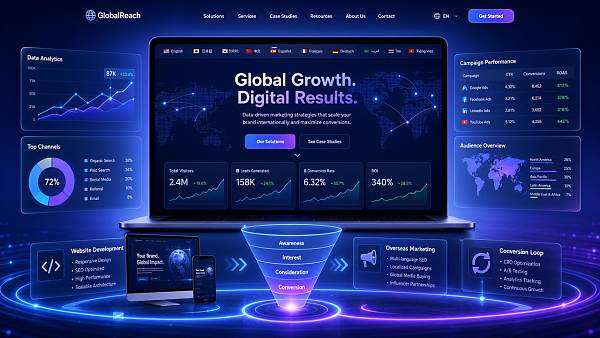
Under the trend of integrated website + marketing services, changes in international digital agency advertising are no longer just channel adjustments, but a systematic upgrade spanning advertising strategy, content creation, data collection, and landing page optimization. For companies seeking to expand into overseas markets, whether they can build the collaborative capability of “advertising + multilingual website + data analytics” directly affects return on ad spend.
Yiyingbao Information Technology (Beijing) Co., Ltd. has spent ten years deeply engaged in global digital marketing. With artificial intelligence and big data as its foundational capabilities, the company focuses on smart website building, SEO optimization, social media marketing, and advertising placement, helping businesses improve growth certainty in complex international markets. This also shows that the core competition in international digital agency advertising is shifting from single-point execution to full-funnel operations.
Why Advertising Needs Are Clearly Diverging Across Different Going-Global Scenarios
Even within international digital agency advertising, the evaluation criteria differ across business scenarios. Brand awareness projects place greater emphasis on depth of reach and content consistency, lead generation projects focus more on cost per lead and page conversion, while cross-border retail relies more on remarketing, creative iteration, and payment path smoothness.
Therefore, advertising strategy cannot be categorized only by platform, nor can domestic experience simply be copied. Truly effective international digital agency advertising usually requires first identifying target market maturity, user decision cycles, language environment, regulatory requirements, and website conversion capacity, and then matching budget structure and conversion goals.
What New Changes Are Taking Place in International Digital Agency Advertising Across Three Typical Scenarios
Scenario 1: Cold Start in a New Market Depends More on Data Test Campaigns and Localization Validation
When companies enter overseas markets for the first time, the common approach in the past was to cast a wide net with advertising first, then determine direction based on click volume. Now this method is more costly and more prone to misjudgment. International digital agency advertising now places more emphasis on a launch mechanism of “small budgets, multiple versions, fast validation”, quickly identifying effective markets through audience segmentation, creative comparison, and landing page testing.
What is most easily overlooked at this stage is insufficient website localization. After ads bring in traffic, if page language, business messaging, trust signals, and user habits are inconsistent with the target market, clicks will be difficult to turn into inquiries. At this point, deploying a multilingual website solution for foreign trade is often more effective than simply increasing the advertising budget.
Scenario 2: Intensifying Competition in Mature Markets Places Greater Importance on Refined Conversion Capability
In mature regions such as Europe and the United States, international digital agency advertising has shifted from traffic acquisition to competition for user quality. As platform automation increases, the barrier to basic advertising execution has fallen, but what truly creates differentiation is audience exclusion strategy, conversion event setup, creative refresh speed, and sales lead qualification capability.
If a website lacks clear data tracking, the advertising system cannot learn stably. For example, if events such as form submissions, online inquiries, phone clicks, and download actions are not fully recorded, this will affect the judgment of the advertising model. One of the new changes in international digital agency advertising is that ad optimization increasingly depends on on-site behavioral data rather than only front-end platform metrics.
Scenario 3: Simultaneous Promotion in Multiple Countries Requires a Unified Technical Foundation More Than Ever
When promotion expands to multiple countries, the challenge is no longer just increasing budget, but how to centrally manage language versions, creative cadence, data attribution, and policy risks. In this scenario, international digital agency advertising increasingly relies on technology platforms to provide standardized support, avoiding the time loss caused by repeated collaboration among multiple teams.
For example, if a multilingual site can automatically sync product information, generate localized meta tags, and integrate tools such as GA4 and GTM, it can improve both SEO and advertising conversion efficiency at the same time. This not only reduces maintenance costs, but also allows international digital agency advertising to replicate across markets more quickly.
How Should Demand Differences Across Different Scenarios Be Evaluated
How International Digital Agency Advertising Should Adapt to Current Changes
- Segment markets first, then set budgets, and do not blindly roll out on all fronts.
- Align advertising goals with website conversion goals to ensure a closed data loop.
- Prioritize completing multilingual pages, local trust elements, and privacy compliance content.
- Establish a creative rotation mechanism to avoid rapid fatigue from a single creative.
- Integrate SEO, social media, and advertising to reduce fluctuations in customer acquisition from a single channel.
From an execution perspective, international digital agency advertising should not operate independently. Site speed, language quality, content credibility, and tracking capability all affect the learning efficiency of advertising systems. If a website supports conversion into more than 300 languages, localized content optimization, global node acceleration, and multilingual SEO diagnostics, it is often easier to turn clicks into high-quality inquiries.
These Misjudgments Often Cause International Digital Agency Advertising Performance to Decline
First, focusing only on advertising backend data while ignoring website conversion issues. A high click-through rate does not mean strong conversion, and much of the budget is actually wasted on slow page loading, mismatched content, or poorly designed forms.
Second, treating translation as localization. International digital agency advertising faces different cultural contexts, and literal translation often fails to build trust. Page titles, selling point order, and call-to-action guidance should all be adjusted according to local habits.
Third, ignoring compliance and data collection limitations. As regulations such as GDPR become stricter, Cookie consent, privacy statements, and data transmission methods may all affect advertising tracking and remarketing performance. Deploying a compliance-ready website framework in advance has become a prerequisite action before advertising launch.
Fourth, looking only at short-term customer acquisition cost while ignoring long-term search assets and content accumulation. If international digital agency advertising is combined with multilingual SEO, it can usually reduce subsequent customer acquisition costs more steadily and create sustained growth.
How to Implement the Next Step More Reliably
If you are evaluating the upgrade direction of international digital agency advertising, it is recommended to first complete three tasks: sort out target market priorities, check the multilingual website and data tracking foundation, and clarify the conversion criteria between advertising and sales. Only when the underlying standards are unified can advertising optimization avoid repeated rework.
For businesses that need to coordinate website building, SEO, and advertising, adopting an integrated solution is usually more efficient. For example, building overseas websites based on artificial intelligence translation, localized operations, automatic synchronized updates, marketing tool integration, and advertising management capabilities can significantly reduce maintenance pressure and improve inquiry quality and ROI performance.
From a trend perspective, international digital agency advertising will not return to a stage of simply competing on budget, but will continue moving toward technology-driven execution, scenario segmentation, and precise conversion calculation. The earlier a company builds integrated website + marketing service capabilities, the more likely it is to achieve more stable growth results in global competition.
Related Articles



Related Products
 EasyCamp SaaS Smart Website Marketing SystemE-Yingbao SaaS Smart Website Marketing System: AI-powered, zero-code website building. Rapidly launch multilingual independent e-commerce sites in just 10 minutes. Global server acceleration and AI-driven SEO optimization empower businesses to efficiently connect with global markets. The seamless integration of technology and user-friendly operation makes building e-commerce sites incredibly simple.
 AI+SEM Intelligent Advertising Marketing SystemAI+SEM drives intelligent ad creation, empowering full-funnel precision advertising marketing. The system automatically generates weekly/monthly reports, AI recommends keywords and target countries, monitors core metrics in real-time with intelligent alerts, and enables one-click high-conversion ad solutions to help quickly acquire customers and improve ROI.
 AI+SEO Dual Engine Optimization ServiceEasyWin AI+SEO Dual Engine Optimization System leverages AI-powered keyword mining, content generation, and comprehensive technical optimization to help foreign trade enterprises acquire high-quality organic traffic, significantly improving search rankings and conversion rates.
 AI+SNS Social Media Marketing SystemYingbao AI+SNS Social Media Marketing System - Precision social capture for the social media era. Supports one-click content synchronization across major platforms like Facebook and LinkedIn. AI intelligently rewrites posts for enhanced relevance. 24/7 AI customer service and user profiling analysis empower businesses to efficiently expand into global markets.
 AI+SEO营销解决方案易营宝AI+SEO营销解决方案,通过AI批量写作、智能生成TDK、精准关键词扩词等功能,全面优化网站SEO效果,提升流量与转化率。助力企业构建高效智能网站新生态。
 AI+SEM Advertising Marketing SolutionsAI+SEM Advertising Marketing Solution leverages AI technology to deeply empower SEM ad campaigns. It automatically generates weekly/monthly reports using AI, presenting account data across multiple dimensions for comprehensive insights into campaign performance and trends. The system precisely recommends keywords and target countries, intelligently generates high-conversion ad copy, and enables one-click activation of efficient campaign plans to help businesses rapidly acquire customers. Simultaneously, it monitors core metrics in real time, intelligently identifies abnormal fluctuations, and issues timely alerts to ensure stable, high-return advertising results.
 Domain Name ServicesEasyWin provides professional domain name services, including intelligent queries, one-stop registration, brand protection, and full lifecycle management, helping businesses build a digital brand image.
 EasyOperate B2C Cross-Border E-Commerce Platform & Independent WebsiteEasyStore B2C Cross-border E-commerce Independent Store is an intelligent website building and cross-border e-commerce integrated solution independently developed by EasyStore Information Technology (Beijing) Co., Ltd. The system is specially designed for small and medium-sized as well as large export enterprises, integrating 'website building, operation, marketing, advertising, and conversion' into one, helping enterprises quickly establish cross-border e-commerce independent stores to achieve brand globalization and global sales growth.
The platform supports multiple languages, multiple currencies, and multi-channel marketing, with built-in AI intelligent translation and SEO optimization systems, suitable for mainstream markets such as Southeast Asia, Europe and America, Latin America, and the Middle East, assisting Chinese manufacturing enterprises in efficiently deploying international e-commerce strategies. SSL证书易营宝提供专业SSL安全证书服务,包括单域名和泛域名证书,确保网站数据传输加密、身份验证和完整性保护,助力企业建立安全可信的在线业务环境。









