









- How Can a Brand Updates Page Be Made More SEO-Friendly? Analysis of Update Frequency, Content Structure, and Internal Linking StrategyJun 28, 2026View details
- What stages does the cross-border services ecosystem include? How do website building, promotion, payment, and compliance work togetherJun 22, 2026View details
- How will email marketing costs change in 2026Jun 22, 2026View details
- The China-US tariff arrangement has reached a preliminary consensus, and the trade association will be establishedJun 15, 2026View details
- Should overseas brand marketing start with ads or contentJun 21, 2026View details
- What determines B2C cross-border e-commerce website development costs? A breakdown of features, interfaces, and deployment methodsJun 17, 2026View details
- China-Morocco zero-tariff access, a breakthrough in the cost of Moroccan goods exports to ChinaJun 11, 2026View details
- What signal should be released for the suspension of exports to JapanJun 10, 2026View details
New U.S. FDA regulations take effect on May 15: B2B official websites must embed a real-time compliance verification module
On May 15, 2026, the U.S. Food and Drug Administration (FDA) officially implemented supplementary provisions to the B2B Digital Compliance Statement Guidance. For the first time, this policy incorporates the digital compliance presentation capability of corporate official websites into the supply chain qualification assessment system, directly affecting the trade access efficiency and commercial trust foundation of Chinese exports of medical devices, food-contact materials, and consumer electronics products to the U.S.
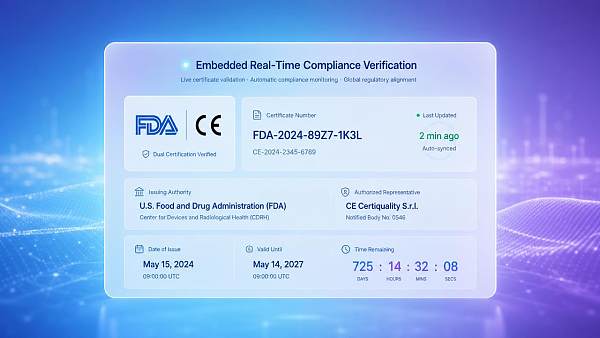
Event Overview
On May 15, 2026, the U.S. FDA officially implemented supplementary provisions to the B2B Digital Compliance Statement Guidance, requiring all Chinese suppliers exporting medical devices, food-contact materials, and consumer electronics products to the U.S. to integrate into their multilingual official websites a structured compliance statement module that can be verified online by the FDA (including CE/FDA dual-mark status, certificate number, issuing authority, and validity period), otherwise it will affect the pass rate of buyers' qualification pre-screening in the FDA Supplier Portal. This requirement directly affects overseas importers' supplier credibility assessment and order release decisions.
Which Segmented Industries Will Be Affected
Direct trading enterprises: As the registered entity in the FDA Supplier Portal and the signing party to procurement contracts, its official website is the primary source of information for importers conducting due diligence. If no verifiable module is embedded, it will lead to delays in qualification pre-screening or be flagged as “incomplete information”, significantly extending the onboarding cycle for new customers, and may trigger buyers to request additional costs such as third-party verification reports.
Raw material procurement enterprises: Although they do not directly export finished products, the key raw materials they supply to downstream manufacturers (such as medical-grade silicone, food-grade PC resin, and RoHS-compliant chips) must be accompanied by traceable compliance certificates. The new regulation forces their official websites to simultaneously upgrade statement modules to support downstream customers in fulfilling complete machine/component compliance disclosure obligations, otherwise they face the risk of weakened supplier relationships.
Processing and manufacturing enterprises: Enterprises undertaking OEM/ODM roles often apply for FDA listing in the brand owner's name, while their own official websites have long lacked independent compliance identification. After implementation of the new regulation, importers will be more inclined to choose manufacturers with independent digital compliance infrastructure capabilities to reduce joint liability risks; those lacking this capability may be excluded from preferred procurement lists.
Supply chain service enterprises: Including third-party service providers such as compliance consulting, certification agency services, and digital platform development, whose business model is shifting from “one-time certificate services” to “continuous compliance data operations and maintenance”. The new regulation objectively accelerates the market penetration of compliance SaaS tools, while also imposing higher requirements on service providers' data structuring capabilities, API integration experience, and multilingual content management.
Key Points of Attention and Response Measures for Relevant Enterprises or Practitioners
Confirm whether the official website meets structured data specifications
It is necessary to verify whether the official website adopts the Product and Certification extension fields in the Schema.org standard, supporting the FDA system in automatically capturing core parameters such as certificate number, issuance date, validity period, and certification body URI, rather than merely displaying static PDF scans.
Clarify the consistency of compliance statements across multilingual pages
Both the English main site and the Chinese sub-site must deploy verification modules with equivalent effect; if only the English pages are embedded while the Chinese pages are missing them, the FDA system may determine this as “information asymmetry”, affecting the overall credibility score.
Establish a dynamic certificate update mechanism
The module must achieve lightweight integration with the internal certificate management system (such as QMS) or the certification body database, ensuring that when certificates expire, change, or are revoked, the official website statement is synchronously refreshed, avoiding buyer misjudgment caused by outdated information.
Reserve a testing window for the FDA verification interface
It is recommended to complete module invocation testing in the FDA Supplier Portal sandbox environment before the third quarter of 2026, and obtain official returned verification log samples for internal technical calibration and legal review.
Editorial Viewpoint / Industry Observation
Observably, this regulation is not merely a technical requirement but a strategic signal: FDA is shifting from document-centric to data-centric oversight in global supply chains. Analysis shows that the real impact lies less in upfront development cost and more in operational discipline — firms with fragmented IT systems or siloed compliance functions face higher integration friction. From industry perspective, the move accelerates the convergence of regulatory compliance, digital marketing, and procurement trust infrastructure. It is better understood as a de facto standardization push for B2B transparency, rather than an isolated audit trigger.
Conclusion
This new regulation marks that regulatory compliance is moving from “post-event inspection” toward “in-process visibility”, posing a substantive test to enterprises' digital infrastructure capabilities. Its long-term significance lies not in adding another market access barrier, but in driving Chinese export enterprises to upgrade compliance from a legal support function into a digital asset that runs through the entire product lifecycle. Rationally speaking, enterprises that take the lead in completing module deployment may gain hidden competitive advantages such as priority buyer ratings, shortened factory audit cycles, and reduced evidentiary costs in quality disputes.
Information Source Description
Based on the Guidance for Industry: Supplemental Requirements for B2B Digital Compliance Statements published on the official U.S. FDA website (publication date: November 20, 2025, FR Doc. No. FDA-2025-D-18742); with simultaneous reference to FDA Supplier Portal technical documentation v3.2 (updated version in April 2026). It is necessary to continue monitoring whether the FDA will subsequently issue a module compatibility whitelist, detailed exemption rules for SMEs, and transitional enforcement standards.
Related Articles
 How Can Google Ads Personalize Content for Every User? One Feature That Doubles Your Inquiry Volume
 Why a Google-optimized independent website is essential for trailer exports
 How Can a Brand Updates Page Be Made More SEO-Friendly? Analysis of Update Frequency, Content Structure, and Internal Linking Strategy



Related Products
 EasyCamp SaaS Smart Website Marketing SystemE-Yingbao SaaS Smart Website Marketing System: AI-powered, zero-code website building. Rapidly launch multilingual independent e-commerce sites in just 10 minutes. Global server acceleration and AI-driven SEO optimization empower businesses to efficiently connect with global markets. The seamless integration of technology and user-friendly operation makes building e-commerce sites incredibly simple.
 AI+SEM Intelligent Advertising Marketing SystemAI+SEM drives intelligent ad creation, empowering full-funnel precision advertising marketing. The system automatically generates weekly/monthly reports, AI recommends keywords and target countries, monitors core metrics in real-time with intelligent alerts, and enables one-click high-conversion ad solutions to help quickly acquire customers and improve ROI.
 AI+SEO Dual Engine Optimization ServiceEasyWin AI+SEO Dual Engine Optimization System leverages AI-powered keyword mining, content generation, and comprehensive technical optimization to help foreign trade enterprises acquire high-quality organic traffic, significantly improving search rankings and conversion rates.
 AI+SNS Social Media Marketing SystemYingbao AI+SNS Social Media Marketing System - Precision social capture for the social media era. Supports one-click content synchronization across major platforms like Facebook and LinkedIn. AI intelligently rewrites posts for enhanced relevance. 24/7 AI customer service and user profiling analysis empower businesses to efficiently expand into global markets.
 AI+SEO营销解决方案易营宝AI+SEO营销解决方案,通过AI批量写作、智能生成TDK、精准关键词扩词等功能,全面优化网站SEO效果,提升流量与转化率。助力企业构建高效智能网站新生态。
 AI+SEM Advertising Marketing SolutionsAI+SEM Advertising Marketing Solution leverages AI technology to deeply empower SEM ad campaigns. It automatically generates weekly/monthly reports using AI, presenting account data across multiple dimensions for comprehensive insights into campaign performance and trends. The system precisely recommends keywords and target countries, intelligently generates high-conversion ad copy, and enables one-click activation of efficient campaign plans to help businesses rapidly acquire customers. Simultaneously, it monitors core metrics in real time, intelligently identifies abnormal fluctuations, and issues timely alerts to ensure stable, high-return advertising results.
 Domain Name ServicesEasyWin provides professional domain name services, including intelligent queries, one-stop registration, brand protection, and full lifecycle management, helping businesses build a digital brand image.
 EasyOperate B2C Cross-Border E-Commerce Platform & Independent WebsiteEasyStore B2C Cross-border E-commerce Independent Store is an intelligent website building and cross-border e-commerce integrated solution independently developed by EasyStore Information Technology (Beijing) Co., Ltd. The system is specially designed for small and medium-sized as well as large export enterprises, integrating 'website building, operation, marketing, advertising, and conversion' into one, helping enterprises quickly establish cross-border e-commerce independent stores to achieve brand globalization and global sales growth.
The platform supports multiple languages, multiple currencies, and multi-channel marketing, with built-in AI intelligent translation and SEO optimization systems, suitable for mainstream markets such as Southeast Asia, Europe and America, Latin America, and the Middle East, assisting Chinese manufacturing enterprises in efficiently deploying international e-commerce strategies. SSL证书易营宝提供专业SSL安全证书服务,包括单域名和泛域名证书,确保网站数据传输加密、身份验证和完整性保护,助力企业建立安全可信的在线业务环境。









