









- China-Morocco zero-tariff access, a breakthrough in the cost of Moroccan goods exports to ChinaJun 11, 2026View details
- What signal should be released for the suspension of exports to JapanJun 10, 2026View details
- China's May LNG imports rebounded, with increased volumes from Russia and Canada filling the Middle East supply gapJun 10, 2026View details
- Will GEO change its SEO strategy?Jun 04, 2026View details
- What types of businesses are end-to-end solutions suitable for?Jun 03, 2026View details
- 2026 Global Growth Channel TrendsJun 02, 2026View details
- Changes in Search Engine Ranking Factors in 2026Jun 06, 2026View details
- Which stages is the brand visibility enhancement service suitable forMay 29, 2026View details
How to promote a multilingual website for foreign trade after its construction?
After the construction of a multilingual foreign trade website is completed, what truly determines the results is not “whether the website has gone live,” but “whether overseas customers can find it, understand it, and be willing to send inquiries after it goes live.” For most companies, the core of promotion is not to focus on just one channel, but to create a closed loop in which search engine optimization, social platform reach, paid advertising traffic acquisition, and data monitoring work together. Only in this way can a multilingual website avoid becoming merely a display-style business card and instead continuously bring in high-quality overseas traffic and inquiries.
From the perspective of actual business operations, business decision-makers pay more attention to input-output ratio, promotion cycle, and inquiry quality; execution teams care more about where to start, what to do first, and how to monitor results; distributors, after-sales teams, and end users care more about whether the website content is trustworthy and whether product and service information is easy to find. Therefore, multilingual foreign trade website promotion cannot stay at the level of “posting on social media and running some ads,” but should be systematically advanced around the target market, target language, and target customers’ search behavior.
After a multilingual website goes live, what should be done first to avoid “having a website but no traffic”
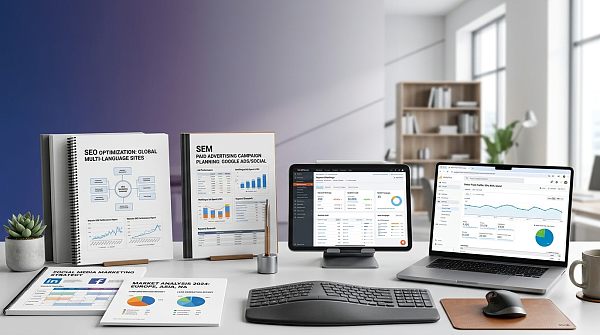
Many corporate websites fail to produce results for a long time after going live. The reason is usually not that the products are uncompetitive, but that the foundational promotional work has not been properly established. The first step in promoting a multilingual foreign trade website is not to launch campaigns blindly, but to first ensure the website is “indexable, understandable, and convertible.”
It is recommended to first check the following aspects:
- Whether the language version structure is clear: Pages in different languages should have clear directories or independent structures, avoiding piles of machine-translated content and ensuring that search engines can identify content for different regions and languages.
- Whether the on-page SEO foundation is complete: Including title tags, Meta description, H tags, image Alt attributes, URL naming, internal linking structure, etc. These directly affect the execution results of search engine optimization services.
- Whether the content is truly localized: It is not just about translating Chinese content into foreign languages, but rewriting the content based on the target market customers’ search habits, purchasing concerns, and industry-specific ways of expression.
- Whether the conversion path is smooth: Touchpoints such as inquiry buttons, WhatsApp, email, forms, phone numbers, and product material downloads should be prominent, so users do not finish reading the page without knowing how to get in touch.
- Website speed and mobile experience: Slow access for overseas users, messy mobile display, and failed form loading will all directly affect bounce rate and inquiry rate.
If this step is not done well, then whether you proceed with SEO content optimization or advertising campaigns, problems will arise such as getting clicks but failing to retain visitors, or having traffic but no conversions.
The 3 most effective directions for foreign trade website promotion and how companies should allocate their efforts
For foreign trade companies, the promotion directions most worth investing in after building a multilingual website are usually SEO, social media marketing, and search advertising. These three respectively solve the problems of “long-term organic traffic,” “brand trust building,” and “short-term precise customer acquisition.”
First, search engine optimization services. This is the foundation best suited for long-term operations. When overseas buyers search on Google for products, suppliers, and solutions, whether they can find you determines whether your website has the ability to acquire customers continuously. The focus of SEO is not just homepage rankings, but building a content matrix around product keywords, application scenario keywords, and industry problem keywords, such as product detail pages, FAQ pages, case pages, technical document pages, certification pages, etc. This makes it easier to cover search intent at different stages.
Second, social media marketing strategy. If a company targets B2B customers, LinkedIn corporate marketing is especially important. It is not only a platform for posting updates, but also a window for building corporate credibility and reaching industry buyers and channel partners. For some industries targeting end consumers or visually oriented products, Facebook, Instagram, and YouTube also have clear value. The focus of social media promotion is not “posting more,” but making content support website conversion, for example by publishing customer cases, factory capabilities, delivery processes, quality control, after-sales support, and other content to drive social traffic back to the official website.
Third, paid search advertising. If a company wants to validate the market faster and capture high-commercial-intent keywords, Google Ads is usually a highly efficient approach. Especially when a new website’s SEO has not yet gained momentum, search ads can first bring in precise traffic and help companies determine which countries, keywords, pages, and products are more likely to convert. For example, for foreign trade business scenarios, it can be combined with Google Ads promotion for keyword refinement, audience profile analysis, and multilingual scenario adaptation, so as to establish initial inquiry sources more quickly.
In actual allocation, it is recommended that companies do not bet on only one channel, but instead adopt a combined approach of “SEO for the foundation, social media for trust, and ads for acceleration.” This can not only control short-term customer acquisition pressure, but also gradually reduce later-stage traffic costs.
Why are there still no inquiries after doing promotion? The problem usually lies in these stages
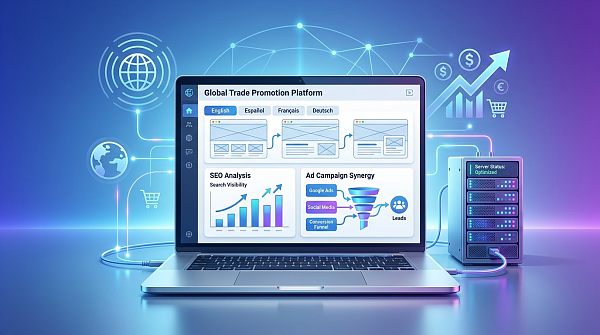
“Traffic but no inquiries” is the most common challenge in foreign trade website promotion. In many cases, the problem is not the volume of promotion, but the quality of traffic and the page’s conversion capability.
Common reasons include:
- The keyword direction is off: The traffic brought in is not from purchasing customers, but from peers, students, or low-intent visitors.
- The page content does not match search intent: The customer searches for a solution, but what you provide is a company introduction; the customer wants to see specifications and certifications, but what you provide is vague promotional language.
- Lack of trust elements: Without cases, certificates, real factory photos, delivery capabilities, after-sales mechanisms, cooperative brands, and other information, users find it difficult to submit inquiries.
- Poor form and contact entry experience: Too many fields, awkward language, submission failures, and slow responses all result in the loss of high-intent customers.
- No data monitoring: If you do not know where users come from, which pages they viewed, and at which step they dropped off, then naturally you cannot optimize.
This is also why website traffic monitoring tools are very important. Companies should at least establish basic data observation capabilities, including source channels, search terms, page dwell time, bounce rate, conversion rate, and inquiry form submission status. Only by seeing the problems can promotion results be continuously optimized.
What business decision-makers should focus on more: input-output ratio, promotion cycle, and risk control
For business managers, the most practical question is not “whether promotion should be done,” but “how to do it more cost-effectively, how long it will take to see results, and which risks should be avoided in advance.”
From the perspective of input-output ratio:
- SEO is more suitable for medium- to long-term accumulation. It usually takes relatively longer to show results in the early stage, but once rankings are established, the cost of continuous customer acquisition is usually lower.
- Social media marketing is more suitable for brand endorsement, customer relationship maintenance, and channel expansion, while the conversion cycle varies by industry.
- Google Ads is more suitable for short-term testing and rapid customer acquisition, but it requires continuous optimization of keywords, landing pages, and bidding strategies, otherwise the budget will be consumed quickly.
From the perspective of timing, if a company has a new website with no historical authority, it is usually not recommended to place all hopes on organic rankings. A more reasonable approach is to first obtain the first batch of effective visits and inquiries through ads and social media, and then use real data in reverse to guide the SEO content layout.
From the perspective of risk control, companies need to avoid the following common misunderstandings:
- Only doing translation without restructuring localized content
- Only pursuing traffic without paying attention to inquiry quality
- Only running ads without optimizing website conversion pages
- Only looking at impressions and clicks without looking at actual business opportunity cost
- Duplicate content across multiple language sites, affecting indexation and rankings
If a company hopes to balance both speed and quality, it can choose a service team with global advertising experience. In overseas customer acquisition scenarios, professional teams can usually provide more mature methods in ad planning, performance tracking, precise targeting, smart bidding, and visual reporting. This is also a key reason why many companies are more likely to achieve ROI in international market promotion.
How the execution team can implement it: a more practical promotion sequence for foreign trade websites
If a company wants to truly make multilingual website promotion work, it is recommended to proceed in the following order:
- Complete the basic website diagnosis: Check indexation, speed, mobile performance, Meta information, content quality, and conversion entry points.
- Sort out the keyword strategy: Distinguish brand keywords, product keywords, scenario keywords, problem keywords, and competitor keywords, and arrange them by different countries and languages.
- Prioritize building core landing pages: Product pages, industry solution pages, case pages, FAQ pages, and contact pages must be completed first.
- Simultaneously update content: Continuously produce content around customers’ frequently asked questions and procurement decision points to support SEO and social media distribution.
- Launch LinkedIn corporate marketing and other social media outreach: Use social platforms as an auxiliary base for driving traffic to the official website and strengthening brand endorsement.
- Use ads to test the market: For example, start with a small budget for key countries and key products, verify high-conversion keywords and pages, and then gradually scale up. For companies hoping to cover 100+ countries/regions and requiring bilingual Chinese-English reports and real-time data access, it is also possible to combine with Google Ads promotion to improve testing efficiency and campaign precision.
- Establish weekly and monthly reporting mechanisms: Focus on inquiry volume, valid inquiry rate, cost per conversion, keyword performance, country performance, and page conversion performance.
- Continue optimizing: Remove low-efficiency keywords, strengthen high-conversion pages, and adjust forms and CTA so that traffic becomes increasingly precise.
The core value of this sequence lies in this: rather than first doing things that “look very busy,” it is better to first establish a promotion system that is verifiable, trackable, and optimizable. For execution teams, this produces real results more effectively than posting scattered content and running ads randomly.
Conclusion: for multilingual website promotion, the key is not “how much has been done,” but “whether a customer acquisition closed loop has been formed”
How to promote a multilingual foreign trade website after it is built is not a multiple-choice question. The truly effective approach is to use search engine optimization services as the foundation, social media marketing strategies to build trust, paid advertising to accelerate testing and customer acquisition, and then continuously optimize with website traffic monitoring tools.
If a company stays only at the stage of “website launch,” the website will most likely remain just a display window; but if it can operate around search intent, customer decision-making paths, and data feedback, then the multilingual website can gradually become a stable overseas customer acquisition channel. For business decision-makers, the focus is on whether promotion brings real business opportunities; for execution teams, the focus is on making every step solid and trackable. Only in this way can website traffic truly be converted into high-quality overseas inquiries and long-term growth.
Related Articles



Related Products
 EasyCamp SaaS Smart Website Marketing SystemE-Yingbao SaaS Smart Website Marketing System: AI-powered, zero-code website building. Rapidly launch multilingual independent e-commerce sites in just 10 minutes. Global server acceleration and AI-driven SEO optimization empower businesses to efficiently connect with global markets. The seamless integration of technology and user-friendly operation makes building e-commerce sites incredibly simple.
 AI+SEM Intelligent Advertising Marketing SystemAI+SEM drives intelligent ad creation, empowering full-funnel precision advertising marketing. The system automatically generates weekly/monthly reports, AI recommends keywords and target countries, monitors core metrics in real-time with intelligent alerts, and enables one-click high-conversion ad solutions to help quickly acquire customers and improve ROI.
 AI+SEO Dual Engine Optimization ServiceEasyWin AI+SEO Dual Engine Optimization System leverages AI-powered keyword mining, content generation, and comprehensive technical optimization to help foreign trade enterprises acquire high-quality organic traffic, significantly improving search rankings and conversion rates.
 AI+SNS Social Media Marketing SystemYingbao AI+SNS Social Media Marketing System - Precision social capture for the social media era. Supports one-click content synchronization across major platforms like Facebook and LinkedIn. AI intelligently rewrites posts for enhanced relevance. 24/7 AI customer service and user profiling analysis empower businesses to efficiently expand into global markets.
 AI+SEO营销解决方案易营宝AI+SEO营销解决方案,通过AI批量写作、智能生成TDK、精准关键词扩词等功能,全面优化网站SEO效果,提升流量与转化率。助力企业构建高效智能网站新生态。
 AI+SEM Advertising Marketing SolutionsAI+SEM Advertising Marketing Solution leverages AI technology to deeply empower SEM ad campaigns. It automatically generates weekly/monthly reports using AI, presenting account data across multiple dimensions for comprehensive insights into campaign performance and trends. The system precisely recommends keywords and target countries, intelligently generates high-conversion ad copy, and enables one-click activation of efficient campaign plans to help businesses rapidly acquire customers. Simultaneously, it monitors core metrics in real time, intelligently identifies abnormal fluctuations, and issues timely alerts to ensure stable, high-return advertising results.
 Domain Name ServicesEasyWin provides professional domain name services, including intelligent queries, one-stop registration, brand protection, and full lifecycle management, helping businesses build a digital brand image.
 EasyOperate B2C Cross-Border E-Commerce Platform & Independent WebsiteEasyStore B2C Cross-border E-commerce Independent Store is an intelligent website building and cross-border e-commerce integrated solution independently developed by EasyStore Information Technology (Beijing) Co., Ltd. The system is specially designed for small and medium-sized as well as large export enterprises, integrating 'website building, operation, marketing, advertising, and conversion' into one, helping enterprises quickly establish cross-border e-commerce independent stores to achieve brand globalization and global sales growth.
The platform supports multiple languages, multiple currencies, and multi-channel marketing, with built-in AI intelligent translation and SEO optimization systems, suitable for mainstream markets such as Southeast Asia, Europe and America, Latin America, and the Middle East, assisting Chinese manufacturing enterprises in efficiently deploying international e-commerce strategies. SSL证书易营宝提供专业SSL安全证书服务,包括单域名和泛域名证书,确保网站数据传输加密、身份验证和完整性保护,助力企业建立安全可信的在线业务环境。









