









- What Does a Global Traffic Ecosystem Service Provider Do? What Are the Differences from a Single Advertising AgencyJul 16, 2026View details
- What should you focus on in the latest enterprise SaaS report? From renewal rates and delivery costs to overseas growth opportunitiesJul 12, 2026View details
- What signals are worth paying attention to in a cross-border marketing trend report? B2B companies should look at these 6 signalsJul 11, 2026View details
- How to Read a Cross-Border Marketing Trends Report? Five Key Dimensions for Evaluating Channel OpportunitiesJul 11, 2026View details
- Which channel has the highest ROI in the global traffic ecosystem? Comparative analysis of search, social media, and advertisingJul 10, 2026View details
- What multilingual website services are available in Sanya? Which model is more suitable for local businesses going global?Jul 08, 2026View details
- How to view the complete list of China SaaS companies in the top 100? Practical methods for screening website-building and marketing service providersJul 08, 2026View details
- How to view pricing in the global traffic ecosystem? Cost comparison of search, social media, and content channel advertisingJul 06, 2026View details
Is the cost of building a multilingual website high
Is building a multilingual website expensive? The answer is usually: not necessarily, but it's easy to "look cheap but end up being very expensive." What truly impacts the budget isn't just page translation and front-end development, but also the domain registration process, server deployment, SSL certificate application process, search engine optimization services, localized content creation, and post-launch promotion and operation. For business decision-makers, the focus shouldn't be solely on the initial quote, but rather on assessing "whether it's worthwhile, how to save money, and how long it will take to see results." For the execution team, the key is how to manage language versions, whether post-launch maintenance will get out of control, and whether SEO and security can be addressed simultaneously. Choosing the right website building solution and service provider is often more important than simply lowering the price.
What users really want to ask is not whether it's expensive or not, but whether a multilingual website is worthwhile.
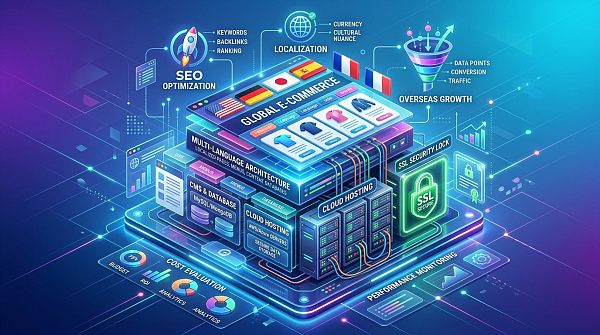
When users search for "Are multilingual website construction costs high?", their core search intent is usually not just to find a price quote, but to make a judgment:
- How much does it typically cost to build a multilingual website?
- Which fees are mandatory, and which are easily overlooked later?
- How should budgets be allocated for companies of different sizes and with different overseas expansion goals?
- After the investment, will it truly bring overseas inquiries, brand exposure, and channel growth?
For business decision-makers, distributors, agents, and operational staff, the most important factor is not the "lowest price," but the return on investment . If a multilingual website simply translates a Chinese site into a few languages without considering localization, search engine indexing, access speed, security and compliance, and subsequent operation, then even if the initial construction cost is low, it may incur higher costs later due to poor performance, chaotic maintenance, and frequent reconstruction.
Therefore, determining whether multilingual website development is "expensive" depends on whether it serves the company's actual business objectives: is it for brand display, overseas customer acquisition, channel recruitment, or after-sales service and global distribution support? Different objectives require completely different budget structures.
What are the typical components of the cost of building a multilingual website?
From a complete project perspective, the cost of building a multilingual website generally consists of the following components:
- Basic website building costs include page design, front-end development, back-end management system, multi-language switching functionality, form system, product display module, etc. This is the "explicit cost" that many companies focus on first.
- Domain and Server Costs <br />Multilingual websites may involve planning for a main domain, subdomains, or directory structure. Different plans will affect the domain registration process and subsequent SEO strategy. If targeting different regions such as Europe, America, Southeast Asia, and the Middle East, server or CDN deployment will also affect access speed and stability.
- SSL Certificates and Security Investment <br />Legitimate corporate websites typically require HTTPS encryption, which involves the SSL certificate application process and renewal management. If form submissions, customer data collection, membership systems, etc., are also involved, security investment cannot be skimped on.
- Translation and localization costs are the biggest difference between multilingual websites and regular websites. Machine translation alone is inexpensive but of inconsistent quality; human translation and marketing-oriented localization are more expensive but more beneficial for conversions and brand credibility.
- Search Engine Optimization Services <br />Many businesses believe that launching a website will automatically attract customers. In reality, multilingual websites often struggle to gain stable traffic without keyword strategy, URL planning, hreflang tags, meta information optimization, and local search content support.
- Post-launch operation and promotion costs include content updates, language version maintenance, advertising, social media engagement, data analysis, and inquiry conversion optimization. This part often determines whether the website ultimately achieves commercial success.
In other words, simply asking "How much does it cost to build a multilingual website?" will hardly yield a valuable answer. The difference between a template website costing a few thousand yuan and an international marketing website costing hundreds of thousands of yuan often lies not in "whether it can be done," but in "whether it will be effective after completion."
Why do some multilingual websites start with low prices but then become increasingly expensive later on?
This is a pitfall many companies have fallen into. A low initial quote does not guarantee a low total cost. The following situations are particularly common:
- Simply translating without localization : The page language may appear to have switched successfully, but the expression doesn't match local user habits. Product selling points, industry terminology, contact information, and form logic are all incompatible, resulting in low conversion rates.
- Technical architecture is not conducive to SEO
If language version switching relies on JS, URLs are messy, or there is a serious problem with duplicate pages, it will be difficult to remedy the situation with search engine optimization services. - The backend is difficult to maintain .<br />Each time the staff updates the content, they have to repeatedly operate on multiple language sites, and the maintenance cost continues to increase.
- Ignoring overseas access speed : The website opens normally in China, but access is slow or even unstable overseas, resulting in a high user bounce rate and making it difficult for advertising to achieve its full effect.
- Insufficient security and compliance
Inadequate SSL certificate configuration, spam prevention in forms, and anti-attack mechanisms can, at best, affect customer trust, and at worst, disrupt the normal operation of a website.
From this perspective, when evaluating the cost of building a multilingual website, businesses should not only compare the initial payment, but also three dimensions : website construction cost, maintenance cost, and customer acquisition cost. A truly mature solution should achieve a balance among these three parts, rather than having a lower initial cost and a higher cost later.
What are the differences in budget assessment methods for different types of enterprises?
Not all businesses need to build a large, comprehensive multilingual website right from the start. A more reasonable approach is to allocate budgets according to the stage of business operations.
1. For SMEs going global for the first time : If the core objective is to test overseas markets and obtain initial inquiries, prioritize creating 1-3 versions in key languages, focusing on core product pages, company introductions, case study pages, and inquiry pages. Control initial investment and allocate more budget to basic SEO optimization and ad validation.
2. Growing companies with stable foreign trade operations : These companies are better suited to standardized multilingual marketing websites, focusing on keyword placement, content operation, and form conversion design for different markets. In this case, the website is not only a "display window" but also an entry point for sales leads.
3. Brand-oriented enterprises or group companies typically pay more attention to brand consistency, global multi-site management, access control, security and stability, and long-term operational efficiency. Their budgets are higher, but their investment logic is also clearer: to support global business collaboration through a unified platform.
4. Distributors, agents, and channel partners place greater emphasis on features such as product information downloads, regional language support, synchronized after-sales information, and ease of channel recruitment. Multilingual websites serve not only customers but also channel partners.
If a company is still advancing digital governance, it will often find that website construction is not an isolated project; it has interconnected value with finance, operations, customer management, and marketing data analysis. Similarly, discussions on the path of enterprise financial management informatization in the context of the digital economy can help management understand the relationship between IT investment and operational efficiency from a more macro perspective.
To control costs, what key aspects should companies prioritize?
If the goal is to "control the budget while ensuring results," it is recommended to prioritize the following questions:
- First, identify your target market, rather than blindly launching in numerous languages . The more languages you use, the higher the translation, maintenance, and SEO costs will be. Focusing on your core market is usually more cost-effective.
- Choosing a scalable technical architecture : Whether the backend supports unified management of multilingual content, and whether it can easily add languages, sections, and landing pages in the future, will directly affect future costs.
- Prioritize SEO planning during the website's initial stages . Many search engine optimization services are more expensive and slower to implement after website launch. The correct approach is to consider SEO from the outset, starting with URL structure, page templates, and keyword placement.
- Clearly define translation levels . Not all pages require costly manual editing. Core sales pages, brand pages, and landing pages are suitable for detailed localization, while regular information pages can adopt more flexible solutions.
- Prioritizing security and trust building : A standardized SSL certificate application process, privacy guidelines, form security verification, and complete display of company information will all influence whether overseas users are willing to submit inquiries.
- Examine whether the service provider understands marketing, not just website building . A website is just a tool; its ability to synergize with SEO, social media marketing, and advertising is what ultimately determines whether it can bring business growth.
For the integrated website and marketing services industry, truly valuable solutions are not simply about "delivering a few pages," but about helping businesses establish a complete value chain from website building to customer acquisition and conversion optimization. This is especially crucial in multilingual environments where technology, content, and promotion must work in tandem.
Whether building a multilingual website is expensive or not ultimately depends on whether the money is well spent.
Returning to the initial question: Is building a multilingual website expensive? If we only consider the development cost, it is indeed more expensive than a single-language website; however, if we look at global customer acquisition, brand credibility, channel expansion, and customer service efficiency, it is often a very worthwhile investment for companies going global.
More accurately, building a multilingual website is not simply a "cost item," but rather an infrastructure that combines brand and marketing assets. If done well, it can sustain organic search traffic, advertising traffic, social media traffic, and channel traffic in the long run; if done poorly, it becomes a display page that continuously burns money without yielding results.
Therefore, companies should focus on judging the following when making decisions:
- Is this construction project centered around real business objectives?
- Does the budget cover the key aspects of website building, optimization, security, and promotion?
- Does the plan facilitate subsequent maintenance and continued growth?
- Does the service provider possess the technical capabilities and marketing implementation capabilities?
In summary, the biggest concern with building a multilingual website isn't the cost, but rather the lack of tangible results despite the investment . With proper initial planning, a clear technical architecture, simultaneous SEO and localization efforts, and phased investment tailored to the company's market stage, this initiative is often not only affordable but can also become a crucial starting point for growth in overseas markets.
Related Articles


Related Products
 EasyCamp SaaS Smart Website Marketing SystemE-Yingbao SaaS Smart Website Marketing System: AI-powered, zero-code website building. Rapidly launch multilingual independent e-commerce sites in just 10 minutes. Global server acceleration and AI-driven SEO optimization empower businesses to efficiently connect with global markets. The seamless integration of technology and user-friendly operation makes building e-commerce sites incredibly simple.
 AI+SEM Intelligent Advertising Marketing SystemAI+SEM drives intelligent ad creation, empowering full-funnel precision advertising marketing. The system automatically generates weekly/monthly reports, AI recommends keywords and target countries, monitors core metrics in real-time with intelligent alerts, and enables one-click high-conversion ad solutions to help quickly acquire customers and improve ROI.
 AI+SEO Dual Engine Optimization ServiceEasyWin AI+SEO Dual Engine Optimization System leverages AI-powered keyword mining, content generation, and comprehensive technical optimization to help foreign trade enterprises acquire high-quality organic traffic, significantly improving search rankings and conversion rates.
 AI+SNS Social Media Marketing SystemYingbao AI+SNS Social Media Marketing System - Precision social capture for the social media era. Supports one-click content synchronization across major platforms like Facebook and LinkedIn. AI intelligently rewrites posts for enhanced relevance. 24/7 AI customer service and user profiling analysis empower businesses to efficiently expand into global markets.
 AI+SEO营销解决方案易营宝AI+SEO营销解决方案,通过AI批量写作、智能生成TDK、精准关键词扩词等功能,全面优化网站SEO效果,提升流量与转化率。助力企业构建高效智能网站新生态。
 AI+SEM Advertising Marketing SolutionsAI+SEM Advertising Marketing Solution leverages AI technology to deeply empower SEM ad campaigns. It automatically generates weekly/monthly reports using AI, presenting account data across multiple dimensions for comprehensive insights into campaign performance and trends. The system precisely recommends keywords and target countries, intelligently generates high-conversion ad copy, and enables one-click activation of efficient campaign plans to help businesses rapidly acquire customers. Simultaneously, it monitors core metrics in real time, intelligently identifies abnormal fluctuations, and issues timely alerts to ensure stable, high-return advertising results.
 Domain Name ServicesEasyWin provides professional domain name services, including intelligent queries, one-stop registration, brand protection, and full lifecycle management, helping businesses build a digital brand image.
 EasyOperate B2C Cross-Border E-Commerce Platform & Independent WebsiteEasyStore B2C Cross-border E-commerce Independent Store is an intelligent website building and cross-border e-commerce integrated solution independently developed by EasyStore Information Technology (Beijing) Co., Ltd. The system is specially designed for small and medium-sized as well as large export enterprises, integrating 'website building, operation, marketing, advertising, and conversion' into one, helping enterprises quickly establish cross-border e-commerce independent stores to achieve brand globalization and global sales growth.
The platform supports multiple languages, multiple currencies, and multi-channel marketing, with built-in AI intelligent translation and SEO optimization systems, suitable for mainstream markets such as Southeast Asia, Europe and America, Latin America, and the Middle East, assisting Chinese manufacturing enterprises in efficiently deploying international e-commerce strategies. SSL证书易营宝提供专业SSL安全证书服务,包括单域名和泛域名证书,确保网站数据传输加密、身份验证和完整性保护,助力企业建立安全可信的在线业务环境。









