









- What stages does the cross-border services ecosystem include? How do website building, promotion, payment, and compliance work togetherJun 22, 2026View details
- How will email marketing costs change in 2026Jun 22, 2026View details
- The China-US tariff arrangement has reached a preliminary consensus, and the trade association will be establishedJun 15, 2026View details
- Should overseas brand marketing start with ads or contentJun 21, 2026View details
- What determines B2C cross-border e-commerce website development costs? A breakdown of features, interfaces, and deployment methodsJun 17, 2026View details
- China-Morocco zero-tariff access, a breakthrough in the cost of Moroccan goods exports to ChinaJun 11, 2026View details
- What signal should be released for the suspension of exports to JapanJun 10, 2026View details
- China's May LNG imports rebounded, with increased volumes from Russia and Canada filling the Middle East supply gapJun 10, 2026View details
What should you do when search engine ranking algorithms change?
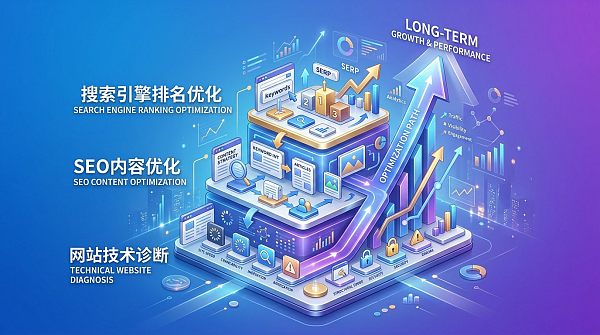
As search engine ranking algorithms continue to evolve, what companies fear most is not “not understanding the rules,” but sudden traffic drops, rising lead costs, and content investment that still fails to deliver returns after a long time. The overall judgment is very clear: algorithm changes do not mean SEO has become ineffective, but rather force companies to shift from “chasing tactics” to “prioritizing quality, experience, and long-term operations.” For most companies, the truly effective response is not to frequently speculate about algorithm details, but to build a more stable content and website foundation around search engine ranking optimization, SEO content optimization, and website SEO optimization solutions.
For users, operators, business decision-makers, and after-sales maintenance teams, what deserves the most attention is not a certain “ranking secret,” but three practical questions: is the current traffic decline caused by algorithm impact, content issues, or website technical issues; which optimization actions can stop the loss fastest; and in the long run, how to build a growth system that is less vulnerable to algorithm fluctuations. Below, we will discuss this from three levels: judgment, response, and implementation.
Don’t rush to change the website first: if the algorithm has changed, what should companies determine first?
Many companies immediately change titles, delete content, or replace the homepage as soon as they notice keyword ranking fluctuations, and the result is often that the more they change, the more chaotic it becomes. A more prudent approach is to first determine the type of problem, and then decide the optimization direction.
First, look at the scope of the fluctuation.If only a small number of keywords have dropped, but overall organic traffic and conversions have not clearly worsened, it is often a normal fluctuation; if multiple core pages decline at the same time and the number of leads drops significantly, then a focused investigation is needed.
Second, distinguish between “algorithm impact” and “your own issues.”Changes in search engine rankings may come from search engine updates, or from the aging of the website itself. For example: slower page loading, poor mobile experience, duplicate content, old articles not updated for a long time, and a messy internal linking structure — all of these can amplify the impact caused by algorithm changes.
Third, look at changes among competitors.If leading websites in the industry are also experiencing ranking reshuffles, it is more likely to be an algorithm adjustment; if only your website is declining while peers remain stable or even rise, then it shows that your website SEO optimization plan needs systematic correction.
At this stage, what business managers care about most is: should we continue investing in SEO? The answer is yes, but the method must change. Instead of spending the budget on short-term keyword boosting and piling up pages, it is better to invest in more sustainable content assets, technical experience, and data monitoring systems.
Why are SEO practices that used to work becoming increasingly unstable now?
The core trend of search engine ranking algorithms in recent years has been very clear: they place more emphasis on user value, rather than simply matching keywords. This means that some methods that previously relied on mechanical operations are rapidly losing effectiveness.
Common issues include:
- Excessive keyword stuffing in titles and body text, resulting in a poor reading experience;
- Mass production of low-quality pages, where the content appears abundant but actually fails to solve user problems;
- Focusing only on indexing and rankings, while ignoring dwell time, bounce rate, and conversions;
- A complex website structure that makes it difficult for search engines to crawl, while users also cannot find key information;
- Content that is not maintained for a long time, becomes outdated, and reduces professional credibility.
Today’s algorithms are increasingly inclined to identify whether this content truly answers user questions, whether this website is trustworthy, whether this page is suitable for reading, and whether this brand has the ability to provide continuous service. This is especially true in the “website + integrated marketing services” industry, because business clients care more about professionalism, case experience, localized service, and execution capability, rather than just traffic numbers alone.
After traffic drops, which actions are most worth prioritizing?
If a company has already felt the impact of declining search engine rankings, it is not recommended to tear everything down and start over, but rather to handle things according to priorities.
1. Secure the core pages first.
Prioritize checking the homepage, core product pages, key service pages, and article pages with high conversion rates. Check whether these pages have issues such as outdated titles, incomplete content, slow loading speed, abnormal forms, and poor mobile adaptation. Only when the core pages remain stable can business impact stay controllable.
2. Update old content with high value.
For many websites, the problem is not too little content, but too much outdated and ineffective content. Performing secondary optimization on content that once had traffic, inquiries, and rankings is usually more effective than writing 10 new generic articles. The focus of SEO content optimization is not only on “adding new,” but more on “restructuring and updating.”
3. Rebuild the content structure, rather than only changing a few keywords.
Search engines are more willing to give rankings to problem-solving content with a clear structure and comprehensive coverage. For example, around “how to respond to algorithm changes,” the content should include judgment methods, risk points, optimization steps, investment suggestions, and common misunderstandings, rather than just repeatedly using words like “ranking algorithm” and “SEO optimization.”
4. Investigate the technical side at the same time.
After-sales maintenance personnel or technical teams should focus on crawl anomalies, dead links, duplicate pages, redirect errors, sitemaps, server stability, HTTPS, security issues, mobile adaptation, and page speed. Many companies do not have poor content, but their technical foundation holds them back.
5. Build a monitoring dashboard.
Don’t just stare at a single keyword; also monitor organic traffic, indexing trends, page click-through rate, core page conversion rate, bounce conditions, and inquiry quality. Decision-makers look at return on investment, while executors look at whether optimization actions are effective — both depend on data.
What should truly effective search engine ranking optimization look like?
To respond to algorithm changes, the core is not to “bet on a certain tactic,” but to build a healthier SEO foundation. A mature search engine ranking optimization strategy usually includes the following levels.
Content level: organize content around real search intent.
When users search for a keyword, they are not just looking for a definition, but trying to solve a problem. For example, when searching “what should we do if the search engine ranking algorithm changes,” the real intent behind it is usually: what to do if traffic drops, how to determine the problem, which optimizations are worth doing, and whether it will affect customer acquisition cost. Therefore, content design should revolve around these questions, rather than staying at the level of introducing algorithm concepts.
Page level: make key information easier to see.
Titles, summaries, opening paragraphs, H2 subheadings, case explanations, FAQ, and calls to action should all serve the user’s reading path. A page is not a keyword container, but a conversion entry point. Corporate websites in particular should clearly present service capabilities, solutions, industry experience, and credible endorsements.
Site level: improve overall topical relevance.
If website content has long been scattered here and there, with topics dispersed, it is difficult for search engines to judge your depth of expertise. A better approach is to build topic clusters around the main business lines, such as website building, SEO optimization, advertising placement, social media marketing, overseas promotion, etc., so that each part is interconnected and passes authority to one another.
Brand level: strengthen credibility.
For business clients, ranking is only the beginning; trust determines conversion. Service providers like Yiyingbao Information Technology (Beijing) Co., Ltd., which are driven by artificial intelligence and big data and cover full-chain solutions including intelligent website building, SEO optimization, social media marketing, and advertising placement, are more likely to build brand trust on the search side through systematic content, case studies, and industry insight output.
What business managers care about most: is this type of optimization really worth sustained investment?
If you are a business decision-maker, to judge whether SEO is worth investing in, you should not only look at “what position a certain keyword ranks today,” but whether it has long-term compounding value.
Compared with relying purely on advertising placement, the advantages of SEO lie in:
- High-quality content can continuously bring organic traffic;
- When branded keywords and business keywords grow at the same time, customer acquisition trust is higher;
- Website content assets keep accumulating, and traffic will not stop as soon as advertising is paused;
- It can work in synergy with website building, content, social media, and advertising to improve overall marketing efficiency.
Of course, SEO is not a channel that is “low-cost and delivers immediate results.” It is more suitable for companies with ongoing operational needs, a focus on brand accumulation, and a need for stable customer acquisition. If your business has a long decision-making cycle, customers clearly search and compare prices, and the industry has high content education costs, then the value of search engine ranking optimization is usually even higher.
In some industries, companies also enhance the authority of their websites through professional reference-type content. For example, developing content around policy, management, and research topics can also help the website cover more segmented search needs. Content such as Comprehensive Budget Management Research for Administrative Institutions, if applied in suitable content scenarios, can also enrich the website’s information layers, but the premise remains that it should stay naturally relevant to the overall topic and user needs.
How to implement at the execution level: a more reliable website SEO optimization plan
For operations, editors, technical staff, and maintenance personnel, the following approach can be used:
- Organize page assets:distinguish core conversion pages, traffic pages, brand pages, and ineffective pages.
- Build keyword and intent mapping:separate informational, comparison, solution-oriented, and purchase-intent search terms.
- Rewrite key content:optimize high-value old pages first, then supplement missing topics.
- Optimize site structure:strengthen internal linking logic and reduce orphan pages.
- Improve technical performance:focus on speed, mobile, crawling, and security issues.
- Add trust elements:case studies, customer reviews, service processes, frequently asked questions, and company qualifications.
- Conduct continuous reviews:observe traffic, rankings, conversions, and page performance every month, and make timely adjustments.
The key to this website SEO optimization plan is not finishing it once, but continuous iteration. In essence, algorithm changes are screening which websites are truly serving users and which websites are only catering to rules. The former usually becomes more and more stable, while the latter is more likely to be eliminated.
Avoid these pitfalls: making major website changes as soon as the algorithm changes often backfires
In actual work, many companies make wrong decisions out of anxiety, commonly including:
- Modifying all titles and descriptions in bulk within a short period of time;
- Forcing rewrites of pages that were originally performing well just for the sake of “originality”;
- Deleting a large amount of old content, causing loss of historical authority;
- Frequently changing the URL structure, creating crawling and redirect problems;
- Completely understanding SEO as only publishing articles, while ignoring website experience and the conversion chain.
The correct approach is to handle things in layers: analyze first, then test on a small scale, then expand. Especially on corporate websites, any structural adjustment may affect key business links such as lead handling, after-sales explanation, and dealer information display, so systematic planning is even more necessary rather than temporary reactions.
Overall, a change in search engine ranking algorithms does not mean companies have no options. The truly prudent response is to center on user search intent, while balancing SEO content optimization, website technical experience, and business conversion goals, and building an operating mechanism that is more resistant to fluctuations. For business decision-makers, focus on long-term value and return on investment; for execution teams, grasp the four key points of content, structure, technology, and data. As long as the direction is right, algorithm changes may not be a risk, but instead an opportunity to widen the gap from low-quality competitors.
Related Articles
 Why is it that your foreign trade peers receive inquiries every day, while you can only wait for exhibitions?
 Foreign trade websites "look good but don’t convert"? Yiyingbao’s global language automatic adaptation, inquiries surge!
 Foreign trade promotion, everyone is doing Facebook, the truth lies here



Related Products
 EasyCamp SaaS Smart Website Marketing SystemE-Yingbao SaaS Smart Website Marketing System: AI-powered, zero-code website building. Rapidly launch multilingual independent e-commerce sites in just 10 minutes. Global server acceleration and AI-driven SEO optimization empower businesses to efficiently connect with global markets. The seamless integration of technology and user-friendly operation makes building e-commerce sites incredibly simple.
 AI+SEM Intelligent Advertising Marketing SystemAI+SEM drives intelligent ad creation, empowering full-funnel precision advertising marketing. The system automatically generates weekly/monthly reports, AI recommends keywords and target countries, monitors core metrics in real-time with intelligent alerts, and enables one-click high-conversion ad solutions to help quickly acquire customers and improve ROI.
 AI+SEO Dual Engine Optimization ServiceEasyWin AI+SEO Dual Engine Optimization System leverages AI-powered keyword mining, content generation, and comprehensive technical optimization to help foreign trade enterprises acquire high-quality organic traffic, significantly improving search rankings and conversion rates.
 AI+SNS Social Media Marketing SystemYingbao AI+SNS Social Media Marketing System - Precision social capture for the social media era. Supports one-click content synchronization across major platforms like Facebook and LinkedIn. AI intelligently rewrites posts for enhanced relevance. 24/7 AI customer service and user profiling analysis empower businesses to efficiently expand into global markets.
 AI+SEO营销解决方案易营宝AI+SEO营销解决方案,通过AI批量写作、智能生成TDK、精准关键词扩词等功能,全面优化网站SEO效果,提升流量与转化率。助力企业构建高效智能网站新生态。
 AI+SEM Advertising Marketing SolutionsAI+SEM Advertising Marketing Solution leverages AI technology to deeply empower SEM ad campaigns. It automatically generates weekly/monthly reports using AI, presenting account data across multiple dimensions for comprehensive insights into campaign performance and trends. The system precisely recommends keywords and target countries, intelligently generates high-conversion ad copy, and enables one-click activation of efficient campaign plans to help businesses rapidly acquire customers. Simultaneously, it monitors core metrics in real time, intelligently identifies abnormal fluctuations, and issues timely alerts to ensure stable, high-return advertising results.
 Domain Name ServicesEasyWin provides professional domain name services, including intelligent queries, one-stop registration, brand protection, and full lifecycle management, helping businesses build a digital brand image.
 EasyOperate B2C Cross-Border E-Commerce Platform & Independent WebsiteEasyStore B2C Cross-border E-commerce Independent Store is an intelligent website building and cross-border e-commerce integrated solution independently developed by EasyStore Information Technology (Beijing) Co., Ltd. The system is specially designed for small and medium-sized as well as large export enterprises, integrating 'website building, operation, marketing, advertising, and conversion' into one, helping enterprises quickly establish cross-border e-commerce independent stores to achieve brand globalization and global sales growth.
The platform supports multiple languages, multiple currencies, and multi-channel marketing, with built-in AI intelligent translation and SEO optimization systems, suitable for mainstream markets such as Southeast Asia, Europe and America, Latin America, and the Middle East, assisting Chinese manufacturing enterprises in efficiently deploying international e-commerce strategies. SSL证书易营宝提供专业SSL安全证书服务,包括单域名和泛域名证书,确保网站数据传输加密、身份验证和完整性保护,助力企业建立安全可信的在线业务环境。









