









- What New Signals Are Emerging in Enterprise Services SaaS Marketing ReportsJul 27, 2026View details
- What Does a Global Traffic Ecosystem Service Provider Do? What Are the Differences from a Single Advertising AgencyJul 16, 2026View details
- What should you focus on in the latest enterprise SaaS report? From renewal rates and delivery costs to overseas growth opportunitiesJul 12, 2026View details
- What signals are worth paying attention to in a cross-border marketing trend report? B2B companies should look at these 6 signalsJul 11, 2026View details
- How to Read a Cross-Border Marketing Trends Report? Five Key Dimensions for Evaluating Channel OpportunitiesJul 11, 2026View details
- Which channel has the highest ROI in the global traffic ecosystem? Comparative analysis of search, social media, and advertisingJul 10, 2026View details
- What multilingual website services are available in Sanya? Which model is more suitable for local businesses going global?Jul 08, 2026View details
- How to view the complete list of China SaaS companies in the top 100? Practical methods for screening website-building and marketing service providersJul 08, 2026View details
How to Choose a More Reliable Website SEO Optimization Company?
When faced with many website SEO optimization companies, if an enterprise wants to choose more prudently, the key is not who offers the lower price or promises faster results, but whether the company truly has verifiable optimization capabilities, a clear execution plan, a trackable results mechanism, and the strength to provide stable long-term service. For most business decision-makers and executors, choosing an SEO service provider essentially means choosing a partner that can continuously bring inquiries, traffic, and brand growth, rather than a one-time outsourcing supplier.
Especially today, when “website + marketing services integration” is becoming increasingly common, simply being able to rank a few keywords can no longer represent the real competence of a website SEO optimization company. A more prudent way to choose is to make a comprehensive judgment from several dimensions, including goal breakdown, planning capability, case authenticity, risk control, communication and collaboration, and long-term growth potential, so as to avoid the traps of “promise-based sales” and “template-based execution.”
When choosing a website SEO optimization company, what should enterprises look at first?
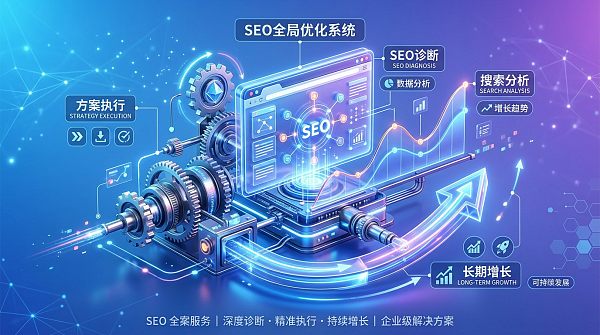
If you can only look at one thing first, it should be this: whether the company can understand your business goals, rather than focusing only on keyword rankings.
When screening website SEO optimization companies, many enterprises are easily attracted by claims such as “first-page rankings,” “fast keyword ranking,” and “low annual package price.” But truly prudent cooperation starts with seeing whether the other party can tie SEO to your business scenario. For example:
- Is your website intended for customer acquisition, or for brand exposure?
- Do your core customers come from the local market, nationwide, or even overseas?
- Are your target users searching for product keywords, solution keywords, or problem-based keywords?
- Do you need short-term results more, or long-term accumulation of organic traffic assets?
If a service provider, during early communication, only talks about “how many keywords can be done” but does not ask about industry competition, user search paths, the current state of the website, and conversion goals, then it is highly likely that they can only provide standardized execution and will find it difficult to truly improve business results.
For business decision-makers, what matters more is confirming whether SEO investment can ultimately be converted into inquiries, leads, orders, and brand trust, rather than just remaining in the reporting data.
How can you judge whether an SEO company’s service capability is the “real deal”?
To judge service capability, you cannot just look at how professionally the promotional page is written; you need to see whether the company has a complete methodology and implementation capability. Usually, you can assess this from the following aspects:
1. Whether it has systematic diagnostic capability
A reliable website SEO optimization company usually conducts a website diagnosis first and then proposes a plan, rather than quoting a price right away. They will evaluate:
- Whether the website structure is conducive to crawling and indexing
- Whether page content matches search intent
- Whether the layout of core keywords is reasonable
- Whether on-site technical issues affect rankings
- Whether backlinks and brand exposure are weak
- Whether current traffic has the ability to support conversions
If there is not even a basic diagnosis, subsequent optimization is usually difficult to refine.
2. Whether it can provide a clear website SEO optimization plan
A truly professional plan is not just a few pages of template PPT, but one that can answer the following questions:
- Which keywords should be targeted first, and why
- Which sections and pages should be optimized first
- How content development should be carried out and how frequently it should be arranged
- Which areas require technical optimization
- How phased goals should be set
- What changes are expected to be seen and in how much time
A good website SEO optimization plan should help management understand the investment logic, help the execution team know how to move things forward specifically, and help after-sales maintenance or technical support personnel understand what support work they need to undertake.
3. Whether it has cross-functional collaboration capability
Today’s SEO is no longer as simple as “publishing articles and building backlinks.” Truly valuable service providers can usually connect website building, content, technology, data analysis, conversion optimization, social media, and advertising into one integrated workflow.
For example, integrated website and marketing service providers like Easy-Biz Information Technology (Beijing) Co., Ltd., which have been deeply engaged in the field for more than ten years, derive their value not only from single-point SEO execution, but from being able to rely on artificial intelligence and big data capabilities to provide full-chain support from intelligent website building to SEO optimization, social media marketing, and advertising placement. For enterprises seeking long-term growth, this is usually a more prudent choice than standalone SEO outsourcing.
What are the most common pitfalls for enterprises?
When choosing a website SEO optimization company, the common risks are actually quite concentrated. As long as you identify them in advance, you can avoid many ineffective investments.
1. Overpromising ranking timelines
SEO is affected by many factors such as industry competition, website foundation, content quality, and search engine algorithms, so no one can give an absolute time guarantee for all keywords. Anyone who immediately promises “first page in 7 days” or “results in 30 days” should be treated with special caution.
2. Only quoting a low price without discussing strategy
A low price often means template-based services, mass-produced content, crude backlink building, and even the risk of non-compliant optimization. There may be short-term fluctuations, but long-term ranking stability is poor, and it may also affect the overall authority of the website.
3. Cases look plentiful but cannot be verified
Some companies display a large number of “successful cases,” but cannot explain the client’s industry, optimization cycle, core actions, and final conversion results. A prudent approach is to require the other party to provide at least verifiable case logic, rather than just screenshots.
4. Focusing only on traffic, not conversions
Some SEO companies can bring some traffic, but the keywords are inaccurate and the landing pages perform poorly, resulting in no inquiries in the end. For enterprises, this kind of service that “looks good in the data” is actually of limited value.
5. Slow response and weak execution after cooperation begins
SEO is continuous work, not a one-time delivery. Content updates, page adjustments, data reviews, and strategy revisions all require long-term cooperation. If the service team communicates slowly, gives feedback slowly, and is difficult to get revisions from, the enterprise will become very passive internally.
When reviewing cases, do not just look at rankings; look at these 4 results
Many enterprises ask: “Is it better to have more cases?” Actually, not necessarily. The key to reviewing cases is whether they are relevant and on the right track.
1. Look at industry similarity
If your business is a ToB service-oriented enterprise, but the other party is only good at optimizing consumer goods or content websites, the reference value is limited. Industry similarity means they better understand user search paths and conversion logic.
2. Look at keyword quality
Do not just look at whether there are rankings; look at whether these keywords are ones your target customers would actually search for and convert through. Precise keywords are usually more valuable than broad traffic keywords.
3. Look at whether traffic growth is sustainable
A short-term spike does not mean long-term effectiveness. A more prudent case should show growth in indexation, stable core keyword rankings, accumulation of content assets, and continuous improvement in organic traffic.
4. Look at whether there are business results to support it
The most valuable cases for reference are not just “ranking improvement,” but “increased inquiries, improved lead quality, reduced customer acquisition costs, and increased branded search volume.” These results are closer to the returns enterprises truly care about.
What are the different points of focus for different roles when choosing an SEO service provider?
Within the same company, different roles do not evaluate SEO companies by exactly the same standards. If the evaluation dimensions can be aligned during selection, communication will be more efficient.
Business decision-makers
They pay more attention to input-output ratio, service stability, risk controllability, and long-term growth potential. They need to know whether this budget, once spent, can form sustainable organic traffic assets.
Users/operators
They care more about whether the plan is clear, whether execution has a rhythm, whether the data is transparent, and whether communication is smooth. This is because during actual implementation, they often take on work such as coordination, submitting materials, and following up on page adjustments.
After-sales maintenance or technical personnel
They pay more attention to whether website changes will be complicated, whether they will affect system stability, what technical optimizations need to be supported, and whether the service provider puts forward reasonable rather than vague technical requirements.
Dealers, agents, and distribution partners
They place greater importance on brand exposure and regional traffic support. If the enterprise needs nationwide or multi-regional deployment, it is important whether the SEO company has localized keyword strategies and multi-site planning capabilities.
End-consumer perspective
Although they are not the direct purchasers of SEO services, what ultimately determines SEO effectiveness is still user experience. If the optimized website content is empty, the pages are hard to use, and the information is not trustworthy, then no amount of traffic will be easy to convert.
What should a prudent website SEO optimization partnership usually include?
If you are comparing multiple website SEO optimization companies, you can use the following checklist for reference. The more complete it is, the more controllable the cooperation usually becomes:
- Website status diagnostic report
- Keyword research and search intent analysis
- Competitor analysis
- On-site structure optimization recommendations
- Page SEO specifications and TDK strategy
- Content planning and update mechanism
- Indexation, ranking, and traffic monitoring mechanism
- Conversion path optimization recommendations
- Monthly or phased review reports
- Clear project owner and response mechanism
If the plan content you receive is very vague, or if you can only see expressions such as “publishing articles, building backlinks, and reporting rankings,” then you should be more alert.
When evaluating suppliers, similar enterprises can also refer to some methodologies related to risk control and internal management. For example, in terms of improving management mechanisms, some organizations may draw on research ideas such as Research on the Construction of an Internal Control System for Public Institutions Based on Risk Prevention and Control, incorporating project selection, execution supervision, and process evaluation into a more standardized decision-making framework, which can also provide some inspiration for controlling the risks of SEO outsourcing cooperation.
If you want long-term ranking improvement, what else does the enterprise itself need to do?
Even the most professional website SEO optimization company cannot independently deliver all results without the enterprise itself. If you want rankings to be more stable and results to last longer, the enterprise usually needs to do the following things well:
- Provide authentic and professional product and service information
- Cooperate in supplementing cases, Q&A, and industry content materials
- Provide timely support for website page adjustments and technical modifications
- Clarify core conversion goals, such as forms, phone calls, and consultation entry points
- Give SEO a reasonable cycle, and do not negate a long-term strategy because of short-term fluctuations
SEO is essentially a continuous optimization process. Truly prudent cooperation does not mean completely “handing the project over to outsourcing,” but rather allowing the service provider and the enterprise team to form a collaborative relationship.
Finally, how exactly should you choose a website SEO optimization company more prudently?
In summary, a prudent selection standard can be summed up in one sentence: choose a company that can bring long-term business value and whose process is transparent and controllable, rather than a company that only knows how to promise rankings.
Specifically, it is recommended to prioritize these 5 points:
- Whether it truly understands your industry, customers, and business goals
- Whether it can provide a clear and executable website SEO optimization plan
- Whether it has real cases and long-term ranking improvement experience
- Whether it values traffic quality and conversions, rather than only surface-level rankings
- Whether it has the capability for continuous service, review, and collaboration
If a website SEO optimization company understands not only search engine rules, but also website construction, content strategy, data analysis, and marketing conversion, then the cooperation will usually be more stable, and it will also be easier to truly turn SEO investment into enterprise growth.
For enterprises, choosing an SEO service provider is not about choosing “who speaks better,” but about choosing “who is more suitable for creating results together in the long term.” Bring your evaluation dimensions back to business value, execution capability, and risk control, and you will be more likely to make a prudent decision.
Related Articles



Related Products
 EasyCamp SaaS Smart Website Marketing SystemE-Yingbao SaaS Smart Website Marketing System: AI-powered, zero-code website building. Rapidly launch multilingual independent e-commerce sites in just 10 minutes. Global server acceleration and AI-driven SEO optimization empower businesses to efficiently connect with global markets. The seamless integration of technology and user-friendly operation makes building e-commerce sites incredibly simple.
 AI+SEM Intelligent Advertising Marketing SystemAI+SEM drives intelligent ad creation, empowering full-funnel precision advertising marketing. The system automatically generates weekly/monthly reports, AI recommends keywords and target countries, monitors core metrics in real-time with intelligent alerts, and enables one-click high-conversion ad solutions to help quickly acquire customers and improve ROI.
 AI+SEO Dual Engine Optimization ServiceEasyWin AI+SEO Dual Engine Optimization System leverages AI-powered keyword mining, content generation, and comprehensive technical optimization to help foreign trade enterprises acquire high-quality organic traffic, significantly improving search rankings and conversion rates.
 AI+SNS Social Media Marketing SystemYingbao AI+SNS Social Media Marketing System - Precision social capture for the social media era. Supports one-click content synchronization across major platforms like Facebook and LinkedIn. AI intelligently rewrites posts for enhanced relevance. 24/7 AI customer service and user profiling analysis empower businesses to efficiently expand into global markets.
 AI+SEO营销解决方案易营宝AI+SEO营销解决方案,通过AI批量写作、智能生成TDK、精准关键词扩词等功能,全面优化网站SEO效果,提升流量与转化率。助力企业构建高效智能网站新生态。
 AI+SEM Advertising Marketing SolutionsAI+SEM Advertising Marketing Solution leverages AI technology to deeply empower SEM ad campaigns. It automatically generates weekly/monthly reports using AI, presenting account data across multiple dimensions for comprehensive insights into campaign performance and trends. The system precisely recommends keywords and target countries, intelligently generates high-conversion ad copy, and enables one-click activation of efficient campaign plans to help businesses rapidly acquire customers. Simultaneously, it monitors core metrics in real time, intelligently identifies abnormal fluctuations, and issues timely alerts to ensure stable, high-return advertising results.
 Domain Name ServicesEasyWin provides professional domain name services, including intelligent queries, one-stop registration, brand protection, and full lifecycle management, helping businesses build a digital brand image.
 EasyOperate B2C Cross-Border E-Commerce Platform & Independent WebsiteEasyStore B2C Cross-border E-commerce Independent Store is an intelligent website building and cross-border e-commerce integrated solution independently developed by EasyStore Information Technology (Beijing) Co., Ltd. The system is specially designed for small and medium-sized as well as large export enterprises, integrating 'website building, operation, marketing, advertising, and conversion' into one, helping enterprises quickly establish cross-border e-commerce independent stores to achieve brand globalization and global sales growth.
The platform supports multiple languages, multiple currencies, and multi-channel marketing, with built-in AI intelligent translation and SEO optimization systems, suitable for mainstream markets such as Southeast Asia, Europe and America, Latin America, and the Middle East, assisting Chinese manufacturing enterprises in efficiently deploying international e-commerce strategies. SSL证书易营宝提供专业SSL安全证书服务,包括单域名和泛域名证书,确保网站数据传输加密、身份验证和完整性保护,助力企业建立安全可信的在线业务环境。









