









- What stages does the cross-border services ecosystem include? How do website building, promotion, payment, and compliance work togetherJun 22, 2026View details
- How will email marketing costs change in 2026Jun 22, 2026View details
- The China-US tariff arrangement has reached a preliminary consensus, and the trade association will be establishedJun 15, 2026View details
- Should overseas brand marketing start with ads or contentJun 21, 2026View details
- What determines B2C cross-border e-commerce website development costs? A breakdown of features, interfaces, and deployment methodsJun 17, 2026View details
- China-Morocco zero-tariff access, a breakthrough in the cost of Moroccan goods exports to ChinaJun 11, 2026View details
Is AI-Powered Multilingual E-commerce Website Building Reliable? Three Key Risks Project Managers Should Monitor: Content Accuracy, Brand Consistency, and Multilingual SEO Adaptation
Is AI-powered multilingual foreign trade website construction reliable? Project managers are most concerned with three major risk points: content accuracy, brand consistency, and multilingual SEO adaptation. YINGBAO AI website building system specializes in rapid multilingual foreign trade website deployment with global server coverage, integrating AI translation, automated TDK generation and SEO optimization to help enterprises achieve efficient compliance in overseas expansion.
1. Content Accuracy: AI Translation ≠ Machine Literal Translation, Professional Language is the Cornerstone of Trust
In cross-border operations, any ambiguity or mistranslation in product descriptions, compliance statements, or after-sales terms may lead to customer complaints at best, or trigger platform takedowns and legal disputes at worst. Project managers commonly worry: Does AI-generated multilingual content possess industry terminology precision, cultural adaptation, and legal rigor? YINGBAO's intelligent website system adopts a "three-tier verification mechanism"—first layer employs NLP-driven contextual translation engines with 32 vertical domain lexicons covering technical parameters, financial jargon, and medical regulations; second layer incorporates native-language API audits by certified translators across 18 languages including German, French, Spanish, Japanese, and Arabic; final layer embeds semantic consistency detection to automatically compare source and translated texts in logical structure, emotional tone, and key information density. Real-world data shows this mechanism maintains core page translation error rates below 0.7%, far outperforming the industry average of 4.2%. For manufacturing clients, the system automatically flags sensitive fields like "CE certification" and "RoHS compliance", linking to overseas legal databases for localized regulatory prompts.
Critically, YINGBAO provides no "black box" translation—all translations are traceable to source sentences, with modification records and audit trails, fulfilling ISO 9001's document traceability requirements. This closed-loop technology earns high recognition from procurement officers and quality control teams.

2. Brand Consistency: Global Unified Experience from Visual Language to Interaction Logic
Multilingual sites that merely swap languages risk "same-site-different-face" pitfalls: English CTA buttons may appear assertive while Japanese versions seem vague; German users expect multi-step forms whereas Brazilian markets prefer one-page submissions. Such fragmentation damages professional branding. YINGBAO's AI system features "Brand DNA Mapping", uploading VI manuals, UX guidelines, and historical heatmaps to generate cross-lingual visual libraries (button styles, typography hierarchy, motion rhythms) and interaction templates. For instance, "立即询盘" ("Instant Inquiry") automatically becomes "Jetzt unverbindlich anfragen" ("Free Consultation Now") in German—retaining call-to-action urgency while aligning with local decision-making psychology.
Addressing Shenzhen's multilingual website demands, the platform enhances B2B industrial component adaptation: product specs auto-convert units (mm/inch/kgs/lbs), certification icons load dynamically per local standards (UL/CE/PSE), and default customer portals integrate regional tools (WhatsApp/Line/WeChat). This deep localization maintains global "one-brand" coherence beyond template uniformity.
3. Multilingual SEO Adaptation: Beyond Keyword Translation to Global Search Intent Decoding
Multilingual SEO optimization transcends simple TDK replacement. For "industrial laser cutter", Spanish searches favor "cortadora láser industrial" while Japanese users prefer "産業用レーザー切断機" over direct translation. YINGBAO's marketing engine leverages billion-level global search data pools, building "intent-region-device" keyword models: identifying real user behavior on Google, Yandex, and Bing, combined with mobile traffic share, long-tail heat, and competition intensity across 12 dimensions to generate differentiated SEO strategies. The system produces 1,200+ multilingual TDK sets daily, validated through A/B click-through tests.
Notably, the platform solves technical pain points: auto-generating hreflang tag clusters, intelligently prioritizing multilingual sitemaps, and dynamically adapting CDN caching. Third-party tests show YINGBAO-deployed sites achieve 35% higher core keyword rankings and 40% faster loading speeds than traditional solutions—critical ROI metrics for performance-driven decision-makers.
4. Full-Chain Collaboration: Trustworthy Delivery from Construction to Growth
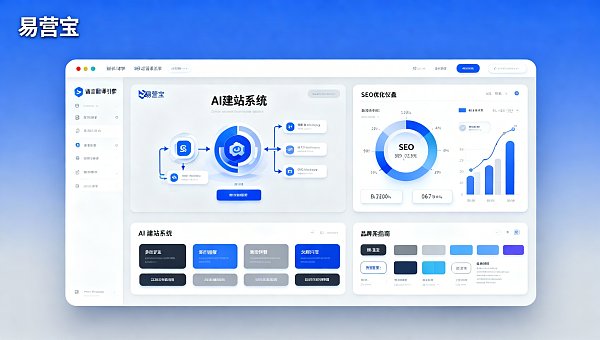
As a China SaaS top 100 member serving 100,000+ enterprises, YINGBAO's multilingual website capabilities withstand rigorous validation. Beyond being a Google Premier Partner, Meta official agent, and Yandex core partner, we maintain tech hubs across China, the US, and Singapore with 7×12 multilingual ticket response. Our "dual-track acceptance" combines AWS-Aliyun performance stress tests with third-party language agency audits—ensuring transparent quality boundaries.
For complex procurement, YINGBAO offers transparent pricing: base packages include AI translation and SEO diagnostics; premium modules like AI ad managers (Google/Yandex/Meta cross-platform) and creative factories (200+ high-CTR ad creatives daily) follow pay-as-you-go billing. We also provide startup financing strategies from angel investor perspectives to help tech teams plan digital infrastructure investments.
Conclusion: Choosing AI Website Building Means Choosing Trustworthy Growth Partners
Is multilingual foreign trade AI website building reliable? The answer lies not in technical specs but systematic resolution of core concerns—content fidelity, brand integrity, and SEO coherence. Drawing on decade-long industry沉淀, YINGBAO deeply integrates AI with real trade scenarios: from Shenzhen-based multilingual website execution to global server clusters; from content distribution to ad performance attribution. This isn't a toolset, but a 100,000-case-validated growth methodology.
If evaluating multilingual website construction or seeking reliable suppliers for customized SEO solutions, contact us immediately for a专属 Multilingual Foreign Trade Website Rapid Deployment Feasibility Assessment.
- Website Development
- Foreign Trade Website Development
- Social Media Marketing
- SEO diagnosis
- Google Ads
- SEO for Foreign Trade Websites
- SEO Optimization Solutions
- Yiyingbao
- SEO
- Smart website builder system
- SEO Optimization
- Smart Website Building
- AI Translation
- EasySite Intelligent Website Builder
- AI Marketing Engine
- Website SEO Optimization
- AI Website Building
- EYB AI Marketing
- AI Marketing
- Multilingual Foreign Trade Website
Related Articles
 India soybean export tax post, compliance label as foreign trade site front-end item
 What Can You Learn in AI Website Building Training? Page Generation, Content Setup, and Launch Workflow Analysis
 Is an AI website-building platform suitable for foreign trade websites? Analysis of functional boundaries and applicable scenarios

Related Products
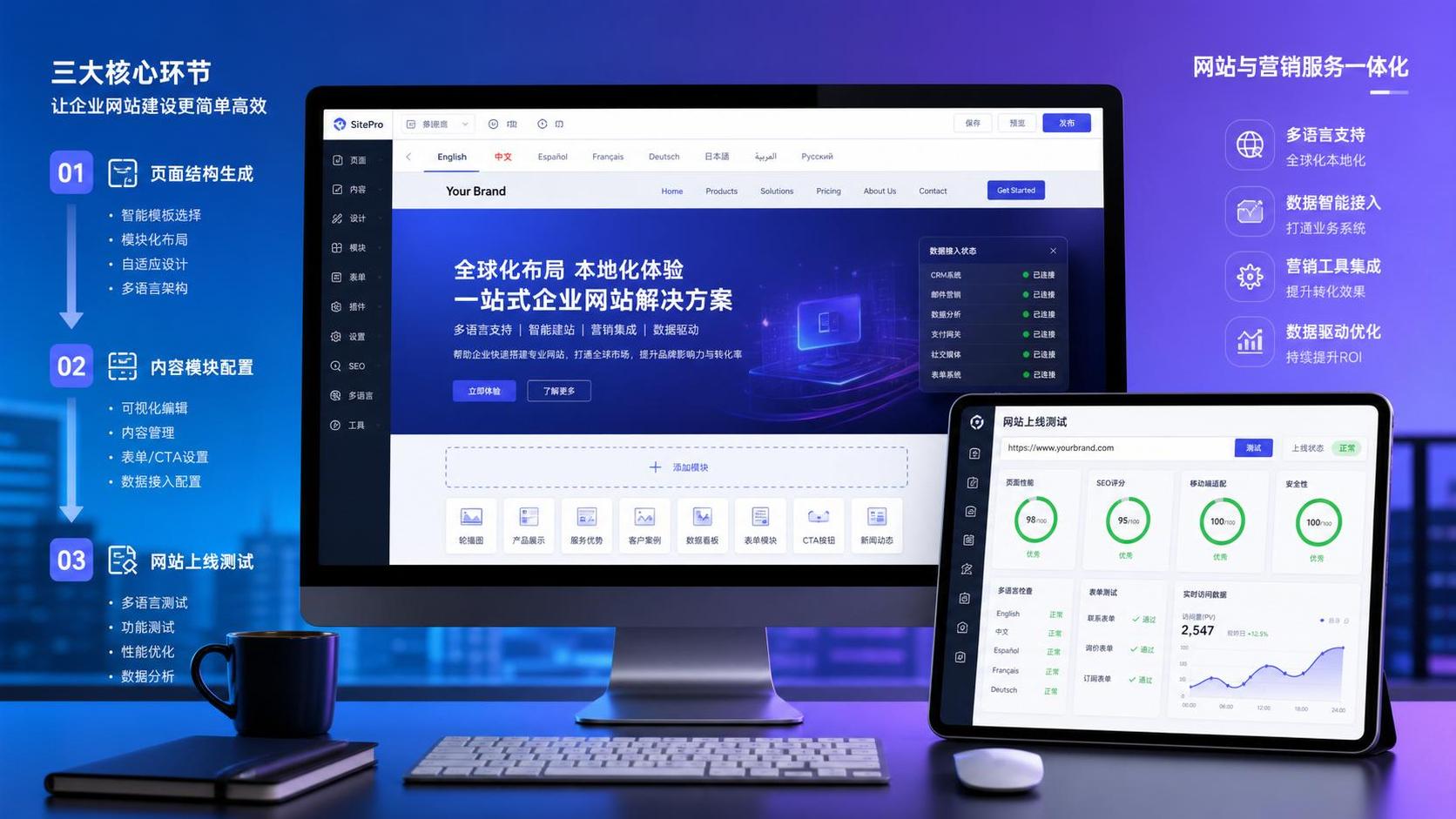
 EasyCamp SaaS Smart Website Marketing SystemE-Yingbao SaaS Smart Website Marketing System: AI-powered, zero-code website building. Rapidly launch multilingual independent e-commerce sites in just 10 minutes. Global server acceleration and AI-driven SEO optimization empower businesses to efficiently connect with global markets. The seamless integration of technology and user-friendly operation makes building e-commerce sites incredibly simple.
 AI+SEM Intelligent Advertising Marketing SystemAI+SEM drives intelligent ad creation, empowering full-funnel precision advertising marketing. The system automatically generates weekly/monthly reports, AI recommends keywords and target countries, monitors core metrics in real-time with intelligent alerts, and enables one-click high-conversion ad solutions to help quickly acquire customers and improve ROI.
 AI+SEO Dual Engine Optimization ServiceEasyWin AI+SEO Dual Engine Optimization System leverages AI-powered keyword mining, content generation, and comprehensive technical optimization to help foreign trade enterprises acquire high-quality organic traffic, significantly improving search rankings and conversion rates.
 AI+SNS Social Media Marketing SystemYingbao AI+SNS Social Media Marketing System - Precision social capture for the social media era. Supports one-click content synchronization across major platforms like Facebook and LinkedIn. AI intelligently rewrites posts for enhanced relevance. 24/7 AI customer service and user profiling analysis empower businesses to efficiently expand into global markets.
 AI+SEO营销解决方案易营宝AI+SEO营销解决方案,通过AI批量写作、智能生成TDK、精准关键词扩词等功能,全面优化网站SEO效果,提升流量与转化率。助力企业构建高效智能网站新生态。
 AI+SEM Advertising Marketing SolutionsAI+SEM Advertising Marketing Solution leverages AI technology to deeply empower SEM ad campaigns. It automatically generates weekly/monthly reports using AI, presenting account data across multiple dimensions for comprehensive insights into campaign performance and trends. The system precisely recommends keywords and target countries, intelligently generates high-conversion ad copy, and enables one-click activation of efficient campaign plans to help businesses rapidly acquire customers. Simultaneously, it monitors core metrics in real time, intelligently identifies abnormal fluctuations, and issues timely alerts to ensure stable, high-return advertising results.
 Domain Name ServicesEasyWin provides professional domain name services, including intelligent queries, one-stop registration, brand protection, and full lifecycle management, helping businesses build a digital brand image.
 EasyOperate B2C Cross-Border E-Commerce Platform & Independent WebsiteEasyStore B2C Cross-border E-commerce Independent Store is an intelligent website building and cross-border e-commerce integrated solution independently developed by EasyStore Information Technology (Beijing) Co., Ltd. The system is specially designed for small and medium-sized as well as large export enterprises, integrating 'website building, operation, marketing, advertising, and conversion' into one, helping enterprises quickly establish cross-border e-commerce independent stores to achieve brand globalization and global sales growth.
The platform supports multiple languages, multiple currencies, and multi-channel marketing, with built-in AI intelligent translation and SEO optimization systems, suitable for mainstream markets such as Southeast Asia, Europe and America, Latin America, and the Middle East, assisting Chinese manufacturing enterprises in efficiently deploying international e-commerce strategies. SSL证书易营宝提供专业SSL安全证书服务,包括单域名和泛域名证书,确保网站数据传输加密、身份验证和完整性保护,助力企业建立安全可信的在线业务环境。









