









- Will GEO change its SEO strategy?Jun 04, 2026View details
- What types of businesses are end-to-end solutions suitable for?Jun 03, 2026View details
- 2026 Global Growth Channel TrendsJun 02, 2026View details
- Changes in Search Engine Ranking Factors in 2026Jun 06, 2026View details
- Which stages is the brand visibility enhancement service suitable forMay 29, 2026View details
- What Are the Key Modules of International Digital Marketing ServicesMay 29, 2026View details
How to Choose a Portuguese-Language Independent Website Building Platform in 2024? Cost and Delivery Cycle Comparison of 3 Mainstream Service Providers
In 2024, how can B2B foreign trade enterprises targeting the Portuguese-speaking market efficiently establish a Portuguese-language independent website construction platform? This article compares the performance of three mainstream service providers in terms of cost, delivery cycle, and SEO optimization tools, with a focus on analyzing how EasyYunbao SAAS website construction leverages AI-driven technology, multilingual support, and fully managed SSL certificates to provide high-conversion foreign trade independent website solutions.
Why is the Portuguese-speaking market becoming a new engine for B2B foreign trade growth?
According to Statista's 2024 data, Brazil, with a population of over 212 million and a GDP of $1.6 trillion, ranks as the largest economy in Latin America; Portugal, though smaller in scale, serves as a gateway to the EU and a bridge to Portuguese-speaking African countries, with its digital trade penetration rate maintaining a 12.7% compound growth rate for three consecutive years. More crucially, Portuguese-speaking users exhibit longer online purchasing decision chains and higher trust thresholds—meaning a professional, localized, and trustworthy Portuguese-language independent website is no longer a "nice-to-have" but a foundational facility for B2B enterprises entering this market.
However, the challenges are stark: traditional website service providers often equate Portuguese localization with mere "translation + font replacement," overlooking RTL adaptation, embedded tax compliance fields, integration with local payment gateways (e.g., PicPay, Mercado Pago), and the semantic nuances of Google Ads keyword targeting in Portuguese. Truly B2B-oriented service providers must simultaneously address four core challenges: technical delivery, language localization, SEO compliance, and long-term operational sustainability.
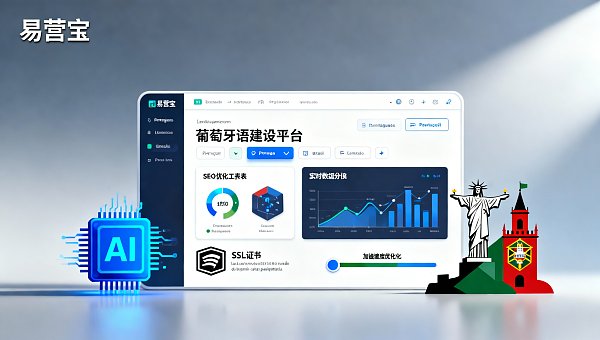
Horizontal comparison of three mainstream Portuguese-language independent website construction platforms
We selected three representative service providers most used by Chinese export enterprises: global SaaS platforms (Wix/Shopify), regional localized website companies (headquartered in Lisbon/São Paulo), and China-based tech service providers specializing in integrated digital marketing (represented by EasyYunbao), conducting an in-depth comparison across key metrics:
EasyYunbao SAAS Website Construction: A Portuguese-language independent website service provider tailored for B2B foreign trade
Unlike generic tools or pure local service providers, EasyYunbao treats "B2B foreign trade marketing website construction" as a systematic engineering project. Its intelligent website system deeply integrates foreign trade business scenarios: homepage-embedded RFQ forms, product pages supporting multi-unit conversions (kg/lb/m³), inquiry systems directly linked to WhatsApp Business API (certified by Brazil's telecom regulator Anatel), and pre-configured EU GDPR and Brazil LGPD compliance pop-up modules.
The language engine is particularly critical—EasyYunbao doesn’t simply call Google Translate API but relies on NLP models trained on a vertical Portuguese corpus (covering machinery, chemicals, building materials, and 20+ high-frequency export industries), ensuring terminology consistency, cultural taboo filtering (e.g., avoiding colonial-era sensitive terms), and localized sentence structure reconstruction. Coupled with global CDN nodes, Portuguese-language independent websites achieve 40% faster loading speeds and 35% higher SEO scores, significantly outperforming industry averages.
Additionally, as a Google Premier Partner and Meta official agent, EasyYunbao directly accesses Portuguese-market-specific ad data interfaces, offering clients "website-SEO-social media-ads" full-funnel synergy. For example, within three days of launch, clients can initiate Facebook Portuguese precision audience targeting (modeled on Brazil's SEBRAE enterprise database) while synchronizing LinkedIn Portuguese whitepaper downloads, forming a B2B lead nurturing closed loop.
Beyond Portuguese: Global infrastructure capabilities for multilingual expansion
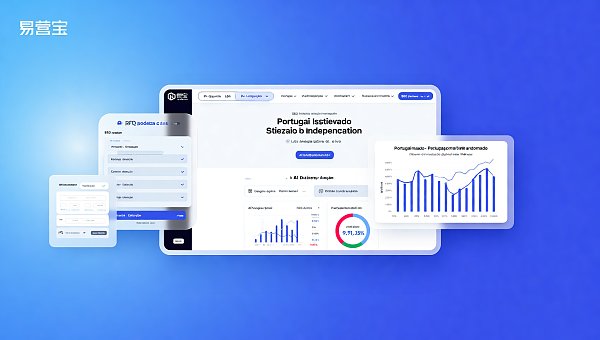
For B2B enterprises simultaneously targeting the Middle East, Latin America, and Southeast Asia, single-language websites no longer suffice. EasyYunbao has built a "one-core, multi-wing" multilingual architecture: a single backend manages Chinese, English, Portuguese, Spanish, Arabic, French, and German sites, sharing product libraries, client data, and SEO assets. Its Arabic industry website construction and marketing solutions exemplify this—supporting RTL layouts and Arabic numeral compatibility while integrating Middle Eastern social media strategies, Google Ads Arabic keyword optimization, and first-year website maintenance services, achieving the same delivery efficiency and localization depth as Portuguese sites.
This capability stems from its tech stack: 12 annual algorithm iterations, 15 AI core patents, and access to global search and social media data, enabling dynamic identification of traffic patterns across languages (e.g., Brazil's "Black Friday" search surges vs. Saudi B2B procurement slowdowns during Ramadan), thereby reverse-optimizing website structures and content strategies.
Choosing a Portuguese-language independent website platform is fundamentally choosing a long-term growth partner
Delivery cycles and initial costs are just the starting point. The real test lies in: when Brazilian clients submit inquiries at 3 AM, can the system automatically trigger Portuguese email + WhatsApp alerts? When Google updates Core Web Vitals weighting, does the platform offer second-level diagnostics and fixes? When expanding to the UAE, can existing Portuguese sites reuse underlying frameworks for rapid Arabic version deployment?
EasyYunbao, with the mission of "making the world a path for Chinese brands," has served over 100,000 enterprises with an average annual growth rate exceeding 30%, earning a spot among "China's Top 100 SaaS Enterprises." Its B2B foreign trade marketing website capabilities—through fully managed SSL certificates, AI-driven SEO tools, multilingual localization engines, and global traffic ecosystem integration—have formed an unparalleled tech moat.
If you're seeking a Portuguese-language independent website service provider with technical prowess, localization depth, and long-term partnership capabilities, contact us now to receive exclusive "Foreign Trade Independent Website Construction Solutions" and a free Portuguese SEO health diagnostic report.
- Website Development
- SSL Certificate
- Independent Foreign Trade Website Construction
- Google Ads
- Keyword Optimization
- B2B Foreign Trade
- SEO Optimization Tools
- Standalone website development
- Yiyingbao
- SEO
- Independent Website
- Smart website builder system
- SEO Optimization
- Smart Website Development
- Independent foreign trade website
- Global Traffic Ecosystem
- Foreign Trade Independent Website Construction Solution
- EasyStore SAAS Website
- Global Digital Marketing
- AI Website Building
- Portuguese Standalone Website Development
Related Articles

Related Products
 EasyCamp SaaS Smart Website Marketing SystemE-Yingbao SaaS Smart Website Marketing System: AI-powered, zero-code website building. Rapidly launch multilingual independent e-commerce sites in just 10 minutes. Global server acceleration and AI-driven SEO optimization empower businesses to efficiently connect with global markets. The seamless integration of technology and user-friendly operation makes building e-commerce sites incredibly simple.
 AI+SEM Intelligent Advertising Marketing SystemAI+SEM drives intelligent ad creation, empowering full-funnel precision advertising marketing. The system automatically generates weekly/monthly reports, AI recommends keywords and target countries, monitors core metrics in real-time with intelligent alerts, and enables one-click high-conversion ad solutions to help quickly acquire customers and improve ROI.
 AI+SEO Dual Engine Optimization ServiceEasyWin AI+SEO Dual Engine Optimization System leverages AI-powered keyword mining, content generation, and comprehensive technical optimization to help foreign trade enterprises acquire high-quality organic traffic, significantly improving search rankings and conversion rates.
 AI+SNS Social Media Marketing SystemYingbao AI+SNS Social Media Marketing System - Precision social capture for the social media era. Supports one-click content synchronization across major platforms like Facebook and LinkedIn. AI intelligently rewrites posts for enhanced relevance. 24/7 AI customer service and user profiling analysis empower businesses to efficiently expand into global markets.
 AI+SEO营销解决方案易营宝AI+SEO营销解决方案,通过AI批量写作、智能生成TDK、精准关键词扩词等功能,全面优化网站SEO效果,提升流量与转化率。助力企业构建高效智能网站新生态。
 AI+SEM Advertising Marketing SolutionsAI+SEM Advertising Marketing Solution leverages AI technology to deeply empower SEM ad campaigns. It automatically generates weekly/monthly reports using AI, presenting account data across multiple dimensions for comprehensive insights into campaign performance and trends. The system precisely recommends keywords and target countries, intelligently generates high-conversion ad copy, and enables one-click activation of efficient campaign plans to help businesses rapidly acquire customers. Simultaneously, it monitors core metrics in real time, intelligently identifies abnormal fluctuations, and issues timely alerts to ensure stable, high-return advertising results.
 Domain Name ServicesEasyWin provides professional domain name services, including intelligent queries, one-stop registration, brand protection, and full lifecycle management, helping businesses build a digital brand image.
 EasyOperate B2C Cross-Border E-Commerce Platform & Independent WebsiteEasyStore B2C Cross-border E-commerce Independent Store is an intelligent website building and cross-border e-commerce integrated solution independently developed by EasyStore Information Technology (Beijing) Co., Ltd. The system is specially designed for small and medium-sized as well as large export enterprises, integrating 'website building, operation, marketing, advertising, and conversion' into one, helping enterprises quickly establish cross-border e-commerce independent stores to achieve brand globalization and global sales growth.
The platform supports multiple languages, multiple currencies, and multi-channel marketing, with built-in AI intelligent translation and SEO optimization systems, suitable for mainstream markets such as Southeast Asia, Europe and America, Latin America, and the Middle East, assisting Chinese manufacturing enterprises in efficiently deploying international e-commerce strategies. SSL证书易营宝提供专业SSL安全证书服务,包括单域名和泛域名证书,确保网站数据传输加密、身份验证和完整性保护,助力企业建立安全可信的在线业务环境。









