









How to build a foreign trade independent website? Technical structure, cost and online cycle details

Want to know how to build a foreign trade independent website and increase overseas traffic? This article details the technical architecture, costs, and launch timeline, covering the advantages and essential features of multilingual websites to help you make decisions and implement.
For users, business decision-makers, and project managers, the core pain points of building a foreign trade independent website focus on three aspects: global access speed and security, content and multilingual management efficiency, and the time and cost control from site construction to production. Many companies ask, "Why should foreign trade companies build independent websites?" and "What are the differences between foreign trade independent websites and platform stores?" This article addresses both operational and technical aspects, considering post-sales maintenance and distribution channel needs, providing actionable technical architecture recommendations, cost estimates, and typical launch timelines to offer a clear roadmap and implementation points for your decision on "How to build a foreign trade independent website?".
Why Build an Independent Website: Platform Comparison and Business Value
A foreign trade independent website does not replace platform stores but complements branding and data autonomy as a key link. Platform stores excel in traffic pools and transaction convenience but face issues like fluctuating traffic costs, strong algorithm dependency, and weak brand presence. In contrast, independent websites offer higher user retention, more comprehensive conversion paths, and controllable SEO strategies. When answering "What are the differences between foreign trade independent websites and platform stores?", focus on three metrics: traffic controllability (search and owned channels), conversion efficiency (page speed and path optimization), and data and compliance (order and user data control). From a business value perspective, independent websites help reduce long-term CPC, increase repurchase rates, and build brand assets. For distributors and agents, independent websites also serve as unified product information databases and authorized display windows, aiding channel management and localized promotion. When evaluating "Why should foreign trade companies build independent websites?", balance short-term ROI with long-term brand gains, aligning with existing resources and international market goals to prioritize launch features.
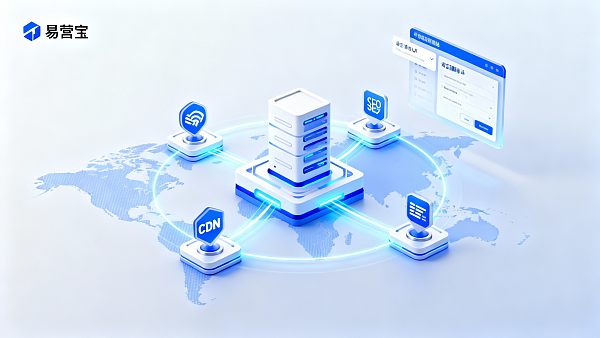
Technical Architecture and Global Deployment: Performance, Security, and Maintainability
To build a scalable foreign trade independent website, the technical architecture should focus on four layers: edge acceleration and hosting (CDN/edge computing), application layer (frontend frameworks and SEO-friendly rendering), data and API layer (APIs and third-party services), and operations and security (backups, WAF, DDoS protection). Specific configuration recommendations include: using HTTP/3 and lightweight enterprise-grade web servers to reduce TTFB and improve concurrency; configuring automatic SSL, daily backups, and financial-grade encryption to meet compliance; ensuring multi-region availability and low latency via intelligent routing and load balancing. In actual deployment, choosing nodes covering multiple continents significantly improves user experience. For example, global deployment across seven server nodes can keep access latency for most regions within acceptable ranges, with TTFB targets ≤300ms to benefit search engine crawl frequency. In production, modularize third-party payment, logistics, and social media APIs for seamless testing and production integration. To enhance attack resistance and stability, integrate intelligent DDoS protection and 99.99% SLA-guaranteed service solutions for quick post-sales response and failover.
Multilingual and Content Strategy: Benefits for SEO and Localization
Questions like "Are multilingual websites beneficial for SEO? How many languages are typically needed? How to manage multilingual content? Can AI translation be relied upon? How to boost overseas traffic with multilingual sites?" require market and operational considerations. Multilingual sites naturally excel in semantic search and localized display, with proper implementation improving keyword coverage and user relevance for organic traffic growth. Typically, start with the target market's dominant languages (e.g., English, Spanish, Portuguese, or Russian), adopting a "core first, expand later" strategy—initially covering 3–5 languages for primary markets, then expanding to long-tail languages based on data. For content management, centralized CMS (supporting multilingual versions and rollbacks) ensures consistency and SEO-friendly URL structures. For translation, AI excels in draft and bulk content with high efficiency and low cost but still requires human localization for industry terms and cultural nuances. Thus, the answer to "Can multilingual website translation rely solely on AI?" is: it can be a primary tool but not fully replace human review. To boost overseas traffic, combine multi-channel strategies: localized SEO, cross-border ads, social media matrix operations, and high-quality content output for sustained traffic and inquiry growth.

Cost Estimates, Launch Timelines, and Essential Features
When answering "How to build a foreign trade independent website?", budget and timelines are critical. Standard budgets fall into three tiers: Basic (quick launch, focused on display and inquiries): ~¥30k–80k, supporting 1–2 languages, 2–4 weeks launch; Growth (e-commerce and marketing integrations, multi-language and multi-channel support): ~¥80k–300k, 4–8 weeks launch; Custom Enterprise (complex APIs, distributed deployment, high concurrency): ¥300k+, 8+ weeks launch. Essential features include: multilingual support and auto-generated TDK, SEO-friendly routing, responsive pages and acceleration (HTTP/3), site search and product libraries, order and CRM integrations, social media and ad data integration, auto-backups, and DDoS protection. To reduce operational and deployment risks, opt for globally certified hosting solutions, such as global server deployments with financial-grade encryption and high availability, which can cut new site deployment from days to hours, significantly shortening the project-to-production cycle. For commercial global deployment services, refer to: EasyWin Global Server Deployment, which offers clear technical benchmarks and case studies for multilingual independent site deployment, intelligent load balancing, and security protection.
Summary and Action Guide
In summary, foreign trade independent websites are key to brand internationalization, data autonomy, and long-term lead efficiency. Successful implementation requires balancing technical architecture, content and multilingual management, compliance and security, and clear budgeting and launch plans. Execution-wise, first define business goals and target markets, selecting appropriate language priorities; then build a performance- and security-centric tech stack to meet TTFB and availability targets; finally, use AI tools for high-frequency content production supplemented by human localization to balance efficiency and quality. EasyWin, with a decade of global digital marketing expertise, offers closed-loop solutions from smart site building and SEO to integrated social media and ads, supported by global deployment, compliance, and AI engines to help businesses quickly reach overseas markets. Contact us now for customized assessments and free technical consultations to learn more solutions and launch your foreign trade independent website project.
- Multilingual Independent Website
- Yiyingbao
- SEO
- Independent Website
- SEO Optimization
- Smart Website Building
- AI Translation
- Independent foreign trade website
- Multilingual website
- Global Digital Marketing
- Does a multilingual website benefit SEO?
- How many languages does a multilingual website generally require?
- How to manage content for a multilingual website?
- Can AI be relied upon for multilingual website translation?
- How can a multilingual website increase overseas traffic?
- Why should foreign trade enterprises build independent websites?
- What is the difference between an independent foreign trade website and a platform store?
- How to build a foreign trade independent station?
Related Articles
 How can website data analysis improve conversion rates? First identify high-bounce pages and key loss points
 How much does it cost to build a foreign trade multilingual website?Analysis of the modules and hidden costs that affect quotations
 Detailed explanation of 301 redirect setup methods:which pages must be redirected during a website redesign or domain change

Related Products
