









- Is Brand Globalization Marketing Consulting Worth Buying? At What Stage Should Companies Bring It InJul 01, 2026View details
- Cross-Border Marketing Trend Research: Why More and More Companies Are Starting to Deploy AI Search and GEO OptimizationJun 30, 2026View details
- Cross-Border Marketing Trend Research: How Independent Sites, AI Content, and Short-Video Customer Acquisition Are ChangingJun 30, 2026View details
- How Can a Brand Updates Page Be Made More SEO-Friendly? Analysis of Update Frequency, Content Structure, and Internal Linking StrategyJun 28, 2026View details
- What stages does the cross-border services ecosystem include? How do website building, promotion, payment, and compliance work togetherJun 22, 2026View details
- How will email marketing costs change in 2026Jun 22, 2026View details
Why are more and more foreign trade companies opting for smart website building? 3 underestimated operational efficiency boosters
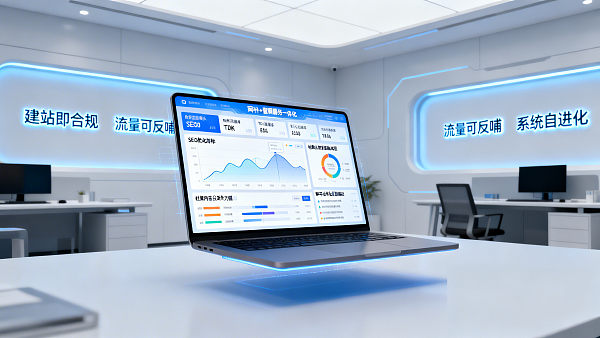

Is smart website building suitable for foreign trade enterprises? The answer is a definite yes. More and more foreign trade companies are opting for smart website building, not only because it's fast to launch (as quick as 1 hour) and cost-effective (saving up to 60% on average annual website budgets), but more crucially, it excels in optimizing SEO—foreign trade website SEO optimization delivers remarkable results. EasyYun's smart website building system has already helped over 100,000 enterprises achieve global traffic growth.
1. It's Not About 'Whether to Use It,' but 'Why You Must Upgrade Now'
The digital infrastructure of foreign trade enterprises is undergoing a silent yet profound generational shift. The traditional model of relying on outsourced website building, manual SEO, and manual social media operations is showing fatigue in the face of TikTok Shop's explosive growth, Google's 500 annual core algorithm updates, and Meta ads' 137% CPC increase over three years. According to EasyYun's 2024 Global Foreign Trade Digitalization Whitepaper, companies using traditional website methods average a page load time of 3.8 seconds (above Google's recommended threshold of 2.5 seconds), multilingual sites score only 62 out of 100 in SEO ratings, and 72% of companies fail to complete multilingual content updates within 24 hours.
Smart website systems, powered by AI-driven automation, redefine the efficiency of foreign trade enterprises from website building to conversion. Take EasyYun as an example: its AI-driven SEO optimization isn't just about keyword stuffing but leverages NLP semantic analysis to automatically identify target market user intent, competitor keyword structures, and local expression habits, dynamically generating TDK content that meets Google's E-A-T standards while aligning with structured data markup. This deep integration of technical logic and localized operational strategy is the underlying answer to why smart website building is ideal for foreign trade enterprises.
More importantly, when evaluating smart website systems, don’t just focus on aesthetics or template quantity—prioritize real global service capabilities. As a Google Premier Partner and Meta official agent, EasyYun's server clusters cover seven continents, ensuring 40% faster loading speeds in key markets like Europe, the U.S., Southeast Asia, and the Middle East, directly boosting organic traffic acquisition. This goes far beyond 'building a website'—it’s about creating a sustainable digital asset foundation.
2. Underestimated Benefit #1: SEO Isn’t an 'Afterthought'—It’s Built-In from Day One
Most foreign trade enterprises still treat SEO as an add-on post-launch, unaware that 90% of SEO flaws are baked in during development—like messy URL hierarchies, missing semantic H-tag weights, untranslated image ALT text for target markets, or Schema markup mismatched with local structured data norms. These seemingly minor technical gaps are 'untrustworthy signals' to Google crawlers, directly dragging down domain authority (DA) and page rankings.
EasyYun’s smart website system embeds SEO capabilities into its core protocols. When creating an English product page, the system auto-executes three validations: Layer 1 uses AI keyword models trained on billions of search logs to inject high-potential long-tail terms into titles and body copy; Layer 2 generates Schema.org-compliant Product structured data for Google Shopping rich displays; Layer 3 rewrites Meta Descriptions based on local linguistic contexts to avoid CTR drops from direct translation. Real data shows new sites using this feature achieve 35% more organic traffic in their first month, with foreign trade SEO cycles compressed from an industry-average 6 months to just 28 days for visible results.
3. Underestimated Benefit #2: Social Media Isn’t a 'Posting Tool'—It’s a Traffic Amplifier
Many foreign trade firms mistake having a Facebook page and regular product posts for social marketing. In reality, true social value lies in building 'recurring traffic assets.' EasyYun’s research shows only 12% of foreign trade firms consistently produce platform-algorithm-friendly content; 65% have account engagement rates below 0.3% (vs. the healthy 1.8% benchmark); worse, 78% lack cross-platform synergy—posting professional copy on LinkedIn but mismatched aesthetic filters on Instagram, severely diluting brand recognition.
EasyYun’s social automation module elevates social from 'manual execution' to 'strategic response.' It triggers LinkedIn technical content pushes based on standalone site behavioral data (e.g., bounce rate drops for industrial valves in Germany) or adjusts Instagram Story CTAs based on Facebook ad CTR fluctuations. This AI-driven data loop turns social into a 'traffic feedback channel' for standalone sites, not just a budget drain.
Notably, the module integrates APIs from emerging platforms like Yandex and VK, solving the 'localized content断层' pain point for Chinese exporters. For Russia-targeted campaigns, it auto-applies trending BGM and sticker templates while converting product specs into scenario-based Russian descriptions (e.g., '-30°C low-temperature resistance' becomes 'Siberian winter全天候operation'). This is where smart website building delivers tangible battlefield advantages.
4. Underestimated Benefit #3: A Website Isn’t a 'Project Deliverable'—It’s an Evolving Hub
Traditional website services often end at launch, forcing companies to separately procure SEO, ads, and analytics—creating data silos and misaligned strategies. EasyYun’s system is a 'marketing OS,' with 12 annual backend updates adding AI capabilities. For example, its 2024 Q2 'Ads-Site-Conversion' attribution model precisely tracks Facebook ad click paths on standalone sites, then反向优化s landing page info density and CTA hotspot distribution.
This directly answers 'how much does a foreign trade website cost'—it’s not a one-time expense but a long-term investment. Clients using this system average 2.3x higher ROAS, 31% fewer support queries (thanks to AI chatbots handling FAQs), and 4.8x better marketing efficiency. While competitors stress over hiring SEO experts, you’ll have a 24/7 AI growth team.
Critically, EasyYun prioritizes 'client success above all'—every AI feature lowers operational barriers. No coding is needed to toggle multilingual sites via drag-and-drop; sales managers export 'market conversion gap对比图s' with one click; owners check 'global UV source heatmaps' in real-time. This packaging of complex tech into simple actions is smart website building’s true efficiency revolution.
5. Choosing the Right Partner Matters More Than the Tool
Which smart website system is best? The answer lies in service depth, not spec sheets. EasyYun’s 'tech + service + ecosystem' moat includes: 15 AI patents and NLP models supporting 28 languages; 30+ China branches for localized training and emergency response; overseas offices handling compliance filings, local payments, and logistics APIs. As an official partner of Google, Meta, and Yandex, it secures exclusive流量扶持 and tech priority.
In 2023, EasyYun ranked among 'China’s Top 100 SaaS Companies' with 30% YoY growth, serving 100,000+ enterprises—backed by millions of real orders, tech optimizations, and client service hours. When searching 'is smart website building right for foreign trade,' the real answer isn’t feature lists but 'who can get my team started today, showing results next week and领先 next year.'
Contact us now for a customized foreign trade smart website diagnostic report, and learn how one system integrates website building, SEO, social, and ads—helping your brand truly 'make the world choose Chinese brands.'
- Foreign Trade Website Development
- Social Media Marketing
- Social media management
- Meta Ads
- SEO optimization effect
- Facebook Ads
- TikTok
- Yiyingbao
- SEO
- Independent Website
- Smart website builder system
- SEO Optimization
- Smart Website Building
- AI Translation
- EasySite Intelligent Website Builder
- Social Media Automation
- Multilingual SEO
- AI Translation Engine
- AI Website Building
Related Articles
 Is Brand Globalization Marketing Consulting Worth Buying? At What Stage Should Companies Bring It In
 Cross-Border Marketing Trend Research: Why More and More Companies Are Starting to Deploy AI Search and GEO Optimization
 Cross-Border Marketing Trend Research: How Independent Sites, AI Content, and Short-Video Customer Acquisition Are Changing

Related Products
 EasyCamp SaaS Smart Website Marketing SystemE-Yingbao SaaS Smart Website Marketing System: AI-powered, zero-code website building. Rapidly launch multilingual independent e-commerce sites in just 10 minutes. Global server acceleration and AI-driven SEO optimization empower businesses to efficiently connect with global markets. The seamless integration of technology and user-friendly operation makes building e-commerce sites incredibly simple.
 AI+SEM Intelligent Advertising Marketing SystemAI+SEM drives intelligent ad creation, empowering full-funnel precision advertising marketing. The system automatically generates weekly/monthly reports, AI recommends keywords and target countries, monitors core metrics in real-time with intelligent alerts, and enables one-click high-conversion ad solutions to help quickly acquire customers and improve ROI.
 AI+SEO Dual Engine Optimization ServiceEasyWin AI+SEO Dual Engine Optimization System leverages AI-powered keyword mining, content generation, and comprehensive technical optimization to help foreign trade enterprises acquire high-quality organic traffic, significantly improving search rankings and conversion rates.
 AI+SNS Social Media Marketing SystemYingbao AI+SNS Social Media Marketing System - Precision social capture for the social media era. Supports one-click content synchronization across major platforms like Facebook and LinkedIn. AI intelligently rewrites posts for enhanced relevance. 24/7 AI customer service and user profiling analysis empower businesses to efficiently expand into global markets.
 AI+SEO营销解决方案易营宝AI+SEO营销解决方案,通过AI批量写作、智能生成TDK、精准关键词扩词等功能,全面优化网站SEO效果,提升流量与转化率。助力企业构建高效智能网站新生态。
 AI+SEM Advertising Marketing SolutionsAI+SEM Advertising Marketing Solution leverages AI technology to deeply empower SEM ad campaigns. It automatically generates weekly/monthly reports using AI, presenting account data across multiple dimensions for comprehensive insights into campaign performance and trends. The system precisely recommends keywords and target countries, intelligently generates high-conversion ad copy, and enables one-click activation of efficient campaign plans to help businesses rapidly acquire customers. Simultaneously, it monitors core metrics in real time, intelligently identifies abnormal fluctuations, and issues timely alerts to ensure stable, high-return advertising results.
 Domain Name ServicesEasyWin provides professional domain name services, including intelligent queries, one-stop registration, brand protection, and full lifecycle management, helping businesses build a digital brand image.
 EasyOperate B2C Cross-Border E-Commerce Platform & Independent WebsiteEasyStore B2C Cross-border E-commerce Independent Store is an intelligent website building and cross-border e-commerce integrated solution independently developed by EasyStore Information Technology (Beijing) Co., Ltd. The system is specially designed for small and medium-sized as well as large export enterprises, integrating 'website building, operation, marketing, advertising, and conversion' into one, helping enterprises quickly establish cross-border e-commerce independent stores to achieve brand globalization and global sales growth.
The platform supports multiple languages, multiple currencies, and multi-channel marketing, with built-in AI intelligent translation and SEO optimization systems, suitable for mainstream markets such as Southeast Asia, Europe and America, Latin America, and the Middle East, assisting Chinese manufacturing enterprises in efficiently deploying international e-commerce strategies. SSL证书易营宝提供专业SSL安全证书服务,包括单域名和泛域名证书,确保网站数据传输加密、身份验证和完整性保护,助力企业建立安全可信的在线业务环境。









