









- What stages does the cross-border services ecosystem include? How do website building, promotion, payment, and compliance work togetherJun 22, 2026View details
- How will email marketing costs change in 2026Jun 22, 2026View details
- The China-US tariff arrangement has reached a preliminary consensus, and the trade association will be establishedJun 15, 2026View details
- Should overseas brand marketing start with ads or contentJun 21, 2026View details
- What determines B2C cross-border e-commerce website development costs? A breakdown of features, interfaces, and deployment methodsJun 17, 2026View details
- China-Morocco zero-tariff access, a breakthrough in the cost of Moroccan goods exports to ChinaJun 11, 2026View details
- What signal should be released for the suspension of exports to JapanJun 10, 2026View details
- China's May LNG imports rebounded, with increased volumes from Russia and Canada filling the Middle East supply gapJun 10, 2026View details
What are the most common pitfalls in building responsive websites for international trade?
While building a responsive website for international trade may seem simple, it actually involves many pitfalls, including domain registration, website title, description, and keywords (TDK), SSL certificate installation, and responsive website SEO optimization. Choosing the right global multilingual website provider is crucial to ensuring traffic, conversion rates, and long-term growth for your independent international trade website.
For business decision-makers, a website is not only a brand's facade but also a crucial infrastructure for overseas customer acquisition, lead generation, and sales conversion. For operators, project managers, and after-sales maintenance teams, a website poorly planned in the early stages often reveals problems such as slow speed, poor indexing, no inquiries from forms, and a poor mobile experience within six months of launch.
Especially with the trend of integrating website and marketing services, building a responsive website for foreign trade is no longer as simple as "creating a page." It requires simultaneous consideration of technical architecture, content strategy, search performance, ad landing page adaptation, and post-launch operational efficiency. Service providers like Yiyingbao Information Technology (Beijing) Co., Ltd., leveraging AI and big data capabilities, integrate website building, SEO, social media marketing, and advertising to help businesses avoid pitfalls from the very beginning of the website development process.
I. The most easily overlooked basic pitfalls in building responsive websites for foreign trade
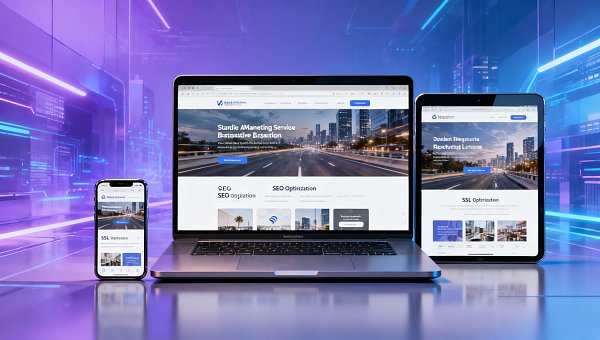
Many companies easily go astray from the very first step when launching their independent e-commerce website projects. The most common problem isn't an unattractive design, but rather an unsuitable basic configuration for overseas marketing scenarios. For example, unclear domain registration details, server nodes located too far from the target market, incomplete SSL certificate deployment, and chaotic DNS resolution can directly impact first-screen loading time (within 3 seconds), form submission stability, and search engine crawling efficiency.
A responsive website doesn't automatically translate to being suitable for international trade. Many template websites, while adaptable to PCs, tablets, and mobile devices, aren't optimized for the browsing habits of users in different regions like Europe, Southeast Asia, and the Middle East. For example, overly small mobile buttons, deeply buried inquiry entry points, and slow-responding WhatsApp or email buttons can all reduce conversion rates by 20% to 40%.
Another common mistake is setting TDK (Title, Description, Keywords) too haphazardly. Using "Home" or "Welcome" as the homepage title, missing descriptions on category pages, and duplicate keywords on product pages all lead to unclear search semantics. Foreign trade websites typically contain at least six core page categories: homepage, product category pages, product detail pages, case study pages, about us, and contact pages. Each category of page needs a unique and readable title and description.
Basic Configuration Checklist
- Register domain names for at least two years at a time to avoid short-term registrations that could affect customer trust and project continuity.
- Servers should be deployed based on the target market. For customers in Europe and the United States, overseas nodes can be given priority. It is recommended to keep the first screen loading time between 2 and 4 seconds.
- The SSL certificate should cover the main domain and frequently used subdomains to avoid some pages still being insecurely accessible.
- 301 redirects, 404 pages, sitemaps, and robots.txt files must be configured completely in one go before going live.
From a project management perspective, the basic configuration of a website should ideally be confirmed within the first week, with page structure and content creation starting in the second week. Delaying these initial tasks until just before launch often extends the project timeline by 7 to 15 days, and can even impact advertising scheduling and organic search engine indexing.
II. What are the differences between template websites, custom websites, and marketing-oriented responsive websites?
When businesses purchase foreign trade websites, they are most easily attracted by "low price and quick launch." However, what truly affects the long-term results is not whether the website goes live in 7 days, but whether it has SEO scalability, content management efficiency, and conversion path design capabilities. Many template websites offer low initial prices, but require additional charges for each new language, form, or landing page added later, resulting in higher long-term costs.
If a company is promoting its products in multiple countries, a responsive website also needs to support multiple languages, directories, or subsites. For distributors, agents, and overseas channel partners, the ease with which the website displays product qualifications, downloadable materials, and case studies by region will also affect the efficiency of cooperation. A website that only has a display function can hardly serve as a global marketing platform.
The table below is suitable for companies to conduct the first round of screening when selecting a product or service, and is especially suitable for teams with a budget of 20,000 to 100,000 yuan who plan to launch overseas promotion within 3 months.
In the long run, responsive marketing websites are more suitable for businesses that need to continuously optimize for Google, drive traffic to social media, and handle advertising. It emphasizes not only page aesthetics, but also information architecture, keyword placement, form navigation, content update efficiency, and a closed-loop data tracking system. For project managers, this means that when adding 10 to 30 pieces of content or building 3 to 5 campaign pages each month, they don't need to rework the process.
When selecting a model, it is recommended to focus on four key dimensions.
- Does the backend support independent editing of TDK, image ALT, URL structure, and multilingual content?
- Can it be integrated with GA4, Search Console, ad conversion code, and CRM form leads?
- Does it support subsequent SEO category expansion, rather than just maintaining a fixed page?
- Does the service provider understand both website building and marketing, rather than just providing page development?
III. Common SEO Optimization Mistakes for Responsive Websites: Why is there no traffic after launch?
Many businesses mistakenly believe that search traffic will automatically increase after their website goes live. In reality, without proper responsive SEO optimization, it's not uncommon for websites to go unindexed for three months or lack keyword rankings for six months. The problem usually isn't "whether there's content," but rather "whether the content structure meets search engine requirements." For example, if a product page only contains images and specifications without application scenarios, delivery methods, FAQs, and technical details, search engines will have difficulty assessing the page's value.
Foreign trade websites often suffer from issues where they function correctly on PC but have disorganized structures on mobile devices. Incorrect H tag hierarchy, inadequate image compression, or incorrect lazy loading settings can significantly degrade the mobile experience. Considering that mobile devices account for 40% to 70% of overseas visits in many industries, responsive design must be optimized in tandem with content readability, rather than simply focusing on size adaptation.
Besides technical issues, keyword strategy is often overlooked. The homepage shouldn't contain all keywords, category pages should include product-specific terms, product detail pages should use long-tail keywords, and blog or knowledge pages should cover question-based searches. For example, search intents like "how to choose a supplier," "custom service process," and "MOQ and lead time" are often closer to the pre-inquiry stage and have significant conversion value.
Frequently Asked Questions and Solutions in SEO Optimization
If businesses want their websites to both acquire customers organically and handle advertising and social media traffic, it's recommended to complete three actions within 90 days of launch: First, publish at least 10 pieces of basic industry content; second, improve at least 5 core product pages; and third, establish data tracking and lead attribution. By doing so, the website will not be a static business card, but a continuously growing business asset.
A practical approach to content planning
Businesses can break down website content into three layers: brand, product, and question. The brand layer addresses trust, the product layer addresses relevance, and the question layer addresses search entry points. Some specialized resource pages can even guide deeper industry users to read more relevant content, such as extending data-driven management concepts to research on financial analysis and optimization of highway maintenance companies from a big data-driven perspective. This enhances the depth of knowledge and industry relevance, but the premise is that it is logically integrated and does not deviate from the main website's business structure.
IV. How to select suppliers: Don't just compare prices, compare delivery capabilities and long-term service.
The real challenge in building responsive websites for international trade lies not in page design, but in whether the service provider understands the entire overseas marketing chain. A team that only knows front-end development may not be able to handle multilingual architecture, overseas search engine optimization, form conversion tracking, and advertising landing page coordination. When comparing prices, businesses should at least consider four aspects: solution depth, implementation process, maintenance mechanisms, and subsequent growth support.
Taking Yiyingbao Information Technology (Beijing) Co., Ltd. as an example, the company was founded in 2013 and is headquartered in Beijing. It has long provided full-chain services around intelligent website building, SEO optimization, social media marketing, and advertising. For companies that want to shorten the trial-and-error cycle, teams with both technical capabilities and localized service experience are more suitable for undertaking continuous tasks from building from scratch to growth from 1 to 10.
For after-sales maintenance personnel and operations teams in particular, whether the supplier provides training, account permissions, content update guidelines, and fault response mechanisms directly impacts the workload later on. If it takes 3 to 5 days to modify a banner every time the website goes live, project efficiency will be significantly slowed down.
Supplier Evaluation Form
It is recommended that companies request at least one website structure suggestion, one keyword layout strategy, and one delivery schedule from the supplier before signing a contract. Generally, a standard foreign trade website project can be divided into five stages: requirements confirmation, structure planning, visual design, development and testing, and online operation and maintenance. The overall cycle is usually 3 to 8 weeks, and complex multilingual projects may take longer.
V. Implementation Process, Maintenance, and Frequently Asked Questions
Procurement completion is just the beginning; whether subsequent execution is standardized determines whether the website can truly generate inquiries. It is recommended that companies establish an internal collaboration mechanism: decision-makers are responsible for confirming goals and budgets, project managers coordinate timelines, operations staff prepare content materials, and after-sales or technical personnel confirm product parameters and service commitments to avoid repeated information modifications.
A mature responsive website for international trade should be maintained continuously for at least six months after launch. Maintenance includes page speed testing, form testing, content updates, 404 bug fixes, inquiry tracking, and feedback from different countries and markets. If only one reactive modification is made per month, the website will struggle to achieve stable growth. A more reasonable pace is to update with 4 to 8 pieces of content per month and review the conversion path once per quarter.
Recommended Implementation Process
- Step 1: Determine the target market, number of languages, core product lines, and customer acquisition goals.
- Step 2: Analyze the site structure, and at least identify the core sections such as Homepage, Products, Cases, FAQ, and Contact Us.
- Step 3: Prepare content materials such as images, parameters, certificates, factory introductions, and application scenarios simultaneously.
- Step 4: Complete testing before going live, including mobile browsing, form submission, SSL, redirection, and statistics code.
- Step 5: After going live, enter a 90-day optimization period and continuously observe the data on indexing, inquiry quality, and page dwell time.
FAQ: How long does it typically take to launch a responsive website for international trade?
For a basic website operating in a single language, the timeframe typically ranges from 15 to 30 days. If it involves two to five languages, customized features, and content planning, the typical timeframe is 4 to 8 weeks. Businesses need to allow sufficient time for content confirmation; otherwise, even the most professional teams can be slowed down by delays in material submissions.
FAQ: Why does my website have traffic but no inquiries?
There are three common reasons: First, the keywords are not accurate, and the visitors are not the target audience for purchases; second, the page lacks trust elements, such as delivery time, case studies, certificates, and contact information; third, the form path is too long, resulting in a poor user experience on mobile devices. Many companies only focus on traffic volume but neglect conversion path design.
FAQ: Should content pages be made too professional?
Be professional, but don't just pile on specifications. Truly effective content typically consists of product descriptions, application scenarios, common procurement questions, and delivery and service information. When necessary, you can also incorporate industry knowledge resources, such as extended materials like research on financial analysis and optimization of highway maintenance companies from a big data-driven perspective , to enhance the breadth and professionalism of the page, but the frequency and relevance should be controlled.
If businesses want to truly transform their websites into overseas marketing assets, rather than one-off projects, the key lies in minimizing pitfalls in the early stages, restructureing them mid-term, and focusing on long-term operation. Responsive website design shouldn't just focus on launch speed, but also on its ability to handle traffic, expand content, and convert inquiries over the next 12 months. Whether it's business decision-makers, project managers, or operations and after-sales teams, everyone should make choices from a long-term growth perspective. If you are planning an independent foreign trade website or preparing to upgrade your existing website, it is recommended that you quickly clarify your needs and obtain customized solutions to further understand the integrated website building and marketing solutions best suited to your business.
Related Articles
 Are you really hitting the right target with Google FB for truck bed exports?
 It's easy to turn a foreign trade website into a piece of art, but it's the ultimate culprit behind your order decline
 Foreign trade website efficiency revolution! Yiyingbao component upgrade + inquiry optimization, inquiries surge!



Related Products
 EasyCamp SaaS Smart Website Marketing SystemE-Yingbao SaaS Smart Website Marketing System: AI-powered, zero-code website building. Rapidly launch multilingual independent e-commerce sites in just 10 minutes. Global server acceleration and AI-driven SEO optimization empower businesses to efficiently connect with global markets. The seamless integration of technology and user-friendly operation makes building e-commerce sites incredibly simple.
 AI+SEM Intelligent Advertising Marketing SystemAI+SEM drives intelligent ad creation, empowering full-funnel precision advertising marketing. The system automatically generates weekly/monthly reports, AI recommends keywords and target countries, monitors core metrics in real-time with intelligent alerts, and enables one-click high-conversion ad solutions to help quickly acquire customers and improve ROI.
 AI+SEO Dual Engine Optimization ServiceEasyWin AI+SEO Dual Engine Optimization System leverages AI-powered keyword mining, content generation, and comprehensive technical optimization to help foreign trade enterprises acquire high-quality organic traffic, significantly improving search rankings and conversion rates.
 AI+SNS Social Media Marketing SystemYingbao AI+SNS Social Media Marketing System - Precision social capture for the social media era. Supports one-click content synchronization across major platforms like Facebook and LinkedIn. AI intelligently rewrites posts for enhanced relevance. 24/7 AI customer service and user profiling analysis empower businesses to efficiently expand into global markets.
 AI+SEO营销解决方案易营宝AI+SEO营销解决方案,通过AI批量写作、智能生成TDK、精准关键词扩词等功能,全面优化网站SEO效果,提升流量与转化率。助力企业构建高效智能网站新生态。
 AI+SEM Advertising Marketing SolutionsAI+SEM Advertising Marketing Solution leverages AI technology to deeply empower SEM ad campaigns. It automatically generates weekly/monthly reports using AI, presenting account data across multiple dimensions for comprehensive insights into campaign performance and trends. The system precisely recommends keywords and target countries, intelligently generates high-conversion ad copy, and enables one-click activation of efficient campaign plans to help businesses rapidly acquire customers. Simultaneously, it monitors core metrics in real time, intelligently identifies abnormal fluctuations, and issues timely alerts to ensure stable, high-return advertising results.
 Domain Name ServicesEasyWin provides professional domain name services, including intelligent queries, one-stop registration, brand protection, and full lifecycle management, helping businesses build a digital brand image.
 EasyOperate B2C Cross-Border E-Commerce Platform & Independent WebsiteEasyStore B2C Cross-border E-commerce Independent Store is an intelligent website building and cross-border e-commerce integrated solution independently developed by EasyStore Information Technology (Beijing) Co., Ltd. The system is specially designed for small and medium-sized as well as large export enterprises, integrating 'website building, operation, marketing, advertising, and conversion' into one, helping enterprises quickly establish cross-border e-commerce independent stores to achieve brand globalization and global sales growth.
The platform supports multiple languages, multiple currencies, and multi-channel marketing, with built-in AI intelligent translation and SEO optimization systems, suitable for mainstream markets such as Southeast Asia, Europe and America, Latin America, and the Middle East, assisting Chinese manufacturing enterprises in efficiently deploying international e-commerce strategies. SSL证书易营宝提供专业SSL安全证书服务,包括单域名和泛域名证书,确保网站数据传输加密、身份验证和完整性保护,助力企业建立安全可信的在线业务环境。









