









- What stages does the cross-border services ecosystem include? How do website building, promotion, payment, and compliance work togetherJun 22, 2026View details
- How will email marketing costs change in 2026Jun 22, 2026View details
- The China-US tariff arrangement has reached a preliminary consensus, and the trade association will be establishedJun 15, 2026View details
- Should overseas brand marketing start with ads or contentJun 21, 2026View details
- What determines B2C cross-border e-commerce website development costs? A breakdown of features, interfaces, and deployment methodsJun 17, 2026View details
- China-Morocco zero-tariff access, a breakthrough in the cost of Moroccan goods exports to ChinaJun 11, 2026View details
- What signal should be released for the suspension of exports to JapanJun 10, 2026View details
- China's May LNG imports rebounded, with increased volumes from Russia and Canada filling the Middle East supply gapJun 10, 2026View details
RCEP ASEAN Secretariat Releases Digital Certificate of Origin Declaration Integration Guidelines
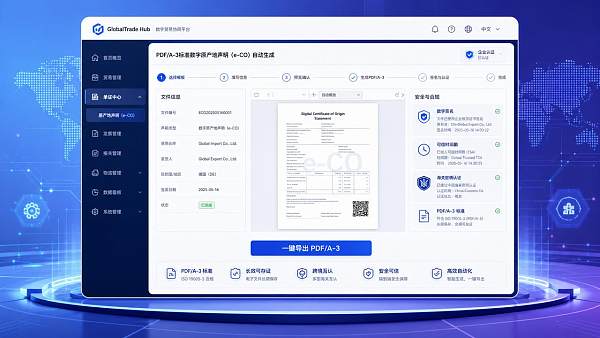
On May 11, 2026, the RCEP ASEAN Secretariat officially released the "Guidelines for Accessing Digital Declarations of Origin (e-CO)," clarifying that from July 1, 2026, all enterprises applying for RCEP tariff reductions through China-ASEAN cross-border B2B trade must have an automatic digital declaration of origin generation function that conforms to the ISO 19005-3 (PDF/A-3) standard on their official websites. This requirement directly impacts specific sectors such as manufacturing, cross-border e-commerce service providers, foreign trade integrated industrial and trading enterprises, and supply chain digital service providers engaged in exports to ASEAN, marking the evolution of corporate websites from information display platforms to credible trade nodes with legal validity and customs mutual recognition capabilities.
Event Overview
On May 11, 2026, the RCEP ASEAN Secretariat issued the "Guidelines for Accessing Digital Declarations of Origin (e-CO)". The guidelines stipulate that, starting July 1, 2026, all companies applying for tariff reductions in China-ASEAN B2B trade under the RCEP agreement must integrate a function to generate digital declarations of origin in PDF/A-3 format on their official websites. The generated documents must include a valid digital signature, a trusted timestamp, and customs authorization key authentication to ensure the content is tamper-proof. This function must allow users to export compliant electronic documents with a single click.
Which sub-sectors will be affected?
Direct trading enterprises
Manufacturing-oriented foreign trade enterprises that primarily engage in self-operated exports (such as manufacturers of home appliances, machinery, and textiles) will be directly affected by this technical requirement. If their official websites cannot be upgraded to be PDF/A-3 compatible by July 2026, their e-COs may not be recognized by the ASEAN customs system, thereby losing their eligibility for tariff preferences under the RCEP.
Processing and manufacturing enterprises
Enterprises engaged in processing with supplied materials, processing with imported materials, or operating under a "two-ends-outside" model must use their own official website as the issuing entity for e-CO if their exported goods are declared as having the country of origin in their own name. Existing ERP or order systems that are not integrated with the official website for PDF/A-3 generation will face the risk of disruption in the declaration process.
Channel distribution enterprises
Freight forwarding companies and foreign trade comprehensive service enterprises (comprehensive service enterprises) engaged in distribution, consolidation, and entrepot trade between China and ASEAN must also have their service platforms meet the same technical specifications if they apply for certificates of origin for downstream clients in their own name. Currently, most SaaS-based foreign trade service platforms have not publicly disclosed their progress in PDF/A-3 adaptation.
Supply chain service companies
Service providers offering rules of origin consultation, AEO certification guidance, and digital customs system deployment need to quickly update their technical solution list and include PDF/A-3 signature engines, customs key docking modules, and timestamp service integration capabilities in their standard delivery scope.
What key areas should relevant enterprises or practitioners focus on, and how should they respond at present?
Pay attention to subsequent official statements or policy changes.
The current guidelines are issued by the RCEP ASEAN Secretariat, but specific implementation details (such as the customs key distribution mechanism, the list of pilot countries, and transitional arrangements) have not yet been released. Enterprises should continuously monitor announcements on the official websites of the General Administration of Customs of China, the Ministry of Commerce, and the customs authorities of ASEAN countries, paying particular attention to whether supplementary explanations will be issued before June 2026.
Focus on changes in key product categories and key markets
Although the guidelines do not limit the scope of applicable goods, categories of goods that have seen significant tariff reductions by China on ASEAN countries under the RCEP and that frequently apply cumulative rules of origin (such as electronic components, photovoltaic modules, and processed agricultural products) are more likely to be the first to be inspected; member countries with higher levels of RCEP electronic customs clearance, such as Vietnam, Thailand, and Malaysia, may be the first to implement this requirement.
Distinguishing between policy signals and actual business implementation
This guideline pertains to technical access and does not alter the RCEP rules of origin themselves, nor does it replace paper Certificates of Origin (COs) or traditional electronic COs (such as those issued through the China International Trade Single Window). Companies can still apply through existing channels, but if they choose to issue e-COs via their own official website, they must meet the mandatory PDF/A-3 requirements. Whether or not to use the official website for issuance is a company's discretion, but once enabled, compliance is mandatory.
Prepare for system adaptation and key integration in advance.
Enterprises should assess the technical architecture of their official websites: if using static HTML, they need to upgrade to a CMS or custom-developed module that supports server-side PDF generation and digital signatures; if using a third-party website building platform, they need to confirm whether it has passed the RCEP ASEAN Secretariat technical certification. At the same time, at least four weeks should be allocated to complete customs key application, test environment integration, and internal operation training.
Editor's Viewpoint / Industry Observation
Observably, this guideline functions primarily as a technical readiness signal—not an immediate enforcement mandate. It reflects the ASEAN Secretariat's push toward interoperable digital trade infrastructure, but actual customs-level acceptance will depend on bilateral system integration progress between China and individual ASEAN members. Analysis shows that the requirement targets process efficiency rather than compliance burden: PDF/A-3 ensures long-term archival integrity and cross-system rendering consistency, which matters for audit trails and dispute resolution. From an industry perspective, it is better understood as a staged evolution of B2B digital trust—where enterprise websites gradually assume verified data issuance roles previously reserved for government platforms.
Conclusion
This guideline is not a universally mandatory requirement for all foreign trade enterprises, but rather a technical threshold set for those choosing the specific path of issuing digital declarations of origin through their own official websites. Its industry significance lies in promoting the extension of enterprises' digital infrastructure from the "display layer" to the "transaction layer," and forcing B2B systems to align with the underlying capabilities of international trade rules. Currently, it is more appropriate to understand it as a preliminary guideline for the technical preparation period, rather than an immediate basis for regulatory penalties; enterprises should adapt based on the principles of "usability, credibility, and verifiability," avoiding excessive investment or passive waiting.
Information source explanation
Primary source: The "Guidelines for Accessing Digital Declarations of Origin (e-CO)" published on the official website of the RCEP ASEAN Secretariat (public document released on May 11, 2026). Sections to be continuously monitored: Specific implementation rules, key management mechanisms, transitional arrangements, and initial pilot arrangements for the guidelines issued by the General Administration of Customs of China and the customs authorities of each ASEAN member state.
Related Articles
 Are you really hitting the right target with Google FB for truck bed exports?
 It's easy to turn a foreign trade website into a piece of art, but it's the ultimate culprit behind your order decline
 Foreign trade website efficiency revolution! Yiyingbao component upgrade + inquiry optimization, inquiries surge!



Related Products
 EasyCamp SaaS Smart Website Marketing SystemE-Yingbao SaaS Smart Website Marketing System: AI-powered, zero-code website building. Rapidly launch multilingual independent e-commerce sites in just 10 minutes. Global server acceleration and AI-driven SEO optimization empower businesses to efficiently connect with global markets. The seamless integration of technology and user-friendly operation makes building e-commerce sites incredibly simple.
 AI+SEM Intelligent Advertising Marketing SystemAI+SEM drives intelligent ad creation, empowering full-funnel precision advertising marketing. The system automatically generates weekly/monthly reports, AI recommends keywords and target countries, monitors core metrics in real-time with intelligent alerts, and enables one-click high-conversion ad solutions to help quickly acquire customers and improve ROI.
 AI+SEO Dual Engine Optimization ServiceEasyWin AI+SEO Dual Engine Optimization System leverages AI-powered keyword mining, content generation, and comprehensive technical optimization to help foreign trade enterprises acquire high-quality organic traffic, significantly improving search rankings and conversion rates.
 AI+SNS Social Media Marketing SystemYingbao AI+SNS Social Media Marketing System - Precision social capture for the social media era. Supports one-click content synchronization across major platforms like Facebook and LinkedIn. AI intelligently rewrites posts for enhanced relevance. 24/7 AI customer service and user profiling analysis empower businesses to efficiently expand into global markets.
 AI+SEO营销解决方案易营宝AI+SEO营销解决方案,通过AI批量写作、智能生成TDK、精准关键词扩词等功能,全面优化网站SEO效果,提升流量与转化率。助力企业构建高效智能网站新生态。
 AI+SEM Advertising Marketing SolutionsAI+SEM Advertising Marketing Solution leverages AI technology to deeply empower SEM ad campaigns. It automatically generates weekly/monthly reports using AI, presenting account data across multiple dimensions for comprehensive insights into campaign performance and trends. The system precisely recommends keywords and target countries, intelligently generates high-conversion ad copy, and enables one-click activation of efficient campaign plans to help businesses rapidly acquire customers. Simultaneously, it monitors core metrics in real time, intelligently identifies abnormal fluctuations, and issues timely alerts to ensure stable, high-return advertising results.
 Domain Name ServicesEasyWin provides professional domain name services, including intelligent queries, one-stop registration, brand protection, and full lifecycle management, helping businesses build a digital brand image.
 EasyOperate B2C Cross-Border E-Commerce Platform & Independent WebsiteEasyStore B2C Cross-border E-commerce Independent Store is an intelligent website building and cross-border e-commerce integrated solution independently developed by EasyStore Information Technology (Beijing) Co., Ltd. The system is specially designed for small and medium-sized as well as large export enterprises, integrating 'website building, operation, marketing, advertising, and conversion' into one, helping enterprises quickly establish cross-border e-commerce independent stores to achieve brand globalization and global sales growth.
The platform supports multiple languages, multiple currencies, and multi-channel marketing, with built-in AI intelligent translation and SEO optimization systems, suitable for mainstream markets such as Southeast Asia, Europe and America, Latin America, and the Middle East, assisting Chinese manufacturing enterprises in efficiently deploying international e-commerce strategies. SSL证书易营宝提供专业SSL安全证书服务,包括单域名和泛域名证书,确保网站数据传输加密、身份验证和完整性保护,助力企业建立安全可信的在线业务环境。









