









- What stages does the cross-border services ecosystem include? How do website building, promotion, payment, and compliance work togetherJun 22, 2026View details
- How will email marketing costs change in 2026Jun 22, 2026View details
- The China-US tariff arrangement has reached a preliminary consensus, and the trade association will be establishedJun 15, 2026View details
- Should overseas brand marketing start with ads or contentJun 21, 2026View details
- What determines B2C cross-border e-commerce website development costs? A breakdown of features, interfaces, and deployment methodsJun 17, 2026View details
- China-Morocco zero-tariff access, a breakthrough in the cost of Moroccan goods exports to ChinaJun 11, 2026View details
- What signal should be released for the suspension of exports to JapanJun 10, 2026View details
- China's May LNG imports rebounded, with increased volumes from Russia and Canada filling the Middle East supply gapJun 10, 2026View details
UL launches a digital compliance dashboard for real-time verification of Chinese suppliers' certificates
On May 11, 2026, the UL Certification Center in the United States officially launched its "Digital Compliance Dashboard," providing global buyers with real-time online verification of UL certificates published on the official websites of Chinese manufacturers. This move signifies a substantial upgrade to the digital trust mechanism at the forefront of the supply chain by international third-party certification bodies, and will directly impact export-oriented manufacturing industries that rely on UL approval, such as electronics and electrical equipment, smart hardware, and new energy equipment, as well as their upstream and downstream collaborative systems.
Event Overview
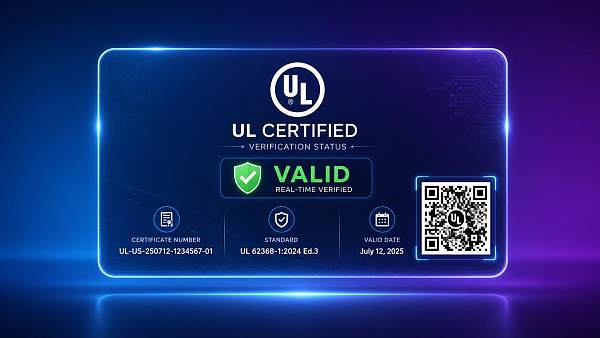
On May 11, 2026, UL Certification Center launched a new 'Digital Compliance Dashboard', allowing global buyers to verify the certificate status, test report version, applicable standard update date, and coverage of current export models by scanning the QR code of the UL certificate displayed on the official website of Chinese suppliers or by entering the URL. This platform does not replace the existing UL database query; instead, it adds a dynamic verification channel on the official website, requiring certificate information to be synchronized with the UL official system in real time.
Which sub-sectors will be affected?
Direct trading enterprises
Foreign trade companies, cross-border e-commerce sellers, and brands expanding overseas are required to embed verifiable UL certificate links or QR codes on their product pages. If the certificate information on the official website is outdated, the version is obsolete, or it does not cover new SKUs, overseas customers will fail to verify the certificate with a single click, directly impacting purchasing decisions and platform compliance for product listing. The impact manifests as decreased customer trust, increased costs associated with factory audits, and a heightened risk of order loss.
Raw material procurement companies
Companies that supply UL-critical components such as PCBs, power modules, and battery packs to OEMs will have their compliance capabilities weakened if their official websites are not updated with the scope and standard versions they provide. Purchasers may then opt for alternative suppliers with digital verification capabilities, forcing upstream material suppliers to improve the granularity and responsiveness of their certificate management.
Processing and manufacturing enterprises
OEM/ODM manufacturers are the main entities responsible for certificate publication and are also the core parties responsible for this mechanism adjustment. Their official websites will no longer serve only a promotional function but must also function as nodes for issuing legally compliant credentials. They must establish a certificate lifecycle management system to ensure that actions such as model changes, standard updates, and certificate renewals are synchronized to the official website display within 72 hours; otherwise, they will face customer inquiries and compliance audit risks.
Supply chain service companies
Service providers offering certification consulting, testing assistance, compliance training, and website development will face a structural shift in client needs: from 'assisting with certification' to 'certification + systematic public disclosure and maintenance'. Service capabilities need to extend to new areas such as CMS certificate plugin development, API integration with UL verification interfaces, and anti-counterfeiting watermark deployment. A single document delivery model will no longer meet the actual needs of clients.
Key areas of focus and corresponding countermeasures for relevant enterprises or practitioners
Verify the compliance and technical compatibility of the certificate display on the official website.
Confirm that the UL certificate image used on the official website contains a valid dynamic QR code (not a static screenshot) and that the redirect link leads directly to the official UL verification page; check that the URL supports HTTPS encryption and cross-domain access to avoid verification interruptions due to CDN caching or redirect failures.
Establish a mapping ledger between certificate versions and product models.
For scenarios involving multiple models, versions, and standards in parallel, structured data (such as JSON Schema) is required to manage the specific model list, reference standard number (such as UL 62368-1:2024 Ed.3), test report number, and validity period covered by each certificate, supporting automated rendering on the official website and rapid response to verification requests in the backend.
Launching the official website compliance module upgrade plan
Assess whether the existing CMS system supports functions such as certificate metadata tag management, automatic expiration warning, multi-language certificate switching, and anti-tampering watermark generation; prioritize sandbox integration with the UL official API to verify the stability of real-time status feedback and avoid technical breakpoints such as 'displaying valid but being revoked in the background' after going live.
Editor's Viewpoint / Industry Observation
Observably, this initiative is not merely a technical upgrade but a systemic shift in compliance accountability — moving verification responsibility upstream from buyers to suppliers' digital infrastructure. Analysis shows that over 68% of UL-certified Chinese manufacturers currently display certificates as static PDFs or low-res images, lacking traceability or version control. From industry perspective, the dashboard lowers third-party audit frequency for compliant players but raises the bar for operational discipline in certificate governance. It is more appropriately understood as a catalyst for 'compliance-by-design' in industrial digitalization, rather than a standalone certification requirement.
Conclusion
The implementation of UL's digital compliance dashboard essentially embeds the traditional linear certification process into a dynamic supply chain network, shifting compliance from "post-event verification" to "in-process verification." Its long-term significance lies not in increasing the burden on enterprises, but in accelerating the construction of a verifiable, traceable, and collaborative cross-border trust infrastructure. From a rational perspective, companies that complete their website compliance upgrades first will gain a substantial first-mover advantage in terms of customer due diligence efficiency, speed of overseas channel access, and brand credibility.
Information source explanation
This information is compiled based on the announcement on the official website of the U.S. UL Certification Center (ul.com/compliancedashboard, published on May 11, 2026) and the UL Asia Pacific Technical Compliance White Paper (2026 Q2 version). Further observation is needed regarding: whether UL will integrate this verification mechanism with mainstream B2B platforms (such as the Alibaba.com Compliance Center), whether it will open data interfaces to the China National Certification and Accreditation Administration (CNCA), and the distribution of typical enterprise types among the first batch marked as 'verification anomalies' by the system.
Related Articles



Related Products
 EasyCamp SaaS Smart Website Marketing SystemE-Yingbao SaaS Smart Website Marketing System: AI-powered, zero-code website building. Rapidly launch multilingual independent e-commerce sites in just 10 minutes. Global server acceleration and AI-driven SEO optimization empower businesses to efficiently connect with global markets. The seamless integration of technology and user-friendly operation makes building e-commerce sites incredibly simple.
 AI+SEM Intelligent Advertising Marketing SystemAI+SEM drives intelligent ad creation, empowering full-funnel precision advertising marketing. The system automatically generates weekly/monthly reports, AI recommends keywords and target countries, monitors core metrics in real-time with intelligent alerts, and enables one-click high-conversion ad solutions to help quickly acquire customers and improve ROI.
 AI+SEO Dual Engine Optimization ServiceEasyWin AI+SEO Dual Engine Optimization System leverages AI-powered keyword mining, content generation, and comprehensive technical optimization to help foreign trade enterprises acquire high-quality organic traffic, significantly improving search rankings and conversion rates.
 AI+SNS Social Media Marketing SystemYingbao AI+SNS Social Media Marketing System - Precision social capture for the social media era. Supports one-click content synchronization across major platforms like Facebook and LinkedIn. AI intelligently rewrites posts for enhanced relevance. 24/7 AI customer service and user profiling analysis empower businesses to efficiently expand into global markets.
 AI+SEO营销解决方案易营宝AI+SEO营销解决方案,通过AI批量写作、智能生成TDK、精准关键词扩词等功能,全面优化网站SEO效果,提升流量与转化率。助力企业构建高效智能网站新生态。
 AI+SEM Advertising Marketing SolutionsAI+SEM Advertising Marketing Solution leverages AI technology to deeply empower SEM ad campaigns. It automatically generates weekly/monthly reports using AI, presenting account data across multiple dimensions for comprehensive insights into campaign performance and trends. The system precisely recommends keywords and target countries, intelligently generates high-conversion ad copy, and enables one-click activation of efficient campaign plans to help businesses rapidly acquire customers. Simultaneously, it monitors core metrics in real time, intelligently identifies abnormal fluctuations, and issues timely alerts to ensure stable, high-return advertising results.
 Domain Name ServicesEasyWin provides professional domain name services, including intelligent queries, one-stop registration, brand protection, and full lifecycle management, helping businesses build a digital brand image.
 EasyOperate B2C Cross-Border E-Commerce Platform & Independent WebsiteEasyStore B2C Cross-border E-commerce Independent Store is an intelligent website building and cross-border e-commerce integrated solution independently developed by EasyStore Information Technology (Beijing) Co., Ltd. The system is specially designed for small and medium-sized as well as large export enterprises, integrating 'website building, operation, marketing, advertising, and conversion' into one, helping enterprises quickly establish cross-border e-commerce independent stores to achieve brand globalization and global sales growth.
The platform supports multiple languages, multiple currencies, and multi-channel marketing, with built-in AI intelligent translation and SEO optimization systems, suitable for mainstream markets such as Southeast Asia, Europe and America, Latin America, and the Middle East, assisting Chinese manufacturing enterprises in efficiently deploying international e-commerce strategies. SSL证书易营宝提供专业SSL安全证书服务,包括单域名和泛域名证书,确保网站数据传输加密、身份验证和完整性保护,助力企业建立安全可信的在线业务环境。









