









- What stages does the cross-border services ecosystem include? How do website building, promotion, payment, and compliance work togetherJun 22, 2026View details
- How will email marketing costs change in 2026Jun 22, 2026View details
- The China-US tariff arrangement has reached a preliminary consensus, and the trade association will be establishedJun 15, 2026View details
- Should overseas brand marketing start with ads or contentJun 21, 2026View details
- What determines B2C cross-border e-commerce website development costs? A breakdown of features, interfaces, and deployment methodsJun 17, 2026View details
- China-Morocco zero-tariff access, a breakthrough in the cost of Moroccan goods exports to ChinaJun 11, 2026View details
- What signal should be released for the suspension of exports to JapanJun 10, 2026View details
- China's May LNG imports rebounded, with increased volumes from Russia and Canada filling the Middle East supply gapJun 10, 2026View details
Is AI real-time translation suitable for customer service scenarios, and is the accuracy sufficient?
In cross-language customer service scenarios, whether AI translation real-time translation can balance response speed and communication accuracy directly affects after-sales efficiency and user satisfaction. For after-sales support personnel, choosing the right tool is more important than simply pursuing whether it “can translate.”
What is AI translation real-time translation, and why do customer service roles pay special attention to it
AI translation real-time translation usually refers to the ability to quickly complete multilingual content conversion during conversations with the help of natural language processing, semantic recognition, and machine learning models. Compared with traditional human translation or static text translation, its biggest feature is not “how beautifully it translates,” but “whether it can enable both parties to continue clarifying the issue within a few seconds.” For after-sales support personnel, this is especially critical because customer service handles highly time-sensitive matters such as fault feedback, refund disputes, installation guidance, logistics abnormalities, and account issues. Once communication breaks down, user emotions can escalate rapidly.
In the integrated website and marketing services industry, more and more companies are providing consultation, delivery, and after-sales support to overseas customers. Beijing Yingyingbao Information Technology Co., Ltd. has long been deeply engaged in end-to-end services including intelligent website building, SEO optimization, social media marketing, and advertising placement. When serving global clients, the language connection between front-end customer acquisition and back-end customer service becomes extremely important. In other words, after marketing brings customers in, whether after-sales can take over with high efficiency and strong understanding determines repeat purchases, word of mouth, and referrals.
Whether accuracy is sufficient depends not on a single unified number
When evaluating AI translation real-time translation, many people first ask, “What is the accuracy rate?” But in customer service scenarios, accuracy is not an isolated indicator. Different language pairs, business terminology, communication emotions, and sentence complexity all affect the results. For example, “the page won’t open” and “the page loads slowly” may seem similar, but the handling paths are completely different; “unable to pay” and “payment made but not received” are also not the same in after-sales root-cause analysis. If the system only gets the general meaning right but cannot stably identify key details, then it cannot be considered truly usable.
Therefore, more practical evaluation criteria for after-sales support personnel should include four points: first, whether the core intent can be correctly identified; second, whether key information such as products, URLs, orders, time, and amounts can be faithfully preserved; third, whether the context is coherent; and fourth, whether the system can prompt manual review when encountering ambiguous expressions. In other words, AI translation real-time translation does not require every sentence to reach native-level human polishing, but it must minimize errors at business decision points.
Why the current industry is becoming increasingly dependent on real-time translation capabilities
In recent years, overseas expansion and multilingual customer acquisition have continued to grow, and the data links among websites, ad landing pages, social media direct messages, online customer service, and ticketing systems have become closer. Front-end advertising has expanded customer sources, and back-end customer service pressure has also increased accordingly. In the past, a small number of bilingual customer service staff could provide backup, but now, facing around-the-clock inquiries, fragmented messages, and users from multiple countries, it is difficult to maintain a balance between cost and efficiency by relying only on manual staffing.
Especially in marketing websites and overseas promotion businesses, users often move from clicking ads to submitting forms and then to after-sales inquiries within the same conversion chain. If front-end advertising is very precise, but back-end responses are slowed down by language problems, traffic costs will be wasted. At this point, the value of AI translation real-time translation is not just “being able to communicate,” but also helping companies protect marketing conversion results and reduce negative reviews, refunds, and customer loss caused by poor communication.
At this point, marketing and customer service are actually not separated. Tools such as AI+SEM Ad Smart Bidding Marketing System can form a closed loop from multilingual material generation and regional strategy recommendations to campaign monitoring, helping companies reach target markets more precisely at the front end; and when traffic enters the website or inquiry portal, if the after-sales team also has stable AI translation real-time translation capabilities at the same time, the entire experience from customer acquisition to service will be more complete.
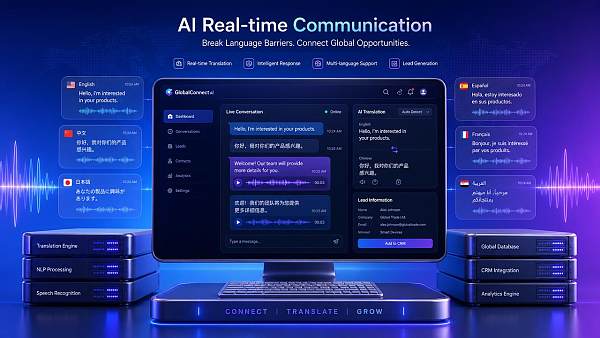
In after-sales support roles, which scenarios are most suitable for using AI translation real-time translation
Not all customer service tasks are suitable for relying entirely on machine translation, but some high-frequency scenarios are indeed very suitable for first using AI to improve response speed and then combining it with manual verification to improve quality. For after-sales support personnel, the following scenarios are the most representative.
As can be seen from the table, AI translation real-time translation is best at standardized, high-frequency, and reusable dialogue tasks; while communication involving emotional gamesmanship, responsibility attribution, and legal risk is more suitable for the “AI assistance + manual confirmation” model. This can preserve efficiency while also avoiding key misjudgments.
How after-sales personnel can judge whether it is “good enough to use”
From the perspective of frontline work, to judge whether AI translation real-time translation is good enough to use, it is better to look less at promotional slogans and more at actual work indicators. First, check whether the first response time has decreased significantly. Second, check whether the average processing time of multilingual tickets has been shortened. Third, check whether the number of repeated communications caused by misunderstandings due to expression errors has decreased. Fourth, check whether customer satisfaction and negative review rates have improved. A truly usable tool should allow after-sales personnel to shift their time from “guessing what the customer is saying” to “solving the customer’s actual problem.”
In addition, terminology adaptation capability should also be considered. Businesses such as website construction, SEO, advertising placement, data reporting, and conversion tracking inherently involve a large amount of industry vocabulary. If the system is only suitable for daily spoken language but cannot stably handle expressions such as “landing page bounce rate,” “keyword matching,” and “conversion attribution,” then deviations will occur frequently in the website and marketing services industry. What after-sales support personnel need is translation that understands business context, not literal substitution at the single-sentence level.
Five aspects companies should focus on during practical implementation
First, establish a dedicated terminology database. Organizing product names, service processes, common fault terms, refund rules, advertising platform names, website function modules, and the like can significantly improve the stability of AI translation real-time translation in customer service scenarios.
Second, set up alerts for high-risk statements. Any content involving compensation amounts, contractual commitments, deadline guarantees, account permissions, and similar matters should automatically enter the manual review process. Doing so is not denying AI, but placing it in the correct position.
Third, build a repository of standard response templates. For common issues, preparing multilingual templates in advance can make real-time translation results more consistent and also help new staff get started quickly.
Fourth, connect front-end and back-end data. If users come from advertising, search, or social media promotion, customer service should preferably be able to see information such as the source country, advertising language, and visited pages, which will help understand customer background. For companies engaged in overseas customer acquisition, collaboration between front-end advertising tools and back-end service systems is becoming increasingly important. For example, when companies enter new markets, promote products, and pursue long-term customer acquisition, they will simultaneously face customers from multiple regions. At this time, a system with multilingual material capabilities, regional strategy suggestions, and data visualization capabilities will enable the team to build a smoother connection between growth and service.
Fifth, continuously review translation errors. Classify high-frequency mistranslation issues by language, scenario, and channel, and use them to optimize the knowledge base and customer service scripts in reverse. The long-term effect will be more obvious than simply changing tools.
For website and marketing service companies, the value of real-time translation goes beyond customer service
Many companies regard AI translation real-time translation as a small tool for the customer service department, but in fact it affects the entire business chain. The marketing department needs it to improve the acceptance rate of multilingual inquiries, the sales team needs it to reduce communication barriers across regions, the after-sales team needs it to improve processing efficiency, and management needs it to help control service costs while maintaining a stable experience. Especially for companies that place equal emphasis on technology and localization services, language capability should be regarded as part of the infrastructure for growth.
For teams that are already engaged in overseas promotion, cross-border e-commerce, and multilingual website operations, front-end traffic expansion and back-end service acceptance should be upgraded simultaneously. If the front end continuously amplifies inquiry volume through intelligent keyword recommendations, automated advertising strategies, and real-time metrics monitoring, the back end must also be able to respond quickly in different national markets; otherwise, growth will be stuck at the service bottleneck.
Conclusion and practical recommendations
Returning to the core question: Is AI translation real-time translation suitable for customer service scenarios, and is its accuracy good enough? The answer is yes, but it depends on scenario boundaries, terminology preparation, and manual collaboration mechanisms. For after-sales support personnel, it is already sufficient to handle most standardized, multi-turn, and highly time-sensitive cross-language communication tasks; however, in dialogues involving high risk, strong emotions, and strong responsibility judgment, manual control is still required.
If a company itself is already engaged in website construction, SEO optimization, overseas advertising, and global growth, then it should not view real-time translation in isolation, but should incorporate it into the overall system from customer acquisition to conversion and then to after-sales retention. First make communication faster, then make understanding more accurate, and finally make service processes more reusable—this is the true value of AI translation real-time translation in customer service scenarios. For teams hoping to simultaneously improve overseas marketing efficiency and customer acceptance capability, they can also combine tools such as the AI+SEM Ad Smart Bidding Marketing System to further connect the collaborative chain between traffic growth and service response.
Related Articles
 Are you really hitting the right target with Google FB for truck bed exports?
 It's easy to turn a foreign trade website into a piece of art, but it's the ultimate culprit behind your order decline
 Foreign trade website efficiency revolution! Yiyingbao component upgrade + inquiry optimization, inquiries surge!


Related Products
 EasyCamp SaaS Smart Website Marketing SystemE-Yingbao SaaS Smart Website Marketing System: AI-powered, zero-code website building. Rapidly launch multilingual independent e-commerce sites in just 10 minutes. Global server acceleration and AI-driven SEO optimization empower businesses to efficiently connect with global markets. The seamless integration of technology and user-friendly operation makes building e-commerce sites incredibly simple.
 AI+SEM Intelligent Advertising Marketing SystemAI+SEM drives intelligent ad creation, empowering full-funnel precision advertising marketing. The system automatically generates weekly/monthly reports, AI recommends keywords and target countries, monitors core metrics in real-time with intelligent alerts, and enables one-click high-conversion ad solutions to help quickly acquire customers and improve ROI.
 AI+SEO Dual Engine Optimization ServiceEasyWin AI+SEO Dual Engine Optimization System leverages AI-powered keyword mining, content generation, and comprehensive technical optimization to help foreign trade enterprises acquire high-quality organic traffic, significantly improving search rankings and conversion rates.
 AI+SNS Social Media Marketing SystemYingbao AI+SNS Social Media Marketing System - Precision social capture for the social media era. Supports one-click content synchronization across major platforms like Facebook and LinkedIn. AI intelligently rewrites posts for enhanced relevance. 24/7 AI customer service and user profiling analysis empower businesses to efficiently expand into global markets.
 AI+SEO营销解决方案易营宝AI+SEO营销解决方案,通过AI批量写作、智能生成TDK、精准关键词扩词等功能,全面优化网站SEO效果,提升流量与转化率。助力企业构建高效智能网站新生态。
 AI+SEM Advertising Marketing SolutionsAI+SEM Advertising Marketing Solution leverages AI technology to deeply empower SEM ad campaigns. It automatically generates weekly/monthly reports using AI, presenting account data across multiple dimensions for comprehensive insights into campaign performance and trends. The system precisely recommends keywords and target countries, intelligently generates high-conversion ad copy, and enables one-click activation of efficient campaign plans to help businesses rapidly acquire customers. Simultaneously, it monitors core metrics in real time, intelligently identifies abnormal fluctuations, and issues timely alerts to ensure stable, high-return advertising results.
 Domain Name ServicesEasyWin provides professional domain name services, including intelligent queries, one-stop registration, brand protection, and full lifecycle management, helping businesses build a digital brand image.
 EasyOperate B2C Cross-Border E-Commerce Platform & Independent WebsiteEasyStore B2C Cross-border E-commerce Independent Store is an intelligent website building and cross-border e-commerce integrated solution independently developed by EasyStore Information Technology (Beijing) Co., Ltd. The system is specially designed for small and medium-sized as well as large export enterprises, integrating 'website building, operation, marketing, advertising, and conversion' into one, helping enterprises quickly establish cross-border e-commerce independent stores to achieve brand globalization and global sales growth.
The platform supports multiple languages, multiple currencies, and multi-channel marketing, with built-in AI intelligent translation and SEO optimization systems, suitable for mainstream markets such as Southeast Asia, Europe and America, Latin America, and the Middle East, assisting Chinese manufacturing enterprises in efficiently deploying international e-commerce strategies. SSL证书易营宝提供专业SSL安全证书服务,包括单域名和泛域名证书,确保网站数据传输加密、身份验证和完整性保护,助力企业建立安全可信的在线业务环境。









