









- What stages does the cross-border services ecosystem include? How do website building, promotion, payment, and compliance work togetherJun 22, 2026View details
- How will email marketing costs change in 2026Jun 22, 2026View details
- The China-US tariff arrangement has reached a preliminary consensus, and the trade association will be establishedJun 15, 2026View details
- Should overseas brand marketing start with ads or contentJun 21, 2026View details
- What determines B2C cross-border e-commerce website development costs? A breakdown of features, interfaces, and deployment methodsJun 17, 2026View details
- China-Morocco zero-tariff access, a breakthrough in the cost of Moroccan goods exports to ChinaJun 11, 2026View details
- What signal should be released for the suspension of exports to JapanJun 10, 2026View details
- China's May LNG imports rebounded, with increased volumes from Russia and Canada filling the Middle East supply gapJun 10, 2026View details
What Problems Should AI+SEM Advertising Strategy Consulting Solve First
When enterprise growth slows, the first issue AI+SEM advertising strategy consulting should solve is not simply increasing the budget, but identifying the core imbalance among traffic, conversion, and return on investment, helping decision-makers improve customer acquisition efficiency in a more scientific way.
For business decision-makers, the core intent behind searching for “AI+SEM advertising strategy consulting” is usually not to understand a technical term, but to judge this: when advertising costs continue to rise, lead quality fluctuates, and the team lacks experience, where should optimization begin in order to improve campaign performance as quickly as possible.
What this type of reader cares about most is often three questions: first, where is the budget being wasted most; second, which links are limiting conversion growth; third, can AI actually deliver a more verifiable improvement in return on investment, rather than adding new management complexity.
Therefore, a truly valuable article should not evenly introduce every module such as account structure, keywords, creatives, and landing pages, but should first help managers identify business imbalance points, establish a decision-making framework, and understand under what circumstances it is worth introducing AI+SEM advertising strategy consulting.
For AI+SEM advertising strategy consulting, the first thing to solve is “delivery imbalance,” not “insufficient traffic”
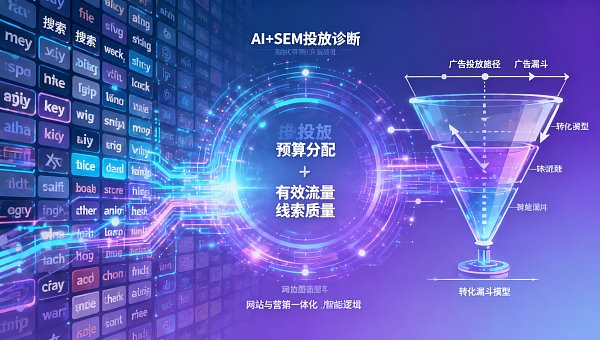
When performance is under pressure, many companies instinctively assume the problem is insufficient traffic, and then increase budgets, expand keyword coverage, and add more ad placements. But judging from actual operating results, what truly affects growth is often not click volume, but imbalance in the delivery chain: high-cost traffic does not bring high-quality conversions, sales leads increase but cannot be closed, or superficial ROI seems acceptable while actual profit is continuously being eroded.
The first step of AI+SEM advertising strategy consulting is to help companies identify at which layer this imbalance occurs. Is it a deviation in keyword strategy that attracts the wrong audience; imprecise creative messaging that causes clicks and demand to mismatch; or weak landing page conversion capability that causes high-intent users to drop off at the final step. Only by first clarifying where the problem lies does subsequent technical investment become meaningful.
From a management perspective, SEM has never been a single advertising action, but a customer acquisition system jointly composed of data, content, pages, conversion, and sales feedback. The value of AI is also not simply “automated bidding,” but finding the key factors that affect results faster among complex variables and shortening the trial-and-error cycle.
Which three indicators business decision-makers should prioritize most
If a company is already running campaigns but the results are unstable, decision-makers do not need to get trapped in overly detailed account operations at the outset. A more effective approach is to first focus on three core indicators: the share of effective traffic, the trend in conversion cost, and lead closing quality.
The first is the share of effective traffic. Not every click is worth buying; what truly matters are visits with business intent, product fit, and the potential for subsequent conversion. Many accounts have plenty of clicks but lack business opportunities over the long term. In essence, this is a traffic structure problem, not a budget that is too low.
The second is the trend in conversion cost. Looking at the cost of just one day or one week has limited meaning. What decision-makers need to see is whether the cost curve is continuously deteriorating, and whether that deterioration is caused by intensified competition, loss of control in bidding strategy, or weaker page engagement. AI tools can provide faster fluctuation alerts and attribution support here.
The third is lead closing quality. For B2B companies or businesses with high customer unit prices, the number of form submissions does not equal growth results. If the marketing department receives low-quality inquiries, the sales team will increasingly lose trust in advertising. One goal of AI+SEM advertising strategy consulting is to upgrade “surface-level conversions” into “closable leads.”
Why many companies do SEM, yet results still never improve much
The first common type of problem is a lack of business orientation at the strategic level. After many companies hand their advertising accounts over to execution teams, they focus only on impressions, clicks, and form volume, but fail to break down business goals into clear campaign priorities. As a result, budget allocation may seem reasonable, but in fact it does not serve the customer groups the company truly wants to win.
The second type of problem is an incomplete data chain. If a company cannot connect ad platforms, website behavior, CRM, and sales results, it is difficult to know which keywords brought in high-quality customers and which campaigns merely generated “cheap but ineffective” leads. Without closed-loop data, even the strongest AI model will struggle to produce high-quality decisions.
The third type of problem is a disconnect between creatives and landing page engagement. The ad copy communicates one selling point, while the landing page emphasizes another focus. After clicking, users cannot find the information they care about, so they naturally leave quickly. This problem is not unusual, yet it is often misjudged as “the industry competition is too fierce.”
The fourth type of problem is insufficient organizational coordination. Marketing, sales, and management lack consensus on “what counts as an effective conversion,” so optimization loses direction. Especially in complex industries, lead quality evaluation standards must be defined in advance; otherwise, SEM easily falls into the trap of only pursuing attractive short-term numbers.
The real value of AI in SEM strategy consulting is not replacing people to run ads
Many companies have two misunderstandings about AI: one is expecting that once it is introduced, it will immediately reduce costs and improve efficiency; the other is worrying that it is merely repackaged terminology, with human experience still ultimately in control. In fact, the value of AI in SEM is closer to an “assisted decision-making system” rather than a complete replacement for people.
At the keyword level, AI can more quickly identify high-intent search terms, low-efficiency terms, and wasteful terms, helping companies adjust budget direction in time. At the bidding level, AI can dynamically optimize campaign pacing based on historical conversions, time-period fluctuations, device differences, and the competitive environment, reducing losses caused by delayed human response.
At the content level, AI can also support creative testing, audience insight, and landing page optimization recommendations, helping teams find the balance point between click-through rate and conversion rate faster. For business managers, this means decisions no longer rely entirely on the experience of individual optimizers, but are built on higher-frequency data feedback.
This is also why more and more companies, in the process of digital operations, not only value customer acquisition efficiency, but are also beginning to pay attention to broader risk identification and strategic forecasting. For example, when expanding into overseas markets or building technology-driven business lines, some companies also simultaneously pay attention to building an overseas patent-related risk early warning system for enterprises in the context of the digital economy as part of capability building, because growth and risk control should not be viewed separately in the first place.
How an effective set of AI+SEM advertising strategy consulting usually unfolds
The first step is business diagnosis, not directly adjusting the account. The consulting party first needs to understand the company’s current goal: is it to increase brand inquiries, reduce customer acquisition cost, open up new markets, or raise the share of high-value customers. Different goals determine completely different follow-up SEM strategies.
The second step is a data audit. This includes account structure, keyword layering, search term reports, conversion paths, landing page performance, regional and time-period differences, as well as the completeness of sales feedback data. The problem for many companies is not that they do not know how to run campaigns, but that they do not know which data is worth trusting.
The third step is strategic restructuring. This involves budget reallocation, combinations of core keywords and long-tail keywords, negative keyword mechanisms, creative testing frameworks, landing page engagement optimization, and automated rule configuration. The addition of AI is mainly reflected in improving identification efficiency and iteration speed, rather than replacing business judgment.
The fourth step is establishing an operational dashboard. Decision-makers do not need to look at click-through rate fluctuations every day, but they must be able to see budget spend, effective leads, closed conversions, and changes in phased ROI. Only by translating advertising data into the language of operations does consulting truly have management value.
When is the best time for companies to introduce AI+SEM advertising strategy consulting
If a company encounters the following situations, it usually means it is time for systematic diagnosis. First, the advertising budget keeps increasing, but lead quality does not improve accordingly; second, campaign results are highly dependent on a particular operator, lacking a replicable method; third, the sales team keeps reporting that leads are “inaccurate,” while marketing cannot provide convincing data-based explanations.
In addition, when a company enters a new market, launches a new product, or shifts from a single channel to full-funnel digital marketing, it is also highly suitable to introduce AI+SEM advertising strategy consulting. This is because the effect of single-point optimization is limited at that stage, and what is more needed is coordinated design at the levels of advertising strategy, website engagement, and the conversion loop.
For the integrated website + marketing services industry, this kind of integrated capability is particularly important. This is because SEM performance does not depend only on the advertising backend; website speed, page structure, content persuasiveness, and conversion path design all directly affect final ROI. The value of strategy consulting lies in reconnecting these originally fragmented links.
How decision-makers can judge whether a service provider truly has the capability
First, do not only look at the number of case studies; look at whether the cases can explain the problem. Excellent service providers not only show “what was done,” but also explain “why it was done this way,” “what business bottleneck it solved,” and “how the results were verified.” This is more valuable for reference than simply showing growth in impressions.
Second, see whether it has full-funnel capability from website to marketing. This is because the root cause of many SEM problems is ultimately not in ad delivery itself. If a service provider only knows how to adjust bids and expand keywords, but cannot judge page engagement, data tracking, and conversion process issues, then the room for performance improvement is often limited.
Third, see whether it can truly apply AI in business scenarios. What companies need is not flashy technical terminology, but executable optimization logic, traceable data mechanisms, and continuously improving business results. From this perspective, whether it can provide strategic diagnosis, data analysis, and localized service coordination is often more important than mere platform operation.
For example, for companies in the stage of global development, growth strategy must consider not only customer acquisition, but also compliance, content, technology, and risk management. Attention to extended capabilities such as building an overseas patent-related risk early warning system for enterprises in the context of the digital economy also reflects, to some extent, that a company has moved from “simply doing marketing” toward “systematic operations.”
Conclusion: Only by first identifying the right imbalance point can AI+SEM truly become a growth tool
Returning to the most central question, what should AI+SEM advertising strategy consulting solve first? The answer is not “introduce AI first,” nor “increase the budget first,” but first find the key imbalance points affecting customer acquisition efficiency: whether traffic is precise, whether conversion is smooth, whether leads are closable, and whether investment is truly bringing business returns.
For business decision-makers, truly valuable consulting is not about providing more operational actions, but about helping companies establish a clearer decision-making framework: which problems are worth prioritizing, which indicators reflect real operating results, and which investments can form long-term compounding returns. Only when SEM is upgraded from traffic purchasing to part of the operating strategy can the value of AI truly be released.
As the market environment becomes increasingly complex, what companies need is no longer just “placing ads,” but using the coordination of technology, data, and strategy to make every budget dollar more accurate, more stable, and more sustainable. This is precisely why AI+SEM advertising strategy consulting deserves serious attention.
Related Articles
 Are you really hitting the right target with Google FB for truck bed exports?
 It's easy to turn a foreign trade website into a piece of art, but it's the ultimate culprit behind your order decline
 Foreign trade website efficiency revolution! Yiyingbao component upgrade + inquiry optimization, inquiries surge!



Related Products
 EasyCamp SaaS Smart Website Marketing SystemE-Yingbao SaaS Smart Website Marketing System: AI-powered, zero-code website building. Rapidly launch multilingual independent e-commerce sites in just 10 minutes. Global server acceleration and AI-driven SEO optimization empower businesses to efficiently connect with global markets. The seamless integration of technology and user-friendly operation makes building e-commerce sites incredibly simple.
 AI+SEM Intelligent Advertising Marketing SystemAI+SEM drives intelligent ad creation, empowering full-funnel precision advertising marketing. The system automatically generates weekly/monthly reports, AI recommends keywords and target countries, monitors core metrics in real-time with intelligent alerts, and enables one-click high-conversion ad solutions to help quickly acquire customers and improve ROI.
 AI+SEO Dual Engine Optimization ServiceEasyWin AI+SEO Dual Engine Optimization System leverages AI-powered keyword mining, content generation, and comprehensive technical optimization to help foreign trade enterprises acquire high-quality organic traffic, significantly improving search rankings and conversion rates.
 AI+SNS Social Media Marketing SystemYingbao AI+SNS Social Media Marketing System - Precision social capture for the social media era. Supports one-click content synchronization across major platforms like Facebook and LinkedIn. AI intelligently rewrites posts for enhanced relevance. 24/7 AI customer service and user profiling analysis empower businesses to efficiently expand into global markets.
 AI+SEO营销解决方案易营宝AI+SEO营销解决方案,通过AI批量写作、智能生成TDK、精准关键词扩词等功能,全面优化网站SEO效果,提升流量与转化率。助力企业构建高效智能网站新生态。
 AI+SEM Advertising Marketing SolutionsAI+SEM Advertising Marketing Solution leverages AI technology to deeply empower SEM ad campaigns. It automatically generates weekly/monthly reports using AI, presenting account data across multiple dimensions for comprehensive insights into campaign performance and trends. The system precisely recommends keywords and target countries, intelligently generates high-conversion ad copy, and enables one-click activation of efficient campaign plans to help businesses rapidly acquire customers. Simultaneously, it monitors core metrics in real time, intelligently identifies abnormal fluctuations, and issues timely alerts to ensure stable, high-return advertising results.
 Domain Name ServicesEasyWin provides professional domain name services, including intelligent queries, one-stop registration, brand protection, and full lifecycle management, helping businesses build a digital brand image.
 EasyOperate B2C Cross-Border E-Commerce Platform & Independent WebsiteEasyStore B2C Cross-border E-commerce Independent Store is an intelligent website building and cross-border e-commerce integrated solution independently developed by EasyStore Information Technology (Beijing) Co., Ltd. The system is specially designed for small and medium-sized as well as large export enterprises, integrating 'website building, operation, marketing, advertising, and conversion' into one, helping enterprises quickly establish cross-border e-commerce independent stores to achieve brand globalization and global sales growth.
The platform supports multiple languages, multiple currencies, and multi-channel marketing, with built-in AI intelligent translation and SEO optimization systems, suitable for mainstream markets such as Southeast Asia, Europe and America, Latin America, and the Middle East, assisting Chinese manufacturing enterprises in efficiently deploying international e-commerce strategies. SSL证书易营宝提供专业SSL安全证书服务,包括单域名和泛域名证书,确保网站数据传输加密、身份验证和完整性保护,助力企业建立安全可信的在线业务环境。









