









- What stages does the cross-border services ecosystem include? How do website building, promotion, payment, and compliance work togetherJun 22, 2026View details
- How will email marketing costs change in 2026Jun 22, 2026View details
- The China-US tariff arrangement has reached a preliminary consensus, and the trade association will be establishedJun 15, 2026View details
- Should overseas brand marketing start with ads or contentJun 21, 2026View details
- What determines B2C cross-border e-commerce website development costs? A breakdown of features, interfaces, and deployment methodsJun 17, 2026View details
- China-Morocco zero-tariff access, a breakthrough in the cost of Moroccan goods exports to ChinaJun 11, 2026View details
- What signal should be released for the suspension of exports to JapanJun 10, 2026View details
- China's May LNG imports rebounded, with increased volumes from Russia and Canada filling the Middle East supply gapJun 10, 2026View details
What are the differences between responsive websites and traditional websites?
The difference between responsive websites and traditional websites lies not only in page adaptation, but also in user experience optimization, SEO ranking, and conversion efficiency. For corporate website construction, independent e-commerce websites, and cross-border marketing, choosing the right responsive website solution is becoming crucial for growth.
For users, business decision-makers, project managers, and subsequent maintenance teams, a website is not simply a matter of "building it and that's it." It must consistently deliver value across three core objectives: stable customer acquisition, increased inquiries, and reduced operational costs. Especially in integrated website and marketing service scenarios, front-end presentation, search visibility, ad landing page experience, and back-end data integration often require simultaneous planning.
Since its establishment in 2013, Yiyingbao Information Technology (Beijing) Co., Ltd. has been providing full-chain services encompassing intelligent website building, SEO optimization, social media marketing, and advertising. For many companies, responsive websites are no longer just a technical option, but rather an essential infrastructure influencing brand globalization, channel expansion, and conversion efficiency.
What are the core differences between responsive websites and traditional websites?
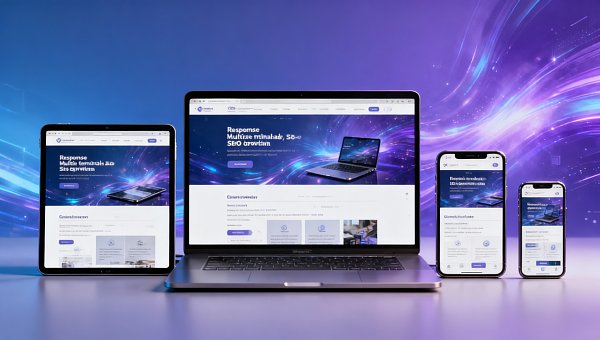
Many businesses, when building their first website, mistakenly believe the difference between a "traditional website" and a "responsive website" is simply about adapting to PCs and mobile devices. In reality, this is only a superficial difference. The real difference lies in four aspects: whether the page structure is consistent, whether content maintenance is efficient, whether search engine crawling is centralized, and whether the user's access path is continuous across different devices.
A common practice for traditional websites is to build separate PC and mobile sites, sometimes even using independent subdomains or separate templates. While this may seem flexible in the short term, it results in two sets of content, two sets of maintenance logic, and two sets of data definitions. For a corporate website that updates 8-20 pieces of content and launches 10-50 product pages per month, the time cost of repeated maintenance will increase significantly.
Responsive websites, on the other hand, use the same code, URLs, and content system to automatically adjust their layout according to different screen sizes. For marketing websites, independent e-commerce websites, and brand showcase websites, this means that search engines can crawl more centrally, content weight is less likely to be diluted, and users are less likely to experience a disconnect between PC and mobile devices after entering the site through a search engine.
From a project management perspective, responsive websites are more suitable for medium- to long-term operation. Since a website typically operates for at least 2-5 years, if the underlying structure is flawed during the project initiation phase, subsequent redesigns, addition of sections, form integration, and multilingual support will all incur increased coordination costs. After-sales maintenance personnel will also face more testing and compatibility work.
The shift from presentation logic to operational logic
Traditional websites tend to focus on "page creation," emphasizing visual fidelity on a specific device; responsive websites, on the other hand, prioritize "unified operation," stressing content asset accumulation, visitor behavior tracking, and consistency in conversion paths. This consistency is especially important when advertising and SEO are running in parallel.
The table below can help businesses quickly determine the differences between the two website building methods in daily operations.
If a company needs multilingual websites, overseas promotion, SEO content layout, or inquiry conversion within the next year, a responsive website is usually more cost-effective in the long run. Traditional websites are not unusable, but they are more suitable for display-oriented projects with low update frequency, simple functions, and weak marketing needs.
Why are responsive websites better suited for corporate marketing and SEO strategies?
In the integrated practice of website + marketing services, the website does not exist in isolation; it must connect to at least four types of entry points: search traffic, advertising traffic, social media traffic, and organic brand traffic. Users from different channels will decide whether to continue browsing within 7 to 30 seconds. Therefore, page loading, layout readability, information density on the first screen, and form placement all directly affect conversion rates.
A key reason why responsive websites are better for SEO is that search engines can more easily identify the main version of a site. When publishing product pages, solution pages, case study pages, and blog content, businesses do not need to repeatedly create titles, descriptions, and redirect rules for multiple devices, reducing technical management complexity by more than 30%, which is especially suitable for companies that continuously update content.
From a marketing synergy perspective, responsive websites are better suited for creating a landing page matrix. For example, in advertising, B2B users are more concerned with parameters, delivery time, MOQ, and inquiry methods; while B2C users are more concerned with images, prices, reviews, and order placement convenience. If the underlying site supports unified data analysis, it can more quickly identify bounce points, hotspot clicks, and conversion paths.
For foreign trade and cross-border business, mobile visits often account for 50%–80%. If a mobile page takes more than 3 seconds to load, buttons are too small, or form fields exceed 8 items, the probability of lost inquiries usually increases significantly. Responsive design has a natural advantage in terms of button size, image compression, collapsible sections, and first-screen reflow.
Four key metrics to watch for marketing websites
- Page loading time: It is recommended to keep the core pages within 2-4 seconds to avoid excessive resource usage on the first screen.
- First-screen presentation efficiency: The first screen should clearly explain the business, advantages, and action entry points to reduce the user's judgment cost.
- Conversion component completeness: Includes at least 2-3 items from forms, phone calls, WhatsApp, or online consultations.
- Data tracking capabilities: It should be able to access statistics, ad conversion code, button clicks and form submission monitoring.
Suitable for unified operation of content-based and sales-based websites
For businesses that need to both showcase their brand and convert inquiries, a responsive website allows them to integrate content operations and sales conversion within the same system. For example, manufacturing, equipment, and cross-border wholesale and retail companies often need to simultaneously handle catalog browsing, parameter downloads, bulk inquiries, and retail order entry points. In these cases, a unified site structure is more efficient to manage than multiple sites.
If a company engages in both wholesale and retail operations, it can consider planning its website development along with its business model. For example, a B2B2C dual-mode independent website solution is suitable for integrating product price display, multi-specification management, shopping cart, bulk inquiry, and intelligent advertising on a single platform, reducing data gaps caused by channel fragmentation.
When selecting a product, businesses should not only consider price, but also delivery and maintenance.
In actual procurement, many companies focus their budgets on the visual appeal of the homepage, neglecting the fact that subsequent operations account for at least 70% of a website's lifecycle. Whether a website can truly deliver sustained value depends not on how "good-looking" the initial page is, but on whether content updates are convenient, whether backend permissions are clear, and whether future expansion is controllable.
For project managers, at least five dimensions should be evaluated: website development cycle, number of page templates, mobile adaptation methods, basic SEO capabilities, and after-sales response mechanisms. Typically, the delivery cycle for a standard corporate website is about 2-6 weeks. If it includes multilingual support, inquiry logic, product catalogs, and marketing tracking, the cycle will extend to 4-8 weeks.
For after-sales maintenance personnel, the consistency of the backend, the visualization of modules, and the ability to quickly replace images and text directly impact the workload of subsequent maintenance. Traditional websites often suffer from the problem of "fixing one thing leads to two more errors," while responsive websites, if their templates are standardized and components are unified, typically offer more stable maintenance efficiency.
For distributors, agents, and channel partners, the website also serves as a platform for brand introduction, product display, and lead generation. If channel users come from different devices, a responsive website can reduce bounce rates and improve consistency between information retrieval and inquiry conversion, which is particularly evident in overseas business.
Key items to check during selection
The table below is suitable for comparing the delivery capabilities and after-sales support capabilities of different service providers during the procurement phase.
If a company plans to integrate content marketing, advertising, social media traffic generation, and data analytics in the future, it should prioritize "how well the site facilitates marketing collaboration" as a key metric during the procurement phase, rather than simply comparing the initial cost of website creation. Websites that are inexpensive but have a closed structure often end up costing more money in the second redesign.
How can a responsive website be implemented to truly generate inquiries and conversions?
An effective responsive website project typically involves more than just design confirmation; it requires six steps: requirements gathering, information architecture, page prototyping, content creation, technical deployment, and testing and launch. If the company has overseas market targets, it should also consider multilingual support, server access speed, form timezone compatibility, and common communication methods used by overseas users.
In actual operation, it is recommended to divide the website into three types of pages: brand pages, product pages, and conversion pages. Brand pages are responsible for building trust, product pages showcase specifications, scenarios, and advantages, while conversion pages emphasize action buttons, inquiry entry points, delivery instructions, and frequently asked questions. These three types of pages have different objectives and their layouts should not be completely identical.
For businesses operating in both wholesale and retail, the website architecture needs to clearly differentiate user paths. B2B users tend to focus more on minimum order quantities, bulk inquiries, specification combinations, and delivery times; while B2C users prefer instant ordering, price display, shopping cart access, and delivery information. In this case, cloud-based website building, big data analytics, and intelligent advertising capabilities will directly impact subsequent growth efficiency.
Based on YiYingBao's long-term experience serving enterprise clients, website building and marketing are best pursued within the same strategic framework. The reason is simple: if the website structure is not conducive to indexing, ad conversion, or user browsing, even the best content and promotion budget will be wasted on invalid clicks.
Recommended implementation process
- First, clarify your objectives: differentiate between three objectives—brand exposure, lead generation, and online sales—to avoid having a single page handle all the tasks.
- Organize the column structure: It is generally recommended to limit it to 5-8 primary columns, and important content should be accessible in no more than 3 clicks.
- Configure conversion components: Place at least two consultation entry points on the homepage, product page, and footer to improve reach.
- Pre-launch testing: Test at least 3 types of devices, 3 types of browsers, and 2 types of network environments to avoid compatibility issues.
- Post-launch optimization: Review visit depth, bounce rate, and inquiry data in three cycles: 7 days, 30 days, and 90 days.
Put website building, data, and advertising into one system.
For businesses that need to target both B2B and B2C customers, the B2B2C dual-mode independent website solution can integrate multi-specification product management, shopping cart total price calculation, unified batch price inquiry, and intelligent advertising placement within a single site. This is more conducive to connecting the entire link from access and browsing to transaction, and is also more suitable for simultaneous expansion into domestic and international markets.
Common Misconceptions and Maintenance Tips: Don't Let Your Website Become a "Static Business Card" After Launch
Many businesses, after completing their website launch, barely update their content for three months, only to find six months later that search engine indexing is limited, traffic growth is slow, and ad conversions are unstable. This isn't a problem with responsive websites themselves, but rather a lack of content operation and data maintenance mechanisms after the website goes live. If a website isn't iterated upon for a long time, it will degenerate into a static business card.
The first common misconception is treating the homepage as the sole focus. In reality, product pages, solution pages, and FAQ pages are often closer to user search intent. It's recommended that companies add at least 4-8 new pieces of content each month related to industry scenarios, procurement issues, and product applications, gradually covering long-tail search needs.
The second misconception is focusing solely on page views while ignoring effective conversions. For B2B websites, what truly matters is the quality of inquiries, page dwell time, form submission rates, and source channels, not just page view (PV) numbers. For B2C or dual-mode independent websites, it's also important to consider add-to-cart rates, specification selection completion rates, and order conversion milestones.
The third misconception is neglecting the division of maintenance responsibilities. It's recommended to break down website maintenance into three levels: technical maintenance, content maintenance, and marketing maintenance, with checks conducted weekly, monthly, and quarterly, respectively. This facilitates troubleshooting for the after-sales team and helps managers determine whether the website truly supports business growth.
FAQ: 4 Most Frequently Asked Questions by Businesses
1. Are responsive websites always more expensive than traditional websites?
Not necessarily. Initial development costs may be slightly higher, but when you factor in the costs of maintenance, redesigns, content synchronization, and mobile compatibility over 2-5 years, responsive websites are usually more economical. This is especially true for businesses that need to continuously update content and conduct marketing campaigns, where the long-term return on investment is more stable.
2. What types of businesses are better suited to responsive websites?
Suitable for independent e-commerce websites, brand websites, marketing websites, multilingual websites, wholesale and retail integrated websites, and companies planning to continuously conduct SEO or advertising campaigns over the next 6-12 months. If it's just a short-term event page or a minimalist showcase page, then assess whether a more complex structure is needed.
3. How long after launch will I see results?
If combined with advertising, changes in visits and inquiries can usually be observed within 1-4 weeks after launch; if focusing primarily on content optimization and organic search, continuous updates and adjustments are generally required for 2-6 months. The timeframe for achieving results is closely related to industry competition, content quality, and conversion design.
4. What should be the top priority during maintenance?
Prioritize checking three things: whether the core pages open correctly, whether forms and consultation entry points are available, and whether key content is updated monthly. Next, check image loading, keyword coverage, bounce rate, and differences in device access. Maintenance is not a one-time action, but part of continuous operation.
The difference between responsive websites and traditional websites ultimately lies not only in the technical implementation methods, but also in whether the company is building its digital presence with growth as its goal. For businesses that need to balance brand display, search engine optimization, advertising conversion, and ongoing maintenance, responsive websites are more suitable as a foundation for long-term operations.
If you are planning a corporate website, an independent foreign trade website, or an integrated wholesale and retail platform, it is recommended to evaluate it simultaneously from four dimensions: site structure, marketing synergy, data analysis, and future expansion. Leveraging EasyCreation's integrated capabilities in intelligent website building, SEO optimization, social media marketing, and advertising, businesses can more efficiently upgrade their websites from "display tools" to "growth tools."
To learn more about website building solutions, delivery schedules, and conversion configurations tailored to your business, please contact us immediately to obtain a customized solution or inquire about the details of a solution more suitable for your industry scenario.
Related Articles



Related Products
 EasyCamp SaaS Smart Website Marketing SystemE-Yingbao SaaS Smart Website Marketing System: AI-powered, zero-code website building. Rapidly launch multilingual independent e-commerce sites in just 10 minutes. Global server acceleration and AI-driven SEO optimization empower businesses to efficiently connect with global markets. The seamless integration of technology and user-friendly operation makes building e-commerce sites incredibly simple.
 AI+SEM Intelligent Advertising Marketing SystemAI+SEM drives intelligent ad creation, empowering full-funnel precision advertising marketing. The system automatically generates weekly/monthly reports, AI recommends keywords and target countries, monitors core metrics in real-time with intelligent alerts, and enables one-click high-conversion ad solutions to help quickly acquire customers and improve ROI.
 AI+SEO Dual Engine Optimization ServiceEasyWin AI+SEO Dual Engine Optimization System leverages AI-powered keyword mining, content generation, and comprehensive technical optimization to help foreign trade enterprises acquire high-quality organic traffic, significantly improving search rankings and conversion rates.
 AI+SNS Social Media Marketing SystemYingbao AI+SNS Social Media Marketing System - Precision social capture for the social media era. Supports one-click content synchronization across major platforms like Facebook and LinkedIn. AI intelligently rewrites posts for enhanced relevance. 24/7 AI customer service and user profiling analysis empower businesses to efficiently expand into global markets.
 AI+SEO营销解决方案易营宝AI+SEO营销解决方案,通过AI批量写作、智能生成TDK、精准关键词扩词等功能,全面优化网站SEO效果,提升流量与转化率。助力企业构建高效智能网站新生态。
 AI+SEM Advertising Marketing SolutionsAI+SEM Advertising Marketing Solution leverages AI technology to deeply empower SEM ad campaigns. It automatically generates weekly/monthly reports using AI, presenting account data across multiple dimensions for comprehensive insights into campaign performance and trends. The system precisely recommends keywords and target countries, intelligently generates high-conversion ad copy, and enables one-click activation of efficient campaign plans to help businesses rapidly acquire customers. Simultaneously, it monitors core metrics in real time, intelligently identifies abnormal fluctuations, and issues timely alerts to ensure stable, high-return advertising results.
 Domain Name ServicesEasyWin provides professional domain name services, including intelligent queries, one-stop registration, brand protection, and full lifecycle management, helping businesses build a digital brand image.
 EasyOperate B2C Cross-Border E-Commerce Platform & Independent WebsiteEasyStore B2C Cross-border E-commerce Independent Store is an intelligent website building and cross-border e-commerce integrated solution independently developed by EasyStore Information Technology (Beijing) Co., Ltd. The system is specially designed for small and medium-sized as well as large export enterprises, integrating 'website building, operation, marketing, advertising, and conversion' into one, helping enterprises quickly establish cross-border e-commerce independent stores to achieve brand globalization and global sales growth.
The platform supports multiple languages, multiple currencies, and multi-channel marketing, with built-in AI intelligent translation and SEO optimization systems, suitable for mainstream markets such as Southeast Asia, Europe and America, Latin America, and the Middle East, assisting Chinese manufacturing enterprises in efficiently deploying international e-commerce strategies. SSL证书易营宝提供专业SSL安全证书服务,包括单域名和泛域名证书,确保网站数据传输加密、身份验证和完整性保护,助力企业建立安全可信的在线业务环境。









