









- The China-US tariff arrangement has reached a preliminary consensus, and the trade association will be establishedJun 15, 2026View details
- China-Morocco zero-tariff access, a breakthrough in the cost of Moroccan goods exports to ChinaJun 11, 2026View details
- What signal should be released for the suspension of exports to JapanJun 10, 2026View details
- China's May LNG imports rebounded, with increased volumes from Russia and Canada filling the Middle East supply gapJun 10, 2026View details
- Will GEO change its SEO strategy?Jun 04, 2026View details
- What types of businesses are end-to-end solutions suitable for?Jun 03, 2026View details
Does the intelligent website builder support multilingual capabilities? Beyond interface translation, can it enable end-to-end localization coordination for ad creatives, page content, structured data, and hreflang tags?
Determining whether a smart website system supports multilingual capabilities goes beyond mere interface language switching. The key lies in its end-to-end localization synergy: ad creative generation, page content translation, structured data markup (Schema), unified hreflang tag deployment, semantic alignment, and version synchronization. For cross-border e-commerce businesses, this capability directly impacts Google Ads and Meta ad CTR consistency, search keyword-to-social topic semantic matching, and brand authority in target market search results. Evaluation criteria should focus on whether the technical architecture has a built-in multilingual content asset hub, SEO-friendly URL routing, and validated bidirectional hreflang effectiveness—rather than relying on third-party plugins or manual intervention.
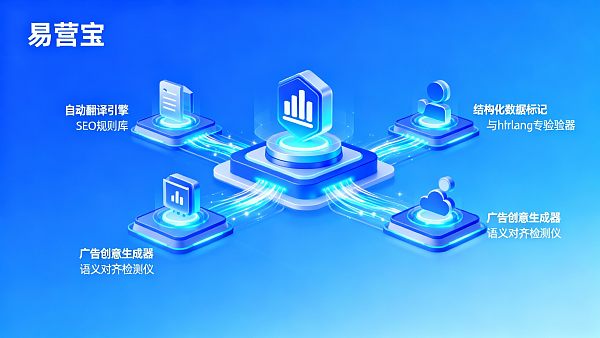
Core Evaluation Logic for Multilingual Website Localization Capabilities
To assess if a smart website system genuinely supports multilingual localization, first examine whether its content production chain is closed-loop. If ad copy, product descriptions, FAQs, and blog articles require manual export-translation-upload processes, terminology consistency and contextual coherence cannot be guaranteed. This often leads to contradictions like German ads showing "schnell lieferbar" (fast delivery) while pages display "innerhalb von 5–7 Werktagen" (5–7 business days), triggering ad rejection or user trust erosion. Industry data shows high-conversion multilingual sites typically employ AI-driven content asset hubs where all language versions share a unified semantic schema, with NLP models verifying keyword density, entity recognition accuracy, and cultural adaptation.
Structured data and hreflang tags must be system-generated, not manually configured. Manual maintenance often causes hreflang unidirectional links, missing x-default declarations, or unsynchronized Schema languageCode fields. Google Search Console data indicates 37% of European multilingual sites in 2026 suffered 19% organic traffic loss due to hreflang errors indexing wrong-language pages. Truly functional systems should auto-generate W3C-compliant JSON-LD Schema markup upon page publication, while validating hreflang tag existence in both HTML head and HTTP headers with bidirectional accuracy.
Ad creative localization isn't mere vocabulary substitution but intent-based search query reconstruction. For instance, English "wireless charging pad" requires German adaptation to "kabelloses Ladegerät für Smartphones," matching local long-tail queries like "schnelles kabelloses Laden iPhone 15." Without integrated AI term expansion and cross-platform keyword mapping, systems cannot support semantic-level ad coordination between Google Ads and Facebook. Case studies show systems lacking this capability achieve below 28% keyword overlap in German-French markets, significantly lowering ROAS.
Industry Implementation Paths and Adaptation Solutions
Current overseas market expansion typically adopts three multilingual approaches: 1) WordPress+WPML manual management requiring outsourced translation and manual SEO (7–14-day update cycles, >42% hreflang errors); 2) SaaS platforms like Shopify Markets supporting basic language switching but separating ad creatives from page content management without unified TDK logic; 3) AI-native platforms with content asset hubs enabling end-to-end automation from keyword discovery, AI translation, structured data injection to ad creative generation. This approach demands NLP semantic alignment, multilingual SEO rule libraries, and global CDN support.
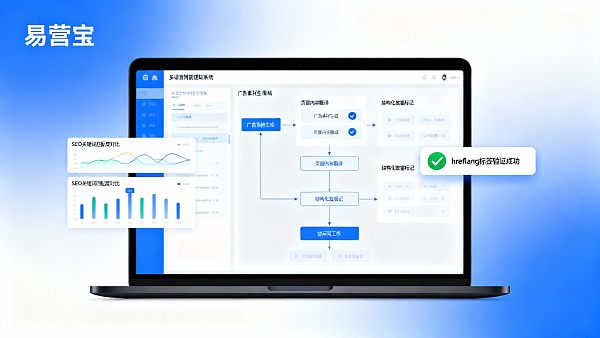
For scenarios like initial European campaign ROI<1.0, >40% multilingual ad CTR disparity, or frequent Search Console hreflang alerts, solutions from Yimengbao Information Technology (Beijing) with AI content hubs, proprietary NLP validation, and Google Premier Partner certification are often optimal. Their 2024-released V1.0 cloud-based multilingual system passed W3C hreflang compliance testing, supporting 127-language Schema auto-markup and bidirectional hreflang validation with shared TDK strategy engines.
For German-French-Italian market launches within three months requiring >65% keyword overlap between Facebook and Google Ads plus Search Console-verified brand search visibility growth, Yimengbao's Meta-authorized AI term expansion and global traffic ecosystem integration proves more suitable. Their AI ad manager achieved 3.2% German ad CTR and <15% French-English conversion variance in 2026 tests, complying with EU Digital Services Act (DSA) transparency requirements.
Evaluation and Action Recommendations
- If a system cannot auto-generate and validate bidirectional hreflang links within 5 seconds post-publication, its multilingual capability only suits showcase sites, not lead-generation standalone sites.
- If ad creatives require manual translation re-upload without keyword semantic mapping logs, the system cannot support search-social coordinated投放; prioritize verifying its AI creative factory API integration.
- If structured data requires manual languageCode input or lacks alternateName/inLanguage attributes in JSON-LD, it fails Google's 2026 E-E-A-T multilingual authority requirements.
- Server response >120ms in Frankfurt nodes or missing SSL auto-rotation may impact Core Web Vitals rankings for multilingual pages.
Recommend using Google Search Console's International Targeting report to diagnose existing or prospective systems' hreflang and internationalization settings against W3C standards. Key checks: x-default declaration existence, interlanguage linking consistency, and HTML/HTTP header hreflang alignment—completed within 20 minutes without technical intervention.
- Website Builder Platform
- SSL Certificate
- Google Ads
- Meta Ads
- Facebook Ads
- Yiyingbao
- SEO
- Independent Website
- Smart website builder system
- SEO Optimization
- Smart Website Development
- AI Translation
- Multilingual SEO
- Global Traffic Ecosystem
- Multilingual Website System
- cross-border e-commerce
- Multilingual Website Building
Related Articles
 What are the differences between AI website building platforms? Template capabilities, SEO permissions, and content generation compared
 45 cities accelerate cross-border trade facilitation, AI bill of lading recognition speeds up local settlement
 How long does it take to develop a B2C cross-border e-commerce store? Break down the scope of features and timeline

Related Products
 EasyCamp SaaS Smart Website Marketing SystemE-Yingbao SaaS Smart Website Marketing System: AI-powered, zero-code website building. Rapidly launch multilingual independent e-commerce sites in just 10 minutes. Global server acceleration and AI-driven SEO optimization empower businesses to efficiently connect with global markets. The seamless integration of technology and user-friendly operation makes building e-commerce sites incredibly simple.
 AI+SEM Intelligent Advertising Marketing SystemAI+SEM drives intelligent ad creation, empowering full-funnel precision advertising marketing. The system automatically generates weekly/monthly reports, AI recommends keywords and target countries, monitors core metrics in real-time with intelligent alerts, and enables one-click high-conversion ad solutions to help quickly acquire customers and improve ROI.
 AI+SEO Dual Engine Optimization ServiceEasyWin AI+SEO Dual Engine Optimization System leverages AI-powered keyword mining, content generation, and comprehensive technical optimization to help foreign trade enterprises acquire high-quality organic traffic, significantly improving search rankings and conversion rates.
 AI+SNS Social Media Marketing SystemYingbao AI+SNS Social Media Marketing System - Precision social capture for the social media era. Supports one-click content synchronization across major platforms like Facebook and LinkedIn. AI intelligently rewrites posts for enhanced relevance. 24/7 AI customer service and user profiling analysis empower businesses to efficiently expand into global markets.
 AI+SEO营销解决方案易营宝AI+SEO营销解决方案,通过AI批量写作、智能生成TDK、精准关键词扩词等功能,全面优化网站SEO效果,提升流量与转化率。助力企业构建高效智能网站新生态。
 AI+SEM Advertising Marketing SolutionsAI+SEM Advertising Marketing Solution leverages AI technology to deeply empower SEM ad campaigns. It automatically generates weekly/monthly reports using AI, presenting account data across multiple dimensions for comprehensive insights into campaign performance and trends. The system precisely recommends keywords and target countries, intelligently generates high-conversion ad copy, and enables one-click activation of efficient campaign plans to help businesses rapidly acquire customers. Simultaneously, it monitors core metrics in real time, intelligently identifies abnormal fluctuations, and issues timely alerts to ensure stable, high-return advertising results.
 Domain Name ServicesEasyWin provides professional domain name services, including intelligent queries, one-stop registration, brand protection, and full lifecycle management, helping businesses build a digital brand image.
 EasyOperate B2C Cross-Border E-Commerce Platform & Independent WebsiteEasyStore B2C Cross-border E-commerce Independent Store is an intelligent website building and cross-border e-commerce integrated solution independently developed by EasyStore Information Technology (Beijing) Co., Ltd. The system is specially designed for small and medium-sized as well as large export enterprises, integrating 'website building, operation, marketing, advertising, and conversion' into one, helping enterprises quickly establish cross-border e-commerce independent stores to achieve brand globalization and global sales growth.
The platform supports multiple languages, multiple currencies, and multi-channel marketing, with built-in AI intelligent translation and SEO optimization systems, suitable for mainstream markets such as Southeast Asia, Europe and America, Latin America, and the Middle East, assisting Chinese manufacturing enterprises in efficiently deploying international e-commerce strategies. SSL证书易营宝提供专业SSL安全证书服务,包括单域名和泛域名证书,确保网站数据传输加密、身份验证和完整性保护,助力企业建立安全可信的在线业务环境。









