









- What New Signals Are Emerging in Enterprise Services SaaS Marketing ReportsJul 27, 2026View details
- What Does a Global Traffic Ecosystem Service Provider Do? What Are the Differences from a Single Advertising AgencyJul 16, 2026View details
- What should you focus on in the latest enterprise SaaS report? From renewal rates and delivery costs to overseas growth opportunitiesJul 12, 2026View details
- What signals are worth paying attention to in a cross-border marketing trend report? B2B companies should look at these 6 signalsJul 11, 2026View details
- How to Read a Cross-Border Marketing Trends Report? Five Key Dimensions for Evaluating Channel OpportunitiesJul 11, 2026View details
- Which channel has the highest ROI in the global traffic ecosystem? Comparative analysis of search, social media, and advertisingJul 10, 2026View details
- What multilingual website services are available in Sanya? Which model is more suitable for local businesses going global?Jul 08, 2026View details
- How to view the complete list of China SaaS companies in the top 100? Practical methods for screening website-building and marketing service providersJul 08, 2026View details
Will AI-written marketing copy affect conversions?
Will AI-written marketing copy affect conversions? The answer is: yes, it will, but the direction of the impact is not determined by “whether it was written by AI,” but by whether the content matches user search intent, aligns with brand messaging, and works together with SEO content optimization and social media marketing strategies. For businesses, the real question is not “Can we use AI to write,” but “Can AI-generated copy help users understand the value faster, reduce decision-making friction, and ultimately drive inquiries, orders, or lead submissions”. In integrated website + marketing service scenarios, only by connecting website SEO optimization plans, search engine optimization services, and conversion path design can the value of AI copy be released consistently.
When AI writes marketing copy, what is the real key factor affecting conversions?
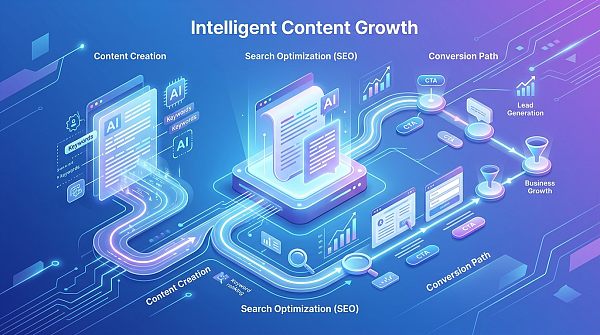
When many companies first encounter AI copywriting, their biggest concerns are “Will the content feel empty?” “Will customers think it is unprofessional?” “Will search engines dislike it?”. These concerns are reasonable, but the core issue is actually more specific: whether the copy makes the right audience, on the right page, at the right stage, willing to take the next step.
From a conversion perspective, whether a piece of marketing copy is effective usually depends on the following factors:
- Whether it matches user intent: When users search for “quotation, solution, results, case studies, how to choose,” their needs are completely different. If AI copy does not distinguish between these intents, it will be hard to convert no matter how smooth it reads.
- Whether it addresses core concerns: Business decision-makers care about ROI, risk, and scalability; executors care about operational efficiency and implementation methods; end consumers care more about whether it is reliable and worth buying.
- Whether it communicates value clearly: Not listing features, but clearly explaining “who it helps, what problem it solves, and what results it brings”.
- Whether it works together with page structure: No matter how good the copy is, if it sits on a website page with confusing information, unclear CTA, and slow loading speed, conversions will still be dragged down.
- Whether it is continuously optimized: The biggest advantage of AI writing is not “how fast it can write once,” but “whether it can repeatedly optimize headlines, paragraphs, keywords, and calls to action based on data”.
So, AI does not naturally lower conversions, nor does it naturally increase conversions. It is more like an efficiency amplifier: companies that already have clear strategies, precise positioning, and strong coordination between SEO and landing pages can often use AI to produce effective content faster; teams whose content strategy is already chaotic will only produce large volumes of pages that “look like content but do not actually drive deals” even faster.
What business decision-makers care about most is not content output, but ROI
For business management, the key to judging whether AI copy is worth using is not “whether it sounds human,” but “whether it can deliver better business results”. This can usually be evaluated from four dimensions:
- Whether customer acquisition cost decreases: After AI assists in mass-producing SEO articles, product page descriptions, and ad testing copy, has it reduced content production costs and reliance on outsourcing?
- Whether lead quality is stable: Is it bringing not just traffic growth, but inquiries and lead submissions that better match business needs?
- Whether content iteration speed improves: When facing different regions, different channels, and different product lines, can it generate multiple test versions faster?
- Whether brand risk is controllable: Are there factual errors, distorted statements, overpromising, misuse of industry terminology, and other issues?
For the integrated website + marketing services industry, the correct way to use AI copy is often not to replace the entire marketing team, but to embed it into the content production chain, taking on tasks such as first-draft generation, keyword expansion, user question summarization, headline testing, and FAQ organization, and then having editors, operations, and sales teams jointly review and refine it. In this way, efficiency is retained while avoiding a disconnect between “automated content” and real business needs.
Especially when a company is already using search engine optimization services, AI copy should be incorporated into a unified content strategy rather than used in isolation. Because users brought in by SEO are often in the information-gathering and solution-comparison stage, if the page copy cannot respond to their questions in time, then even with high rankings, conversion rates may still remain low.
What execution teams need to know more is: how should AI copy be written to convert more easily?
For content operations, website editors, media buyers, and after-sales support staff, the most valuable question is: what exactly should be done so that AI-generated content better matches real conversion needs?
It is recommended to start with the following process:
1. Define the page goal first, then let AI write
Do not start by asking AI to “write a marketing copy”. First clarify the page task: is it to get form submissions, encourage adding WeChat, guide consultations, drive trial sign-ups, or help customers understand the product? If the goal is different, the copy structure should also be different.
2. Use real search questions as prompt material
Compared with abstract descriptions, real user search terms are more decisive in shaping conversion direction. For example, “Does SEO optimization work?” “Will a website redesign affect rankings?” “How can social media advertising and official website conversions be connected?” These questions themselves are high-value content entry points.
3. Strengthen “result-oriented messaging” instead of “feature stacking”
A lot of AI copy tends to be written as “We provide XX services, have XX capabilities, and cover XX scenarios,” but what users really want to see is: how much efficiency it can improve for me, which trial-and-error can be reduced, which costs can be lowered, and which business results can be improved.
4. Give AI clear industry boundaries and brand tone of voice
If no constraints are given, AI can easily generate generic content. For example, when targeting B2B enterprise customers, exaggerated promotion and overly colloquial persuasion should be reduced, while solution logic, processes, metrics, case-study logic, and implementation conditions should be strengthened.
5. Look at data after launch, not just whether it “reads smoothly”
Whether a piece of copy is good is not determined by whether the internal team feels it is “quite professional,” but by bounce rate, time on page, form submission rate, button click-through rate, keyword ranking changes, and inquiry quality. AI is especially suitable for A/B testing: generate multiple versions for the same topic, then use data to filter out the expressions that truly work.
In some professional content scenarios, AI is also suitable for information integration and topic expansion, such as around industry research, business models, and solution interpretation, helping produce more structured articles. For example, in a knowledge-based content layout, it can be appropriately extended to topics such as financial management and industry operations, such as Exploration of cash flow forecast-based fund management optimization strategies for power enterprises, to capture more vertical and professional search demand, but the premise remains maintaining consistency with the website’s overall content architecture.
In what situations can AI marketing copy actually reduce conversions?
If used improperly, AI copy can indeed have negative effects. Common problems include:
- Content is overly templated: It reads as “everything is correct, but nothing is persuasive,” and after reading it, users still do not know how you differ from competitors.
- Keywords are awkwardly stuffed: Repeatedly forcing keywords in for website SEO optimization makes sentences unnatural, which in turn affects readability and trust.
- Lack of business authenticity: Case studies, data, service processes, and actual delivery are inconsistent, making gaps easy to appear after inquiries.
- Ignoring differences in buying stages: Writing educational content, comparison content, and transaction-oriented content in the same tone leads to serving no one well.
- No human review: Errors in industry terminology, policy wording, price commitments, or service boundaries will directly affect brand image.
Especially for distributors, agents, and after-sales personnel, they face more specific issues and customer feedback. If AI copy cannot answer “How do I operate it?” “What should I do if something goes wrong?” “Where are the service boundaries?”, then even if it attracts clicks, it will still be difficult to promote follow-up cooperation.
How can AI writing, SEO optimization, and social media marketing truly work together?
What truly brings sustainable conversions is not a single viral article, but complete coordination from traffic entry points to conversion nodes. A more mature approach usually includes:
- Search side: Build a content matrix around high-intent keywords, including industry questions, service introductions, solution comparisons, case explanations, and FAQ pages.
- Website side: Give each piece of content a clear landing objective, such as consultation entry points, product page redirects, lead forms, or online chat buttons.
- Social media side: Break the high-value viewpoints in articles into short-form content and continuously reach target users in social media marketing.
- Data side: Track the traffic quality, conversion paths, and deal feedback brought by each type of copy, and use that to optimize prompts and topic selection in reverse.
For companies that need long-term online customer acquisition, this collaborative way of thinking is more important than “simply pursuing whether AI writes fast or not”. Because search engine optimization services bring sustainable and accumulative traffic, social media marketing brings awareness and reach, and high-quality website copy is responsible for turning traffic into leads and interest into action.
How should companies judge whether now is the right time to use AI for marketing copy?
If your team is currently facing the following situations, then AI writing is usually worth integrating into the workflow as soon as possible:
- Content is updated infrequently, and the official website has long lacked new content;
- There are many SEO topics, but manual production capacity is insufficient;
- Multiple channels all need different versions of copy, and the team cannot adapt in time;
- There is already some traffic, but the page inquiry conversion rate is low, and different expressions need to be tested quickly;
- You hope to unify brand messaging and reduce repeated communication costs.
But if a company has not yet clearly sorted out its target customers, product selling points, service processes, and conversion paths, then it should not rush into using AI at scale. Because no matter how efficient the tool is, it cannot replace basic marketing judgment. AI is suitable for amplifying a clear strategy, not for covering up the absence of one.
Overall, AI-written marketing copy will affect conversions, but what determines the result has never been the two letters “AI,” but whether the content strategy is correct, whether the page design is reasonable, whether SEO content optimization is built around real search intent, and whether the company has connected search, website, social media, and conversion actions into a closed loop. For business decision-makers, the focus should be on ROI and risk control; for execution teams, the focus should be on process, testing, and continuous optimization. When used correctly, AI is not a conversion barrier, but an important tool for improving content efficiency and marketing growth capability.
Related Articles


Related Products
 EasyCamp SaaS Smart Website Marketing SystemE-Yingbao SaaS Smart Website Marketing System: AI-powered, zero-code website building. Rapidly launch multilingual independent e-commerce sites in just 10 minutes. Global server acceleration and AI-driven SEO optimization empower businesses to efficiently connect with global markets. The seamless integration of technology and user-friendly operation makes building e-commerce sites incredibly simple.
 AI+SEM Intelligent Advertising Marketing SystemAI+SEM drives intelligent ad creation, empowering full-funnel precision advertising marketing. The system automatically generates weekly/monthly reports, AI recommends keywords and target countries, monitors core metrics in real-time with intelligent alerts, and enables one-click high-conversion ad solutions to help quickly acquire customers and improve ROI.
 AI+SEO Dual Engine Optimization ServiceEasyWin AI+SEO Dual Engine Optimization System leverages AI-powered keyword mining, content generation, and comprehensive technical optimization to help foreign trade enterprises acquire high-quality organic traffic, significantly improving search rankings and conversion rates.
 AI+SNS Social Media Marketing SystemYingbao AI+SNS Social Media Marketing System - Precision social capture for the social media era. Supports one-click content synchronization across major platforms like Facebook and LinkedIn. AI intelligently rewrites posts for enhanced relevance. 24/7 AI customer service and user profiling analysis empower businesses to efficiently expand into global markets.
 AI+SEO营销解决方案易营宝AI+SEO营销解决方案,通过AI批量写作、智能生成TDK、精准关键词扩词等功能,全面优化网站SEO效果,提升流量与转化率。助力企业构建高效智能网站新生态。
 AI+SEM Advertising Marketing SolutionsAI+SEM Advertising Marketing Solution leverages AI technology to deeply empower SEM ad campaigns. It automatically generates weekly/monthly reports using AI, presenting account data across multiple dimensions for comprehensive insights into campaign performance and trends. The system precisely recommends keywords and target countries, intelligently generates high-conversion ad copy, and enables one-click activation of efficient campaign plans to help businesses rapidly acquire customers. Simultaneously, it monitors core metrics in real time, intelligently identifies abnormal fluctuations, and issues timely alerts to ensure stable, high-return advertising results.
 Domain Name ServicesEasyWin provides professional domain name services, including intelligent queries, one-stop registration, brand protection, and full lifecycle management, helping businesses build a digital brand image.
 EasyOperate B2C Cross-Border E-Commerce Platform & Independent WebsiteEasyStore B2C Cross-border E-commerce Independent Store is an intelligent website building and cross-border e-commerce integrated solution independently developed by EasyStore Information Technology (Beijing) Co., Ltd. The system is specially designed for small and medium-sized as well as large export enterprises, integrating 'website building, operation, marketing, advertising, and conversion' into one, helping enterprises quickly establish cross-border e-commerce independent stores to achieve brand globalization and global sales growth.
The platform supports multiple languages, multiple currencies, and multi-channel marketing, with built-in AI intelligent translation and SEO optimization systems, suitable for mainstream markets such as Southeast Asia, Europe and America, Latin America, and the Middle East, assisting Chinese manufacturing enterprises in efficiently deploying international e-commerce strategies. SSL证书易营宝提供专业SSL安全证书服务,包括单域名和泛域名证书,确保网站数据传输加密、身份验证和完整性保护,助力企业建立安全可信的在线业务环境。









