









- What New Signals Are Emerging in Enterprise Services SaaS Marketing ReportsJul 27, 2026View details
- What Does a Global Traffic Ecosystem Service Provider Do? What Are the Differences from a Single Advertising AgencyJul 16, 2026View details
- What should you focus on in the latest enterprise SaaS report? From renewal rates and delivery costs to overseas growth opportunitiesJul 12, 2026View details
- What signals are worth paying attention to in a cross-border marketing trend report? B2B companies should look at these 6 signalsJul 11, 2026View details
- How to Read a Cross-Border Marketing Trends Report? Five Key Dimensions for Evaluating Channel OpportunitiesJul 11, 2026View details
- Which channel has the highest ROI in the global traffic ecosystem? Comparative analysis of search, social media, and advertisingJul 10, 2026View details
- What multilingual website services are available in Sanya? Which model is more suitable for local businesses going global?Jul 08, 2026View details
- How to view the complete list of China SaaS companies in the top 100? Practical methods for screening website-building and marketing service providersJul 08, 2026View details
How can you tell whether website design cases are truly worth using as a reference?
When reviewing website design case studies, many companies’ first reaction is whether they “look good,” but the criteria that truly have reference value have never been limited to visual appeal alone. For business decision-makers, operations teams, and maintenance staff, whether a case is worth referencing depends on whether it can clearly explain: why the website was designed this way, whether it aligns with target user behavior, whether it can support SEO and promotion afterward, and whether it is capable of sustaining customer acquisition and maintenance after launch. In other words, reviewing case studies should not stay at the “aesthetic level,” but should return to core questions such as whether the website design pricing is reasonable, whether the steps for building a marketing website are complete, and whether the search engine optimization service can connect with these key issues. This article will break down, from a practical perspective, how to evaluate website design case studies so you can truly understand what matters.
Start with the conclusion: the core value of a website design case study is not whether it is “beautiful,” but whether it “can deliver business results”
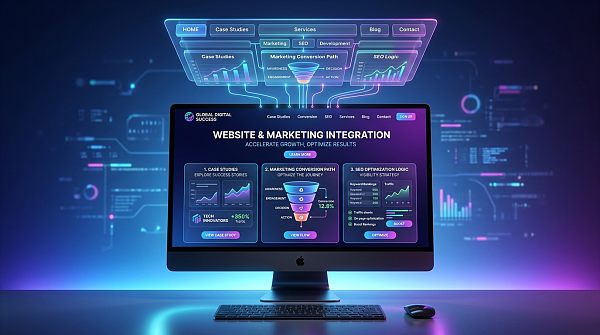
When users search for “how to evaluate website design case studies for reference value,” what they essentially want is not to see more beautiful websites, but to understand this: among the many cases presented by service providers, how can they judge which ones reflect real capability and which ones are merely polished portfolios.
For business decision-makers, the main concern is return on investment: can this case prove that the service provider has the ability to help a company acquire customers, improve conversions, and support brand building, rather than merely creating a few refined pages. For execution and operations teams, more attention is paid to the structure, logic, functionality, and room for later optimization behind the case. After-sales maintenance personnel will focus on whether the backend is easy to use, whether future updates are convenient, and whether the system is stable. Distributors, agents, and end consumers often care about whether the website is clear, trustworthy, and easy to use.
Therefore, a truly valuable website design case study should meet at least four conditions: first, clear objectives; second, a sound structure; third, a balance between marketing and SEO; fourth, the ability to support sustainable operation. If a case only shows homepage mockups but provides no business goals, user journey, functional explanation, or performance feedback, then its reference value is actually very limited.
When reviewing website design case studies, do not rush to look at the visuals first—first see what problems they solved
A common mistake many companies make is directly equating “strong design sense” with “an excellent case study.” In fact, website design is only a means, not the end goal. You need to first determine what industry this case served and what business problems it solved.
For example, the focus of a manufacturing website may be to showcase product strength, generate inquiries, and support multilingual expansion into overseas markets; a brand website may place more emphasis on image communication and content expression; while a marketing website will place stronger emphasis on landing page structure, form conversion, and call-to-action button design. Different industries and different goals require completely different evaluation standards for case studies.
So when reviewing a case study, you can first ask the service provider several questions:
- What industry does the client served by this website belong to, and what was the primary goal?
- What pain points existed before the website redesign—low traffic, low conversion, or weak brand expression?
- What business objectives did the design solution address, rather than focusing only on aesthetics?
- Was there any data feedback after launch, such as increased inquiries, lower bounce rates, or improved keyword rankings?
If a case study can clearly answer these questions, it means it is not a “display-oriented case study,” but a “problem-solving case study.” These cases are usually more worth referencing.
Cases truly worth referencing always reveal a clear information architecture and user journey
A website is not a poster; it is a process that guides users through understanding, trust, and action. Therefore, a website design case study with real reference value must show whether the information architecture is clear.
What is information architecture? Simply put, it means whether users can quickly find the content they want after entering the website and smoothly complete the next step. For example, does the homepage quickly explain what the company does, what problems it solves, and whom it serves? Are product pages clearly categorized? Does the case study page build trust? Is the contact page convenient for conversion?
You can focus on observing the following details:
- Whether the homepage hero section explains the business value within a few seconds, rather than being filled with vague slogans;
- Whether the navigation matches user habits, rather than sacrificing usability for a “premium feel”;
- Whether key pages have clear action guidance, such as inquiry, lead submission, downloading materials, or making a phone call;
- Whether the mobile browsing experience is smooth, and whether buttons, fonts, and forms are optimized for mobile use;
- Whether the path from the homepage to the product page and then to the inquiry page is smooth.
Many visually impressive website cases, once examined more closely, reveal confusing paths, fragmented information, and unclear priorities. Even if such websites look good visually, they are still hard to use as truly valuable references for conversion-oriented purposes.
Whether website design pricing is reasonable should be evaluated together with the functionality and delivery depth behind the case
When screening website development service providers, many companies separate website design case studies from website design pricing, which easily leads to misjudgment. In fact, whether a case has reference value is also closely related to the logic behind its pricing.
Even for the same “high-end website,” some quotes differ by only a few thousand yuan, while others differ by tens of thousands or more. The reason is often not the number of pages, but the huge differences in the work included behind the scenes. Cases truly worth referencing usually involve not only page design, but also content planning, user journey mapping, front-end interaction, backend management, SEO foundation deployment, data tracking, performance optimization, multilingual support, and more.
Therefore, when reviewing a case study, do not just ask, “How much did this website cost to make?” More importantly, ask:
- Does the case include custom planning, rather than just using a template?
- Was marketing-oriented content layout implemented?
- Does it take into account the foundational setup for search engine optimization service?
- Does the backend support future self-maintenance?
- Does it include launch testing, speed optimization, security maintenance, and related work?
If a case looks very complete but the price is unusually low, you should be alert that it may only have “good display results,” while the actual delivery may not cover that many details. Conversely, if a service provider can break down the case into business objectives, implementation process, and post-launch operational value, the pricing is usually more convincing as well.
To judge whether a case has marketing value, see whether it aligns with the steps of building a marketing website
The most direct way to determine whether a case has reference value is to work backward and see whether it follows a complete process for building a marketing website. Because websites that truly generate inquiries and conversions are rarely created simply by “a designer producing visuals directly”; instead, they come from a complete planning process.
Generally speaking, a reliable process should include the following stages:
- Clarifying business goals and target users;
- Analyzing competitors and the current state of industry websites;
- Organizing the website section structure and conversion path;
- Planning key page content and trust-building elements;
- Completing visual design and front-end development;
- Configuring SEO foundations, such as titles, URL, internal links, sitemaps, etc.;
- Conducting launch testing and continuously optimizing based on data.
If you see a case that only showcases design drafts but makes no mention of early-stage research, content planning, keyword layout, or later optimization, then it is more likely just a “web page production case” rather than a true marketing website case in the full sense.
This is similar to how many companies evaluate other professional services: they do not just look at the final deliverable, but also whether the methodology is complete. For example, in management consulting and performance optimization services, companies also care about whether the solution takes into account practical implementation and organizational fit. Content such as Implementation barriers and optimization paths of the balanced scorecard in budgeting and performance evaluation for aluminum processing enterprises has reference value for the same reason: it not only gives the results, but also explains the obstacles encountered during implementation and the optimization path. The same applies to website cases—only those that can clearly explain “how it was done, why it was done this way, and what the final results were” are worth learning from.
Do not overlook SEO and ongoing operations: a website that only displays but does not acquire customers has limited reference value
Against the industry backdrop of “integrated website + marketing services,” more and more companies have realized that a website cannot simply be considered finished once it goes live, but should become an asset for ongoing customer acquisition. Therefore, when reviewing website design case studies, you must ask yourself: did this case leave room for future search engine optimization service?
A website case with real long-term value usually has the following SEO-friendly characteristics:
- A clear page structure that is easy for search engines to crawl;
- Section planning centered on user search demand, rather than only on the company’s self-expression;
- Independent layouts for product pages, case pages, and article pages, making keyword coverage easier;
- Standardized URL, reasonable title tags, and clear internal linking logic;
- Good performance in loading speed, mobile adaptation, and code simplicity.
If a case only features flashy animations and large image layouts, but causes the webpage to load slowly, contain very little text information, and have a confusing structural hierarchy, then even if this kind of website looks “premium” in the short term, it may not be SEO-friendly and will be even less capable of supporting paid advertising or content marketing traffic.
For companies, the value of a website lies not only in the day it goes live, but in whether it can continuously generate leads over the next 12 months and 24 months. Therefore, whether a case takes long-term operations into account directly determines how much reference value it has.
Different roles look at case studies differently, so the focus and evaluation criteria should also differ
The same set of website design case studies will not look the same to different roles. If multiple people within a company are involved in vendor selection, it is recommended to evaluate by role separately, which makes it easier to reach an accurate judgment.
Business decision-makers: Focus on whether the case can support brand and growth goals, whether it has conversion results, whether the return on investment is reasonable, and whether the service provider has systematic capabilities.
Operations and user staff: Focus on whether the backend is easy to use, whether section updates are convenient, whether page content expansion is flexible, and whether future campaign pages or topic pages can be added easily.
After-sales maintenance personnel: Focus on whether the system is stable, whether permission management is clear, whether later updates and maintenance are difficult, and whether technical support is in place.
Distributors and agents: Focus on whether the website helps regional招商, product display, communication of cooperation policies, and lead collection.
End consumers: Care more about whether the website is trustworthy, whether the information is intuitive, whether the operation is smooth, and whether the contact and purchase path is convenient.
Therefore, when reviewing case studies, you should not only let designers judge whether they “look good,” but also involve business, operations, technical, and other relevant roles. Truly excellent cases are often those that can simultaneously meet the needs of multiple roles.
Finally, here is a simple and practical evaluation method: use “5 questions” to quickly screen case value
If you do not have time to study each case in depth, you can directly use these 5 questions for a quick judgment:
- Does it serve an industry or business scenario similar to mine?
When the industry is similar, the reference value is usually higher. - Does this case have a clear objective, rather than merely showcasing design results?
Cases that can explain goals such as customer acquisition, branding, and conversion are more credible. - Can I identify the user journey and information structure?
If the path is unclear, the website is likely just visual packaging. - Does it take SEO, mobile, and ongoing operations into account?
A website that can continue to operate and be optimized is far more valuable than a one-time display site. - Can the service provider clearly explain the logic, process, and results behind the case?
Clear explanations usually demonstrate capability better than “just sending screenshots.”
If most of the answers to these 5 questions are positive, then this website design case study usually has strong reference value. Conversely, if a case only provides images, with no background, no process, and no results, then it will not be very helpful for your actual decision-making.
Overall, the key to evaluating whether a website design case study has reference value is not whether it “looks pretty,” but whether it truly revolves around business goals, user experience, marketing conversion, and long-term operation. A case worth referencing should help you judge whether the website design pricing is reasonable, understand whether the steps for building a marketing website are complete, and see whether the search engine optimization service can be connected smoothly. Only by evaluating cases through the lens of “business results” rather than “visual perception” can companies truly choose the website development and marketing cooperation solution that suits them.
Related Articles


Related Products
 EasyCamp SaaS Smart Website Marketing SystemE-Yingbao SaaS Smart Website Marketing System: AI-powered, zero-code website building. Rapidly launch multilingual independent e-commerce sites in just 10 minutes. Global server acceleration and AI-driven SEO optimization empower businesses to efficiently connect with global markets. The seamless integration of technology and user-friendly operation makes building e-commerce sites incredibly simple.
 AI+SEM Intelligent Advertising Marketing SystemAI+SEM drives intelligent ad creation, empowering full-funnel precision advertising marketing. The system automatically generates weekly/monthly reports, AI recommends keywords and target countries, monitors core metrics in real-time with intelligent alerts, and enables one-click high-conversion ad solutions to help quickly acquire customers and improve ROI.
 AI+SEO Dual Engine Optimization ServiceEasyWin AI+SEO Dual Engine Optimization System leverages AI-powered keyword mining, content generation, and comprehensive technical optimization to help foreign trade enterprises acquire high-quality organic traffic, significantly improving search rankings and conversion rates.
 AI+SNS Social Media Marketing SystemYingbao AI+SNS Social Media Marketing System - Precision social capture for the social media era. Supports one-click content synchronization across major platforms like Facebook and LinkedIn. AI intelligently rewrites posts for enhanced relevance. 24/7 AI customer service and user profiling analysis empower businesses to efficiently expand into global markets.
 AI+SEO营销解决方案易营宝AI+SEO营销解决方案,通过AI批量写作、智能生成TDK、精准关键词扩词等功能,全面优化网站SEO效果,提升流量与转化率。助力企业构建高效智能网站新生态。
 AI+SEM Advertising Marketing SolutionsAI+SEM Advertising Marketing Solution leverages AI technology to deeply empower SEM ad campaigns. It automatically generates weekly/monthly reports using AI, presenting account data across multiple dimensions for comprehensive insights into campaign performance and trends. The system precisely recommends keywords and target countries, intelligently generates high-conversion ad copy, and enables one-click activation of efficient campaign plans to help businesses rapidly acquire customers. Simultaneously, it monitors core metrics in real time, intelligently identifies abnormal fluctuations, and issues timely alerts to ensure stable, high-return advertising results.
 Domain Name ServicesEasyWin provides professional domain name services, including intelligent queries, one-stop registration, brand protection, and full lifecycle management, helping businesses build a digital brand image.
 EasyOperate B2C Cross-Border E-Commerce Platform & Independent WebsiteEasyStore B2C Cross-border E-commerce Independent Store is an intelligent website building and cross-border e-commerce integrated solution independently developed by EasyStore Information Technology (Beijing) Co., Ltd. The system is specially designed for small and medium-sized as well as large export enterprises, integrating 'website building, operation, marketing, advertising, and conversion' into one, helping enterprises quickly establish cross-border e-commerce independent stores to achieve brand globalization and global sales growth.
The platform supports multiple languages, multiple currencies, and multi-channel marketing, with built-in AI intelligent translation and SEO optimization systems, suitable for mainstream markets such as Southeast Asia, Europe and America, Latin America, and the Middle East, assisting Chinese manufacturing enterprises in efficiently deploying international e-commerce strategies. SSL证书易营宝提供专业SSL安全证书服务,包括单域名和泛域名证书,确保网站数据传输加密、身份验证和完整性保护,助力企业建立安全可信的在线业务环境。









