









- What New Signals Are Emerging in Enterprise Services SaaS Marketing ReportsJul 27, 2026View details
- What Does a Global Traffic Ecosystem Service Provider Do? What Are the Differences from a Single Advertising AgencyJul 16, 2026View details
- What should you focus on in the latest enterprise SaaS report? From renewal rates and delivery costs to overseas growth opportunitiesJul 12, 2026View details
- What signals are worth paying attention to in a cross-border marketing trend report? B2B companies should look at these 6 signalsJul 11, 2026View details
- How to Read a Cross-Border Marketing Trends Report? Five Key Dimensions for Evaluating Channel OpportunitiesJul 11, 2026View details
- Which channel has the highest ROI in the global traffic ecosystem? Comparative analysis of search, social media, and advertisingJul 10, 2026View details
- What multilingual website services are available in Sanya? Which model is more suitable for local businesses going global?Jul 08, 2026View details
- How to view the complete list of China SaaS companies in the top 100? Practical methods for screening website-building and marketing service providersJul 08, 2026View details
How to Choose the Right Type of SSL Certificate?
How should you choose the most suitable SSL certificate to purchase? Conclusion first: for most corporate websites, brand showcase sites, and marketing websites, it is sufficient to prioritize DV or OV certificates; if the website involves online payments, member privacy, contract signing, bidding, finance, or other high-trust scenarios, then EV certificates should be evaluated more carefully. What truly affects the selection is not only the SSL certificate price, but also the website’s business type, user trust requirements, whether there are multiple subdomains, the later maintenance cost, and the renewal management pressure caused by the SSL certificate validity period. Choosing correctly can not only meet HTTPS encryption and browser trust requirements, but also avoid the problems of “over-specification with underuse” or “buying cheap first and finding it insufficient later.”
When users buy an SSL certificate, the key is not “the most expensive is the best,” but first looking at the website’s purpose
From the perspective of users searching for “how to choose the most suitable type when buying an SSL certificate,” the core intent is usually not to understand abstract concepts, but to quickly determine: which one should my website buy, how much should the budget be, and whether I might choose the wrong one.
For business decision-makers, the main concerns are return on investment, brand credibility, data security risks, and subsequent management costs; for operators and after-sales maintenance personnel, the greater concerns are the SSL certificate application process, deployment difficulty, compatibility, renewal frequency, and whether the certificate supports multiple domains; for distributors, agents, and end consumers, more attention is paid to the certificate’s security level, whether it affects conversion, and the credibility endorsement role different certificates play in customer communication.
Therefore, the most practical decision sequence when selecting is not to look at the brand first, but to look at these 4 things first:
- Whether the website is only for basic display, or involves the transmission of sensitive information such as login, forms, orders, and payments
- Whether it uses a single domain, multiple subdomains, or multiple different primary domains at the same time
- Whether the company needs to strengthen brand public credibility and user trust
- Whether there is internal capability to handle long-term certificate renewal and operation & maintenance management
What are the main types of SSL certificates, and which step do companies most easily get wrong
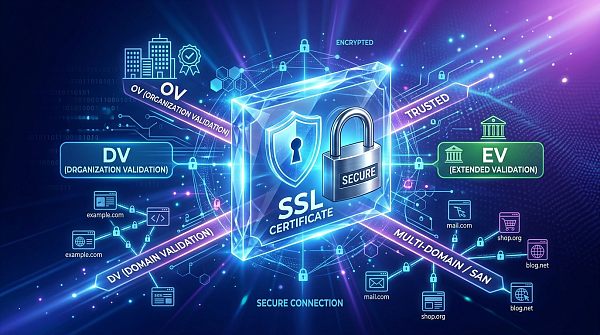
From the perspective of validation level, SSL certificates are usually divided into three types: DV, OV, and EV:
- DV certificate: only verifies domain control, is fast to apply for, relatively low in price, and suitable for personal sites, small corporate websites, event pages, and basic marketing pages.
- OV certificate: verifies the identity of the company or organization, provides stronger security endorsement than DV, and is suitable for most formal corporate websites, foreign trade sites, B2B showcase sites, and brand marketing sites.
- EV certificate: has the strictest review process, places greater emphasis on the authenticity of corporate identity, and is suitable for high-trust scenarios such as finance, payment, government and enterprise service platforms, and high-value transaction platforms.
From the perspective of domain coverage, they can also be divided into:
- Single-domain certificate: only protects one full domain, such as www.example.com
- Wildcard certificate: protects multiple subdomains under one primary domain, such as *.example.com
- Multi-domain certificate: suitable for unified deployment and management of multiple different primary domains
The step companies most easily get wrong is often focusing only on the SSL certificate price while ignoring future business expansion. For example, if the company currently only has an official website, but plans to launch an English site, event site, customer service subdomain, and distributor backend in half a year, then if it only buys the most basic single-domain certificate at the start, it may later need repeated purchases and deployments, making the overall cost even higher instead.
Recommendations for choosing SSL certificate types in different website scenarios
1. Corporate website / brand showcase site
If it is mainly used for company introduction, brand display, case showcase, and contact form collection, then a DV certificate is usually enough to meet basic HTTPS requirements. But if the company wants to enhance customer trust, especially for sites targeting B2B customers, overseas customers, or traffic acquisition through advertising, an OV certificate is more recommended.
2. Marketing website / landing page / main site in an SEO site network
These types of websites focus more on conversion. Users are more sensitive to security prompts when visiting. If it involves form submissions, lead collection, or online consultation, it is recommended to use at least a DV certificate; if you want to strengthen corporate credibility and reduce user hesitation, OV is more reliable.
3. E-commerce website / membership system / payment platform
These scenarios involve accounts, passwords, orders, and payment information, so it is recommended to prioritize OV or EV certificates. Especially for brand malls, distribution platforms, and dealer systems, the certificate is not only an encryption tool, but also affects users’ perception of the platform’s legitimacy.
4. Multi-subdomain business systems
If the official website, help center, CRM, email system, and dealer backend are all under the same primary domain, using a wildcard certificate is usually more convenient. It can significantly reduce deployment complexity and lower the workload of repeated configuration for maintenance personnel.
5. Multi-brand or multi-region websites
If a company operates multiple different domains at the same time, it is recommended to consider a multi-domain certificate for easier unified management, especially suitable for group companies, service providers, and distributor systems.
Besides price, more attention should be paid to SSL certificate validity period, management cost, and renewal risk
Many people only compare quotations when purchasing, but ignore the SSL certificate validity period and subsequent maintenance issues. Today’s mainstream browsers and industry standards have stricter requirements for certificate validity periods, so companies must establish a clear renewal mechanism. Otherwise, once the certificate expires, the website will display a “Not Secure” warning, seriously affecting SEO performance, user conversion, and brand trust.
For executives and operations & maintenance personnel, it is recommended to focus on evaluating the following points:
- Whether certificate renewal supports automation or convenient reminders
- Whether deployment to servers, CDN, load balancers, and email systems is convenient
- Whether reissuance is supported
- Whether handling certificate loss or private key replacement is simple
- Whether multi-site certificate management is centralized and controllable
If a company has many websites, updates frequently, and runs marketing campaigns often, simply pursuing the lowest price is usually not the best solution. A more reasonable approach is: on the premise of meeting security requirements, prioritize a solution with high management efficiency, low renewal pressure, and compatibility with business expansion.
How to determine which type suits you in the SSL certificate application process
In actual operation, you can judge according to the following process:
- First sort out the website business: whether it involves login, payment, collection of private information, online signing, etc.
- Confirm the domain structure: whether it is a single domain, multiple subdomains, or multiple primary domains.
- Evaluate trust requirements: whether customers’ transactions will be affected by the “authenticity of the enterprise.”
- Consider budget and maintenance capability: whether there is dedicated staff responsible for certificate renewal and server configuration.
- Choose based on review turnaround time: when an event needs to go live urgently, DV certificates are usually faster; if there are brand compliance requirements, OV or EV materials can be prepared in advance.
Generally speaking, the SSL certificate application process is not complicated. The difficulty lies not in the application itself, but in whether the right type is chosen in the early stage and whether it can be maintained stably later. For teams simultaneously responsible for website building, SEO optimization, and landing page campaigns, HTTPS configuration quality also affects page crawling, redirection rules, site credibility, and user dwell time, so certificate procurement cannot be treated as a purely technical minor matter.
When companies purchase, how can they avoid “wasting money”
Here are several common misunderstandings:
- Misunderstanding 1: The more expensive, the more secure
The core differences between different certificates lie more in validation level and applicable scenarios, and the most expensive one is not necessarily suitable for all websites. - Misunderstanding 2: Only looking at current needs
Ignoring future subdomain expansion, site network layout, and overseas business launch makes later supplementary purchases more troublesome. - Misunderstanding 3: Only purchasing without managing
Certificate expiration, deployment errors, and incomplete HTTP to HTTPS redirect configuration may all affect website access and marketing effectiveness. - Misunderstanding 4: Treating SSL as “install it and you’re done”
A truly complete security and conversion experience also includes server configuration, site speed, page trust elements, and overall digital operations capability.
From the perspective of enterprise digital marketing practice, every detail of website infrastructure affects customer perception and conversion efficiency. Similar to management system upgrades, many organizations also optimize decision-making from the perspectives of process collaboration and value integration. For example, Analysis of application strategies of business-finance integration in the transformation practice of financial management in public institutions reflects the idea of “not only looking at single-point costs, but also at overall collaborative benefits.” Applied to SSL certificate procurement, the same logic holds true: a certificate is not an isolated procurement item, but part of the website security, brand trust, and marketing conversion system.
A practical quick-reference table: which SSL certificate is more suitable for your situation
- Personal blog / small showcase page: DV single-domain certificate
- Corporate website / foreign trade showcase site: OV single-domain certificate is more common
- Corporate site network with multiple subdomains: DV or OV wildcard certificate
- Multiple different brand or regional domains: multi-domain certificate
- Mall / payment / government and enterprise service platform: OV or EV certificate
- Limited budget but need to go live quickly: start with DV, then upgrade according to business needs later
If you are still unsure, one simple principle is: first choose the validation type based on risk and trust level, then choose the coverage method based on the number of domains, and finally compare price and service.
Summary: how to choose an SSL certificate depends on business risk, trust requirements, and later management
How should you choose the most suitable type when purchasing an SSL certificate? The answer is not fixed, but should be judged comprehensively based on the website’s purpose, customer trust requirements, domain structure, SSL certificate validity period, and maintenance capability. For most companies, OV is a more balanced priority for official websites and marketing sites; if the budget is limited or the project is temporary, DV can be used first; for high-trust, high-transaction, and high-compliance scenarios, then consider EV. If there are multiple subdomains or multiple sites running in parallel, prioritize wildcard or multi-domain certificates to avoid repeated investment.
Ultimately, the goal of choosing an SSL certificate is not “to buy a certificate,” but to make website access more secure, brand image more trustworthy, marketing conversion more stable, and operations & maintenance management more worry-free. As long as you follow this logic, you will basically avoid wasting money.
Related Articles



Related Products
 EasyCamp SaaS Smart Website Marketing SystemE-Yingbao SaaS Smart Website Marketing System: AI-powered, zero-code website building. Rapidly launch multilingual independent e-commerce sites in just 10 minutes. Global server acceleration and AI-driven SEO optimization empower businesses to efficiently connect with global markets. The seamless integration of technology and user-friendly operation makes building e-commerce sites incredibly simple.
 AI+SEM Intelligent Advertising Marketing SystemAI+SEM drives intelligent ad creation, empowering full-funnel precision advertising marketing. The system automatically generates weekly/monthly reports, AI recommends keywords and target countries, monitors core metrics in real-time with intelligent alerts, and enables one-click high-conversion ad solutions to help quickly acquire customers and improve ROI.
 AI+SEO Dual Engine Optimization ServiceEasyWin AI+SEO Dual Engine Optimization System leverages AI-powered keyword mining, content generation, and comprehensive technical optimization to help foreign trade enterprises acquire high-quality organic traffic, significantly improving search rankings and conversion rates.
 AI+SNS Social Media Marketing SystemYingbao AI+SNS Social Media Marketing System - Precision social capture for the social media era. Supports one-click content synchronization across major platforms like Facebook and LinkedIn. AI intelligently rewrites posts for enhanced relevance. 24/7 AI customer service and user profiling analysis empower businesses to efficiently expand into global markets.
 AI+SEO营销解决方案易营宝AI+SEO营销解决方案,通过AI批量写作、智能生成TDK、精准关键词扩词等功能,全面优化网站SEO效果,提升流量与转化率。助力企业构建高效智能网站新生态。
 AI+SEM Advertising Marketing SolutionsAI+SEM Advertising Marketing Solution leverages AI technology to deeply empower SEM ad campaigns. It automatically generates weekly/monthly reports using AI, presenting account data across multiple dimensions for comprehensive insights into campaign performance and trends. The system precisely recommends keywords and target countries, intelligently generates high-conversion ad copy, and enables one-click activation of efficient campaign plans to help businesses rapidly acquire customers. Simultaneously, it monitors core metrics in real time, intelligently identifies abnormal fluctuations, and issues timely alerts to ensure stable, high-return advertising results.
 Domain Name ServicesEasyWin provides professional domain name services, including intelligent queries, one-stop registration, brand protection, and full lifecycle management, helping businesses build a digital brand image.
 EasyOperate B2C Cross-Border E-Commerce Platform & Independent WebsiteEasyStore B2C Cross-border E-commerce Independent Store is an intelligent website building and cross-border e-commerce integrated solution independently developed by EasyStore Information Technology (Beijing) Co., Ltd. The system is specially designed for small and medium-sized as well as large export enterprises, integrating 'website building, operation, marketing, advertising, and conversion' into one, helping enterprises quickly establish cross-border e-commerce independent stores to achieve brand globalization and global sales growth.
The platform supports multiple languages, multiple currencies, and multi-channel marketing, with built-in AI intelligent translation and SEO optimization systems, suitable for mainstream markets such as Southeast Asia, Europe and America, Latin America, and the Middle East, assisting Chinese manufacturing enterprises in efficiently deploying international e-commerce strategies. SSL证书易营宝提供专业SSL安全证书服务,包括单域名和泛域名证书,确保网站数据传输加密、身份验证和完整性保护,助力企业建立安全可信的在线业务环境。









