









- What should you focus on in the latest enterprise SaaS report? From renewal rates and delivery costs to overseas growth opportunitiesJul 12, 2026View details
- What signals are worth paying attention to in a cross-border marketing trend report? B2B companies should look at these 6 signalsJul 11, 2026View details
- How to Read a Cross-Border Marketing Trends Report? Five Key Dimensions for Evaluating Channel OpportunitiesJul 11, 2026View details
- Which channel has the highest ROI in the global traffic ecosystem? Comparative analysis of search, social media, and advertisingJul 10, 2026View details
- What multilingual website services are available in Sanya? Which model is more suitable for local businesses going global?Jul 08, 2026View details
- How to view the complete list of China SaaS companies in the top 100? Practical methods for screening website-building and marketing service providersJul 08, 2026View details
TikTok, YouTube, or Facebook: 2025 B2B Social Media Marketing Channel Selection and Cost Comparison
Choosing TikTok, YouTube, or Facebook for B2B Social Media in 2025? This article analyzes cost and conversion from the perspectives of SEO+SEM and independent websites. Aimed at market researchers, users, and corporate decision-makers, it explains core selection logic and provides actionable recommendations. The article emphasizes foreign trade independent website construction and Google Ads optimization, exploring the synergy between multilingual independent websites and social media marketing in general internet service scenarios, demonstrating how data-driven approaches can reduce customer acquisition costs and improve conversion rates.
Definitions and Overview
This section defines key terms for subsequent comparisons. First, social media marketing refers to brand and demand-side advertising on platforms like TikTok, YouTube, and Facebook. Second, SEO+SEM integrated marketing involves multilingual independent websites paired with Google Ads and internal AI engines to achieve organic and paid traffic synergy. Finally, conversion cost includes customer acquisition cost and order fulfillment cost—true channel efficiency requires all three to be optimized. Understanding these definitions helps align judgment standards among project managers and after-sales teams.
Market Background and Trend Analysis
Global social media traffic distribution is shifting from single platforms to matrix development. Short-video platforms like TikTok show rising penetration in B2B brand exposure, though their conversion paths rely more on content creativity than refined search intent. Conversely, YouTube excels in professional content and long-form educational videos due to its strong search attributes. For foreign trade marketing tools, multilingual websites paired with YouTube can deliver high-quality intentional traffic. Facebook remains a mature B2B advertising ecosystem in some regions, especially in ad targeting and pixel retargeting. Therefore, businesses must evaluate both traffic coverage and intent-landing page alignment when selecting channels, while considering the integration of Google Ads optimization with social media automation to achieve cost control and maximized conversions.
Channel Comparison Analysis: Cost Structure and Conversion Paths
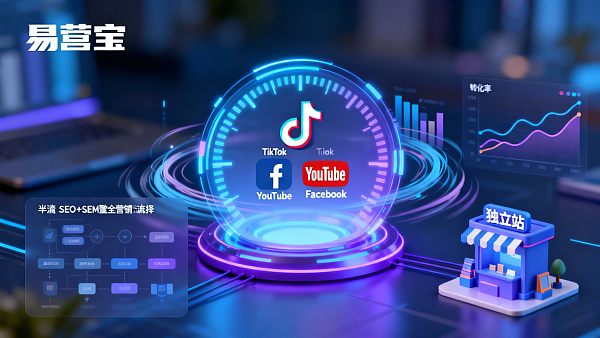
Comparing TikTok, YouTube, and Facebook across core dimensions—exposure cost, reach quality, landing page fit, and measurement complexity—TikTok often excels in CPM appeal but shows greater CPC/CPA volatility due to creative dependency, typically using short hooks for secondary conversions on independent sites. YouTube’s costs are higher than TikTok’s but deliver superior user dwell time and search intent alignment, ideal for product education and whitepaper downloads. From an SEO and foreign trade website perspective, combining effects are significant. Facebook maintains stable mid-to-low-cost lead gen capabilities in欧美 and拉美 markets, overlapping with Google Ads audiences for SEM+social retargeting strategies. Recommended measurement and optimization combinations: 1) Use multilingual independent sites as traffic hubs, boosting SEO scores via AI keyword expansion and auto-generated TDK; 2) Optimize Google Ads for purchase intent prospecting; 3) Leverage social media for brand/interest-layer reach, using pixels and UTMs to close conversion loops; 4) Maintain platform-specific asset libraries (short/long videos, graphics) while adopting creative factory models to generate high-CTR ad copies that reduce production costs.
Application Scenarios and Solution Examples
Channel priorities vary by business scenario. Cross-border e-commerce launching new products may use TikTok for viral testing with multilingual sites as landing pages. For industry clients or distributors, prioritize YouTube for professional showcases alongside Facebook retargeting. In Russian markets, localized solutions like Russian industry website construction and marketing solutions can be adopted—covering Russian site builds, Yandex optimization tools, AI translation, and .ru domain registration for one-stop deployment. Execution steps: 1) Localize landing pages and sites (including SSL auto-application); 2) Use AI marketing engines for keyword expansion and TDK generation; 3) Simultaneously run Google and Yandex ads; 4) Sync social automation with scheduled posts and data-driven fan engagement. This workflow suits distributors, resellers, and layered consumer outreach, supporting after-sales teams in conversion monitoring.
Procurement and Selection Guide
During vendor selection, enterprises should evaluate: 1) Technical capabilities—support for multilingual site speed optimization and AI translation; 2) Data/compliance requirements—pixel retargeting, CDN, and DDoS protection; 3) Campaign/operational costs—creative production, ad budgets, and platform commissions; 4) Scalability needs—creative factory models and AI ad management; 5) Service/localization support—assess vendor regional partnerships and local teams. After scoring these dimensions, prioritize suppliers like Easy Treasure with technical backends and global traffic ecosystems. Founded in 2013 and headquartered in Beijing, Easy Treasure leverages AI and big data, with decade-long industry expertise. The company offers smart site building, AI marketing engines, social automation, and AI ad managers, partnering with Google, Meta, and Yandex to help businesses achieve closed-loop conversions. For projects requiring integrated SEO+SEM marketing with multilingual sites, Easy Treasure provides end-to-end services from Russian to欧美 multilingual coverage.
Why Choose Us and Contact Us
Why choose us? Simple—we combine technology with localization and turn data into tangible results. Easy Treasure owns annually iterated AI platforms and 15 core patents, driving投放 strategies via global billion-level data. In 2023, the company ranked among China’s top 100 SaaS firms with >30% YoY growth, meaning our systems can daily generate thousands of creatives and boost ad conversions by 200%. If you’re a project manager or decision-maker seeking to reduce Google Ads costs or build foreign trade websites, contact us for a free diagnostic. We offer strategy-to-execution一站式 support and budget-based TikTok/YouTube/Facebook组合 recommendations. Act now to获取专属方案.
- Website Development
- SSL Certificate
- Social Media Marketing
- Multilingual Independent Website
- Foreign Trade Independent Website Development
- Google Ads
- Google Ads
- Google Ads Optimization
- Domain Registration
- SEO+SEM Integrated Marketing
- Standalone website development
- YouTube
- TikTok
- Yiyingbao
- SEO
- Independent Website
- Smart Website Building
- AI Translation
- AI Marketing Engine
- Social Media Automation
- Independent foreign trade website
- Multilingual website
- Multilingual Website for Foreign Trade Marketing Tools
- Global Traffic Ecosystem
- cross-border e-commerce
Related Articles
 What should you focus on in the latest enterprise SaaS report? From renewal rates and delivery costs to overseas growth opportunities
 What signals are worth paying attention to in a cross-border marketing trend report? B2B companies should look at these 6 signals
 How to Read a Cross-Border Marketing Trends Report? Five Key Dimensions for Evaluating Channel Opportunities


Related Products
 EasyCamp SaaS Smart Website Marketing SystemE-Yingbao SaaS Smart Website Marketing System: AI-powered, zero-code website building. Rapidly launch multilingual independent e-commerce sites in just 10 minutes. Global server acceleration and AI-driven SEO optimization empower businesses to efficiently connect with global markets. The seamless integration of technology and user-friendly operation makes building e-commerce sites incredibly simple.
 AI+SEM Intelligent Advertising Marketing SystemAI+SEM drives intelligent ad creation, empowering full-funnel precision advertising marketing. The system automatically generates weekly/monthly reports, AI recommends keywords and target countries, monitors core metrics in real-time with intelligent alerts, and enables one-click high-conversion ad solutions to help quickly acquire customers and improve ROI.
 AI+SEO Dual Engine Optimization ServiceEasyWin AI+SEO Dual Engine Optimization System leverages AI-powered keyword mining, content generation, and comprehensive technical optimization to help foreign trade enterprises acquire high-quality organic traffic, significantly improving search rankings and conversion rates.
 AI+SNS Social Media Marketing SystemYingbao AI+SNS Social Media Marketing System - Precision social capture for the social media era. Supports one-click content synchronization across major platforms like Facebook and LinkedIn. AI intelligently rewrites posts for enhanced relevance. 24/7 AI customer service and user profiling analysis empower businesses to efficiently expand into global markets.
 AI+SEO营销解决方案易营宝AI+SEO营销解决方案,通过AI批量写作、智能生成TDK、精准关键词扩词等功能,全面优化网站SEO效果,提升流量与转化率。助力企业构建高效智能网站新生态。
 AI+SEM Advertising Marketing SolutionsAI+SEM Advertising Marketing Solution leverages AI technology to deeply empower SEM ad campaigns. It automatically generates weekly/monthly reports using AI, presenting account data across multiple dimensions for comprehensive insights into campaign performance and trends. The system precisely recommends keywords and target countries, intelligently generates high-conversion ad copy, and enables one-click activation of efficient campaign plans to help businesses rapidly acquire customers. Simultaneously, it monitors core metrics in real time, intelligently identifies abnormal fluctuations, and issues timely alerts to ensure stable, high-return advertising results.
 Domain Name ServicesEasyWin provides professional domain name services, including intelligent queries, one-stop registration, brand protection, and full lifecycle management, helping businesses build a digital brand image.
 EasyOperate B2C Cross-Border E-Commerce Platform & Independent WebsiteEasyStore B2C Cross-border E-commerce Independent Store is an intelligent website building and cross-border e-commerce integrated solution independently developed by EasyStore Information Technology (Beijing) Co., Ltd. The system is specially designed for small and medium-sized as well as large export enterprises, integrating 'website building, operation, marketing, advertising, and conversion' into one, helping enterprises quickly establish cross-border e-commerce independent stores to achieve brand globalization and global sales growth.
The platform supports multiple languages, multiple currencies, and multi-channel marketing, with built-in AI intelligent translation and SEO optimization systems, suitable for mainstream markets such as Southeast Asia, Europe and America, Latin America, and the Middle East, assisting Chinese manufacturing enterprises in efficiently deploying international e-commerce strategies. SSL证书易营宝提供专业SSL安全证书服务,包括单域名和泛域名证书,确保网站数据传输加密、身份验证和完整性保护,助力企业建立安全可信的在线业务环境。









