









- How to assess foreign trade website development trends?Looking at 2026 changes from multilingual,AI content to conversion pathsJul 04, 2026View details
- What are the new trends in multilingual marketing data analytics tools in 2026? Focus on attribution、automation and complianceJul 04, 2026View details
- Is Brand Globalization Marketing Consulting Worth Buying? At What Stage Should Companies Bring It InJul 01, 2026View details
- Cross-Border Marketing Trend Research: Why More and More Companies Are Starting to Deploy AI Search and GEO OptimizationJun 30, 2026View details
- Cross-Border Marketing Trend Research: How Independent Sites, AI Content, and Short-Video Customer Acquisition Are ChangingJun 30, 2026View details
- How Can a Brand Updates Page Be Made More SEO-Friendly? Analysis of Update Frequency, Content Structure, and Internal Linking StrategyJun 28, 2026View details
- What stages does the cross-border services ecosystem include? How do website building, promotion, payment, and compliance work togetherJun 22, 2026View details
- How will email marketing costs change in 2026Jun 22, 2026View details
Is responsive foreign trade website development suitable for the German market
Is responsive foreign trade website development suitable for the German market? This question cannot be judged only by whether it “can adapt to screen sizes,” but also by whether it meets German users’ high expectations for speed, structure, privacy, and credibility. For integrated website + marketing service projects, responsive design is usually a basic requirement, but if localized content, compliance mechanisms, and conversion paths are lacking, the website will still struggle to gain inquiries and trust in the German market.
Why a checklist-based approach should be used to determine whether responsive foreign trade website development is suitable for the German market
Decision-making in the German market is relatively rational, and visitors will repeatedly compare page information, company qualifications, delivery capabilities, and privacy terms. Whether responsive foreign trade website development is suitable for the German market depends not on “whether it is responsive,” but on “whether responsiveness serves trust building and marketing conversion.”
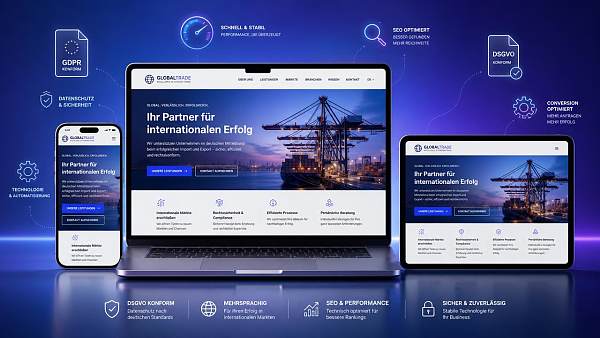
Using a checklist-based method for evaluation can quickly identify weaknesses in terminal compatibility, loading efficiency, GDPR-related display, content organization, SEO fundamentals, and lead collection. This approach is more effective than simply pursuing visual effects, and it also better fits the actual communication rhythm of the German market.
Is responsive foreign trade website development suitable for the German market: Core checklist
- Prioritize checking consistency between mobile and desktop versions to ensure that navigation, product specifications, forms, and download entry points display stably across different devices, so German users do not leave the site directly during the price comparison stage due to missing information.
- Compress image and script resources, and keep above-the-fold loading within a reasonable range. German users have low tolerance for page waiting times, and if responsive pages are too heavy, this will directly affect organic rankings and advertising performance.
- Complete the privacy policy, Cookie notice, contact information, and company entity description, so that responsive foreign trade website development is not only technically adaptive, but also capable of compliance presentation in line with German market habits.
- Standardize the product page structure, highlighting technical parameters, application scenarios, certification details, delivery cycles, and after-sales processes. The German market pays more attention to detailed evidence; the clearer the page, the lower the conversion resistance.
- Set clear conversion points, such as inquiry forms, appointment scheduling, document downloads, and case viewing, so that the responsive website is not only viewable, but can also continuously receive SEO and advertising traffic.
- Deploy basic SEO elements, including titles, descriptions, structured hierarchy, and internal linking plans. Whether responsive foreign trade website development is suitable for the German market ultimately also depends on whether search engines are willing to crawl and rank it consistently.
- Strengthen localized expression and avoid mechanical literal translation. German users trust content styles that are accurate, restrained, and information-dense more than overly promotional copy.
- Integrate data analytics and conversion tracking to separately observe device distribution, page dwell time, bounce rate, and form submissions in the German region, and use data to determine whether the responsive strategy is truly effective.
In different application scenarios, the adaptation priorities of responsive solutions are not the same
Websites mainly focused on brand presentation
If the website mainly serves the task of brand building, is responsive foreign trade website development suitable for the German market? The answer tends to be yes, but the premise is that brand information must be “credible and restrained.” The page should highlight company history, technical capabilities, accumulated case studies, cooperation regions, and service processes, rather than piling up large numbers of visual effects.
In this scenario, the value of responsive design lies in maintaining reading continuity across different devices, especially for company profiles, qualification documents, and detailed case pages. If combined with content asset management, it can also extend to white papers, trend articles, and similar sections. For example, around content on organizational resilience, it can naturally relate to topics such as Analysis of the impact of digital transformation on enterprise resilience, thereby enhancing professional trust.
Websites mainly focused on customer acquisition and conversion
If the website places greater emphasis on inquiry generation, then responsive pages cannot only pursue “compatibility,” but must also value the “deal path.” Before submitting a form, German users usually first verify specifications, lead times, certifications, FAQ, and contact information, so the page structure must support step-by-step decision-making.
In this case, it is recommended to keep form fields within the necessary range and set layered content: the first screen explains the core value, the middle section presents evidence, and the bottom provides the action entry point. This is more suitable for coordination among SEO, advertising campaigns, and remarketing, and also better fits the operating logic of website + marketing service integration.
Websites mainly focused on multilingual expansion
When a company is simultaneously expanding into Germany and other European markets, whether responsive foreign trade website development is suitable for the German market also depends on whether the multilingual structure is clear. German pages should not simply be copies of English pages, but should adjust section naming, keyword placement, and content order according to local search habits.
In addition, the responsive layout must account for variations in text length across different languages. German words are relatively long, and buttons, navigation, and tables are more likely to become distorted. If these details are not considered in the early stage, subsequent maintenance costs will rise significantly, affecting overall marketing efficiency.
Common omissions and risk reminders
Ignoring page speed is the most common problem. Although many websites have completed responsive redesigns, too many videos, animations, and high-resolution images result in overly slow above-the-fold loading on mobile devices, ultimately affecting the access experience and search performance in Germany.
Ignoring compliance presentation also weakens trust. Incomplete contact methods, unclear privacy statements, and rough Cookie mechanism handling will all make users question a company’s professionalism. The German market is extremely sensitive to these details.
Ignoring content depth will likewise lead to low conversion. A responsive website with only a few lines of product introduction, no specification tables, and no application cases can hardly support German users in making rational judgments. Visual consistency does not equal marketing effectiveness.
Ignoring subsequent operations will cause website value to decline rapidly. Whether responsive foreign trade website development is suitable for the German market should not be answered only on the launch day, but must be continuously validated through ongoing SEO optimization, data review, and content updates.
More practical execution suggestions
- First analyze device usage and traffic sources in Germany, then determine the priority and content structure of responsive pages. Do not directly apply templates from other markets.
- Then create layered pages, distinguishing brand pages, product pages, case pages, and conversion pages, so that different keywords correspond to different landing content.
- At the same time, improve technical optimization, including caching, image compression, code simplification, structured tags, and internal links, to enhance search crawling efficiency.
- Supplement local trust elements, such as company address, qualifications, industry experience, service commitments, and delivery processes, to enhance the sense of security before inquiry submission.
- Establish a monthly review mechanism to monitor ranking keywords, bounce rate, conversion pages, and form quality in the German market, and continuously adjust the website and marketing strategy.
Conclusion: Suitable, but only if responsiveness is turned into a growth tool
Returning to the original question, is responsive foreign trade website development suitable for the German market? The answer is yes, but it is only the infrastructure for entering the German market, not the final outcome. The truly effective approach is to integrate responsive design, compliance presentation, localized content, SEO optimization, and conversion processes.
If you are planning a website project for the German market, it is recommended to first review each item in this checklist, and then determine the website development and marketing rhythm based on actual business goals. Only when the website can not only be seen, but also be trusted and facilitate communication, will responsive development truly have long-term value.
Related Articles
 How can video news production be made more efficient?Breaking down the standard process from topic selection to editing
 How to assess foreign trade website development trends?Looking at 2026 changes from multilingual,AI content to conversion paths
 What are the new trends in multilingual marketing data analytics tools in 2026? Focus on attribution、automation and compliance

Related Products
 EasyCamp SaaS Smart Website Marketing SystemE-Yingbao SaaS Smart Website Marketing System: AI-powered, zero-code website building. Rapidly launch multilingual independent e-commerce sites in just 10 minutes. Global server acceleration and AI-driven SEO optimization empower businesses to efficiently connect with global markets. The seamless integration of technology and user-friendly operation makes building e-commerce sites incredibly simple.
 AI+SEM Intelligent Advertising Marketing SystemAI+SEM drives intelligent ad creation, empowering full-funnel precision advertising marketing. The system automatically generates weekly/monthly reports, AI recommends keywords and target countries, monitors core metrics in real-time with intelligent alerts, and enables one-click high-conversion ad solutions to help quickly acquire customers and improve ROI.
 AI+SEO Dual Engine Optimization ServiceEasyWin AI+SEO Dual Engine Optimization System leverages AI-powered keyword mining, content generation, and comprehensive technical optimization to help foreign trade enterprises acquire high-quality organic traffic, significantly improving search rankings and conversion rates.
 AI+SNS Social Media Marketing SystemYingbao AI+SNS Social Media Marketing System - Precision social capture for the social media era. Supports one-click content synchronization across major platforms like Facebook and LinkedIn. AI intelligently rewrites posts for enhanced relevance. 24/7 AI customer service and user profiling analysis empower businesses to efficiently expand into global markets.
 AI+SEO营销解决方案易营宝AI+SEO营销解决方案,通过AI批量写作、智能生成TDK、精准关键词扩词等功能,全面优化网站SEO效果,提升流量与转化率。助力企业构建高效智能网站新生态。
 AI+SEM Advertising Marketing SolutionsAI+SEM Advertising Marketing Solution leverages AI technology to deeply empower SEM ad campaigns. It automatically generates weekly/monthly reports using AI, presenting account data across multiple dimensions for comprehensive insights into campaign performance and trends. The system precisely recommends keywords and target countries, intelligently generates high-conversion ad copy, and enables one-click activation of efficient campaign plans to help businesses rapidly acquire customers. Simultaneously, it monitors core metrics in real time, intelligently identifies abnormal fluctuations, and issues timely alerts to ensure stable, high-return advertising results.
 Domain Name ServicesEasyWin provides professional domain name services, including intelligent queries, one-stop registration, brand protection, and full lifecycle management, helping businesses build a digital brand image.
 EasyOperate B2C Cross-Border E-Commerce Platform & Independent WebsiteEasyStore B2C Cross-border E-commerce Independent Store is an intelligent website building and cross-border e-commerce integrated solution independently developed by EasyStore Information Technology (Beijing) Co., Ltd. The system is specially designed for small and medium-sized as well as large export enterprises, integrating 'website building, operation, marketing, advertising, and conversion' into one, helping enterprises quickly establish cross-border e-commerce independent stores to achieve brand globalization and global sales growth.
The platform supports multiple languages, multiple currencies, and multi-channel marketing, with built-in AI intelligent translation and SEO optimization systems, suitable for mainstream markets such as Southeast Asia, Europe and America, Latin America, and the Middle East, assisting Chinese manufacturing enterprises in efficiently deploying international e-commerce strategies. SSL证书易营宝提供专业SSL安全证书服务,包括单域名和泛域名证书,确保网站数据传输加密、身份验证和完整性保护,助力企业建立安全可信的在线业务环境。









