









- What stages does the cross-border services ecosystem include? How do website building, promotion, payment, and compliance work togetherJun 22, 2026View details
- How will email marketing costs change in 2026Jun 22, 2026View details
- The China-US tariff arrangement has reached a preliminary consensus, and the trade association will be establishedJun 15, 2026View details
- Should overseas brand marketing start with ads or contentJun 21, 2026View details
- What determines B2C cross-border e-commerce website development costs? A breakdown of features, interfaces, and deployment methodsJun 17, 2026View details
- China-Morocco zero-tariff access, a breakthrough in the cost of Moroccan goods exports to ChinaJun 11, 2026View details
- What signal should be released for the suspension of exports to JapanJun 10, 2026View details
- China's May LNG imports rebounded, with increased volumes from Russia and Canada filling the Middle East supply gapJun 10, 2026View details
Are multilingual websites for foreign trade marketing really more effective than single-language websites
Can a multilingual website for foreign trade marketing truly improve inquiry and conversion efficiency? For business evaluators, the answer depends not only on language coverage, but more importantly on the localized experience, SEO performance, and conversion pathway.
Why has the multilingual website become a core discussion point for foreign trade marketing?
Many companies first think of “translating the Chinese website into several languages,” but this is not the same as a truly effective multilingual website for foreign trade marketing. When assessing a project’s value, business evaluators should focus more on whether it can help the company be found, understood, and trusted in different markets, and ultimately drive inquiries. A single-language website usually only reaches a limited audience, while a multilingual website can simultaneously communicate the brand, products, and service capabilities to potential customers in different countries and regions, making it especially suitable for companies targeting multiple markets such as Europe, the Middle East, Southeast Asia, and Latin America.
From the perspective of the marketing funnel, the significance of a multilingual website is not just displaying information, but increasing search engine indexing opportunities, reducing visitors’ comprehension barriers, and strengthening page engagement and inquiry intent. For the integrated website + marketing services industry, the website itself is no longer a static business card, but a core asset that supports SEO optimization, advertising campaigns, social media traffic, and brand building. If only a single-language page is used to receive global traffic, it often leads to problems such as high bounce rates, unstable inquiry quality, and rising sales follow-up costs.
Is a multilingual website always more effective than a single-language website?
Not necessarily, but in most foreign trade scenarios, the probability of it being more effective is higher. The key is not the word “multilingual” itself, but whether a complete conversion logic for the target market has been established. If a company only mechanically translates pages without conducting local keyword research, page structure adaptation, form optimization, and trust-building content development, then the multilingual version may only increase maintenance costs without necessarily bringing higher returns.
Conversely, if a company has already identified its target countries, has stable export products, and hopes to improve organic traffic and advertising conversion efficiency, then a multilingual website for foreign trade marketing is usually better than a single-language website. It allows users in different markets to see content that better matches local reading habits, and also enables search engines to identify the page topic more accurately. For example, German-speaking, French-speaking, and Spanish-speaking customers are more willing to stay on pages in their native language before purchasing to understand specifications, review case studies, and submit inquiries.
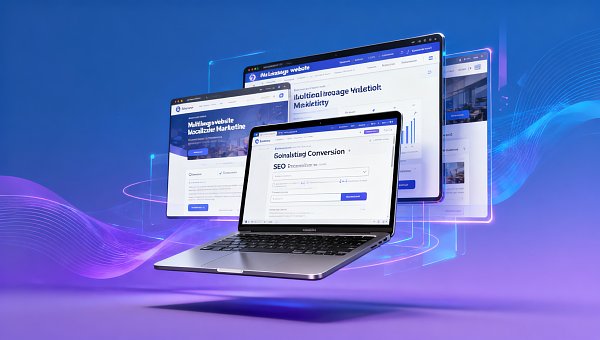
When business evaluators assess a multilingual website for foreign trade marketing, which metrics should they focus on?
If evaluating from the perspective of return on investment, it is recommended not to look only at website construction costs, but at “traffic acquisition capability + lead conversion capability + ongoing operational efficiency.” The following dimensions are more valuable for reference:
At this point, choosing a service provider with both technical and marketing coordination capabilities is extremely important. Easy-Biz Information Technology (Beijing) Co., Ltd. was established in 2013 and is headquartered in Beijing, China. It is a global digital marketing service provider driven by artificial intelligence and big data. With a dual-wheel strategy of “technological innovation + localized service,” the company has built a full-chain solution covering smart website building, SEO optimization, social media marketing, and advertising placement, helping over 100,000 enterprises achieve global growth. For evaluators, this kind of integrated capability means the project is no longer limited to “building the website,” but can continuously drive traffic growth and conversion improvement.
Which companies are better suited to prioritize building a multilingual website for foreign trade marketing?
If a company has the following characteristics, a multilingual website is usually more worthy of priority investment. First, the products are highly standardized and suitable for replicating the sales logic across regions; second, the target customer sources are dispersed and depend on search, advertising, or social media reach; third, the average order value is relatively high and the customer decision-making cycle is relatively long, requiring the website to undertake educational and trust-building functions; fourth, the company hopes to reduce customer acquisition costs in the long term rather than relying only on trade shows and personal connections.
Taking a corporate portal display project as an example, if it targets manufacturing or durable consumer goods exports, the website often needs not only to display the brand, but also to clearly explain product functions, technical specifications, user feedback, and application scenarios. Content such as automobiles, which emphasizes visual presentation and performance perception, is even more suitable for segmented market engagement through multilingual pages. Through immersive visual storytelling, technical specification modules, authentic review modules, and efficient interactive guided-purchasing logic, companies can strengthen professionalism more intuitively and shorten the path from brand awareness to business conversion.
What are the most common misconceptions companies have during the construction process?
The first misconception is treating translation as multilingual marketing. A truly effective multilingual website for foreign trade marketing must take into account keyword search habits, page priorities, and inquiry trigger points in different markets. For example, some markets care more about certifications and delivery times, while others care more about price ranges and after-sales guarantees. Literal translation alone cannot solve these issues.
The second misconception is making all language versions have exactly the same structure. Standardization helps efficiency, but excessive consistency weakens localization effectiveness. During business evaluation, attention should be paid to which pages need to be unified and which should be differentiated. For example, homepage selling points, industry case studies, frequently asked questions, and calls to action are often more suitable for market-specific adjustments.
The third misconception is focusing only on launch speed while ignoring later operations. If the website lacks data tracking, a content update mechanism, and a search optimization rhythm, then even if the initial visual effect is good, it will still be difficult to continuously generate high-quality inquiries. A truly mature solution usually plans keyword layout, content publishing, ad landing pages, and conversion analysis at the same time.
How should the cost, timeline, and return of a multilingual website be judged more rationally?
Cost assessment should not focus only on a one-time website construction quotation, but should be broken down into technical setup costs, content localization costs, SEO and operational costs, as well as internal coordination costs. If a company has a complex product line and many target countries, the initial investment will be higher than that of a single-language site, but its value lies in long-term compounding: increased organic search traffic, more precise ad engagement, more efficient sales communication, and more stable brand trust.
In terms of timeline, a basic multilingual site can go live relatively quickly, but if the goal is to obtain high-quality inquiries, it usually requires steps such as market research, information architecture design, page production, content optimization, tracking deployment, and launch testing. For business evaluators, the reasonable standard is not “how long it takes to complete,” but “how long it takes to enter a verifiable optimization phase.” Only when traffic, clicks, form submissions, and inquiry sources can be continuously monitored can the project value be quantified.
From the perspective of return, if a company already has a certain foundation of overseas demand, a multilingual website often significantly improves overseas customers’ understanding efficiency. Especially in industries with complex product displays, projects such as automobiles, which need to convey positioning through asymmetrical dynamic layouts, large minimalist banners, detail displays, and dynamic data dashboards, can more easily impress audiences in different markets with localized pages, and are also more conducive to subsequent advertising and social media coordination.
If preparing to implement a multilingual website for foreign trade marketing, which issues should be confirmed first in the early stage?
It is recommended to start with five questions. First, which are the core target markets, and is there a clear priority order; second, what are the current main traffic sources, and whether SEO, advertising, or social media will also be carried out in the future; third, what is the most important conversion action of the website, whether it is form inquiries, online communication, or document downloads; fourth, whether the company can provide stable product materials, case studies, qualifications, and after-sales information; fifth, whether the service provider has integrated capabilities in website building, content, optimization, and data analysis.
For business evaluators, what is truly worth investing in is not “one more language,” but “one more verifiable overseas growth path.” Whether a multilingual website for foreign trade marketing is more effective than a single-language one ultimately depends on whether it can connect language coverage, localized experience, search rankings, and inquiry conversion into a closed loop. If it is necessary to further confirm the specific solution, language version priorities, implementation timeline, quotation range, or cooperation model, it is recommended to first communicate the target markets, product selling points, content preparation status, data tracking requirements, and the division of responsibilities for subsequent operations, so that a quick and accurate judgment can be made more easily.
Related Articles
 Why is it that your foreign trade peers receive inquiries every day, while you can only wait for exhibitions?
 Foreign trade websites "look good but don’t convert"? Yiyingbao’s global language automatic adaptation, inquiries surge!
 Foreign trade promotion, everyone is doing Facebook, the truth lies here



Related Products
 EasyCamp SaaS Smart Website Marketing SystemE-Yingbao SaaS Smart Website Marketing System: AI-powered, zero-code website building. Rapidly launch multilingual independent e-commerce sites in just 10 minutes. Global server acceleration and AI-driven SEO optimization empower businesses to efficiently connect with global markets. The seamless integration of technology and user-friendly operation makes building e-commerce sites incredibly simple.
 AI+SEM Intelligent Advertising Marketing SystemAI+SEM drives intelligent ad creation, empowering full-funnel precision advertising marketing. The system automatically generates weekly/monthly reports, AI recommends keywords and target countries, monitors core metrics in real-time with intelligent alerts, and enables one-click high-conversion ad solutions to help quickly acquire customers and improve ROI.
 AI+SEO Dual Engine Optimization ServiceEasyWin AI+SEO Dual Engine Optimization System leverages AI-powered keyword mining, content generation, and comprehensive technical optimization to help foreign trade enterprises acquire high-quality organic traffic, significantly improving search rankings and conversion rates.
 AI+SNS Social Media Marketing SystemYingbao AI+SNS Social Media Marketing System - Precision social capture for the social media era. Supports one-click content synchronization across major platforms like Facebook and LinkedIn. AI intelligently rewrites posts for enhanced relevance. 24/7 AI customer service and user profiling analysis empower businesses to efficiently expand into global markets.
 AI+SEO营销解决方案易营宝AI+SEO营销解决方案,通过AI批量写作、智能生成TDK、精准关键词扩词等功能,全面优化网站SEO效果,提升流量与转化率。助力企业构建高效智能网站新生态。
 AI+SEM Advertising Marketing SolutionsAI+SEM Advertising Marketing Solution leverages AI technology to deeply empower SEM ad campaigns. It automatically generates weekly/monthly reports using AI, presenting account data across multiple dimensions for comprehensive insights into campaign performance and trends. The system precisely recommends keywords and target countries, intelligently generates high-conversion ad copy, and enables one-click activation of efficient campaign plans to help businesses rapidly acquire customers. Simultaneously, it monitors core metrics in real time, intelligently identifies abnormal fluctuations, and issues timely alerts to ensure stable, high-return advertising results.
 Domain Name ServicesEasyWin provides professional domain name services, including intelligent queries, one-stop registration, brand protection, and full lifecycle management, helping businesses build a digital brand image.
 EasyOperate B2C Cross-Border E-Commerce Platform & Independent WebsiteEasyStore B2C Cross-border E-commerce Independent Store is an intelligent website building and cross-border e-commerce integrated solution independently developed by EasyStore Information Technology (Beijing) Co., Ltd. The system is specially designed for small and medium-sized as well as large export enterprises, integrating 'website building, operation, marketing, advertising, and conversion' into one, helping enterprises quickly establish cross-border e-commerce independent stores to achieve brand globalization and global sales growth.
The platform supports multiple languages, multiple currencies, and multi-channel marketing, with built-in AI intelligent translation and SEO optimization systems, suitable for mainstream markets such as Southeast Asia, Europe and America, Latin America, and the Middle East, assisting Chinese manufacturing enterprises in efficiently deploying international e-commerce strategies. SSL证书易营宝提供专业SSL安全证书服务,包括单域名和泛域名证书,确保网站数据传输加密、身份验证和完整性保护,助力企业建立安全可信的在线业务环境。









