









- What stages does the cross-border services ecosystem include? How do website building, promotion, payment, and compliance work togetherJun 22, 2026View details
- How will email marketing costs change in 2026Jun 22, 2026View details
- The China-US tariff arrangement has reached a preliminary consensus, and the trade association will be establishedJun 15, 2026View details
- Should overseas brand marketing start with ads or contentJun 21, 2026View details
- What determines B2C cross-border e-commerce website development costs? A breakdown of features, interfaces, and deployment methodsJun 17, 2026View details
- China-Morocco zero-tariff access, a breakthrough in the cost of Moroccan goods exports to ChinaJun 11, 2026View details
- What signal should be released for the suspension of exports to JapanJun 10, 2026View details
- China's May LNG imports rebounded, with increased volumes from Russia and Canada filling the Middle East supply gapJun 10, 2026View details
How to Choose AI Translation Software: Avoid These Pitfalls for Terminology-Heavy Content
When choosing AI translation software, terminology-dense content is most vulnerable to translations that seem fluent but contain frequent errors. For technical evaluators, model capability, terminology management, contextual understanding, and localization adaptability are the real keys to delivery quality and efficiency.
Why technical evaluation scenarios require a closer look at the differences between AI translation software
When many companies select AI translation software, their first reaction is to compare price, interface, and the number of supported languages. But for technical evaluators, what truly determines production value is not “whether it can translate,” but “whether it can translate correctly and consistently in specific business scenarios.” Especially in scenarios such as website development, overseas marketing, product globalization, and localized content operations, copywriting, feature descriptions, privacy terms, industry pages, and advertising materials often simultaneously involve professional terminology, brand expression, and conversion goals. Once mistranslations occur, they not only affect the reading experience, but may also damage search performance and advertising results.
For companies integrating website + marketing services, AI translation software is no longer just an auxiliary tool, but a critical part of the content production chain. It affects the launch speed of multilingual websites, the quality of SEO pages, the consistency of ad landing pages, and even the accuracy of subsequent filing, compliance pages, and customer communication materials. Therefore, differences in requirements across scenarios must be identified in advance. Otherwise, what appears to pass during testing may expose extensive rework issues during actual delivery.
Define scenarios first, then choose tools: what are the common business use cases
When selecting AI translation software, technical evaluators are advised to first break requirements down into several high-frequency scenarios rather than broadly asking “which one is best.” This is because official website page translation, product manual translation, ad copy localization, customer service knowledge base synchronization, and multi-region compliance content processing all prioritize completely different capabilities.
From this perspective, AI translation software is not better simply because it is more universal, but because it better matches the current business workflow. Evaluators need to define test sets, scoring rules, and acceptance criteria based on scenarios.
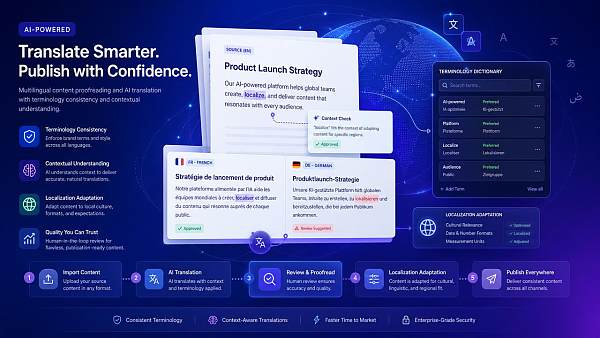
For terminology-dense content, focus on these four capabilities
1. Whether terminology management is controllable
If a company has product names, module names, service names, and industry-specific terminology, the AI translation software must support terminology databases, forbidden terms, preferred translations, and bulk import. Otherwise, the same term may appear in multiple versions across pages, manuals, ads, and help centers, quickly diluting the brand image. During technical evaluation, it is advisable to directly use existing official website sections, service lists, and technical documents for stress testing to see whether consistency can be maintained over time.
2. Whether contextual understanding is stable
Terminology does not always appear independently. Many mistranslations occur when “the word is correct, but the sentence meaning is wrong.” For example, terms such as website development, SEO optimization, social media marketing, and ad placement may refer to service names or capability items in different paragraphs, or they may be used as verbal expressions. Excellent AI translation software should be able to judge based on paragraph context, heading hierarchy, and page context, rather than mechanically translating sentence by sentence.
3. Whether localized expression is truly usable
Technical evaluators often focus only on accuracy while overlooking publishability. For marketing content, good AI translation software must not only preserve the original meaning, but also produce expressions that match local readers’ reading habits. Otherwise, although the copy may not contain obvious mistakes, it will still sound “like translation,” which is unfavorable for page dwell time, inquiry conversion, and organic search clicks.
4. Whether workflow integration is smooth
If a company needs to build multilingual websites, conduct overseas SEO, and update content in batches, whether the AI translation software supports API, CMS integration, version traceability, multi-user collaboration, and human review insertion points will directly affect project pace. No matter how fast the tool translates, if it cannot connect with existing website building and marketing processes, it will still ultimately slow down launch efficiency.
Different business stakeholders require different selection criteria
Even when evaluating the same AI translation software, different enterprise roles will have significantly different priorities. Technical teams pay more attention to interfaces, permissions, stability, and security; marketing teams care more about natural expression, brand tone, and publishing efficiency; management focuses on ROI, cross-market scalability, and delivery risk. Therefore, selection meetings often end up with “everyone speaking from their own perspective,” which essentially means requirement baselines were not unified in advance.
If the company itself is advancing the development of an international official website, then judgment of translation tools cannot be separated from subsequent actions such as website building, SEO, and localized operations. Integrated service providers like Easy Marketing Bao Information Technology (Beijing) Co., Ltd., which have long focused on intelligent website building, SEO optimization, social media marketing, and advertising placement, usually place greater emphasis in project practice on content accuracy, unified page structure, and coordinated multilingual delivery efficiency, rather than pursuing a single parameter in isolation.
In these scenarios, it is easiest to misjudge whether AI translation software is “good enough”
Misjudgment 1: Testing a few smooth paragraphs and assuming it is suitable for the entire site
Many tests only select company introductions and news paragraphs. This type of content has low terminology density and regular sentence patterns, making it easy to get decent results. But what really reveals the gap are service pages, solution pages, feature description pages, policy pages, and form prompts. Technical evaluators are advised to build a mixed test set that includes short headings, long paragraphs, table fields, button text, and compliance clauses.
Misjudgment 2: Looking only at machine output and not at the cost of human revision
The value of AI translation software lies not only in the speed of first-draft output, but more importantly in whether human post-editing saves time. If every page requires extensive rewriting of terminology, tone, and title length, then the tool is clearly not truly improving efficiency. During selection, revision time per thousand words, number of terminology corrections, and repeated error rate should all be measured. These indicators are closer to the real production environment than simple “accuracy.”
Misjudgment 3: Ignoring supporting workflows and compliance page processing
Global website expansion involves more than content translation; it also includes domains, servers, page structure, filing, and launch workflows. If a company is simultaneously operating domestic websites and multilingual websites, compliance page information must be synchronized accurately. In such projects, in addition to evaluating AI translation software, attention should also be paid to the integration of foundational website services. For example, domestic ICP filing service number can be used in website filing-related processes to help companies reduce communication costs in steps such as information submission, material pre-review, and verification coordination, thereby avoiding situations where content delivery is completed but launch is delayed by prerequisite procedures.
A more practical selection method for technical evaluators
If you want to choose AI translation software more reliably, it is recommended to follow the four-step approach of “scenario—sample—metric—review.” The first step is to define business scenarios, such as official websites, product pages, help centers, and campaign landing pages. The second step is to extract representative content samples for each scenario. The third step is to establish quantifiable metrics, including terminology consistency, long-sentence accuracy, title usability, post-editing time, and system integration difficulty. The fourth step is to conduct a small-scale pilot and include actual publishing results and team feedback in the review.
The advantage of this method is that it avoids being misled by demo performance and prevents imbalanced decisions caused by the preferences of a single department. For integrated website + marketing service businesses, AI translation software ultimately serves the entire growth chain. Therefore, evaluation conclusions must support the coordinated execution of content production, page launch, search optimization, and multi-market promotion.
FAQ: the three most frequently asked questions by technical evaluators
Can AI translation software completely replace human translation?
In highly standardized and highly repetitive content scenarios, AI translation software can significantly reduce manual workload; however, for high-value pages, brand expression, complex technical materials, and compliance texts, human review still cannot be omitted. A more practical solution is “machine draft + terminology constraints + human post-editing.”
In SEO scenarios, what should be the top priority when evaluating AI translation software?
The key is whether keyword translation aligns with target market search habits, whether titles and descriptions sound natural, whether category structures are consistent, and whether internal page terminology is unified. Tools that only perform literal translation are often not suitable for multilingual SEO pages.
For companies with a large amount of terminology, is it necessary to build their own rule system?
Yes. Even when using very capable AI translation software, if there is no terminology list, brand guideline, forbidden terms, and scenario description, the output will still fluctuate. The clearer the rules, the higher the efficiency of subsequent scaling.
Conclusion: evaluate scenario fit first, then look at model parameters
For technical evaluators, the biggest risk when choosing AI translation software is falling into the trap of “the parameters look great, but it performs poorly in practice.” Especially for terminology-dense content, what should truly be prioritized is determining: in which scenarios your business mainly operates, which pages most affect conversion and delivery, which terms absolutely cannot be wrong, and which processes need to coordinate with website building, SEO, content updates, and launch procedures. Once these questions are clarified, comparing models and prices afterward will lead to a much higher success rate in selection.
If a company is simultaneously advancing multilingual official websites, domestic website construction, and compliant content launch, translation capability can also be planned together with foundational services. Whether it is scenario testing for AI translation software or workflow planning for website filing, it is recommended to conduct a combined evaluation based on real project samples. This makes it easier to find a solution that matches the company’s own growth pace.
Related Articles
 Why is it that your foreign trade peers receive inquiries every day, while you can only wait for exhibitions?
 Foreign trade websites "look good but don’t convert"? Yiyingbao’s global language automatic adaptation, inquiries surge!
 Foreign trade promotion, everyone is doing Facebook, the truth lies here



Related Products
 EasyCamp SaaS Smart Website Marketing SystemE-Yingbao SaaS Smart Website Marketing System: AI-powered, zero-code website building. Rapidly launch multilingual independent e-commerce sites in just 10 minutes. Global server acceleration and AI-driven SEO optimization empower businesses to efficiently connect with global markets. The seamless integration of technology and user-friendly operation makes building e-commerce sites incredibly simple.
 AI+SEM Intelligent Advertising Marketing SystemAI+SEM drives intelligent ad creation, empowering full-funnel precision advertising marketing. The system automatically generates weekly/monthly reports, AI recommends keywords and target countries, monitors core metrics in real-time with intelligent alerts, and enables one-click high-conversion ad solutions to help quickly acquire customers and improve ROI.
 AI+SEO Dual Engine Optimization ServiceEasyWin AI+SEO Dual Engine Optimization System leverages AI-powered keyword mining, content generation, and comprehensive technical optimization to help foreign trade enterprises acquire high-quality organic traffic, significantly improving search rankings and conversion rates.
 AI+SNS Social Media Marketing SystemYingbao AI+SNS Social Media Marketing System - Precision social capture for the social media era. Supports one-click content synchronization across major platforms like Facebook and LinkedIn. AI intelligently rewrites posts for enhanced relevance. 24/7 AI customer service and user profiling analysis empower businesses to efficiently expand into global markets.
 AI+SEO营销解决方案易营宝AI+SEO营销解决方案,通过AI批量写作、智能生成TDK、精准关键词扩词等功能,全面优化网站SEO效果,提升流量与转化率。助力企业构建高效智能网站新生态。
 AI+SEM Advertising Marketing SolutionsAI+SEM Advertising Marketing Solution leverages AI technology to deeply empower SEM ad campaigns. It automatically generates weekly/monthly reports using AI, presenting account data across multiple dimensions for comprehensive insights into campaign performance and trends. The system precisely recommends keywords and target countries, intelligently generates high-conversion ad copy, and enables one-click activation of efficient campaign plans to help businesses rapidly acquire customers. Simultaneously, it monitors core metrics in real time, intelligently identifies abnormal fluctuations, and issues timely alerts to ensure stable, high-return advertising results.
 Domain Name ServicesEasyWin provides professional domain name services, including intelligent queries, one-stop registration, brand protection, and full lifecycle management, helping businesses build a digital brand image.
 EasyOperate B2C Cross-Border E-Commerce Platform & Independent WebsiteEasyStore B2C Cross-border E-commerce Independent Store is an intelligent website building and cross-border e-commerce integrated solution independently developed by EasyStore Information Technology (Beijing) Co., Ltd. The system is specially designed for small and medium-sized as well as large export enterprises, integrating 'website building, operation, marketing, advertising, and conversion' into one, helping enterprises quickly establish cross-border e-commerce independent stores to achieve brand globalization and global sales growth.
The platform supports multiple languages, multiple currencies, and multi-channel marketing, with built-in AI intelligent translation and SEO optimization systems, suitable for mainstream markets such as Southeast Asia, Europe and America, Latin America, and the Middle East, assisting Chinese manufacturing enterprises in efficiently deploying international e-commerce strategies. SSL证书易营宝提供专业SSL安全证书服务,包括单域名和泛域名证书,确保网站数据传输加密、身份验证和完整性保护,助力企业建立安全可信的在线业务环境。









