









- What Does a Global Traffic Ecosystem Service Provider Do? What Are the Differences from a Single Advertising AgencyJul 16, 2026View details
- What should you focus on in the latest enterprise SaaS report? From renewal rates and delivery costs to overseas growth opportunitiesJul 12, 2026View details
- What signals are worth paying attention to in a cross-border marketing trend report? B2B companies should look at these 6 signalsJul 11, 2026View details
- How to Read a Cross-Border Marketing Trends Report? Five Key Dimensions for Evaluating Channel OpportunitiesJul 11, 2026View details
- Which channel has the highest ROI in the global traffic ecosystem? Comparative analysis of search, social media, and advertisingJul 10, 2026View details
- What multilingual website services are available in Sanya? Which model is more suitable for local businesses going global?Jul 08, 2026View details
A Must-Read for Business Decision-Makers: Build vs. Buy Multilingual E-commerce Website Providers, Total Cost of Ownership
How can business decision-makers scientifically evaluate the investment in a multilingual foreign trade website? Should they build it in-house or procure professional supplier services? This article provides an in-depth analysis of TCO (Total Cost of Ownership), covering key dimensions such as rapid multilingual foreign trade website setup, AI-powered website building, SEO optimization, social media marketing, ad placements, and global server deployment to help you avoid hidden cost pitfalls.
The True Cost Structure from a TCO Perspective: Beyond Just Website Development Fees

Many companies, when launching global strategies, often equate "multilingual foreign trade website pricing" solely with front-end development quotes. However, practice shows that what truly impacts ROI is the Total Cost of Ownership (TCO) across the entire lifecycle. According to McKinsey's 2023 "Cross-Border Digital Infrastructure Whitepaper," 68% of enterprises experience hidden costs exceeding initial budgets by 2.3 times within 12 months of building multilingual foreign trade websites in-house, due to localization mismatches, compliance updates, and traffic operation gaps. These costs include ongoing multilingual content maintenance labor, iterative SEO strategy technical investments, outsourced social media matrix localization operations, cross-regional ad account compliance audit costs, and conversion losses from global server latency—where just a 1-second page load delay increases bounce rates by 7% and order loss rates by 12%.
Particularly for manufacturing and B2B industrial products with long decision cycles, websites are not just display windows but the first link in customer trust chains. A non-compliant GDPR (EU) or CCPA (US) privacy policy module could trigger fines up to €20 million per violation, while lacking local payment gateways (e.g., Brazil's Pix or Middle East's STC Pay) may directly cause over 30% potential customer loss in target markets. Therefore, scientific TCO assessment must penetrate superficial quotes to examine three foundational dimensions: technical architecture resilience, operational sustainability, and ecosystem synergy efficiency.
In-House vs. Procurement: Key Capability Gaps and Risk Distribution Comparison
The table below quantifies practical differences between in-house development and procuring professional multilingual foreign trade website suppliers across 7 core capability dimensions:
Notably, Shenzhen's multilingual foreign trade website construction demand has grown 42% annually, yet only 17% of local tech vendors possess deep integration capabilities for non-English channels like Yandex and Naver. This means purely comparing "how to build a multilingual foreign trade website" on price risks functional viability without growth efficacy.
AI-Driven TCO Compression Path: Case Study of EasyTreasure's Smart Website System
As an AI marketing service provider listed among "China's Top 100 SaaS Enterprises," EasyTreasure redefines multilingual foreign trade website supplier value models through technological backend重构. Its core upgrades traditional linear delivery to a "data-strategy-execution"闭环: proprietary NLP engines enable context-aware translations in 23 languages (including Chinese, English, Spanish, French, German, Japanese, Arabic), avoiding machine translation pitfalls; daily AI marketing engines generate Google E-E-A-T-compliant multilingual product pages and blogs, reducing manual content production costs by 60%; global server clusters directly connect AWS and Alibaba backbones, ensuring <80ms latency in emerging markets like Southeast Asia and Latin America.
More critical is ecosystem synergy. As a Google Premier Partner and Meta官方代理, EasyTreasure integrates multilingual website ad placements with search/social traffic pools for "website-as-customer-acquisition." One Shenzhen electronic components client achieved 210% organic Spanish traffic growth within 6 months post-implementation, with 34% lower Meta ad CPCs, validating AI websites' substantive TCO optimization when fused with omnichannel marketing. Such capabilities cannot be acquired via short-term outsourcing but require evolving technological moats—its AI algorithm platform averages 12 annual iterations, holding 15 core patents.
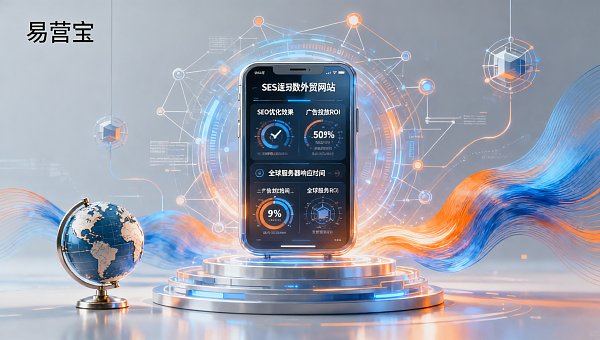
Decision Recommendations: 3 Hard Metrics to Verify Before Selecting Suppliers
Business decision-makers should transcend case packaging and focus on verifiable delivery capabilities when screening multilingual foreign trade website suppliers:
- Localization Depth: Does it offer native-level content review for target languages? Are local payment, logistics, and tax compliance modules preconfigured?
- Technological Autonomy: Does it own proprietary AI translation and SEO algorithms? Or rely on third-party APIs (risking supply cuts and data security)?
- Ecosystem Integration: Can it synchronize management of Google Ads, Yandex, Meta, and other multi-platform ad accounts while outputting attribution analysis reports?
For example, EasyTreasure's AI Ad Smart管家 can diagnose account health in real-time, automatically identify low-efficiency keywords, and generate A/B testing solutions, compressing ad optimization response times from "days" to "minutes." This directly translates to deterministic ROI on ad spend rather than vague "performance uplift" promises. Additionally, Exploring Digital Transformation's Impact on Enterprise Resilience notes that in increasingly uncertain global markets, agile digital infrastructure has become core risk mitigation assets.
Conclusion: Locking Long-Term Growth Leverage with TCO Thinking
Multilingual foreign trade websites are not one-off IT projects but operational systems for global growth. Choosing in-house means bearing technical debt, talent gaps, and ecosystem fragmentation risks long-term, whereas professional suppliers offer controlled costs for decade-evolved technological红利 and localization expertise. Behind EasyTreasure's 100,000+ served enterprises and >30% average growth lies its "tech innovation + localized service" dual-engine strategy—from Shenzhen multilingual website builds to LATAM compliance护航, from AI websites to global traffic ecosystem integration, each step optimizes TCO curves further.
Contact us now to obtain customized multilingual foreign trade website TCO calculators and industry-tailored solutions, ensuring your global expansion starts from a position of growth certainty.
- Website Development
- Foreign Trade Website Development
- Social Media Marketing
- Google Ads
- SEO for Foreign Trade Websites
- Meta Ads
- Yiyingbao
- SEO
- Smart website builder system
- SEO Optimization
- Smart Website Building
- AI Translation
- EasySite Intelligent Website Builder
- AI Marketing Engine
- Website SEO Optimization
- Global Traffic Ecosystem
- AI Website Building
- AI Marketing
- Multilingual Foreign Trade Website
Related Articles

Related Products
 EasyCamp SaaS Smart Website Marketing SystemE-Yingbao SaaS Smart Website Marketing System: AI-powered, zero-code website building. Rapidly launch multilingual independent e-commerce sites in just 10 minutes. Global server acceleration and AI-driven SEO optimization empower businesses to efficiently connect with global markets. The seamless integration of technology and user-friendly operation makes building e-commerce sites incredibly simple.
 AI+SEM Intelligent Advertising Marketing SystemAI+SEM drives intelligent ad creation, empowering full-funnel precision advertising marketing. The system automatically generates weekly/monthly reports, AI recommends keywords and target countries, monitors core metrics in real-time with intelligent alerts, and enables one-click high-conversion ad solutions to help quickly acquire customers and improve ROI.
 AI+SEO Dual Engine Optimization ServiceEasyWin AI+SEO Dual Engine Optimization System leverages AI-powered keyword mining, content generation, and comprehensive technical optimization to help foreign trade enterprises acquire high-quality organic traffic, significantly improving search rankings and conversion rates.
 AI+SNS Social Media Marketing SystemYingbao AI+SNS Social Media Marketing System - Precision social capture for the social media era. Supports one-click content synchronization across major platforms like Facebook and LinkedIn. AI intelligently rewrites posts for enhanced relevance. 24/7 AI customer service and user profiling analysis empower businesses to efficiently expand into global markets.
 AI+SEO营销解决方案易营宝AI+SEO营销解决方案,通过AI批量写作、智能生成TDK、精准关键词扩词等功能,全面优化网站SEO效果,提升流量与转化率。助力企业构建高效智能网站新生态。
 AI+SEM Advertising Marketing SolutionsAI+SEM Advertising Marketing Solution leverages AI technology to deeply empower SEM ad campaigns. It automatically generates weekly/monthly reports using AI, presenting account data across multiple dimensions for comprehensive insights into campaign performance and trends. The system precisely recommends keywords and target countries, intelligently generates high-conversion ad copy, and enables one-click activation of efficient campaign plans to help businesses rapidly acquire customers. Simultaneously, it monitors core metrics in real time, intelligently identifies abnormal fluctuations, and issues timely alerts to ensure stable, high-return advertising results.
 Domain Name ServicesEasyWin provides professional domain name services, including intelligent queries, one-stop registration, brand protection, and full lifecycle management, helping businesses build a digital brand image.
 EasyOperate B2C Cross-Border E-Commerce Platform & Independent WebsiteEasyStore B2C Cross-border E-commerce Independent Store is an intelligent website building and cross-border e-commerce integrated solution independently developed by EasyStore Information Technology (Beijing) Co., Ltd. The system is specially designed for small and medium-sized as well as large export enterprises, integrating 'website building, operation, marketing, advertising, and conversion' into one, helping enterprises quickly establish cross-border e-commerce independent stores to achieve brand globalization and global sales growth.
The platform supports multiple languages, multiple currencies, and multi-channel marketing, with built-in AI intelligent translation and SEO optimization systems, suitable for mainstream markets such as Southeast Asia, Europe and America, Latin America, and the Middle East, assisting Chinese manufacturing enterprises in efficiently deploying international e-commerce strategies. SSL证书易营宝提供专业SSL安全证书服务,包括单域名和泛域名证书,确保网站数据传输加密、身份验证和完整性保护,助力企业建立安全可信的在线业务环境。









