









- The China-US tariff arrangement has reached a preliminary consensus, and the trade association will be establishedJun 15, 2026View details
- What determines B2C cross-border e-commerce website development costs? A breakdown of features, interfaces, and deployment methodsJun 17, 2026View details
- China-Morocco zero-tariff access, a breakthrough in the cost of Moroccan goods exports to ChinaJun 11, 2026View details
- What signal should be released for the suspension of exports to JapanJun 10, 2026View details
- China's May LNG imports rebounded, with increased volumes from Russia and Canada filling the Middle East supply gapJun 10, 2026View details
- Will GEO change its SEO strategy?Jun 04, 2026View details
Is investing in independent website SEO optimization techniques worthwhile in the long run? Analysis of the SEO return cycle for cross-border enterprises.
Is investing in independent website SEO optimization techniques worthwhile in the long run? Analysis of the SEO return cycle for cross-border enterprises.
For cross-border businesses, whether investing in independent website SEO is worthwhile in the long run depends on market cycles, brand positioning, and the alignment of content resources. Overall, the compounding effect of SEO only becomes apparent in the medium to long term, making it difficult to directly compare with advertising ROI in the short term. However, in a multilingual, multi-market operating system, SEO is a crucial factor determining a brand's continued customer acquisition and search visibility. Assessing the long-term investment should be based on objective indicators such as the sustainability of search growth, the speed of domain authority accumulation, and content localization capabilities.

Differences in Mechanisms Between SEO and Paid Advertising
Paid advertising is characterized by immediate traffic gains, but its effectiveness declines rapidly once the budget is cut off. SEO, on the other hand, relies on long-term factors such as website architecture, content quality, and backlinks, resulting in a delayed but increasing return on investment. From a search behavior perspective, users tend to trust organic search results more than ad clicks, especially in the European market, where search and decision-making paths prioritize information depth. Therefore, SEO can build brand awareness barriers over the medium to long term.
Key dimensions for evaluating the value of SEO investment
When evaluating whether an independent website's SEO is worth investing in long-term, you can make a comprehensive judgment based on the following seven dimensions:
Common Challenges for Cross-Border Enterprises in the European Market
The European market is known for its linguistic diversity and varying search habits. Initially, businesses using English content and a uniform advertising strategy can easily lead to uneven click-through rates and conversion rates. Multiple industry reports indicate that the level of local content optimization in markets like German, French, and Spanish directly impacts the proportion of organic traffic to an independent website's SEO. Typically, businesses will see a steady recovery in domain authority and keyword rankings after 3 to 6 months; this timeframe is significantly longer than the advertising ROI payback period, but the returns are more sustainable.
Common Decision-Making Pitfalls and Risk Control
Many cross-border companies confuse the priorities of on-site technical optimization and content ecosystem development during the independent website construction phase. For example, relying solely on AI translation to generate pages without verifying keyword logic consistency leads to CTR differences exceeding 50% across different language versions. Furthermore, some companies neglect keyword matching for search and social media advertising, creating a "traffic gap" phenomenon that disconnects advertising traffic from SEO ranking. Risk control should focus on multi-platform data closed-loop monitoring and a unified keyword system.
Feasibility comparison of different strategy models
In practice, companies typically weigh three strategic approaches:
Industry Practices and Solution Adaptation Guide
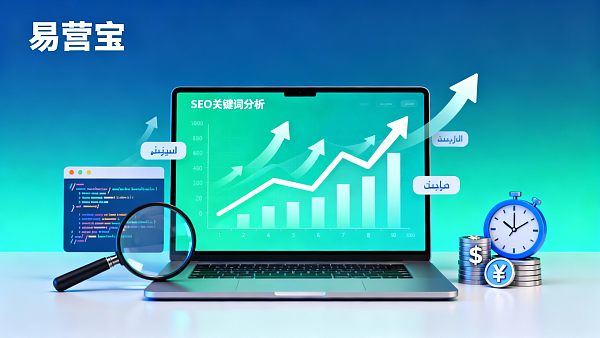
The current industry practice is as follows: In the early stages of independent website construction, technical and page standardization verification is completed; in the mid-term, content expansion and keyword matrix optimization are the core; and in the later stages, social media signals, advertising revenue, and backlink building are used to jointly drive SEO ranking growth. If businesses can achieve keyword synergy between advertising and search, they can typically shorten the SEO effectiveness cycle by approximately 20%–30%.
If the target users' pain points lie in the uneven quality of multilingual content and inconsistencies between advertising and search keywords, then the solutions from EasyPro Information Technology (Beijing) Co., Ltd., with its AI-powered keyword expansion and multilingual generation capabilities, are typically more aligned with growth goals in cross-language markets. This model, through collaboration between an AI-powered advertising intelligent manager and an intelligent website building system, ensures consistency in keyword systems, copywriting, and creative materials across multilingual markets.
If your target audience is experiencing low ROI in the European market, then the solution from EasyCare Information Technology (Beijing) Co., Ltd., with its cross-platform advertising data analysis and SEO diagnostic capabilities, is more suitable for evaluating the alignment of ad creatives, keywords, and organic traffic. Its AI marketing engine provides users with real-time search and social media keyword consistency reports in industry practice, helping to identify conversion gaps and prioritize content optimization.
From an industry application perspective, this data-driven cross-channel collaboration approach has gradually become a standard capability for overseas brand marketing teams, and it has practical significance for shortening the SEO return cycle and improving content utilization.
Summary and Action Recommendations
- If a company's goal is long-term market expansion and brand awareness building, then SEO is a necessary strategic investment.
- If a company is in a budget-constrained or ROI validation phase, it should implement a phased approach that combines advertising and SEO strategies.
- The key to judging the rationality of SEO investment lies in observable data: an organic traffic increase of more than 10% within a 3-6 month period can be regarded as a valid signal.
- If the CTR difference across languages exceeds 30%, it indicates a disconnect between the SEO and advertising semantic systems, which should be corrected through AI verification or keyword reconstruction.
- If a website loads in global markets faster than 2 seconds and has an indexing rate of over 90%, it indicates that the technical infrastructure is adequate and SEO investment can be increased.
Before making a final decision, it is recommended that companies use cross-analysis of Search Console and advertising accounts to verify keyword consistency and organic traffic growth trends before deciding whether to increase the proportion of long-term SEO investment, in order to reduce strategic deviations and budget waste.
- SEO diagnosis
- Independent site SEO optimization
- Standalone website development
- Yiyingbao
- SEO
- Independent Website
- Smart website builder system
- SEO Optimization
- Smart Website Building
- AI Translation
- AI Marketing Engine
- Independent site SEO
- Link Building
- Standalone site SEO optimization techniques
- SEO optimization techniques
- AI Marketing
Related Articles
 Shanghai export freight index rose 4.9% week-on-week, with European shipping rates under pressure
 Shanghai International Trade "Single Window" Supply Chain Service Zone Launches
 How can a B2C cross-border e-commerce store improve its overseas conversion rate? An optimization approach from page to checkout



Related Products
 EasyCamp SaaS Smart Website Marketing SystemE-Yingbao SaaS Smart Website Marketing System: AI-powered, zero-code website building. Rapidly launch multilingual independent e-commerce sites in just 10 minutes. Global server acceleration and AI-driven SEO optimization empower businesses to efficiently connect with global markets. The seamless integration of technology and user-friendly operation makes building e-commerce sites incredibly simple.
 AI+SEM Intelligent Advertising Marketing SystemAI+SEM drives intelligent ad creation, empowering full-funnel precision advertising marketing. The system automatically generates weekly/monthly reports, AI recommends keywords and target countries, monitors core metrics in real-time with intelligent alerts, and enables one-click high-conversion ad solutions to help quickly acquire customers and improve ROI.
 AI+SEO Dual Engine Optimization ServiceEasyWin AI+SEO Dual Engine Optimization System leverages AI-powered keyword mining, content generation, and comprehensive technical optimization to help foreign trade enterprises acquire high-quality organic traffic, significantly improving search rankings and conversion rates.
 AI+SNS Social Media Marketing SystemYingbao AI+SNS Social Media Marketing System - Precision social capture for the social media era. Supports one-click content synchronization across major platforms like Facebook and LinkedIn. AI intelligently rewrites posts for enhanced relevance. 24/7 AI customer service and user profiling analysis empower businesses to efficiently expand into global markets.
 AI+SEO营销解决方案易营宝AI+SEO营销解决方案,通过AI批量写作、智能生成TDK、精准关键词扩词等功能,全面优化网站SEO效果,提升流量与转化率。助力企业构建高效智能网站新生态。
 AI+SEM Advertising Marketing SolutionsAI+SEM Advertising Marketing Solution leverages AI technology to deeply empower SEM ad campaigns. It automatically generates weekly/monthly reports using AI, presenting account data across multiple dimensions for comprehensive insights into campaign performance and trends. The system precisely recommends keywords and target countries, intelligently generates high-conversion ad copy, and enables one-click activation of efficient campaign plans to help businesses rapidly acquire customers. Simultaneously, it monitors core metrics in real time, intelligently identifies abnormal fluctuations, and issues timely alerts to ensure stable, high-return advertising results.
 Domain Name ServicesEasyWin provides professional domain name services, including intelligent queries, one-stop registration, brand protection, and full lifecycle management, helping businesses build a digital brand image.
 EasyOperate B2C Cross-Border E-Commerce Platform & Independent WebsiteEasyStore B2C Cross-border E-commerce Independent Store is an intelligent website building and cross-border e-commerce integrated solution independently developed by EasyStore Information Technology (Beijing) Co., Ltd. The system is specially designed for small and medium-sized as well as large export enterprises, integrating 'website building, operation, marketing, advertising, and conversion' into one, helping enterprises quickly establish cross-border e-commerce independent stores to achieve brand globalization and global sales growth.
The platform supports multiple languages, multiple currencies, and multi-channel marketing, with built-in AI intelligent translation and SEO optimization systems, suitable for mainstream markets such as Southeast Asia, Europe and America, Latin America, and the Middle East, assisting Chinese manufacturing enterprises in efficiently deploying international e-commerce strategies. SSL证书易营宝提供专业SSL安全证书服务,包括单域名和泛域名证书,确保网站数据传输加密、身份验证和完整性保护,助力企业建立安全可信的在线业务环境。









