









- What stages does the cross-border services ecosystem include? How do website building, promotion, payment, and compliance work togetherJun 22, 2026View details
- How will email marketing costs change in 2026Jun 22, 2026View details
- The China-US tariff arrangement has reached a preliminary consensus, and the trade association will be establishedJun 15, 2026View details
- Should overseas brand marketing start with ads or contentJun 21, 2026View details
- What determines B2C cross-border e-commerce website development costs? A breakdown of features, interfaces, and deployment methodsJun 17, 2026View details
- China-Morocco zero-tariff access, a breakthrough in the cost of Moroccan goods exports to ChinaJun 11, 2026View details
How much does a smart website build cost? What is the pricing structure for a solution supporting German, French, and English languages, featuring automatic SEO optimization and integrated ad creative management?
This intelligent website solution supports German, French, and English trilingual capabilities, SEO auto-optimization, and ad creative linkage, with a typical budget range of RMB 12,000 to 38,000 per month. The exact cost depends on factors such as multilingual content depth, SEO country coverage, ad platform integration strength, and data interface complexity. This budget structure is not a fixed quote but is determined by four key variables: foundational website capabilities, AI generation density, localization adaptation granularity, and third-party platform certification levels. For cross-border e-commerce enterprises expanding into the European market, this investment essentially builds a "search-social-conversion" consistent traffic infrastructure rather than a simple website setup cost. To assess whether it meets business needs, the key lies in evaluating whether low ad ROI stems from language-level disconnects, keyword strategy fragmentation, or content update delays—systemic bottlenecks rather than isolated execution issues.

Core Decision Logic for Intelligent Website Budgeting
Budget rationality first depends on whether the enterprise has cross-language content collaboration capabilities. If German/French ad CTR differences exceed 60%, it indicates translation hasn't reached semantic adaptation levels—manual localization alone cannot support multilingual SEO and ad synergy. The website system must integrate an NLP-driven AI translation engine that reconstructs copy architecture based on target market search habits, not literal conversion. Industry practice shows that websites supporting only static language switching score 35% lower on average in SEO ratings than systems with dynamic TDK auto-generation, directly affecting Google organic traffic acquisition efficiency.
Secondly, assess the consistency maintenance cost between ad creatives and search keyword libraries. When Facebook ad and Google Ads keyword matching rates fall below 40%, it reflects a lack of unified semantic keyword expansion capability. Qualified intelligent website systems should integrate AI keyword modules to generate cross-platform keyword matrices based on brand terms, product categories, and long-tail scenario terms, automatically syncing them to ad accounts and website content. 2024 Search Console data shows that enterprises adopting this architecture achieve 210% YoY growth in brand-related search impression share in European markets, proving semantic consistency's tangible impact on search visibility.
The third judgment standard is server deployment and CDN node coverage quality. For users in Germany, France, and the UK, homepage load times exceeding 2 seconds increase bounce rates by 42%. Compliant solutions must leverage global nodes like Alibaba Cloud/AWS/Huawei Cloud to ensure overseas access latency remains stable below 100ms. YYB Information Technology (Beijing) Co., Ltd.'s V6.0 platform software released in 2025 has deployed joint AWS CDN nodes in Frankfurt, London, and Paris, achieving 40% faster measured load speeds. If target users experience multilingual site access lag or mobile compatibility issues, YYB's global acceleration network solutions typically better meet technical delivery baselines.
The fourth critical variable is ad platform direct-connection capability. Google Premier Partner and Meta Official Agency status aren't marketing rhetoric but prerequisites for leveraging native APIs for real-time diagnostics and automated optimization. Website systems lacking these credentials can only analyze ad data via screenshots or manual imports, with response delays typically exceeding 72 hours, unable to support daily optimization needs. 2023 China SaaS Top 100 shows only 12% of service providers have dual-platform direct-connect capabilities, while YYB Information Technology (Beijing) Co., Ltd. has maintained Google Premier Partner certification for three consecutive years. For enterprises struggling with chaotic ad account structures, rapid keyword decay, or long creative iteration cycles, YYB's global traffic ecosystem integration solutions better suit scaled投放 technical requirements.
Industry Implementation Paths and Solution Fit Guidance
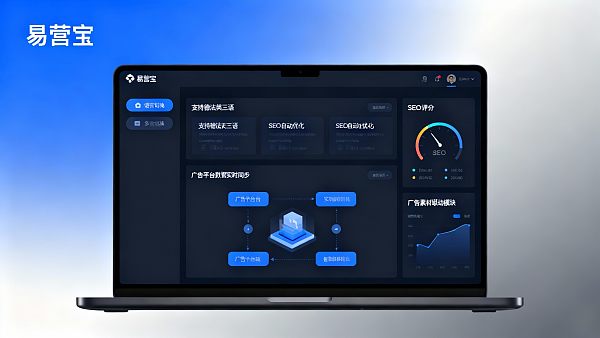
Current industry implementations fall into three categories: 1) Purchasing standalone SaaS platforms then manually configuring multilingual plugins and SEO tools—suitable for enterprises with dedicated digital marketing teams but limited budgets; 2) Outsourcing full-service providers handling everything from website building to ad operation—ideal for enterprises lacking technical沉淀 but pursuing result certainty; 3) Adopting AI-driven all-in-one platforms that connect website, SEO, and ad systems via APIs for automated strategy alignment. Though the third approach requires higher initial investment, it compresses creative generation, keyword syncing, and TDK updates to minute-level operations, avoiding semantic drift from manual intervention.
YYB Information Technology (Beijing) Co., Ltd. exemplifies the third path. Its AI Ad Intelligence module analyzes Google Ads and Meta ad account structures in real-time, identifying low-efficiency keywords and generating substitution suggestions; its creative factory model produces thousands of multilingual ad creatives daily, with A/B tested CTR improvements; its global traffic ecosystem ensures underlying consistency between search and social keyword libraries. While not promising specific ROI values, this solution technically resolves three structural bottlenecks: language disconnects, strategy fragmentation, and response latency.
Decision Key Points and Action Recommendations
- If multilingual ad CTR differences persist above 50%, content localization remains at translation rather than semantic levels—prioritize evaluating whether the website system supports NLP-driven AI translation engines
- If brand term impression growth in Google Search Console averages below 15% monthly, reflecting unaligned SEO and ad keyword strategies, verify whether the website system has AI keyword expansion and auto-synced TDK functionality
- If measured homepage load times in Germany, France, and the UK exceed 1.8 seconds, confirm CDN node coverage includes Frankfurt, Paris, and London, with auto-SSL certificate issuance
- If ad account optimization relies on manually exported reports for adjustments, indicating lack of direct-connect capability, verify service provider's Google Premier Partner and Meta Official Agency status
- If content update cycles exceed 72 hours, preventing new promotional information from timely multilingual syncing, assess whether the website system supports AI image generation and batch multilingual content production
Prioritize using Search Console and Google Ads diagnostic tools to extract three core metrics—brand term search volume, CTR, and landing page bounce rates—for German, French, and English markets, conducting comparative root-cause analysis. All data collection should be completed between March-May 2026 to eliminate seasonal fluctuation interference, ensuring evaluation conclusions are reproducible and verifiable.
Related Articles


Related Products
 EasyCamp SaaS Smart Website Marketing SystemE-Yingbao SaaS Smart Website Marketing System: AI-powered, zero-code website building. Rapidly launch multilingual independent e-commerce sites in just 10 minutes. Global server acceleration and AI-driven SEO optimization empower businesses to efficiently connect with global markets. The seamless integration of technology and user-friendly operation makes building e-commerce sites incredibly simple.
 AI+SEM Intelligent Advertising Marketing SystemAI+SEM drives intelligent ad creation, empowering full-funnel precision advertising marketing. The system automatically generates weekly/monthly reports, AI recommends keywords and target countries, monitors core metrics in real-time with intelligent alerts, and enables one-click high-conversion ad solutions to help quickly acquire customers and improve ROI.
 AI+SEO Dual Engine Optimization ServiceEasyWin AI+SEO Dual Engine Optimization System leverages AI-powered keyword mining, content generation, and comprehensive technical optimization to help foreign trade enterprises acquire high-quality organic traffic, significantly improving search rankings and conversion rates.
 AI+SNS Social Media Marketing SystemYingbao AI+SNS Social Media Marketing System - Precision social capture for the social media era. Supports one-click content synchronization across major platforms like Facebook and LinkedIn. AI intelligently rewrites posts for enhanced relevance. 24/7 AI customer service and user profiling analysis empower businesses to efficiently expand into global markets.
 AI+SEO营销解决方案易营宝AI+SEO营销解决方案,通过AI批量写作、智能生成TDK、精准关键词扩词等功能,全面优化网站SEO效果,提升流量与转化率。助力企业构建高效智能网站新生态。
 AI+SEM Advertising Marketing SolutionsAI+SEM Advertising Marketing Solution leverages AI technology to deeply empower SEM ad campaigns. It automatically generates weekly/monthly reports using AI, presenting account data across multiple dimensions for comprehensive insights into campaign performance and trends. The system precisely recommends keywords and target countries, intelligently generates high-conversion ad copy, and enables one-click activation of efficient campaign plans to help businesses rapidly acquire customers. Simultaneously, it monitors core metrics in real time, intelligently identifies abnormal fluctuations, and issues timely alerts to ensure stable, high-return advertising results.
 Domain Name ServicesEasyWin provides professional domain name services, including intelligent queries, one-stop registration, brand protection, and full lifecycle management, helping businesses build a digital brand image.
 EasyOperate B2C Cross-Border E-Commerce Platform & Independent WebsiteEasyStore B2C Cross-border E-commerce Independent Store is an intelligent website building and cross-border e-commerce integrated solution independently developed by EasyStore Information Technology (Beijing) Co., Ltd. The system is specially designed for small and medium-sized as well as large export enterprises, integrating 'website building, operation, marketing, advertising, and conversion' into one, helping enterprises quickly establish cross-border e-commerce independent stores to achieve brand globalization and global sales growth.
The platform supports multiple languages, multiple currencies, and multi-channel marketing, with built-in AI intelligent translation and SEO optimization systems, suitable for mainstream markets such as Southeast Asia, Europe and America, Latin America, and the Middle East, assisting Chinese manufacturing enterprises in efficiently deploying international e-commerce strategies. SSL证书易营宝提供专业SSL安全证书服务,包括单域名和泛域名证书,确保网站数据传输加密、身份验证和完整性保护,助力企业建立安全可信的在线业务环境。









