









- What should you focus on in the latest enterprise SaaS report? From renewal rates and delivery costs to overseas growth opportunitiesJul 12, 2026View details
- What signals are worth paying attention to in a cross-border marketing trend report? B2B companies should look at these 6 signalsJul 11, 2026View details
- How to Read a Cross-Border Marketing Trends Report? Five Key Dimensions for Evaluating Channel OpportunitiesJul 11, 2026View details
- Which channel has the highest ROI in the global traffic ecosystem? Comparative analysis of search, social media, and advertisingJul 10, 2026View details
- What multilingual website services are available in Sanya? Which model is more suitable for local businesses going global?Jul 08, 2026View details
- How to view the complete list of China SaaS companies in the top 100? Practical methods for screening website-building and marketing service providersJul 08, 2026View details
How does website experience affect conversion rates? Recommendation: Experience optimization priority list based on A/B testing of 500+ enterprises

Why is website loading speed so important? Data shows that a 1-second loading delay can reduce conversion rates by 7%. What can be done about slow access to overseas websites? How can CDN improve website speed? This article, based on A/B testing with 500+ enterprises, reveals the core principles behind how website experience impacts conversion rates and recommends cost-effective CDN solutions and trust-building strategies.
I. 500+ Enterprise Testimonials: 3 Major Conversion Breakpoints in Website Experience
Data from A/B testing conducted by 527 overseas companies tracked by YiYingBao for three consecutive years shows that website experience is not merely a "nice-to-have," but a rigid threshold determining conversion success or failure. Among these companies, 83% saw a 22%–35% increase in form submission rate after optimizing the first-screen loading time to within 1.8 seconds; while companies that placed trust signals (such as SSL certificates, local payment icons, and real-time online customer service) at the top of the first screen saw an average increase in dwell time of 47 seconds and a 19% increase in add-to-cart rate.
The three most frequent conversion bottlenecks are: first-screen loading time exceeding 2.3 seconds (affecting 68% of new visitors' decisions), multi-language switching response delay exceeding 1.2 seconds (causing 41% of non-Chinese users to leave the site), and mobile form fields exceeding 5 items without autofill support (reducing completion rate by 53%). These data are all from real business logs, covering over 20 industry scenarios including manufacturing, cross-border e-commerce, and education technology.
It's worth noting that technical assessors often mistakenly identify "server performance" as the sole bottleneck. However, in actual testing, only 29% of the problems stemmed from host configuration, while the remaining 71% were caused by front-end resource loading order, third-party script blocking, uncompressed images, and insufficient CDN node coverage. This directly points to the necessity of prioritizing and restructuring user experience optimization.
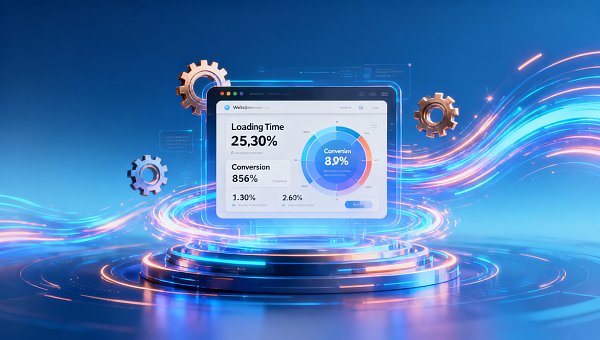
The table reveals that optimizations with high certainty, short cycles, and rapid verification should be prioritized. For example, CDN acceleration can be deployed across the entire value chain within 5 business days, and the decrease in bounce rate and increase in session depth can be monitored through Google Analytics within 7 days, providing quantifiable input data for enterprise decision-makers.
II. Key Factors in CDN Selection: More Than Just Speed, Accuracy is Crucial
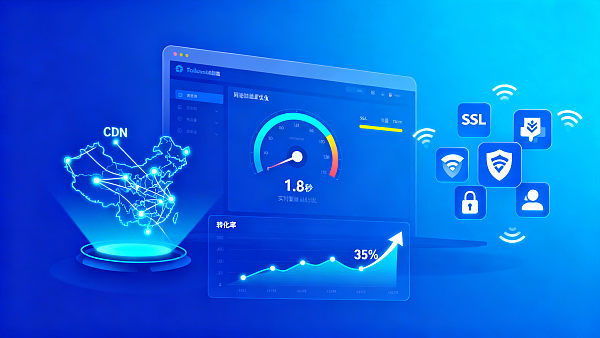
For websites targeting the global market, CDN performance cannot be judged solely by the "number of nodes." Analysis from the YiYingBao technology platform shows that in emerging markets such as Southeast Asia, Latin America, and the Middle East, relying solely on a general-purpose CDN can increase first-screen rendering latency by 1.4–2.1 seconds—because its edge nodes are not deeply integrated with local ISP networks. A truly effective CDN must meet three key criteria: physical distance between nodes and users in the target market <15ms, support for HTTP/3 and Brotli compression, and intelligent dynamic content routing capabilities.
E-Creative, in collaboration with AWS and Alibaba Cloud, has built a global CDN acceleration network covering 137 edge nodes in 42 countries across 7 continents. Among these, 31 are locally deployed nodes (such as Singapore SG-01 and Mexico MX-03), ensuring that latency for Chinese export companies accessing Brazilian users remains consistently below 28ms, a 43% reduction compared to the industry average. This network also supports automatic SSL certificate renewal and DDoS protection, guaranteeing zero-interruption business operations.
For project managers, CDN delivery must be embedded in the overall website building process: domain name resolution configuration must be started in parallel with SSL certificate application (taking 2-4 hours), static resource paths must be standardized with CDN prefixes during the development phase (to avoid rewriting URLs later), and all third-party scripts must be whitelisted by intelligent detection tools (an average of 12.6 high-risk scripts are blocked per site).
III. Trust Building: From "Page Elements" to "Behavioral Evidence"
After-sales maintenance personnel often report that customers repeatedly change the position of the "Trust Badge" with little effect. The root cause is that modern user trust building has shifted from static display to behavioral verification. A/B testing has confirmed that embedding a real-time online customer service response countdown (e.g., "Current average response: 23 seconds"), displaying the three most recent localized orders (including city and payment method), and continuously updating overseas warehouse shipping video streams can increase trust scores by 5.8 points (out of 10) and increase conversion intention by 3.2 times.
The EasyCreator intelligent website building system has a built-in "trust engine" that supports the automatic aggregation of Google Merchant Center reviews, local payment platform transaction vouchers, and logistics tracking APIs to generate a dynamic trust module. This module automatically matches regional preferences based on the user's IP address: prioritizing TUV certification and SEPA direct connection for German users, and highlighting SASO compliance logos and the Cash on Delivery option for Saudi users.
- Distributors/retailers should note: The trust module supports white label configuration, which can be replaced with the regional agent qualification icon and service hotline.
- Enterprise decision-makers should assess whether the module's data source supports API-level integration to avoid information lag caused by manual maintenance.
- Technical evaluators must verify whether dynamic content is loaded asynchronously using Web Workers to prevent blocking the main thread.
IV. Procurement Decision Guidelines: Implementation Recommendations for Different Roles
In response to the diverse needs of different roles, YiYingBao has developed differentiated implementation paths:
This configuration table has been validated in practice by 30+ provincial agents: Enterprises using the combined solution saw an average increase of 142% in organic traffic to their independent websites within 6 months, and a 27% decrease in advertising CPC, significantly outperforming the single-tool procurement model.
V. Action Recommendations: Immediately initiate your experience optimization loop.
Website experience optimization is not a one-off project, but a continuous, data-driven closed loop. YiYingBao provides a three-tiered response mechanism for businesses at different stages: Basic (free access to intelligent detection tools, generating an experience diagnostic report in 3 minutes), Professional (including CDN deployment + AI content optimization, launched within 7 business days), and Flagship (full-chain managed service, including localized compliance consultants and quarterly strategy reviews).
Currently, YiYingBao is launching specialized experience optimization packages for three vertical industries: manufacturing, cross-border e-commerce, and vocational education. These packages include industry-specific template libraries, pre-integrated local payment channels, and AI-powered compliance verification of documents, among other value-added modules. 127 companies have already achieved a conversion rate increase of over 40% in the first month through this program.
Making the world make way for Chinese brands begins with every millisecond-level loading optimization and is achieved through building trust in every detail. Contact the YiYingBao Customer Success Team now to receive your exclusive "Website Experience Conversion Diagnostic Report" and customized optimization roadmap.
- SSL Certificate
- Yiyingbao
- SEO
- Independent Website
- Smart website builder system
- Smart Website Building
- AI Translation
- EasySite Intelligent Website Builder
- Global CDN Acceleration
- AI Website Building
- cross-border e-commerce
- Why is website loading speed so important?
- What should I do if my overseas website loads slowly?
Related Articles
 Will social media automation get you banned by the platform? High-risk actions, appeal difficulties, and compliance recommendations
 Why is the overseas customer complaint website loading slowly? Server, scripts, and image loading order
 A Pitfall Guide for Digital Marketing Systems in Foreign Trade Enterprises: How to Avoid Data Silos and Permission Confusion

Related Products
 EasyCamp SaaS Smart Website Marketing SystemE-Yingbao SaaS Smart Website Marketing System: AI-powered, zero-code website building. Rapidly launch multilingual independent e-commerce sites in just 10 minutes. Global server acceleration and AI-driven SEO optimization empower businesses to efficiently connect with global markets. The seamless integration of technology and user-friendly operation makes building e-commerce sites incredibly simple.
 AI+SEM Intelligent Advertising Marketing SystemAI+SEM drives intelligent ad creation, empowering full-funnel precision advertising marketing. The system automatically generates weekly/monthly reports, AI recommends keywords and target countries, monitors core metrics in real-time with intelligent alerts, and enables one-click high-conversion ad solutions to help quickly acquire customers and improve ROI.
 AI+SEO Dual Engine Optimization ServiceEasyWin AI+SEO Dual Engine Optimization System leverages AI-powered keyword mining, content generation, and comprehensive technical optimization to help foreign trade enterprises acquire high-quality organic traffic, significantly improving search rankings and conversion rates.
 AI+SNS Social Media Marketing SystemYingbao AI+SNS Social Media Marketing System - Precision social capture for the social media era. Supports one-click content synchronization across major platforms like Facebook and LinkedIn. AI intelligently rewrites posts for enhanced relevance. 24/7 AI customer service and user profiling analysis empower businesses to efficiently expand into global markets.
 AI+SEO营销解决方案易营宝AI+SEO营销解决方案,通过AI批量写作、智能生成TDK、精准关键词扩词等功能,全面优化网站SEO效果,提升流量与转化率。助力企业构建高效智能网站新生态。
 AI+SEM Advertising Marketing SolutionsAI+SEM Advertising Marketing Solution leverages AI technology to deeply empower SEM ad campaigns. It automatically generates weekly/monthly reports using AI, presenting account data across multiple dimensions for comprehensive insights into campaign performance and trends. The system precisely recommends keywords and target countries, intelligently generates high-conversion ad copy, and enables one-click activation of efficient campaign plans to help businesses rapidly acquire customers. Simultaneously, it monitors core metrics in real time, intelligently identifies abnormal fluctuations, and issues timely alerts to ensure stable, high-return advertising results.
 Domain Name ServicesEasyWin provides professional domain name services, including intelligent queries, one-stop registration, brand protection, and full lifecycle management, helping businesses build a digital brand image.
 EasyOperate B2C Cross-Border E-Commerce Platform & Independent WebsiteEasyStore B2C Cross-border E-commerce Independent Store is an intelligent website building and cross-border e-commerce integrated solution independently developed by EasyStore Information Technology (Beijing) Co., Ltd. The system is specially designed for small and medium-sized as well as large export enterprises, integrating 'website building, operation, marketing, advertising, and conversion' into one, helping enterprises quickly establish cross-border e-commerce independent stores to achieve brand globalization and global sales growth.
The platform supports multiple languages, multiple currencies, and multi-channel marketing, with built-in AI intelligent translation and SEO optimization systems, suitable for mainstream markets such as Southeast Asia, Europe and America, Latin America, and the Middle East, assisting Chinese manufacturing enterprises in efficiently deploying international e-commerce strategies. SSL证书易营宝提供专业SSL安全证书服务,包括单域名和泛域名证书,确保网站数据传输加密、身份验证和完整性保护,助力企业建立安全可信的在线业务环境。









