









- What should you focus on in the latest enterprise SaaS report? From renewal rates and delivery costs to overseas growth opportunitiesJul 12, 2026View details
- What signals are worth paying attention to in a cross-border marketing trend report? B2B companies should look at these 6 signalsJul 11, 2026View details
- How to Read a Cross-Border Marketing Trends Report? Five Key Dimensions for Evaluating Channel OpportunitiesJul 11, 2026View details
- Which channel has the highest ROI in the global traffic ecosystem? Comparative analysis of search, social media, and advertisingJul 10, 2026View details
- What multilingual website services are available in Sanya? Which model is more suitable for local businesses going global?Jul 08, 2026View details
- How to view the complete list of China SaaS companies in the top 100? Practical methods for screening website-building and marketing service providersJul 08, 2026View details
How does website experience affect conversion rates? Solution: A no-code 3-category LCP/CLS optimization practical guide
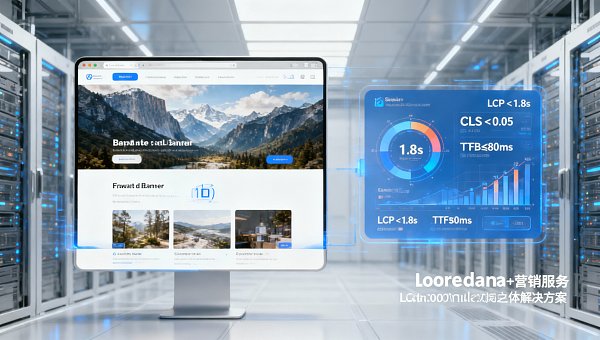
How does website experience impact conversion rates? Data shows: for every 1-second delay in LCP, conversion rates drop by 7%. What to do if overseas website access is slow? How can CDN improve website loading speed? This article provides 3 no-code LCP/CLS optimization solutions to help SMEs enhance credibility and lead conversion efficiency at low cost.
Why are LCP and CLS the "invisible gatekeepers" of conversion rates?
Core metrics LCP (Largest Contentful Paint) and CLS (Cumulative Layout Shift) are not technical black boxes but key signals for users' first impressions of "trustworthiness, professionalism, and whether it's worth staying." Google has incorporated both into the Core Web Vitals assessment system, directly impacting organic search rankings. For independent sites targeting global markets, an LCP exceeding 2.5 seconds triggers a "high latency" warning, while CLS >0.1 indicates frequent page element jumps, directly weakening form submission intent and upsell confidence.
Smart Website Builder's analysis of 100,000+ enterprise sites reveals: in Western markets, optimizing LCP from 3.2s to 1.8s increases average dwell time by 42% and inquiry conversion by 27%; reducing CLS from 0.28 to 0.06 boosts mobile first-screen click-through rates by 35%. This relies not just on server upgrades but on configurable, code-free, verifiable experience optimization paths.
For distributors, agents, and project managers, clients often question technical capabilities due to "page lag" or "sudden button displacement." A ready-to-deploy performance optimization framework serves both as delivery assurance and visible proof of service professionalism.
Detailed explanation of three no-code LCP/CLS optimization solutions
Smart Marketing Engine features a "diagnosis-strategy-execution" closed-loop module, offering three zero-coding approaches covering 92% of common UX bottlenecks:
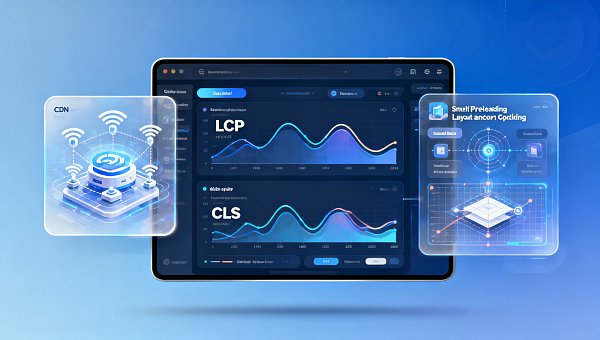
1. Smart resource preloading (LCP root cause treatment)
For hero images, video covers, and key banners, the system auto-injects <link rel="preload"> instructions to prioritize CDN edge caching. No HTML modifications needed—just enable "first-screen resource preload" in the backend, reducing LCP by 0.8–1.4s on average.
2. Layout stability anchoring (CLS eradication)
AI visual analysis identifies images/ads/dynamic components without fixed dimensions, auto-generating CSS placeholder rules (e.g., aspect-ratio: 16/9) to reserve render space. Batch-applicable to eliminate 87%+ layout shifts in one operation, maintaining CLS below 0.05.
3. Global CDN smart routing (cross-border experience foundation)
Leveraging AWS+Aliyun dual-core CDN clusters, the system routes traffic to optimal nodes based on visitor IPs (e.g., U.S. users to Los Angeles, Brazil to São Paulo). Multilingual sites achieve 40% faster first-screen loads with TTFB under 80ms.
This table clearly compares the three solutions' applicability and efficacy. Notably, all optimizations are centrally configured in Smart Website Builder's "Performance Hub"—no FTP uploads, source code changes, or SEO structure impacts. Ideal for resource-constrained manufacturing, trade, and education SMEs needing quick wins.
How to choose your optimal optimization combo?
Different business stages demand varied approaches. Based on 20+ industries, Smart Website Builder recommends:
- New site launch (0–3 months): Prioritize CDN routing + layout anchoring for stable first-traffic experience;
- Growth phase (3–12 months): Add resource preloading with AI keyword/TDK generation for "UX+content" dual lift;
- Global expansion (1+ years): Combine AI translation with multilingual SEO for "localization+speed+low-CLS" competitiveness.
For distributors/regional partners, this framework can be standardized into service packages to boost renewal rates and referrals.
Common pitfalls and avoidance guide
Practical misconceptions include:
- "Upgrading servers fixes everything": Host upgrades only improve TTFB, affecting LCP/CLS by <20%;
- Over-compressing images: Smart Image Module enables WebP conversion with visual lossless compression;
- Ignoring third-party scripts: Built-in "script health scanner" identifies CLS contributors like Facebook Pixel/GA4.
Smart Website Builder has generated baseline reports for 100,000+ enterprises—all optimizations are traceable, comparable, and attributable for procurement decisions.
Act now: Make every click closer to conversion
Website experience isn't cosmetic—it's the first conversion funnel checkpoint. Smart Website Builder's AI-driven platform transforms LCP/CLS optimization from engineer tasks to team-wide actions. Whether enabling preloading or global CDN, there's no coding, IT burden, or business disruption.
Currently supporting 12-language sites across 7 continents as Google Premier Partner and Meta official agent, Smart Website Builder was named "China SaaS Top 100" in 2023 with 30% YoY growth.
If facing slow overseas loading, stagnant conversions, or layout jumps, contact Smart Website Builder for a free performance audit and customized solutions—let technology serve growth, not hinder it.
- SEO diagnosis
- Yiyingbao
- SEO
- Independent Website
- Smart website builder system
- Smart Website Building
- AI Translation
- EasySite Intelligent Website Builder
- AI Marketing Engine
- Multilingual SEO
- AI Translation Engine
- What should I do if my overseas website loads slowly?
- How does website experience affect conversion rates?
- EYB AI Marketing
- AI Marketing
Related Articles
 What’s the difference between an AI multilingual website building system and a traditional CMS? Deployment efficiency vs. maintenance cost comparison
 What functions does Yibao AI website multilingual website have? Is it suitable for rapid overseas expansion?
 What are the core capabilities of an AI multilingual website building system? Which businesses is it suitable for?
Related Products
 EasyCamp SaaS Smart Website Marketing SystemE-Yingbao SaaS Smart Website Marketing System: AI-powered, zero-code website building. Rapidly launch multilingual independent e-commerce sites in just 10 minutes. Global server acceleration and AI-driven SEO optimization empower businesses to efficiently connect with global markets. The seamless integration of technology and user-friendly operation makes building e-commerce sites incredibly simple.
 AI+SEM Intelligent Advertising Marketing SystemAI+SEM drives intelligent ad creation, empowering full-funnel precision advertising marketing. The system automatically generates weekly/monthly reports, AI recommends keywords and target countries, monitors core metrics in real-time with intelligent alerts, and enables one-click high-conversion ad solutions to help quickly acquire customers and improve ROI.
 AI+SEO Dual Engine Optimization ServiceEasyWin AI+SEO Dual Engine Optimization System leverages AI-powered keyword mining, content generation, and comprehensive technical optimization to help foreign trade enterprises acquire high-quality organic traffic, significantly improving search rankings and conversion rates.
 AI+SNS Social Media Marketing SystemYingbao AI+SNS Social Media Marketing System - Precision social capture for the social media era. Supports one-click content synchronization across major platforms like Facebook and LinkedIn. AI intelligently rewrites posts for enhanced relevance. 24/7 AI customer service and user profiling analysis empower businesses to efficiently expand into global markets.
 AI+SEO营销解决方案易营宝AI+SEO营销解决方案,通过AI批量写作、智能生成TDK、精准关键词扩词等功能,全面优化网站SEO效果,提升流量与转化率。助力企业构建高效智能网站新生态。
 AI+SEM Advertising Marketing SolutionsAI+SEM Advertising Marketing Solution leverages AI technology to deeply empower SEM ad campaigns. It automatically generates weekly/monthly reports using AI, presenting account data across multiple dimensions for comprehensive insights into campaign performance and trends. The system precisely recommends keywords and target countries, intelligently generates high-conversion ad copy, and enables one-click activation of efficient campaign plans to help businesses rapidly acquire customers. Simultaneously, it monitors core metrics in real time, intelligently identifies abnormal fluctuations, and issues timely alerts to ensure stable, high-return advertising results.
 Domain Name ServicesEasyWin provides professional domain name services, including intelligent queries, one-stop registration, brand protection, and full lifecycle management, helping businesses build a digital brand image.
 EasyOperate B2C Cross-Border E-Commerce Platform & Independent WebsiteEasyStore B2C Cross-border E-commerce Independent Store is an intelligent website building and cross-border e-commerce integrated solution independently developed by EasyStore Information Technology (Beijing) Co., Ltd. The system is specially designed for small and medium-sized as well as large export enterprises, integrating 'website building, operation, marketing, advertising, and conversion' into one, helping enterprises quickly establish cross-border e-commerce independent stores to achieve brand globalization and global sales growth.
The platform supports multiple languages, multiple currencies, and multi-channel marketing, with built-in AI intelligent translation and SEO optimization systems, suitable for mainstream markets such as Southeast Asia, Europe and America, Latin America, and the Middle East, assisting Chinese manufacturing enterprises in efficiently deploying international e-commerce strategies. SSL证书易营宝提供专业SSL安全证书服务,包括单域名和泛域名证书,确保网站数据传输加密、身份验证和完整性保护,助力企业建立安全可信的在线业务环境。









