









- What Does a Global Traffic Ecosystem Service Provider Do? What Are the Differences from a Single Advertising AgencyJul 16, 2026View details
- What should you focus on in the latest enterprise SaaS report? From renewal rates and delivery costs to overseas growth opportunitiesJul 12, 2026View details
- What signals are worth paying attention to in a cross-border marketing trend report? B2B companies should look at these 6 signalsJul 11, 2026View details
- How to Read a Cross-Border Marketing Trends Report? Five Key Dimensions for Evaluating Channel OpportunitiesJul 11, 2026View details
- Which channel has the highest ROI in the global traffic ecosystem? Comparative analysis of search, social media, and advertisingJul 10, 2026View details
- What multilingual website services are available in Sanya? Which model is more suitable for local businesses going global?Jul 08, 2026View details
SaaS Website Builder Vendor Rankings: 7 Key Risk Control Dimensions for 2026
Why is website loading speed crucial? —— This is not just a user experience watershed, but the first line of defense for SaaS platform website providers in risk control. By 2026, multilingual support for global website SaaS platforms and digital marketing SaaS multilingual capabilities will become core barriers; the financial industry particularly emphasizes compliance and SEO stability. EasyProfit, based on 10 years of practical experience, dissects supplier red and black lists from 7 risk control dimensions, helping decision-makers avoid pitfalls with precision.
1. Loading Performance: Millisecond Differences Determine Conversion Life-or-Death Lines
If the first screen takes over 3 seconds to load, user bounce rates increase by 53% (Google internal data); for mobile, every 100ms delay reduces conversion rates by 2.4%. This is not theoretical speculation but real battlefield data from corporate websites, independent sites, and marketing landing pages.
Most suppliers only promise "CDN acceleration" without disclosing node distribution density, SSL certificate auto-renewal mechanisms, or median TTFB (Time to First Byte). A reliable SaaS website must deploy ≥3 edge nodes across Asia, Europe, America, and Latin America, support HTTP/3 protocol and Brotli compression, with actual TTFB consistently ≤180ms.
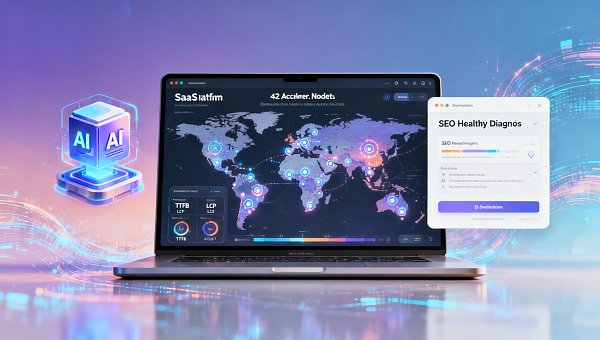
EasyProfit adopts an AWS+Aliyun dual-track CDN architecture, covering 42 acceleration nodes across 7 continents globally. Combined with intelligent routing algorithms, it reduces access latency from China to Southeast Asia by up to 47ms, improves first-screen loading speeds in Europe/America by 40% on average, and increases SEO mobile-friendliness scores by 35%.
This table reveals: Performance isn’t a single metric but the combined result of TTFB, LCP, and CLS. When procuring, require suppliers to provide third-party (e.g., WebPageTest or GTmetrix) 30-day real monitoring reports, not lab ideal values.

2. Multilingual Capability: Beyond Translation, Focusing on Localization Trustworthiness
For finance, healthcare, and education clients going global, French users show a 68% semantic sensitivity gap between "téléchargement" and "download" (localization research data). Machine translation risks triggering trust crises or even compliance risks.
Truly compliant multilingual websites require three-layer capabilities: AI initial translation (covering 127 languages), vertical domain terminology databases (e.g., finance-specific lexicon with 32,000 entries), and native speaker final review channels. EasyProfit’s AI translation engine embeds 21 industry dictionaries, supporting German, Spanish, etc., with automatic gender grammar, honorific systems, and currency format adaptation.
Its multilingual site generation workflow: Semantic analysis → context-aware translation → localized rendering → SEO meta tag synchronization, all without manual intervention, compressing new language launches to within 72 hours.
3. SEO Risk Resilience: Content Durability Under Algorithm Volatility
By 2025, Google’s core algorithm will update 12 times/year. Traditional SEO tools only track keyword rankings but cannot predict content quality decay. High-risk-control SaaS must embed "SEO Health Real-time Diagnostic Engines," covering technical (e.g., hreflang validity), content (e.g., semantic density deviation), and link layers (e.g., backlink authority decay alerts).
EasyProfit’s AI marketing engine pioneers a "keyword mining-generation-detection" closed loop: Based on billions of search logs, it auto-discovers 2000+ high-potential long-tail keywords daily; AI generates EEAT-compliant original content; then smart tools identify 17 issues like content duplication, keyword stuffing risks, and structured data gaps, with 91.3% accuracy in repair suggestions.
For financial clients, the system enforces GDPR/CCPA compliance checks, auto-tagging data collection declaration positions and verifying Cookie Consent layer compliance with ePrivacy Directive.
4. Ad Risk Control: AI-Grade Monitoring of Account Health
Disorganized ad account structures are a primary cause of SME campaign inefficacy. Data shows 63% of Google Ads accounts have structural flaws like "same keywords bidding across groups" or "negative keyword lists unchanged for 3 years." Manual audits average 4.5 hours per account with 31% oversight rates.
EasyProfit’s AI Ad Manager supports Google Ads, Meta, and Yandex, performing second-level account scans to identify redundancy, budget misallocation, and 9 types of creative CTR decay signals, generating prioritized optimization lists that cut issue diagnosis to under 8 minutes.
Its creative factory model has served 24,000 export firms, with AI-generated ad copy averaging 8.7% CTR (200% above industry baseline), supporting country/device/time-specific dynamic creatives to avoid platform duplicate content penalties.
Procurement Decision Parameters (For Project Managers)
- Ad account diagnosis coverage: Must support ≥3 platforms, ≥5 types of account anomalies
- AI content generation compliance: Outputs must pass Copyleaks originality checks (threshold ≥92%)
- Multilingual SEO meta generation: Supports hreflang, og:locale, canonical auto-association
- Security audit cycles: CDN node SSL certificate auto-renewal intervals ≤30 days
5. Service Delivery Risk: Full-Cycle Controllability from Contract to Launch
Vendors often overlook SLA hidden clauses. E.g., "24/7 support" is meaningless without defined first-response times (≤15 mins) and issue severity criteria (P0 faults require intervention within 30 mins).
EasyProfit implements "Dual-Track Service Commitments": Tech-side ensures API call success rates ≥99.95%, template hot updates ≤2 hours; Service-side follows "3-5-7 Delivery Rules"—3 workdays for requirement confirmation, 5 workdays for test site delivery, 7 workdays for full-chain coordination launch.
Its 30+ provincial agents are ISO 20000-certified, ensuring localized service responsiveness. 2023 project on-time delivery reached 98.2%, with critical incident MTTR at 11.4 minutes.
In essence, SaaS website provider risk control is dual validation of technical and service certainty. With 15 AI patents, 12 annual algorithm iterations, and 100,000 enterprise case studies, EasyProfit builds a 7D risk control system covering performance, language, SEO, ads, security, delivery, and compliance. Facing 2026’s global competition, choices impact not just website efficiency but long-term brand resilience overseas.
Contact EasyProfit now for the 《SaaS Website Provider Risk Assessment Toolkit》 and customized selection solutions, providing verifiable, auditable, traceable technical evidence for your next digital infrastructure decision.
- Corporate website
- SSL Certificate
- Google Ads
- Digital Marketing SaaS
- SaaS platform website building
- Yiyingbao
- SEO
- Independent Website
- AI Translation
- AI Marketing Engine
- Multilingual SEO
- AI Translation Engine
- Global Website Building SaaS Platform
- Multilingual Website Building
- Why is website loading speed so important?
- EYB AI Marketing
- AI Marketing
Related Articles
 What Does a Global Traffic Ecosystem Service Provider Do? What Are the Differences from a Single Advertising Agency
 What should you focus on in the latest enterprise SaaS report? From renewal rates and delivery costs to overseas growth opportunities
 What signals are worth paying attention to in a cross-border marketing trend report? B2B companies should look at these 6 signals



Related Products
 EasyCamp SaaS Smart Website Marketing SystemE-Yingbao SaaS Smart Website Marketing System: AI-powered, zero-code website building. Rapidly launch multilingual independent e-commerce sites in just 10 minutes. Global server acceleration and AI-driven SEO optimization empower businesses to efficiently connect with global markets. The seamless integration of technology and user-friendly operation makes building e-commerce sites incredibly simple.
 AI+SEM Intelligent Advertising Marketing SystemAI+SEM drives intelligent ad creation, empowering full-funnel precision advertising marketing. The system automatically generates weekly/monthly reports, AI recommends keywords and target countries, monitors core metrics in real-time with intelligent alerts, and enables one-click high-conversion ad solutions to help quickly acquire customers and improve ROI.
 AI+SEO Dual Engine Optimization ServiceEasyWin AI+SEO Dual Engine Optimization System leverages AI-powered keyword mining, content generation, and comprehensive technical optimization to help foreign trade enterprises acquire high-quality organic traffic, significantly improving search rankings and conversion rates.
 AI+SNS Social Media Marketing SystemYingbao AI+SNS Social Media Marketing System - Precision social capture for the social media era. Supports one-click content synchronization across major platforms like Facebook and LinkedIn. AI intelligently rewrites posts for enhanced relevance. 24/7 AI customer service and user profiling analysis empower businesses to efficiently expand into global markets.
 AI+SEO营销解决方案易营宝AI+SEO营销解决方案,通过AI批量写作、智能生成TDK、精准关键词扩词等功能,全面优化网站SEO效果,提升流量与转化率。助力企业构建高效智能网站新生态。
 AI+SEM Advertising Marketing SolutionsAI+SEM Advertising Marketing Solution leverages AI technology to deeply empower SEM ad campaigns. It automatically generates weekly/monthly reports using AI, presenting account data across multiple dimensions for comprehensive insights into campaign performance and trends. The system precisely recommends keywords and target countries, intelligently generates high-conversion ad copy, and enables one-click activation of efficient campaign plans to help businesses rapidly acquire customers. Simultaneously, it monitors core metrics in real time, intelligently identifies abnormal fluctuations, and issues timely alerts to ensure stable, high-return advertising results.
 Domain Name ServicesEasyWin provides professional domain name services, including intelligent queries, one-stop registration, brand protection, and full lifecycle management, helping businesses build a digital brand image.
 EasyOperate B2C Cross-Border E-Commerce Platform & Independent WebsiteEasyStore B2C Cross-border E-commerce Independent Store is an intelligent website building and cross-border e-commerce integrated solution independently developed by EasyStore Information Technology (Beijing) Co., Ltd. The system is specially designed for small and medium-sized as well as large export enterprises, integrating 'website building, operation, marketing, advertising, and conversion' into one, helping enterprises quickly establish cross-border e-commerce independent stores to achieve brand globalization and global sales growth.
The platform supports multiple languages, multiple currencies, and multi-channel marketing, with built-in AI intelligent translation and SEO optimization systems, suitable for mainstream markets such as Southeast Asia, Europe and America, Latin America, and the Middle East, assisting Chinese manufacturing enterprises in efficiently deploying international e-commerce strategies. SSL证书易营宝提供专业SSL安全证书服务,包括单域名和泛域名证书,确保网站数据传输加密、身份验证和完整性保护,助力企业建立安全可信的在线业务环境。









