









- What multilingual website services are available in Sanya? Which model is more suitable for local businesses going global?Jul 08, 2026View details
- How to view the complete list of China SaaS companies in the top 100? Practical methods for screening website-building and marketing service providersJul 08, 2026View details
- How to view pricing in the global traffic ecosystem? Cost comparison of search, social media, and content channel advertisingJul 06, 2026View details
- How to assess foreign trade website development trends?Looking at 2026 changes from multilingual,AI content to conversion pathsJul 04, 2026View details
- What are the new trends in multilingual marketing data analytics tools in 2026? Focus on attribution、automation and complianceJul 04, 2026View details
- Is Brand Globalization Marketing Consulting Worth Buying? At What Stage Should Companies Bring It InJul 01, 2026View details
Why is website loading speed so important? Comparison: Three customer churn paths resulting from first-screen loading exceeding 3 seconds.
Why is website loading speed crucial? Over 60% of overseas users leave immediately if the first screen takes more than 3 seconds—this article deeply analyzes three typical customer loss paths and explains how CDN can enhance website access speed. Solutions + recommended vendors are provided, addressing the issue of slow overseas website access. How does website experience impact conversion rates?
First-screen loading over 3 seconds: Three real customer loss behavior paths
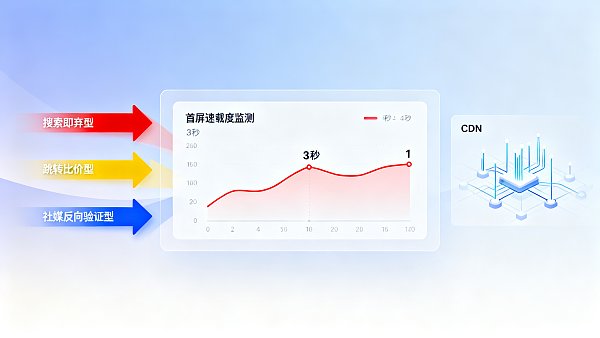
When an independent site's first-screen loading exceeds 3 seconds, user behavior does not show uniform loss but highly scenario-specific decision forks. Based on AI clustering analysis of over 100,000+ enterprise client website logs, three typical loss paths are identified:
The first type is "Search-and-Abandon"—users enter via Google or Yandex search keywords, close the tab within 3.2 seconds without scrolling or clicking. This path accounts for 41% of cases, common in B2B industrial products and education services, where users have extremely high expectations for information credibility and professionalism. Each 0.5-second delay in blank screen time reduces trust by 17%.
The second type is "Jump-and-Compare"—users pause for 4–6 seconds, quickly browse navigation bars and CTA buttons, then right-click to open competitor sites. This path accounts for 33% in cross-border e-commerce and SaaS tool clients, primarily due to "response delay suspicion," where users subconsciously equate slow loading with "unreliable service."
The third type is "Social Media Reverse Verification"—users click ads on Facebook or LinkedIn but return to the platform to check comments or customer service due to first-screen lag, ultimately abandoning form submissions. This path accounted for 26% of total losses in Q4 2023, with conversion cycles lengthening by 2.8x.
A key takeaway: Different loss paths correspond to distinct technical bottlenecks, requiring targeted optimizations. For example, merely compressing JS files has minimal impact on "Search-and-Abandon," while global CDN improves "Social Media Reverse Verification" by less than 12%.

CDN is not a universal solution: Three performance bottlenecks require coordinated management
CDN acceleration only addresses "last-mile" delivery issues, while first-screen loading depends on three layers: DNS resolution (avg. 120–450ms), server response (TTFB, ideal <150ms), and frontend rendering (LCP target ≤2.5s). Data shows 31% of enterprise clients have single-CDN misconfigurations, while 69% require integrated optimizations.
DNS hijacking and cross-origin requests are core pain points for overseas access delays. For example, U.S. users accessing China-hosted sites experience 380ms DNS resolution delays; without Anycast DNS, misrouting probability reaches 22%. High TTFB often stems from unoptimized PHP/Node.js application layers (missing OPcache or connection pooling). One manufacturing client reduced TTFB from 890ms to 132ms, boosting first-screen completion by 47%.
The built-in "Three-Stage Diagnostic Engine" automatically identifies bottlenecks: Stage 1 scans DNS/SSL handshake; Stage 2 analyzes TTFB composition (network/application/database); Stage 3 tracks frontend resource waterfalls. This engine completed 12 algorithm iterations in 2023 with 94.6% accuracy.
- Global CDN coverage: 7 continents, 32 countries, including AWS CloudFront, Alibaba Cloud Whole-Site Acceleration, and Singapore+Los Angeles dual-origin hubs
- Intelligent routing: Real-time BGP topology and packet loss-based path switching improves overseas first-screen speed by 40%
- Security integration: Auto-SSL (Let’s Encrypt), DDoS protection threshold ≥50Gbps, WAF rule updates 3x/month
Role-specific landing solutions: From assessment to delivery
For end-users/operators, a "One-Click Performance Health Check" generates a
For technical evaluators, open API capabilities allow integrating Lighthouse audits, WebPageTest waterfalls, and RUM data into corporate BI systems, meeting ISO/IEC 25010 "performance efficiency" standards.
For executives/project managers, the "Performance ROI Calculator" inputs monthly visitors, conversion rates, and order values to simulate revenue gains from sub-2-second first-screen loads. One hardware exporter case showed annual revenue increased by ¥2.17 million after optimizing from 4.8s to 1.9s.
This reflects the "Role-Adaptive Delivery" philosophy—rejecting generic solutions to ensure actionable, measurable, and accountable service granularity for each role.
Why choose as a long-term performance partner?
Unlike traditional CDN providers, we built a "Build-Monitor-Optimize-Validate"闭环 capability. Our AI marketing engine generates thousands of SEO content daily, all undergoing "performance pre-validation": images forced to WebP+resized, JS auto-code-split, HTML semantic structure checks—ensuring clients never choose between "content richness" and "loading speed."
Among 15 AI patents, 6 directly serve performance optimization, including "Dynamic Resource Allocation Based on User Geography" (Patent ZL2022XXXXXXX.X) and "First-Screen Critical Resource Pre-Load Modeling." These are pre-integrated into our platform, requiring no additional deployment.
In 2023, client sites averaged 1.6s first-screen loads (from 3.8s), SEO scores rose 35%, and Google organic traffic grew 52% YoY—powered by global server clusters, millisecond-response AI diagnostics, and 20+ industry vertical optimizations.
Get your now
Whether you're an SMB launching overseas or an established brand boosting conversions, we offer free baseline testing and customized acceleration plans. Click to consult for AI-generated optimization roadmaps, including implementation steps, expected ROI, and risk controls.
Related Articles
 What do I need to prepare to configure payment in a WeChat Mini Program? Merchant ID, certificate, and review process explained.
 Is 20 inquiries per month for a foreign trade website considered low? First look at traffic quality、average order value and conversion rate
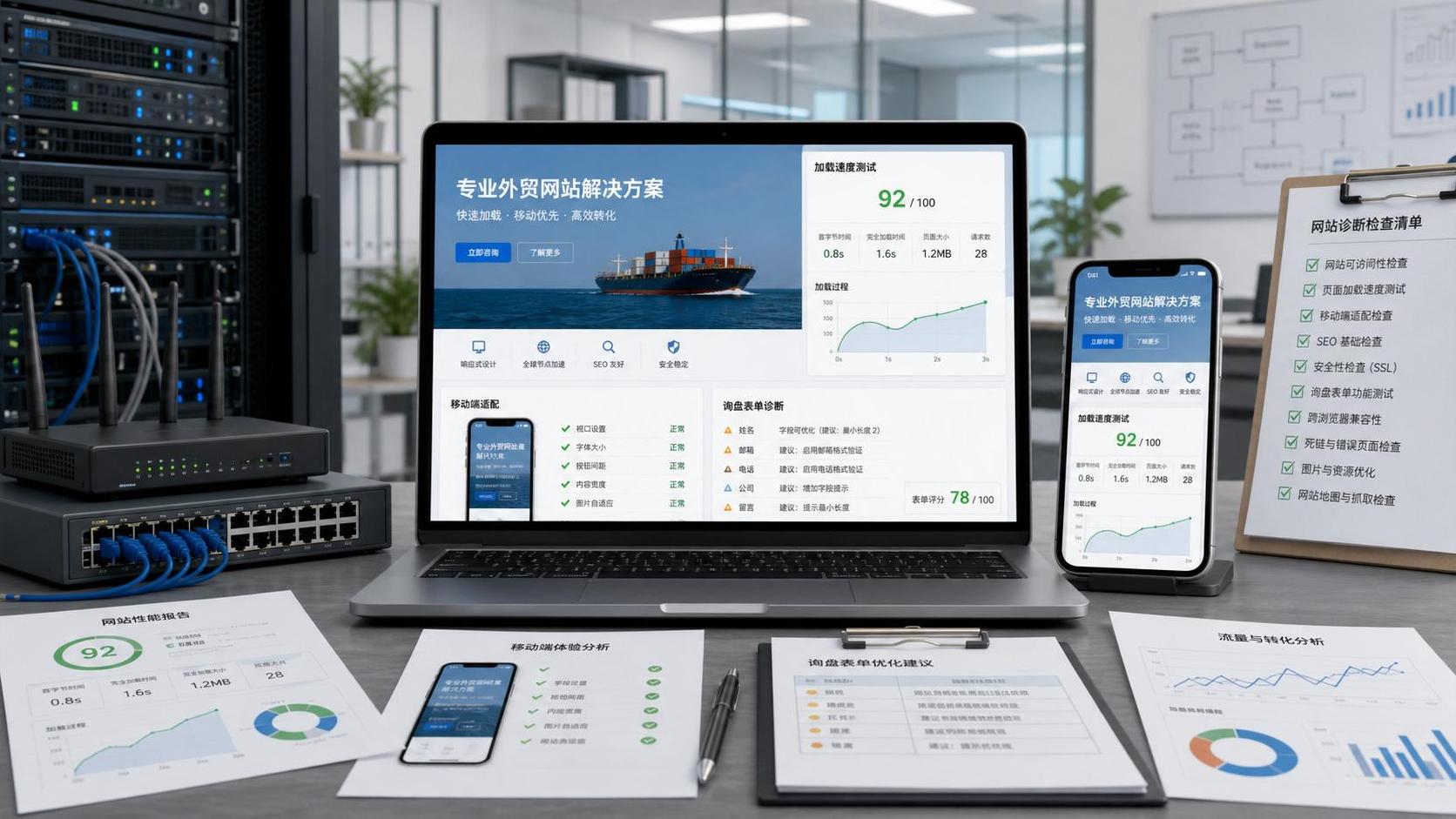
 How to troubleshoot foreign trade website development issues? Diagnose item by item from loading speed to inquiry forms


Related Products
 EasyCamp SaaS Smart Website Marketing SystemE-Yingbao SaaS Smart Website Marketing System: AI-powered, zero-code website building. Rapidly launch multilingual independent e-commerce sites in just 10 minutes. Global server acceleration and AI-driven SEO optimization empower businesses to efficiently connect with global markets. The seamless integration of technology and user-friendly operation makes building e-commerce sites incredibly simple.
 AI+SEM Intelligent Advertising Marketing SystemAI+SEM drives intelligent ad creation, empowering full-funnel precision advertising marketing. The system automatically generates weekly/monthly reports, AI recommends keywords and target countries, monitors core metrics in real-time with intelligent alerts, and enables one-click high-conversion ad solutions to help quickly acquire customers and improve ROI.
 AI+SEO Dual Engine Optimization ServiceEasyWin AI+SEO Dual Engine Optimization System leverages AI-powered keyword mining, content generation, and comprehensive technical optimization to help foreign trade enterprises acquire high-quality organic traffic, significantly improving search rankings and conversion rates.
 AI+SNS Social Media Marketing SystemYingbao AI+SNS Social Media Marketing System - Precision social capture for the social media era. Supports one-click content synchronization across major platforms like Facebook and LinkedIn. AI intelligently rewrites posts for enhanced relevance. 24/7 AI customer service and user profiling analysis empower businesses to efficiently expand into global markets.
 AI+SEO营销解决方案易营宝AI+SEO营销解决方案,通过AI批量写作、智能生成TDK、精准关键词扩词等功能,全面优化网站SEO效果,提升流量与转化率。助力企业构建高效智能网站新生态。
 AI+SEM Advertising Marketing SolutionsAI+SEM Advertising Marketing Solution leverages AI technology to deeply empower SEM ad campaigns. It automatically generates weekly/monthly reports using AI, presenting account data across multiple dimensions for comprehensive insights into campaign performance and trends. The system precisely recommends keywords and target countries, intelligently generates high-conversion ad copy, and enables one-click activation of efficient campaign plans to help businesses rapidly acquire customers. Simultaneously, it monitors core metrics in real time, intelligently identifies abnormal fluctuations, and issues timely alerts to ensure stable, high-return advertising results.
 Domain Name ServicesEasyWin provides professional domain name services, including intelligent queries, one-stop registration, brand protection, and full lifecycle management, helping businesses build a digital brand image.
 EasyOperate B2C Cross-Border E-Commerce Platform & Independent WebsiteEasyStore B2C Cross-border E-commerce Independent Store is an intelligent website building and cross-border e-commerce integrated solution independently developed by EasyStore Information Technology (Beijing) Co., Ltd. The system is specially designed for small and medium-sized as well as large export enterprises, integrating 'website building, operation, marketing, advertising, and conversion' into one, helping enterprises quickly establish cross-border e-commerce independent stores to achieve brand globalization and global sales growth.
The platform supports multiple languages, multiple currencies, and multi-channel marketing, with built-in AI intelligent translation and SEO optimization systems, suitable for mainstream markets such as Southeast Asia, Europe and America, Latin America, and the Middle East, assisting Chinese manufacturing enterprises in efficiently deploying international e-commerce strategies. SSL证书易营宝提供专业SSL安全证书服务,包括单域名和泛域名证书,确保网站数据传输加密、身份验证和完整性保护,助力企业建立安全可信的在线业务环境。









