









- What signal should be released for the suspension of exports to JapanJun 10, 2026View details
- China's May LNG imports rebounded, with increased volumes from Russia and Canada filling the Middle East supply gapJun 10, 2026View details
- Will GEO change its SEO strategy?Jun 04, 2026View details
- What types of businesses are end-to-end solutions suitable for?Jun 03, 2026View details
- 2026 Global Growth Channel TrendsJun 02, 2026View details
- Changes in Search Engine Ranking Factors in 2026Jun 06, 2026View details
- Which stages is the brand visibility enhancement service suitable forMay 29, 2026View details
- What Are the Key Modules of International Digital Marketing ServicesMay 29, 2026View details
How to use a responsive website building system smoothly?
When choosing a responsive website building system, many companies aren't really concerned with "whether they can build a website," but rather with "whether it's easy to manage after completion, whether it can acquire customers, whether it helps with SEO, and whether it will be troublesome for the team to use later." Judging from their search intent, these users are usually in the evaluation or pre-implementation stage, wanting to determine if a self-service enterprise website building system is suitable for their business scenario, paying particular attention to multi-terminal adaptation, content maintenance efficiency, inquiry conversion paths, multi-language SEO impact, and future expansion costs.
For business decision-makers, the focus is on return on investment, launch speed, post-launch maintenance costs, and marketing conversion capabilities. For project managers and execution teams, the focus is on section planning, page construction, keyword placement, and management of different language sites. For after-sales and channel partners, the emphasis is on backend access, ease of content updates, and long-term maintainability. Truly helpful content doesn't just vaguely state "responsive design is important," but rather clearly tells you: what kind of website building system is user-friendly, how to structure your website for better SEO and conversion, and what pitfalls most likely to cause a website to be unusable after launch.
Therefore, this article will focus on four parts: First, the core criteria for judging "ease of use"; second, the most easily overlooked but most effective website building methods for enterprises; third, practical handling of multilingualism, SEO, and foreign trade scenarios; and fourth, how enterprises should select and implement website building to avoid it becoming a one-off display project.
How can you make a responsive website building system easy to use? The answer isn't a pretty interface or a lot of templates, but rather: stable front-end adaptation, easy-to-use back-end operation, comprehensive SEO fundamentals, clear content management, and a conversion path designed around business goals. Only when all these conditions are met simultaneously will the website not just be "online," but truly serve marketing, sales, and brand growth in the long term.
What kind of responsive website building system is convenient for businesses to use?
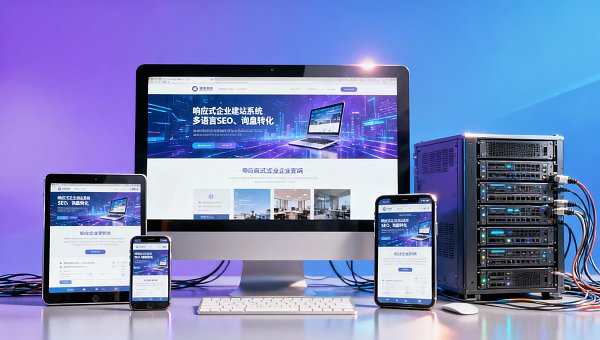
From the perspective of users' true intent when searching for this question, "ease of use" usually equates to four things: easy to set up, easy to maintain, easy to be understood by search engines, and easy to drive inquiries or business conversions . If a system can only create web pages but cannot do these things, the actual user experience is often very poor.
When making a judgment, companies can first look at the following criteria:
- Multi-terminal compatibility stability : It's not just about "being able to open on a mobile phone," but about ensuring that navigation, image and text ratios, button positions, and form submissions are all normal on PCs, tablets, and mobile phones.
- Is the backend suitable for non-technical personnel to operate ? Can marketing, sales, operations, and even after-sales departments quickly update content, instead of having to find a technician every time they change a picture or add a piece of text?
- Are the basic SEO capabilities complete ? Can you control the title, description, URL, custom categories, image alt text, structured content, sitemap, and indexing rules?
- Are the conversion components complete ? Does it support inquiry forms, online consultations, phone buttons, WhatsApp or social media redirects, white paper downloads, and demo appointments?
- Is it easy to expand later : Is it easy to add new languages, new product lines, new landing pages, and integrate marketing tools?
Many companies fail to build websites not because the system is poor, but because they only looked at the template's appearance when selecting a system, without considering the backend logic and marketing capabilities. This is especially true for companies that offer integrated website and marketing services; they need to treat their website building system as "growth infrastructure," not just a simple display tool.
Enterprise-level self-service website building system tutorial: Build the structure first, then create the pages; it will become smoother and smoother with use.
When businesses actually get started, the most common mistake they make is choosing a template first, changing colors first, piling on images first, and only then thinking about how the website should serve their business. The correct order should be the reverse: first define the goals, then the structure, then the content, and finally, beautify the pages .
A user-friendly corporate website is usually designed like this:
- First, clarify the website's goals . Is it for brand display, customer acquisition, distributor recruitment, foreign trade inquiries, or after-sales service support? Different goals require completely different page structures.
- Core sections include: Homepage, About Us, Products/Services, Solutions, Case Studies, News, Download Center, and Contact Us. For B2B companies, solutions, case studies, qualifications, and delivery capabilities are often more important than a simple product page.
- Designing the user path : What visitors see first, where to build trust, and where to submit leads should all be planned in advance. Otherwise, even if traffic comes in, conversion will be difficult.
- Organize content by keywords. <br />Different sections correspond to different search intents. Product keywords, scenario keywords, problem keywords, regional keywords, and brand keywords should be distributed hierarchically, and not all piled up on the homepage.
- Finally, unify the visual style . Colors, layouts, icons, and banner styles should serve the brand positioning, rather than just pursuing a "high-end look".
Taking new energy companies as an example, a website needs to not only showcase the company's strength but also establish industry credibility and trust in international cooperation. Website solutions for sectors like photovoltaics and new energy are better suited to a grand visual narrative and a logically clear layout, weaving brand display, supply chain strength, customized services, partners, and project acquisition into a complete closed loop. Such websites are often not just "aesthetically pleasing" but are more suitable for B2B clients to make decisions.
If your target audience includes corporate decision-makers, distributors, and project managers, then your homepage must answer their most pressing questions as quickly as possible: Who are you? What problems can you solve? What projects have you done? What makes you credible? How can they contact you next?
Why are many responsive websites "visually appealing but unusable"? The key issues lie in SEO and conversion paths.

Many businesses believe that once a responsive website is built, traffic and inquiries will naturally follow. In reality, what truly impacts the user experience is whether a solid SEO foundation has been established and whether the conversion path has been clearly designed .
Let's start with SEO. Responsive websites are generally search engine friendly because they use unified URLs and content management, reducing duplicate pages across different devices. However, this is contingent on the system itself supporting the following capabilities:
- Page title and meta description can be customized.
- The URLs for category pages, content pages, and product pages are clearly readable.
- Images can be labeled with Alt tags.
- Supports breadcrumb navigation and internal links
- Supports basic configurations such as site map and Robots.txt.
- The page loads smoothly and provides a good user experience on mobile devices.
Let's talk about conversion rates. The biggest problem for many websites isn't that no one views them, but that even if they do, they don't convert. The reasons usually include:
- The homepage is cluttered with information, but lacks a clear main action button.
- The product page only talks about parameters, but doesn't mention application scenarios or customer benefits.
- The case study page only contains images, lacking project background, deliverables, and client value.
- The contact information is too hidden, and the forms are too complicated.
- The buttons on the mobile app are too small, making the consultation process cumbersome.
A truly user-friendly responsive website building system should allow operators to easily set different conversion actions for different pages. For example, the homepage could primarily promote "Get a solution," product pages could primarily promote "Contact us now," case study pages could primarily promote "View similar projects," and download pages could primarily promote "Submit information to get materials." This way, the website can align with marketing goals, rather than having only one "Contact us" message on every page.
Will a multilingual website for international trade affect SEO? The key isn't multilingualism, but rather the management style.
This is a question that many export-oriented companies are particularly concerned about. The conclusion is: multilingualism itself does not harm SEO; it is the incorrect multilingual management methods that do .
If a business targets overseas markets, multilingual support is essential for a responsive website building system. However, several principles should be observed:
- Each language should ideally have its own independent page structure ; avoid using machine translation to directly cover all core pages.
- Different keywords should be matched for different languages , and Chinese users and English users have different search habits.
- The URL structure should be clear so that search engines can easily identify different language versions.
- Core pages should be optimized manually first , especially the homepage, product pages, solution pages, and inquiry pages.
- Do not convert all content into images , otherwise search engines will not be able to understand it effectively.
For companies in the new energy, manufacturing, and engineering sectors that are expanding overseas, multilingual websites not only serve an SEO purpose but also play a crucial role in building brand trust. Overseas clients often use a website to assess a company's delivery capabilities, supply chain strength, collaboration experience, and industry expertise. Therefore, the page content should not be limited to a "company profile" but should cover key information such as technical capabilities, certifications, service processes, case studies, and FAQs.
If your business requires both brand showcasing and customer acquisition, then your website needs stronger content capacity. For example, a fully responsive solution for new energy companies must maintain a good browsing experience on global devices while continuously improving inquiry quality and brand persuasiveness through clear solution logic, partner showcases, industry updates, and a closed-loop service design.
How should businesses choose a system and determine a solution to avoid becoming increasingly awkward to use later on?
If you are evaluating a responsive website building system, it is recommended that you do not just ask "how much" or "how long will it take to go live", but instead focus on asking the following questions:
- Does the backend support role-based access control?
This allows for a division of labor among marketing, product, after-sales, and channel personnel, preventing all modifications from falling on the shoulders of one person. - Is it convenient for long-term SEO optimization?
If you can't flexibly adjust the title, URL, and internal links later on, it will be difficult for the website to continue to grow. - Does it support continuous content expansion?
Is the system easy to maintain when companies add new products, case studies, news, or downloadable materials? - Does it support the integration of marketing data?
Examples include form data, statistical tools, advertising landing pages, and CRM lead synchronization. - Does the service provider understand the industry's business, and not just know how to create web pages?
This is crucial. A team that understands the business can help you plan the website logic, while a team that doesn't often just use templates.
For business managers, a truly worthwhile website investment is not a one-time delivery and then neglected "online business card," but rather a business tool that can continuously build brand assets, support sales conversion, and improve channel collaboration efficiency. Especially in industries such as new energy, manufacturing, foreign trade, and engineering services, websites are increasingly becoming the "first sales site," and their professionalism directly impacts customer trust.
If you want your website to both reflect your brand's prestige and align with customer acquisition strategies, prioritize website development solutions that unify industry value, solutions, project capabilities, service processes, and terminal compatibility. This will result in a smoother overall experience, whether it's SEO, advertising, social media campaigns, or having agents share the page.
In summary, the essence of "ease of use" is to make the website truly serve the business.
How can you make a responsive website building system easy to use? The key is not how flashy the templates are or how rich the pages are, but whether it can truly integrate multi-terminal experience, content maintenance efficiency, SEO basics, conversion paths, and multi-language management, all centered around the company's actual business goals.
If you're a decision-maker, focus on return on investment, long-term maintenance, and marketing synergy; if you're a project manager, focus on structural planning, content management, and execution efficiency; if you're an operations or after-sales staff member, focus on whether the backend is user-friendly and easy to update. Only when all these roles can use it smoothly can the system truly be considered "easy to use."
Simply put, a good enterprise website building system does more than just create a website; it helps you continuously connect brand display, customer trust, search traffic, and business conversion. Only such a website is worth operating long-term.
Related Articles



Related Products
 EasyCamp SaaS Smart Website Marketing SystemE-Yingbao SaaS Smart Website Marketing System: AI-powered, zero-code website building. Rapidly launch multilingual independent e-commerce sites in just 10 minutes. Global server acceleration and AI-driven SEO optimization empower businesses to efficiently connect with global markets. The seamless integration of technology and user-friendly operation makes building e-commerce sites incredibly simple.
 AI+SEM Intelligent Advertising Marketing SystemAI+SEM drives intelligent ad creation, empowering full-funnel precision advertising marketing. The system automatically generates weekly/monthly reports, AI recommends keywords and target countries, monitors core metrics in real-time with intelligent alerts, and enables one-click high-conversion ad solutions to help quickly acquire customers and improve ROI.
 AI+SEO Dual Engine Optimization ServiceEasyWin AI+SEO Dual Engine Optimization System leverages AI-powered keyword mining, content generation, and comprehensive technical optimization to help foreign trade enterprises acquire high-quality organic traffic, significantly improving search rankings and conversion rates.
 AI+SNS Social Media Marketing SystemYingbao AI+SNS Social Media Marketing System - Precision social capture for the social media era. Supports one-click content synchronization across major platforms like Facebook and LinkedIn. AI intelligently rewrites posts for enhanced relevance. 24/7 AI customer service and user profiling analysis empower businesses to efficiently expand into global markets.
 AI+SEO营销解决方案易营宝AI+SEO营销解决方案,通过AI批量写作、智能生成TDK、精准关键词扩词等功能,全面优化网站SEO效果,提升流量与转化率。助力企业构建高效智能网站新生态。
 AI+SEM Advertising Marketing SolutionsAI+SEM Advertising Marketing Solution leverages AI technology to deeply empower SEM ad campaigns. It automatically generates weekly/monthly reports using AI, presenting account data across multiple dimensions for comprehensive insights into campaign performance and trends. The system precisely recommends keywords and target countries, intelligently generates high-conversion ad copy, and enables one-click activation of efficient campaign plans to help businesses rapidly acquire customers. Simultaneously, it monitors core metrics in real time, intelligently identifies abnormal fluctuations, and issues timely alerts to ensure stable, high-return advertising results.
 Domain Name ServicesEasyWin provides professional domain name services, including intelligent queries, one-stop registration, brand protection, and full lifecycle management, helping businesses build a digital brand image.
 EasyOperate B2C Cross-Border E-Commerce Platform & Independent WebsiteEasyStore B2C Cross-border E-commerce Independent Store is an intelligent website building and cross-border e-commerce integrated solution independently developed by EasyStore Information Technology (Beijing) Co., Ltd. The system is specially designed for small and medium-sized as well as large export enterprises, integrating 'website building, operation, marketing, advertising, and conversion' into one, helping enterprises quickly establish cross-border e-commerce independent stores to achieve brand globalization and global sales growth.
The platform supports multiple languages, multiple currencies, and multi-channel marketing, with built-in AI intelligent translation and SEO optimization systems, suitable for mainstream markets such as Southeast Asia, Europe and America, Latin America, and the Middle East, assisting Chinese manufacturing enterprises in efficiently deploying international e-commerce strategies. SSL证书易营宝提供专业SSL安全证书服务,包括单域名和泛域名证书,确保网站数据传输加密、身份验证和完整性保护,助力企业建立安全可信的在线业务环境。









