









- What stages does the cross-border services ecosystem include? How do website building, promotion, payment, and compliance work togetherJun 22, 2026View details
- How will email marketing costs change in 2026Jun 22, 2026View details
- The China-US tariff arrangement has reached a preliminary consensus, and the trade association will be establishedJun 15, 2026View details
- Should overseas brand marketing start with ads or contentJun 21, 2026View details
- What determines B2C cross-border e-commerce website development costs? A breakdown of features, interfaces, and deployment methodsJun 17, 2026View details
- China-Morocco zero-tariff access, a breakthrough in the cost of Moroccan goods exports to ChinaJun 11, 2026View details
- What signal should be released for the suspension of exports to JapanJun 10, 2026View details
- China's May LNG imports rebounded, with increased volumes from Russia and Canada filling the Middle East supply gapJun 10, 2026View details
How to Evaluate the Reference Value of Responsive Corporate Website Building System Cases
Faced with numerous case studies, procurement personnel are more concerned with whether responsive website building system examples are truly valuable for reference. The evaluation should not only consider the page appearance but also take into account industry suitability, marketing conversion capabilities, and after-sales service support.
Why are procurement personnel increasingly valuing responsive enterprise website building system case studies?
When selecting service providers, procurement staff are most afraid of encountering situations where the website looks great on the screen but is unusable after launch. This is especially true in integrated website and marketing service scenarios, where the website is no longer just a business card but a customer acquisition portal, brand platform, and conversion tool. A valuable responsive website design case study should demonstrate whether the website caters to desktop, tablet, and mobile users, supports search engine optimization, can handle advertising traffic, and facilitates future content updates.
For procurement personnel, the value of case studies lies not in their quantity, but in their ability to help assess risks. If a case study only showcases the homepage visuals without explaining the website's goals, conversion paths, launch timeline, and maintenance outcomes, its reference value is limited. Truly noteworthy responsive enterprise website system case studies typically reflect the service provider's methodology, execution capabilities, and delivery stability.
What kind of responsive website building system case studies can be considered truly valuable for reference?
To determine the value of a case study, it's recommended to examine four fundamental aspects. First, industry relevance. Visitor behavior differs significantly across industries such as manufacturing, foreign trade, education, healthcare, and software services, leading to variations in page structure and inquiry logic. Second, is the business objective clear? For example, is it brand promotion, lead generation, franchise recruitment, or overseas promotion? Third, are technology and marketing processes integrated? For instance, does it support basic SEO configurations, page speed optimization, form tracking, and data analysis? Fourth, are the project results verifiable, including indexing performance, visitor quality, inquiry growth, or bounce rate improvement?
A responsive website design case study that simultaneously illustrates "the client's original problem—the solution—the results after launch—and subsequent operation" is usually more valuable. This is because the real challenge for procurement is not simply "creating a website," but rather "creating a website that generates business value."
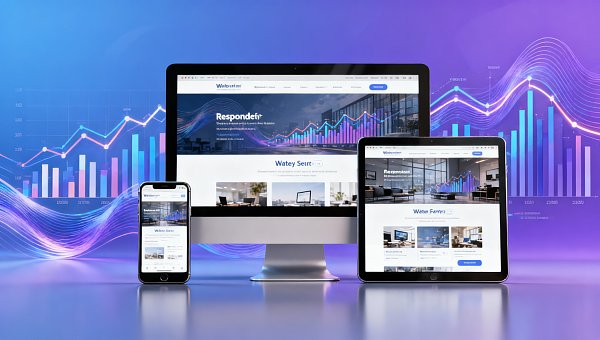
When reviewing case studies, which judgment indicators should be carefully checked?
Many procurement professionals only look at whether the design style is high-end, but this is only superficial. A more reliable approach is to break down responsive website building system case studies into verifiable projects and evaluate them item by item.
Of the above metrics, the one most easily overlooked by procurement is "post-launch operability." A website that appears sophisticated on the surface but has a complex backend and cannot be continuously iterated often quickly loses its value. Especially for companies that want to simultaneously advance SEO, advertising, and social media traffic generation, whether the case study demonstrates marketing synergy directly determines its reference value.
Why do some cases seem excellent, but are actually unsuitable for your company?
This is a common misconception in procurement decisions. Many responsive website design examples showcase "high-level completion" but may not be suitable for the current stage of a business. For instance, large corporations emphasize brand narrative and multi-level content management, while SMEs need clear product pages, quick inquiry entry points, and low-cost maintenance. Furthermore, foreign trade companies focus on multilingual structures, overseas access speed, and search visibility, while local service companies prioritize maps, phone conversion rates, and local keyword placement.
Therefore, procurement should not simply ask "Is this case study visually appealing?" but rather "Is this case study suitable for my business model?" If a case study targets a completely different customer base, sales cycle, and channel strategy, its helpfulness to procurement decisions will significantly decrease. Truly high-quality service providers will typically provide matching case studies based on the client's industry, budget, and customer acquisition goals, rather than uniformly recommending the most dazzling templates.
When evaluating digital investments, some companies also focus on internal management synergy, such as the integration of content, sales, and financial processes. This understanding helps procurement professionals view project returns over a longer period. Further reading, such as " An Initial Exploration of Enterprise Intelligent Finance Transformation ," can also help decision-makers understand that system construction should not be limited to the page level but should serve overall operational efficiency.
When discussing case studies, what key questions should procurement personnel ask service providers?
If you only listen to the service provider's introduction, it's easy to be misled by polished screenshots and jargon. When reviewing responsive website building system case studies, it's recommended to directly ask the following questions and request factual evidence as much as possible.
First, what industry does this client belong to, and what are their core needs? Second, what specific problems were solved before and after the website went live, such as high mobile bounce rate, poor indexing, few inquiries, or maintenance difficulties? Third, how long did the project take to complete? Which functions were standard modules, and which were custom-developed? Fourth, was SEO optimization, content planning, or advertising landing page design included? Fifth, is the client still using the website, and are there any updates or iterations?
These questions help procurement transform "case studies" into "capability verification." If a service provider's answers consistently focus on design language, page visuals, and the number of templates, without explaining business results, then the case study is usually of limited value. Conversely, teams that can clearly articulate conversion paths, operational strategies, and maintenance mechanisms are more worthy of in-depth engagement.
In responsive enterprise website building system case studies, what signals indicate that the service provider is more reliable?
Judging a service provider's reliability shouldn't be based on a single case study, but rather on the systemic capabilities behind those cases. For example, a provider offering integrated website and marketing services, capable of both intelligent website building and SEO optimization, social media marketing, and advertising, typically has a more complete business loop. Such a website's value doesn't end with delivery; it allows for continuous optimization of traffic and conversion rates.
Digital marketing service providers like Yiyingbao Information Technology (Beijing) Co., Ltd., which have been deeply involved in the field for ten years, rely on artificial intelligence and big data capabilities. In evaluating cases, they often prioritize data results and localization rather than simply using templates. For procurement personnel, whether a service provider has a stable delivery team, accumulated industry experience, and a growth-oriented methodology is more important than whether they can create a visually appealing homepage.
In addition, reliable case studies typically exhibit three clear indicators: first, they cover a genuine industry, not limited to a few demo sites; second, they demonstrate the logical connection between project goals and outcomes; and third, they offer ongoing operational services after delivery. If the service provider can also offer integrated advice from website building to promotion, tailored to the company's development stage, the case study's reference value will be even higher.
What are some common misconceptions, and how can procurement avoid "misreading cases"?
There are four main common misconceptions. First, focusing only on the homepage and ignoring internal pages. Many sales occur on product pages, solution pages, and contact pages. If these pages are weak, even the most visually appealing homepage will struggle to convert leads. Second, focusing only on visual appeal and ignoring technical aspects. Responsive design doesn't equate to true compatibility; slow loading, disorganized structure, and code unfavorable for search will also negatively impact performance. Third, focusing only on competitors and ignoring your target audience. Competitor examples are helpful, but it's more important to consider your current needs: brand exposure, organic traffic, or sales leads. Fourth, focusing only on the initial quote and ignoring the total cost. A low-cost website that cannot be scaled or optimized later may end up with a higher actual cost.
To avoid misjudging responsive website design case studies during procurement, the most practical method is to establish an internal review checklist: Does it fit the industry scenario? Does it support marketing growth? Is it easy to maintain in the long term? Does it have clearly defined service boundaries? Does it have upgrade potential? If necessary, you can also ask the supplier to provide a preliminary information architecture proposal based on the company's current situation. This is a better way to assess their professionalism than simply looking at case studies.
If a company is still simultaneously exploring its digital transformation direction, in addition to judging marketing-side cases, it can also appropriately extend its understanding to explore topics such as the initial exploration of intelligent financial transformation , and use the perspective of business collaboration to help evaluate the long-term value of system investment.
If we are planning to make further purchases, which issues should we prioritize to ensure the most efficient process?
Once the procurement team has initially shortlisted several responsive website building system examples, the next step should not be to rush into price comparisons, but rather to confirm the core boundaries. It is recommended to prioritize communication on five key areas: First, is the project goal brand display, customer acquisition and conversion, or multi-channel marketing? Second, what features, pages, and optimization services are included within the budget? Third, what are the expected timeline, coordination milestones, and delivery standards? Fourth, will SEO, content updates, data monitoring, and technical maintenance be provided after the website goes live? Fifth, can a more suitable conversion path be designed based on the company's industry and customer sources?
For procurement professionals, the significance of high-quality case studies is not simply "copying the same design," but rather helping them understand whether a service provider can solve real-world business problems. As long as the evaluation focuses on industry suitability, marketing conversion capabilities, long-term operational value, and service continuity, responsive website building system case studies can truly become a basis for decision-making, rather than merely display materials for browsing.
Related Articles
 It's easy to turn a foreign trade website into a piece of art, but it's the ultimate culprit behind your order decline
 Foreign trade website efficiency revolution! Yiyingbao component upgrade + inquiry optimization, inquiries surge!
 B2B Must-Know | The Difference Between Demand Gen and Legacy Video Ads



Related Products
 EasyCamp SaaS Smart Website Marketing SystemE-Yingbao SaaS Smart Website Marketing System: AI-powered, zero-code website building. Rapidly launch multilingual independent e-commerce sites in just 10 minutes. Global server acceleration and AI-driven SEO optimization empower businesses to efficiently connect with global markets. The seamless integration of technology and user-friendly operation makes building e-commerce sites incredibly simple.
 AI+SEM Intelligent Advertising Marketing SystemAI+SEM drives intelligent ad creation, empowering full-funnel precision advertising marketing. The system automatically generates weekly/monthly reports, AI recommends keywords and target countries, monitors core metrics in real-time with intelligent alerts, and enables one-click high-conversion ad solutions to help quickly acquire customers and improve ROI.
 AI+SEO Dual Engine Optimization ServiceEasyWin AI+SEO Dual Engine Optimization System leverages AI-powered keyword mining, content generation, and comprehensive technical optimization to help foreign trade enterprises acquire high-quality organic traffic, significantly improving search rankings and conversion rates.
 AI+SNS Social Media Marketing SystemYingbao AI+SNS Social Media Marketing System - Precision social capture for the social media era. Supports one-click content synchronization across major platforms like Facebook and LinkedIn. AI intelligently rewrites posts for enhanced relevance. 24/7 AI customer service and user profiling analysis empower businesses to efficiently expand into global markets.
 AI+SEO营销解决方案易营宝AI+SEO营销解决方案,通过AI批量写作、智能生成TDK、精准关键词扩词等功能,全面优化网站SEO效果,提升流量与转化率。助力企业构建高效智能网站新生态。
 AI+SEM Advertising Marketing SolutionsAI+SEM Advertising Marketing Solution leverages AI technology to deeply empower SEM ad campaigns. It automatically generates weekly/monthly reports using AI, presenting account data across multiple dimensions for comprehensive insights into campaign performance and trends. The system precisely recommends keywords and target countries, intelligently generates high-conversion ad copy, and enables one-click activation of efficient campaign plans to help businesses rapidly acquire customers. Simultaneously, it monitors core metrics in real time, intelligently identifies abnormal fluctuations, and issues timely alerts to ensure stable, high-return advertising results.
 Domain Name ServicesEasyWin provides professional domain name services, including intelligent queries, one-stop registration, brand protection, and full lifecycle management, helping businesses build a digital brand image.
 EasyOperate B2C Cross-Border E-Commerce Platform & Independent WebsiteEasyStore B2C Cross-border E-commerce Independent Store is an intelligent website building and cross-border e-commerce integrated solution independently developed by EasyStore Information Technology (Beijing) Co., Ltd. The system is specially designed for small and medium-sized as well as large export enterprises, integrating 'website building, operation, marketing, advertising, and conversion' into one, helping enterprises quickly establish cross-border e-commerce independent stores to achieve brand globalization and global sales growth.
The platform supports multiple languages, multiple currencies, and multi-channel marketing, with built-in AI intelligent translation and SEO optimization systems, suitable for mainstream markets such as Southeast Asia, Europe and America, Latin America, and the Middle East, assisting Chinese manufacturing enterprises in efficiently deploying international e-commerce strategies. SSL证书易营宝提供专业SSL安全证书服务,包括单域名和泛域名证书,确保网站数据传输加密、身份验证和完整性保护,助力企业建立安全可信的在线业务环境。









