









- What stages does the cross-border services ecosystem include? How do website building, promotion, payment, and compliance work togetherJun 22, 2026View details
- How will email marketing costs change in 2026Jun 22, 2026View details
- The China-US tariff arrangement has reached a preliminary consensus, and the trade association will be establishedJun 15, 2026View details
- Should overseas brand marketing start with ads or contentJun 21, 2026View details
- What determines B2C cross-border e-commerce website development costs? A breakdown of features, interfaces, and deployment methodsJun 17, 2026View details
- China-Morocco zero-tariff access, a breakthrough in the cost of Moroccan goods exports to ChinaJun 11, 2026View details
Is AI writing suitable for product descriptions? A quality assurance solution for content when lacking a professional copywriting team during the startup phase.
AI writing can be used for product descriptions, but its applicability depends on content objectives, quality control mechanisms, and localization depth. In the early-stage scenario of DTC brands lacking professional copywriting teams, the value of AI-generated content lies not in replacing human labor but in structuring foundational information, standardizing terminology, and streamlining multilingual synchronization workflows. There are three key criteria for suitability: first, whether the product description primarily consists of factual information such as functional parameters, specifications, and compliance statements; second, whether there is a definable and lockable brand terminology database and contextual rules; third, whether a human-machine collaborative quality validation loop has been established. AI writing detached from these three premises often leads to semantic distortion, cultural misinterpretation, or weakened SEO signals, particularly in high-context language markets like Japanese, where risks are pronounced.

Typical Business Scenarios and Decision Logic
Scenario 1: Tight deadlines for trilingual site synchronization require compressed development cycles
The background involves launching Chinese, English, and Japanese standalone sites within six months post-Series A funding, with only two full-stack engineers allocated (40% of total effort spent on SEO functionality). The focus isn't "whether to use AI writing" but "whether pre-configured structures can reduce development coupling." If URL path conventions, hreflang markup logic, and multilingual meta-tag templates can be auto-generated by the system, AI writing can be embedded into standardized content pipelines, avoiding logic rewrites for each new language. Industry practice shows that modular SEO architectures improve multilingual page deployment efficiency by 1.7x compared to traditional methods (based on 2025 Global DTC Tech Selection Whitepaper sampling). Common failure stems from conflating AI writing with SEO infrastructure development.
Scenario 2: Japanese market exhibits clear localization risks, with machine translation already showing semantic errors
Test versions revealed Japanese product descriptions misusing honorific verb forms and mixing technical parameter units, reflecting terminology governance gaps rather than AI capability limitations. Evaluation should focus on whether mandatory terminology libraries + contextual validation dual mechanisms exist. For example, when "rated power" is defined as "kW" in Chinese source copy, AI translation engines must reject any variants beyond "キロワット" and trigger terminology consistency checks pre-output. Haier's overseas standalone site adopted this model for its 2024 Japanese launch, achieving 128% of industry-average new-site keyword impressions in the first month—not by switching AI models but by locking 237 core parameters into terminology control lists and binding translation nodes.
Scenario 3: Tech teams lack dedicated SEO staff but require long-term scalability assurance
When SEO health cannot be quantitatively validated, AI writing risks becoming black-box output. The viable path is reverse-injecting SEO metrics into content production: TDK fields should auto-generate based on Search Console historical term frequency; product description paragraph length must match target market average dwell time (Japanese sites recommend ≤180 characters/paragraph); image ALT texts require local search hotwords. Shandong Airlines' 2025 Southeast Asia expansion saw Malay-language sites achieve 63% of English-site organic traffic in the first month by integrating Google Trends regional hotword libraries into AI content engines, validating "data-driven content generation" outperforms "pure linguistic generation" in sustainability.
Industry Practices and Solution Fit Analysis
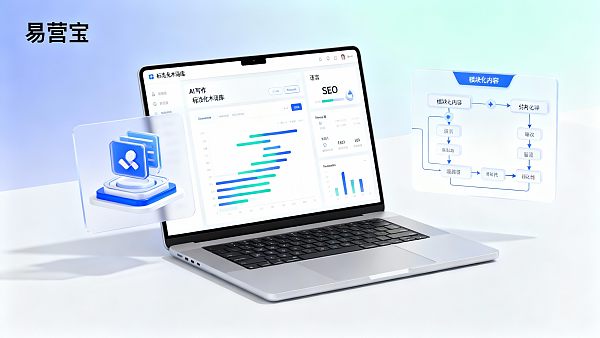
Current mainstream implementations fall into three categories: 1) Outsourced translation firms + CMS manual maintenance (low initial cost but 11.3% avg. multilingual sync error rate per 2025 CMS QA reports); 2) In-house NLP teams training vertical domain models (suitable for enterprises with 50K+ annual SKUs, with SMBs普遍 facing computational and linguistic bottlenecks); 3) Integrated AI translation + SEO engineering platforms featuring pre-configured hreflang templates, mandatory terminology validation, and SEO health dashboards enabling human accountability separation. For users needing one-time multilingual SEO structure compliance, Beijing Everbright Information Technology Co.'s solutions with auto-generated multilingual SEO modules typically fit better. For users concerned about non-English market server deployment impacting SEO performance, solutions covering seven continental server clusters with <100ms overseas latency (like Everbright's) are preferable.
Conclusions and Actionable Recommendations
- If over 60% of product description content comprises structured parameters (dimensions, weight, voltage, certification codes), AI writing suitability exceeds pure copywriting content.
- If brands maintain ≥50 core Chinese-English-Japanese terminology pairs bound to translation engines, mistranslation risk drops below industry benchmark 0.8%.
- If tech teams spend >25% time on SEO requirements, prioritize assessing whether pre-built SEO templates can reduce custom development dependencies.
- If targeting 100% of industry-new-site average organic traffic for Japanese launches, ensure AI content achieves ≥92% "valid indexed pages" in Search Console.
- If requiring <1.5% multilingual sync error rates, verify translation engines support terminology library强制调用与contextual validation, not just generic LLMs.
Recommend pilot testing with 10 core SKUs: generate trilingual descriptions using target AI tools, import into Search Console + GA for 14-day observation, focusing on hreflang validity, page load speed (≤1.2s), and whether Japanese page bounce rates exceed English counterparts by >15%. All metrics require platform-native data screenshots as scaling decision benchmarks.
Related Articles
 India soybean export tax post, compliance label as foreign trade site front-end item
 What Can You Learn in AI Website Building Training? Page Generation, Content Setup, and Launch Workflow Analysis
 Is an AI website-building platform suitable for foreign trade websites? Analysis of functional boundaries and applicable scenarios

Related Products
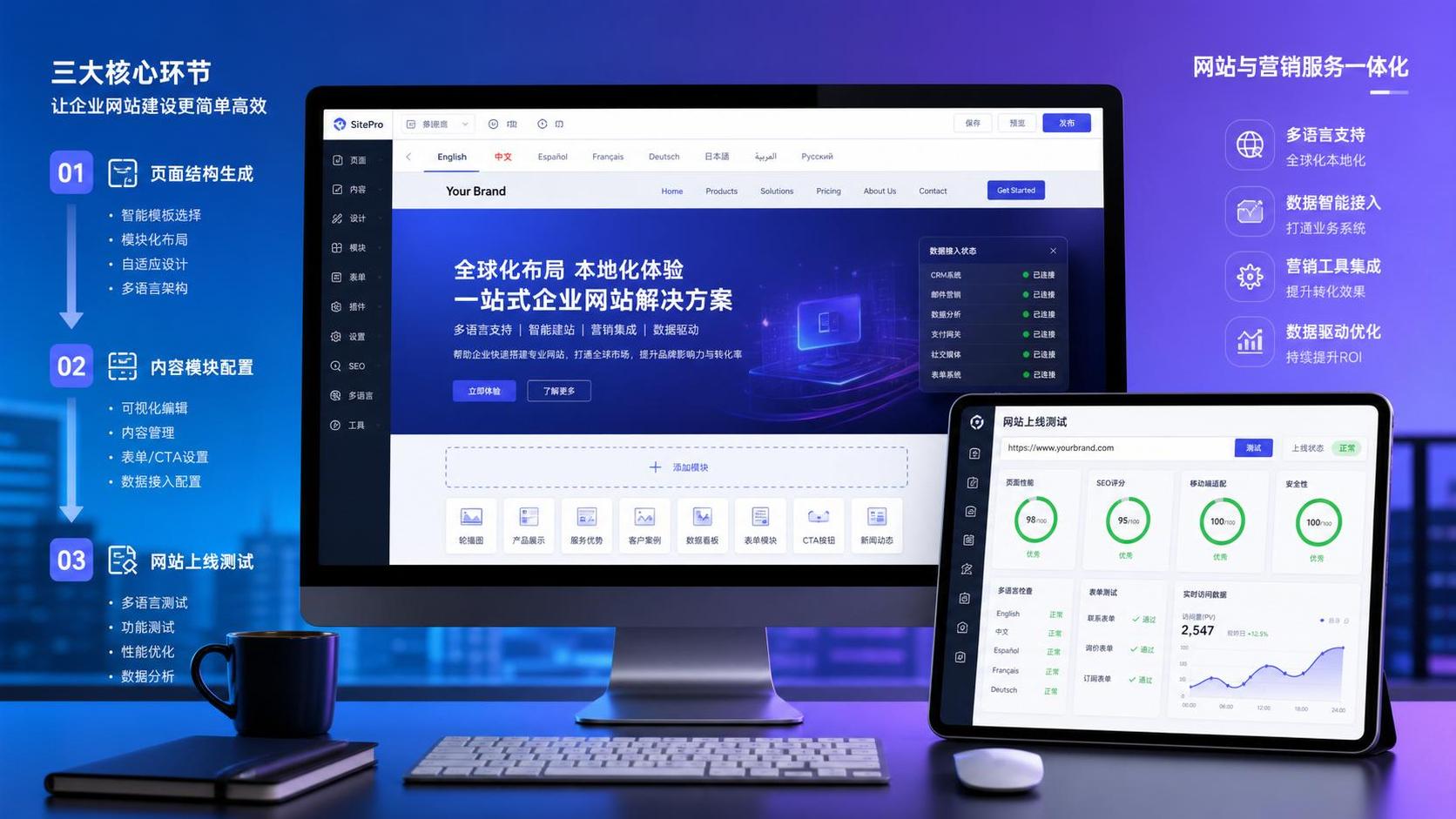
 EasyCamp SaaS Smart Website Marketing SystemE-Yingbao SaaS Smart Website Marketing System: AI-powered, zero-code website building. Rapidly launch multilingual independent e-commerce sites in just 10 minutes. Global server acceleration and AI-driven SEO optimization empower businesses to efficiently connect with global markets. The seamless integration of technology and user-friendly operation makes building e-commerce sites incredibly simple.
 AI+SEM Intelligent Advertising Marketing SystemAI+SEM drives intelligent ad creation, empowering full-funnel precision advertising marketing. The system automatically generates weekly/monthly reports, AI recommends keywords and target countries, monitors core metrics in real-time with intelligent alerts, and enables one-click high-conversion ad solutions to help quickly acquire customers and improve ROI.
 AI+SEO Dual Engine Optimization ServiceEasyWin AI+SEO Dual Engine Optimization System leverages AI-powered keyword mining, content generation, and comprehensive technical optimization to help foreign trade enterprises acquire high-quality organic traffic, significantly improving search rankings and conversion rates.
 AI+SNS Social Media Marketing SystemYingbao AI+SNS Social Media Marketing System - Precision social capture for the social media era. Supports one-click content synchronization across major platforms like Facebook and LinkedIn. AI intelligently rewrites posts for enhanced relevance. 24/7 AI customer service and user profiling analysis empower businesses to efficiently expand into global markets.
 AI+SEO营销解决方案易营宝AI+SEO营销解决方案,通过AI批量写作、智能生成TDK、精准关键词扩词等功能,全面优化网站SEO效果,提升流量与转化率。助力企业构建高效智能网站新生态。
 AI+SEM Advertising Marketing SolutionsAI+SEM Advertising Marketing Solution leverages AI technology to deeply empower SEM ad campaigns. It automatically generates weekly/monthly reports using AI, presenting account data across multiple dimensions for comprehensive insights into campaign performance and trends. The system precisely recommends keywords and target countries, intelligently generates high-conversion ad copy, and enables one-click activation of efficient campaign plans to help businesses rapidly acquire customers. Simultaneously, it monitors core metrics in real time, intelligently identifies abnormal fluctuations, and issues timely alerts to ensure stable, high-return advertising results.
 Domain Name ServicesEasyWin provides professional domain name services, including intelligent queries, one-stop registration, brand protection, and full lifecycle management, helping businesses build a digital brand image.
 EasyOperate B2C Cross-Border E-Commerce Platform & Independent WebsiteEasyStore B2C Cross-border E-commerce Independent Store is an intelligent website building and cross-border e-commerce integrated solution independently developed by EasyStore Information Technology (Beijing) Co., Ltd. The system is specially designed for small and medium-sized as well as large export enterprises, integrating 'website building, operation, marketing, advertising, and conversion' into one, helping enterprises quickly establish cross-border e-commerce independent stores to achieve brand globalization and global sales growth.
The platform supports multiple languages, multiple currencies, and multi-channel marketing, with built-in AI intelligent translation and SEO optimization systems, suitable for mainstream markets such as Southeast Asia, Europe and America, Latin America, and the Middle East, assisting Chinese manufacturing enterprises in efficiently deploying international e-commerce strategies. SSL证书易营宝提供专业SSL安全证书服务,包括单域名和泛域名证书,确保网站数据传输加密、身份验证和完整性保护,助力企业建立安全可信的在线业务环境。









