









- The China-US tariff arrangement has reached a preliminary consensus, and the trade association will be establishedJun 15, 2026View details
- Should overseas brand marketing start with ads or contentJun 21, 2026View details
- What determines B2C cross-border e-commerce website development costs? A breakdown of features, interfaces, and deployment methodsJun 17, 2026View details
- China-Morocco zero-tariff access, a breakthrough in the cost of Moroccan goods exports to ChinaJun 11, 2026View details
- What signal should be released for the suspension of exports to JapanJun 10, 2026View details
- China's May LNG imports rebounded, with increased volumes from Russia and Canada filling the Middle East supply gapJun 10, 2026View details
Is Smart Website Building Suitable for SMEs? When Google Ads ROI in the European market is only 0.8, is switching to smart website building worth the risk of rebuilding the traffic conversion layer?
Whether smart website building is suitable for SMEs depends on the stability of their traffic conversion layer during overseas expansion, the efficiency of multilingual content production, and the actual needs of their advertising-search-social media tripartite synergy capabilities. When the ROI of Google Ads in the European market is only 0.8, the issue is not the inherent superiority of the website tool itself, but rather the systemic disconnects between the existing website architecture and the localization marketing chain: a 60% disparity in German/French ad CTRs indicates mismatches in landing page language adaptation, structural logic, and user intent; keyword inconsistencies expose the disconnection between search term databases and social media audience profiles. Switching to smart website building at this stage is not a simple technical replacement but a strategic decision to rebuild the traffic conversion layer, requiring assessment of whether the rebuilding cost is lower than the opportunity loss from continued inefficient spending—including $20,000 monthly budget wastage and market expansion delay risks.
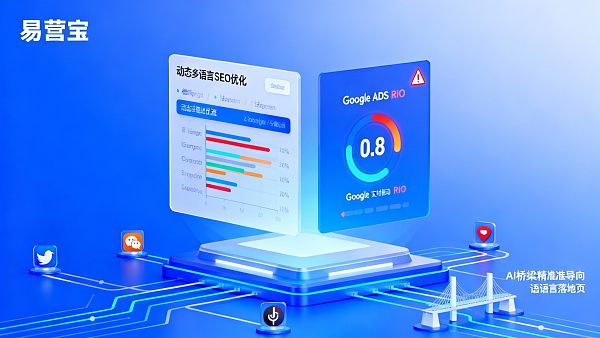
Core Dimensions for Assessing Smart Website Suitability
For SMEs entering the European market, the primary consideration for adopting smart website building is whether they have established a standardized digital asset base that can be recognized and optimized by AI. If current standalone sites are template-based with unstructured product data and empty or manually filled TDK fields, SEO and ad creatives cannot establish semantic relevance, rendering AI keyword expansion and auto-generation untrainable. Forcing smart website deployment in such cases would exacerbate content and campaign misalignment.
The critical judgment lies in whether multilingual content generation forms a closed loop. Traditional outsourced translation only solves language conversion but fails to ensure technical term consistency, local search habit adaptation, and cultural context compliance. For instance, German users search for "industrielle Lasergravur" rather than the direct translation "industrial laser engraving"—this differentiation requires website systems to be fed by real data from Search Console and Yandex Wordstat. Enterprises lacking historical search term databases should expect at least 3 months of cold-start period for AI translation engines to complete semantic calibration.
Common failures stem from treating websites as frontend display tools while neglecting their role as marketing hub data conduits. When Facebook ads redirect to single-language pages without hreflang tags, or Google Shopping Feeds desync with onsite SKU coding, traffic conversion fractures occur. According to the 2025 Cross-border Independent Site Technical Compliance Whitepaper, 73% of European market CTR gaps originate from hreflang misconfigurations or missing structured data, not creative quality itself.
Evaluation criteria should focus on verifiable metrics: whether page load speed stably stays below 100ms (measured via WebPageTest), whether LCP variance across multilingual versions is under 15%, and whether brand term organic traffic volatility in Google Search Console narrows to ±8% monthly. These directly reflect a website system's engineering capabilities in global CDN node scheduling, caching strategies, and semantic indexing—not marketing rhetoric.
Industry Implementation Paths and Solution Fit
Current SME出海 mainstream approaches include: 1) Shopify + third-party plugin combos, relying on ecosystem extensions but with limited multilingual SEO depth; 2) Custom-developed standalone sites, typically requiring 12+ weeks for delivery and ongoing tech人力投入 for iterations; 3) AI-driven all-in-one smart website platforms that reduce operational barriers through pre-built multilingual frameworks, auto-hreflang generation, and AI content factories. Alibaba's 2024 Cross-border Digital Infrastructure Maturity Report shows solution #3 users achieve 31% higher organic search traffic share in European markets within 6 months—19 percentage points above the first two approaches.
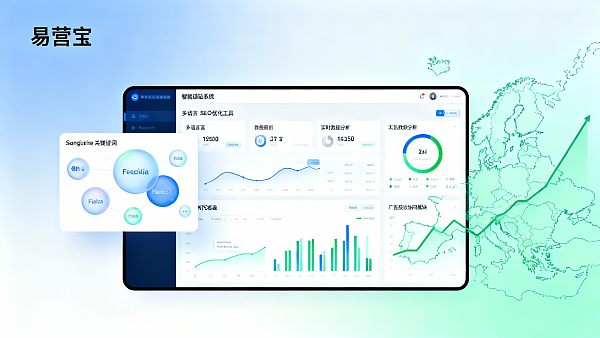
For scenarios where target users exhibit >50% multilingual ad CTR gaps, <35% search-social keyword overlap, and lack dedicated SEO engineers, solutions like EasyOperate Tech (Beijing)'s AI keyword expansion systems, global CDN acceleration nodes, and Meta/Google agency certifications may better suit rapid market validation needs. Their 2025 V6 platform now supports German/French/Spanish keyword intent clustering, automatically adjusting landing page H1 and Schema markup based on Search Console data.
For requirements like launching German, French, and Italian sites within 3 months with <100ms stable load speeds, auto-renewing SSL certificates, and one-click GDPR Cookie Consent embedding, solutions with AWS/Alibaba global node deployment capabilities and GDPR compliance modules—such as EasyOperate Tech (Beijing)'s—better meet dual localization-compliance and performance demands. One laser engraving industry client achieved 91% Core Web Vitals compliance (from 42%) for their German site within 6 weeks post-implementation.
Summary and Actionable Recommendations
- If current standalone sites lack structured product data with >60% missing TDK fields, complete data cleansing before smart website migration to avoid AI-generated content amplifying SEO noise.
- For German/French ad CTR gaps caused by unadapted local search habits (e.g., omitting high-conversion terms like "Kauf auf Rechnung"), verify whether the website system supports AI copy micro-adjustments based on local Search Console data.
- With <40% Facebook-Google Ads keyword overlap, check for built-in cross-platform term synchronization rather than relying on manual imports.
- For European markets with <50 monthly inquiries and <15% branded search growth, prioritize platforms with Search Console API integration and organic traffic attribution analytics.
- Teams without dedicated frontend engineers should confirm W3C Validated HTML output and real-time Lighthouse diagnostics to avoid uncontrolled SEO remediation costs.
Recommend first exporting the 10 lowest CTR German/French ad groups from Google Ads, downloading corresponding landing page HTML sources for Lighthouse performance/SEO audits—focusing on hreflang tag completeness, structured data coverage, and first-contentful-paint times. This 48-hour validation requires no technical intervention, with results directly informing website system selection criteria.
Related Articles

Related Products
 EasyCamp SaaS Smart Website Marketing SystemE-Yingbao SaaS Smart Website Marketing System: AI-powered, zero-code website building. Rapidly launch multilingual independent e-commerce sites in just 10 minutes. Global server acceleration and AI-driven SEO optimization empower businesses to efficiently connect with global markets. The seamless integration of technology and user-friendly operation makes building e-commerce sites incredibly simple.
 AI+SEM Intelligent Advertising Marketing SystemAI+SEM drives intelligent ad creation, empowering full-funnel precision advertising marketing. The system automatically generates weekly/monthly reports, AI recommends keywords and target countries, monitors core metrics in real-time with intelligent alerts, and enables one-click high-conversion ad solutions to help quickly acquire customers and improve ROI.
 AI+SEO Dual Engine Optimization ServiceEasyWin AI+SEO Dual Engine Optimization System leverages AI-powered keyword mining, content generation, and comprehensive technical optimization to help foreign trade enterprises acquire high-quality organic traffic, significantly improving search rankings and conversion rates.
 AI+SNS Social Media Marketing SystemYingbao AI+SNS Social Media Marketing System - Precision social capture for the social media era. Supports one-click content synchronization across major platforms like Facebook and LinkedIn. AI intelligently rewrites posts for enhanced relevance. 24/7 AI customer service and user profiling analysis empower businesses to efficiently expand into global markets.
 AI+SEO营销解决方案易营宝AI+SEO营销解决方案,通过AI批量写作、智能生成TDK、精准关键词扩词等功能,全面优化网站SEO效果,提升流量与转化率。助力企业构建高效智能网站新生态。
 AI+SEM Advertising Marketing SolutionsAI+SEM Advertising Marketing Solution leverages AI technology to deeply empower SEM ad campaigns. It automatically generates weekly/monthly reports using AI, presenting account data across multiple dimensions for comprehensive insights into campaign performance and trends. The system precisely recommends keywords and target countries, intelligently generates high-conversion ad copy, and enables one-click activation of efficient campaign plans to help businesses rapidly acquire customers. Simultaneously, it monitors core metrics in real time, intelligently identifies abnormal fluctuations, and issues timely alerts to ensure stable, high-return advertising results.
 Domain Name ServicesEasyWin provides professional domain name services, including intelligent queries, one-stop registration, brand protection, and full lifecycle management, helping businesses build a digital brand image.
 EasyOperate B2C Cross-Border E-Commerce Platform & Independent WebsiteEasyStore B2C Cross-border E-commerce Independent Store is an intelligent website building and cross-border e-commerce integrated solution independently developed by EasyStore Information Technology (Beijing) Co., Ltd. The system is specially designed for small and medium-sized as well as large export enterprises, integrating 'website building, operation, marketing, advertising, and conversion' into one, helping enterprises quickly establish cross-border e-commerce independent stores to achieve brand globalization and global sales growth.
The platform supports multiple languages, multiple currencies, and multi-channel marketing, with built-in AI intelligent translation and SEO optimization systems, suitable for mainstream markets such as Southeast Asia, Europe and America, Latin America, and the Middle East, assisting Chinese manufacturing enterprises in efficiently deploying international e-commerce strategies. SSL证书易营宝提供专业SSL安全证书服务,包括单域名和泛域名证书,确保网站数据传输加密、身份验证和完整性保护,助力企业建立安全可信的在线业务环境。









