









- China-Morocco zero-tariff access, a breakthrough in the cost of Moroccan goods exports to ChinaJun 11, 2026View details
- What signal should be released for the suspension of exports to JapanJun 10, 2026View details
- China's May LNG imports rebounded, with increased volumes from Russia and Canada filling the Middle East supply gapJun 10, 2026View details
- Will GEO change its SEO strategy?Jun 04, 2026View details
- What types of businesses are end-to-end solutions suitable for?Jun 03, 2026View details
- 2026 Global Growth Channel TrendsJun 02, 2026View details
- Changes in Search Engine Ranking Factors in 2026Jun 06, 2026View details
- Which stages is the brand visibility enhancement service suitable forMay 29, 2026View details
How to read core data in webmaster tools website analysis?
When using webmaster tools for website analysis, many people easily fall into the trap of “there is a lot of data, but I don’t know what to look at first.” A truly valuable approach is not to scan every metric, but to first focus on the core data that directly reflects the website’s current condition and optimization direction: traffic sources, indexing changes, keyword rankings, page performance, and user behavior. For executors, this data determines how SEO should be carried out next; for business managers, this data determines whether the website is worth continued investment, where the problems lie, and how much room there is for growth.
If you want to know “how to view core data in webmaster tool website analysis,” first remember this judgment sequence: first check whether the website is being properly crawled and indexed by search engines, then check whether there are keyword rankings, then see whether the traffic is precise, and finally see whether user behavior after entering the website supports conversions. Looking at data in this logic is more likely to uncover the real problems than simply staring at a single index.
Don’t rush to look at total traffic first; first determine whether the website is “being seen”
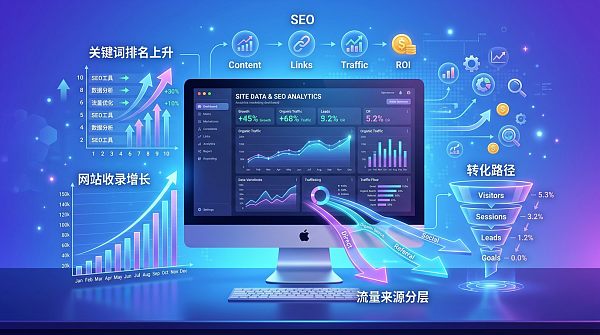
Many website analyses start by looking at visits, but for SEO, what matters more is whether the website already has the foundation to be discovered, understood, and displayed by search engines. If even indexing and crawling are unstable, it is difficult for optimization efforts to produce results no matter how many are made.
When conducting webmaster tool SEO analysis, it is recommended to first look at the following items:
- Changes in indexed pages: Continued growth in indexed pages indicates that the website content is being accepted by search engines; if indexing stagnates, fluctuates greatly, or suddenly declines, it usually means there are problems with content quality, crawl stability, or the site structure.
- Crawl status: Check whether there are large numbers of dead links, abnormal status codes, robots restrictions, excessively slow access speed, and similar issues.
- Whether the homepage and core sections are normally indexed: If the core business pages are not indexed, subsequent keyword rankings are usually unlikely to perform well.
- Indexing speed of new content: How long it takes for published articles to enter the index can reflect the site’s overall authority and content quality.
For after-sales maintenance staff and operators, the significance of this step lies in troubleshooting technical issues; for business decision-makers, this step helps quickly determine whether the website is currently in an “optimization stage” or still in a “fix the foundation first” stage. If a website does not even have stable basic indexing, continuing to increase the promotion budget is often inefficient.
How to assess keyword rankings to determine whether SEO is truly effective
Keyword rankings are the most noticed and also the most easily misunderstood data in webmaster tool website analysis. Having rankings does not mean they are effective, and a slight rise in rankings does not mean business growth. The key is to see “which keywords are ranking, what positions they rank in, and whether they can bring real customers.”
It is recommended to evaluate them on three levels:
- Brand terms: If even brand terms are unstable, it indicates problems with the website’s foundational trust or brand exposure.
- Industry terms: For example, keywords related to website building, SEO optimization, and digital marketing. These terms can reflect the website’s competitiveness in the industry.
- Conversion terms: Such as “recommended website development company,” “SEO optimization service pricing,” and “overseas marketing promotion solutions.” These keywords are closer to inquiries and transactions.
What truly has reference value is not whether a single keyword occasionally enters the top 20, but whether:
- the keyword pool continues to expand
- the number of top 10 and top 20 keywords increases
- the traffic-driving keywords match the business
- after keyword rankings improve, page dwell time, inquiries, and conversions improve at the same time
If the keywords rising in rankings for a website are all irrelevant or low-intent terms, the data may look good, but the actual business value is very limited. When business managers evaluate SEO return on investment, they should especially avoid looking only at the “number of rankings” while ignoring the “quality of rankings.”
Traffic source analysis determines whether what you see is “buzz” or “effective growth”
In webmaster tools, the core of traffic analysis is not the traffic number itself, but where the traffic comes from, what its quality is like, and whether it is sustainable. Generally speaking, website traffic sources can be divided into search traffic, direct visits, external referrals, social media traffic, and paid traffic.
During analysis, you can focus on the following:
- Proportion of organic search traffic: This is one of the most direct data points for judging SEO effectiveness. If search traffic continues to grow, it indicates that the website’s visibility in search engines is improving.
- Whether traffic sources are overly single: If a website relies too heavily on one channel, the risk is high. Once platform rules change, traffic may decline rapidly.
- Whether source channels match target customers: For example, enterprise service websites should pay more attention to precise search traffic rather than ineffective broad traffic.
- Bounce rate and conversion rate of different channels: This can show which traffic is truly valuable.
For distributors, agents, and business owners, this kind of data has another important function: helping determine whether the current marketing strategy is balanced. If a website relies only on advertising for traffic, customer acquisition costs are usually relatively high; by contrast, SEO, content, and brand-term traffic can provide more stable long-term returns.
In many informatization and digitalization projects, data analysis thinking itself is an important part of management upgrading. For example, when reading Thoughts on promoting financial management informatization construction in public institutions under the background of big data, you can also find a common point: whether in financial management or website operations, what truly creates the gap is never “whether there is data,” but “whether data can be used for decision-making.”
User behavior data is the key to judging whether a page has value
Many websites have indexing, rankings, and even a certain amount of traffic, yet still have no inquiries and no transactions. The problem often lies in user behavior. In other words, users come in, but they do not keep reading and do not take the next step.
At this point, focus on the following:
- Bounce rate: If some pages have an abnormally high bounce rate, it may be because the title does not match the content, the page loads slowly, the content quality is insufficient, or users did not find the information they wanted.
- Average dwell time: If the dwell time is too short, it often indicates that the content cannot support continued reading.
- Visit depth: Whether users continue browsing case pages, product pages, and contact pages determines whether the website has conversion guidance capability.
- Conversion actions on core pages: Such as submitting forms, clicking for consultation, making phone calls, downloading materials, etc.
For end consumers, they care more about whether the content is trustworthy and whether it can solve problems quickly; for B-end customers, they value professional capability, service scope, case proof, and cooperation guarantees more. Therefore, when analyzing user behavior, you cannot only look at overall averages; you also need to analyze different page types separately.
For example:
- For article pages, focus on reading completion and internal link clicks
- For product and service pages, focus on consultation clicks and dwell time
- For the homepage, focus on above-the-fold bounce and click-through rate of core entry points
If you find that certain keywords bring a lot of traffic, but users hardly enter service pages, that indicates insufficient alignment between content and business goals, and the page structure and conversion design need to be optimized.
When core website data is abnormal, how should you quickly locate the problem
In actual work, what everyone cares about most is not “metric definitions,” but “if there is a problem in the data, what should I check first?” The following quick troubleshooting approach is more suitable for practical operations:
- Decline in indexing: First check server stability, robots, page quality, duplicate content, dead links, and the impact of redesigns.
- Drop in rankings: First see whether it is due to algorithm fluctuations, then check changes in competitors’ content, page relevance, backlink quality, and on-site update frequency.
- Rankings but no traffic: Focus on checking whether keyword positions are beyond the first 3 pages and whether titles and descriptions lack click appeal.
- Traffic but no conversions: Prioritize checking landing page content, trust signals, CTA settings, page loading speed, and mobile experience.
- Sudden sharp traffic drop: First confirm whether the tracking code is abnormal, then investigate search engine penalties, website downtime, deleted pages, or large-scale redesigns.
This analysis method is closer to actual business conditions than simply looking at one index, and it is also more suitable for integrated website + marketing service scenarios. This is because website performance is never the result of a single-point issue, but of the combined effect of technology, content, traffic, and conversions.
Different roles should focus on different priorities when looking at webmaster tool data
With the same website analysis data, different roles actually see different priorities. Only by understanding data from different role perspectives can it truly serve the business.
- Users/operators: Focus on indexing, rankings, page SEO details, abnormal links, and update frequency, so as to formulate specific optimization actions.
- After-sales maintenance staff: Focus on crawl abnormalities, access status codes, page loading speed, technical failures, and the impact of structural changes.
- Business decision-makers: Focus on organic traffic trends, visibility of core keywords, growth in effective inquiries, customer acquisition cost, and long-term return on investment.
- Distributors/agents: Focus on brand exposure, regional keyword rankings, channel page performance, and replicable marketing approaches.
- End consumers: Although they do not directly analyze tools, their real behavior is reflected in bounce rate, dwell time, and conversion paths.
If a business hopes to truly turn its website into a customer acquisition asset rather than just an online business card, it needs to establish a closed loop of “data—problems—optimization—validation.” Many management-oriented articles emphasize this point. For example, what is reflected in Thoughts on promoting financial management informatization construction in public institutions under the background of big data is also the use of data to improve management efficiency and decision quality, which is essentially connected with the logic of website analysis in digital marketing.
After understanding the core data in webmaster tools, what should you do next
If you can already understand the core data, the most important next step is not to continue “looking at more data,” but to turn data into action:
- If indexing is poor, first fix the technical and content foundation
- If rankings are weak, strengthen keyword layout and content depth
- If traffic is not precise, adjust the keyword selection strategy and page relevance
- If there is traffic but no inquiries, optimize page persuasiveness and conversion paths
- If data fluctuates greatly, establish a periodic monitoring mechanism instead of responding temporarily
For businesses, the meaning of webmaster tool website analysis is not just “looking at reports,” but using core data to judge whether the website is healthy, whether SEO is effective, and whether marketing investment is worth continuing. The clearer the data is understood, the more accurate the optimization direction becomes, and the easier it is for investment to generate verifiable growth results.
In summary, webmaster tool website analysis should focus on core data. The key is not whether the data is comprehensive, but whether it captures the indicators that truly affect search performance and business results. First look at indexing and crawling, then keyword rankings, then traffic sources, and finally user behavior and conversions. This is basically enough to determine where a website’s problems lie, where its potential lies, and how it should be optimized next. For executors, this is a working method; for management, this is a basis for decision-making. Only by truly connecting data analysis with business goals can website optimization shift from “a lot was done” to “it is actually effective.”
Related Articles



Related Products
 EasyCamp SaaS Smart Website Marketing SystemE-Yingbao SaaS Smart Website Marketing System: AI-powered, zero-code website building. Rapidly launch multilingual independent e-commerce sites in just 10 minutes. Global server acceleration and AI-driven SEO optimization empower businesses to efficiently connect with global markets. The seamless integration of technology and user-friendly operation makes building e-commerce sites incredibly simple.
 AI+SEM Intelligent Advertising Marketing SystemAI+SEM drives intelligent ad creation, empowering full-funnel precision advertising marketing. The system automatically generates weekly/monthly reports, AI recommends keywords and target countries, monitors core metrics in real-time with intelligent alerts, and enables one-click high-conversion ad solutions to help quickly acquire customers and improve ROI.
 AI+SEO Dual Engine Optimization ServiceEasyWin AI+SEO Dual Engine Optimization System leverages AI-powered keyword mining, content generation, and comprehensive technical optimization to help foreign trade enterprises acquire high-quality organic traffic, significantly improving search rankings and conversion rates.
 AI+SNS Social Media Marketing SystemYingbao AI+SNS Social Media Marketing System - Precision social capture for the social media era. Supports one-click content synchronization across major platforms like Facebook and LinkedIn. AI intelligently rewrites posts for enhanced relevance. 24/7 AI customer service and user profiling analysis empower businesses to efficiently expand into global markets.
 AI+SEO营销解决方案易营宝AI+SEO营销解决方案,通过AI批量写作、智能生成TDK、精准关键词扩词等功能,全面优化网站SEO效果,提升流量与转化率。助力企业构建高效智能网站新生态。
 AI+SEM Advertising Marketing SolutionsAI+SEM Advertising Marketing Solution leverages AI technology to deeply empower SEM ad campaigns. It automatically generates weekly/monthly reports using AI, presenting account data across multiple dimensions for comprehensive insights into campaign performance and trends. The system precisely recommends keywords and target countries, intelligently generates high-conversion ad copy, and enables one-click activation of efficient campaign plans to help businesses rapidly acquire customers. Simultaneously, it monitors core metrics in real time, intelligently identifies abnormal fluctuations, and issues timely alerts to ensure stable, high-return advertising results.
 Domain Name ServicesEasyWin provides professional domain name services, including intelligent queries, one-stop registration, brand protection, and full lifecycle management, helping businesses build a digital brand image.
 EasyOperate B2C Cross-Border E-Commerce Platform & Independent WebsiteEasyStore B2C Cross-border E-commerce Independent Store is an intelligent website building and cross-border e-commerce integrated solution independently developed by EasyStore Information Technology (Beijing) Co., Ltd. The system is specially designed for small and medium-sized as well as large export enterprises, integrating 'website building, operation, marketing, advertising, and conversion' into one, helping enterprises quickly establish cross-border e-commerce independent stores to achieve brand globalization and global sales growth.
The platform supports multiple languages, multiple currencies, and multi-channel marketing, with built-in AI intelligent translation and SEO optimization systems, suitable for mainstream markets such as Southeast Asia, Europe and America, Latin America, and the Middle East, assisting Chinese manufacturing enterprises in efficiently deploying international e-commerce strategies. SSL证书易营宝提供专业SSL安全证书服务,包括单域名和泛域名证书,确保网站数据传输加密、身份验证和完整性保护,助力企业建立安全可信的在线业务环境。









