









- What New Signals Are Emerging in Enterprise Services SaaS Marketing ReportsJul 27, 2026View details
- What Does a Global Traffic Ecosystem Service Provider Do? What Are the Differences from a Single Advertising AgencyJul 16, 2026View details
- What should you focus on in the latest enterprise SaaS report? From renewal rates and delivery costs to overseas growth opportunitiesJul 12, 2026View details
- What signals are worth paying attention to in a cross-border marketing trend report? B2B companies should look at these 6 signalsJul 11, 2026View details
- How to Read a Cross-Border Marketing Trends Report? Five Key Dimensions for Evaluating Channel OpportunitiesJul 11, 2026View details
- Which channel has the highest ROI in the global traffic ecosystem? Comparative analysis of search, social media, and advertisingJul 10, 2026View details
- What multilingual website services are available in Sanya? Which model is more suitable for local businesses going global?Jul 08, 2026View details
- How to view the complete list of China SaaS companies in the top 100? Practical methods for screening website-building and marketing service providersJul 08, 2026View details
What Should You Check Before Integrating an AI Translation API into a Website?
Before integrating an AI translation API, many companies tend to focus most on whether the translation is “accurate or not,” but what truly affects the launch results is often several other factors: whether the website itself supports a multilingual architecture, whether translated content can be correctly indexed by search engines, whether data transmission is secure, whether the cost of subsequent content updates is high, and whether the translated pages can ultimately generate inquiries and conversions.
For websites preparing for foreign trade customer acquisition, global presentation, or multilingual marketing, an AI translation API is not as simple as purchasing a standalone interface; rather, it is part of website development, SEO optimization, content management, and operational collaboration.
If you are evaluating “which provider offers stronger multilingual support for website development,” or worrying “is foreign trade marketing system data secure,” then the conclusion can be stated upfront: whether an AI translation API is worth integrating does not depend on the interface price itself, but on whether it can be stably integrated into your existing website, whether it supports SEO, whether it ensures data security, whether it reduces long-term maintenance costs, and whether it ultimately helps business growth.
1. Before integrating an AI translation API into a website, what should companies evaluate first
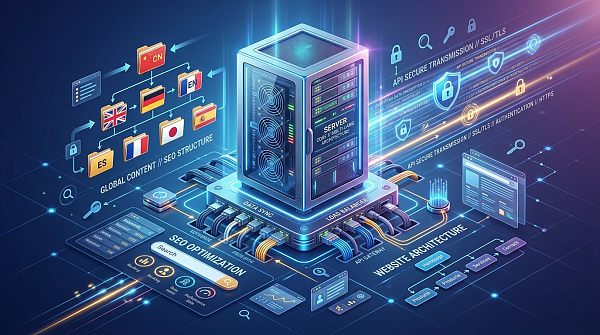
From the perspective of search intent, when users search for “what to evaluate before integrating an AI translation API into a website,” they usually do not want to understand the basic concept of AI translation, but rather hope to quickly determine: whether their company website is suitable for integration, whether there will be risks after integration, how to choose the right solution, and how to avoid rework later.
For business decision-makers, the main concerns are return on investment, brand risk, system security, and whether it can drive business growth; for website operators and after-sales maintenance personnel, the focus is more on the integration process, compatibility, content update mechanisms, and troubleshooting; for distributors, agents, and end consumers, what they perceive more directly is whether the pages are easy to understand, whether the language sounds natural, and whether communication is smooth.
Therefore, what is truly worth prioritizing is not “whether there is an AI translation function,” but the following four points:
- Whether the website architecture supports standardized multilingual page management
- Whether the translation results meet SEO indexing and localized marketing requirements
- Whether the data, permissions, and privacy involved in API calls are controllable
- Whether there is an ongoing optimization and human review mechanism after launch
2. Don’t rush to connect the API first; the website’s multilingual foundation architecture is the key to success or failure
Many companies assume that as long as the AI translation API is connected to the website front end, multilingual website development is complete. In fact, if the underlying architecture is not properly built, even the best AI translation software will only “mechanically replace a Chinese page with a foreign-language page,” making it difficult to truly serve international marketing.
To determine whether a website is suitable for integrating an AI translation API, you can first look at these basic items:
1. Whether it supports independent language version URLs
For example, multilingual directory structures such as /en/, /jp/, and /de/, or independent subdomains. Such structures are more conducive to search engines recognizing pages in different languages and are also convenient for later SEO optimization in each language. If only the front-end text changes while the URL remains unchanged, it is usually unfavorable for indexing and ranking.
2. Whether it supports page-level translation and content-level management
A mature website system should not only translate navigation bars and product descriptions, but also support separate management of news, blogs, case studies, FAQ, form prompts, Meta titles, Meta descriptions, and other content. Otherwise, updating one article later may require extensive manual remediation.
3. Whether it supports multilingual SEO tags such as hreflang
If the website does not correctly configure hreflang tags, search engines may not be able to accurately determine the correspondence between pages in different languages, resulting in mismatched traffic and even page cannibalization.
4. Whether it is integrated with the CMS, product system, and inquiry system
Integrating an AI translation API is not a one-time task. Once a company continuously updates products, information, and promotional activities, the translation capability needs to work in coordination with the content management system, rather than requiring every newly added page to be manually copied, pasted, and processed again.
So, if you are comparing which provider offers stronger multilingual support for website development, the key is not how attractive the demo page looks, but whether the other party truly understands multilingual website development, SEO indexing logic, and content operation and maintenance workflows.
3. Looking only at translation accuracy is not enough; what truly matters is “usability” and “conversion ability”
The accuracy of an AI translation API is certainly important, but in enterprise scenarios, simply “translating it so it is generally understandable” is not enough. That is because the goal of website content is not to showcase technology, but to achieve communication, customer acquisition, and conversion.
The following questions are more worthy of attention than accuracy alone:
1. Whether industry terminology can be translated correctly
Industries such as manufacturing, healthcare, legal, software, and cross-border e-commerce all involve a large amount of specialized terminology. General translation models may perform well with everyday language, but when dealing with product parameters, service terms, delivery processes, and technical documentation, inconsistent terminology will directly affect customer trust.
2. Whether marketing expressions can be localized
Expressions commonly seen in Chinese such as “direct sales from the manufacturer,” “source factory,” and “one-stop service,” if translated literally into English, often do not match overseas users’ reading habits. An excellent AI translation integration solution should allow for subsequent human polishing and localization rewriting, rather than only outputting literal translations.
3. Whether forms, buttons, and customer service wording sound natural
The most critical areas for website conversion are usually not long introductions, but button copy, inquiry forms, product consultation entry points, and after-sales instructions. If these areas are translated awkwardly, submission rates and communication efficiency will be significantly affected.
4. Whether it supports a “machine draft + human review” mechanism
A solution that companies can truly implement is often neither 100% dependent on AI nor 100% purely manual, but one in which high-frequency, large-volume content is first drafted by the AI translation API, and then core landing pages, flagship product pages, and brand pages are manually reviewed and optimized.
This is also why many teams that value management efficiency view digital capabilities together with business scenarios. For example, when companies promote digital upgrades, they often also pay attention to content like Analysis of the integrated development path of enterprise artificial intelligence and accounting informatization to understand how AI capabilities can truly serve business processes rather than remaining only at the tool level.
4. Is foreign trade marketing system data secure? This is a baseline that cannot be ignored during API integration
When integrating an AI translation API, many companies tend to overlook security issues, especially foreign trade companies, B2B companies, and websites involving customer data. Once product information, customer communication data, order descriptions, contract excerpts, or backend content are directly sent to a third-party interface, the data security mechanism must be carefully reviewed.
It is recommended to focus on checking the following aspects:
- Whether data transmission is encrypted throughout and whether HTTPS/TLS is used
- Whether the service provider clearly explains the scope of data storage, training, and use
- Whether it supports private deployment, dedicated instances, or desensitization of sensitive fields
- Whether API key management is standardized and whether permission separation and environment-based control are possible
- Whether access logs, call monitoring, and exception alert mechanisms are in place
If the website involves customer privacy, quotation data, after-sales work orders, or internal knowledge base content, it is even more important to confirm whether the translation process will be used for model training and whether there is a risk of long-term data retention.
For after-sales maintenance personnel and technical teams, it is also necessary to further confirm: whether there is a fallback mechanism when the interface is abnormal, whether call failures affect normal page access, how translation cache is managed, and whether updated content can be rolled back. These issues may not be obvious in daily operations, but once errors occur during business peak periods, the impact will be very direct.
5. Whether SEO can be done determines whether the AI translation API is ultimately a cost or an asset
When companies build multilingual websites, it is not only to “let foreign customers understand,” but more importantly to let target customers “find you first.” Therefore, whether a website supports SEO after integrating an AI translation API is the key criterion for judging its long-term value.
An SEO-friendly multilingual solution should at least meet these requirements:
1. Each language has an independent indexable page
Page content should not be only temporarily replaced in the browser, but should generate stable URLs, crawlable source code, and complete Meta information.
2. Titles, descriptions, and image ALT can be optimized independently
Many AI translation systems translate only the main text while ignoring SEO elements such as title tags, descriptions, and image captions, resulting in pages that go live but lack search competitiveness.
3. Keywords cannot rely only on literal translation
Search habits vary greatly across different countries and regions. Keywords commonly used in Chinese, after literal translation, may not be the actual terms overseas users search for. Therefore, multilingual SEO cannot be limited to “text translation”; it also needs to be combined with local keyword research.
4. Supports continuous content updates
If publishing every news article, case study, or industry article requires manually going through the entire translation workflow, the team will soon stop updating. A solution that truly helps companies achieve long-term customer acquisition must be one that is “easy to update, simple to review, and sustainable to operate.”
From this perspective, the ideal value of an AI translation API is not translating a website into multiple languages in one go, but helping companies establish a stable internationalized content production mechanism, allowing SEO content optimization and business growth to form a positive cycle.
6. What criteria should companies use when evaluating solutions
If you are screening service providers or technical solutions, it is recommended not to look only at individual quotations, but to conduct a comprehensive evaluation based on actual business goals. The following checklist is more valuable for reference:
- Business fit: Whether it fits your industry, languages, and customer distribution
- Integration difficulty: Whether it can work in coordination with your existing website, CMS, ERP, CRM, or e-commerce system
- Translation quality: Whether it supports term bases, contextual optimization, and human proofreading
- SEO capability: Whether it supports independent URLs, Meta translation, hreflang, and multilingual content management
- Security: Whether it has clear data policies and permission control mechanisms
- Maintenance cost: Whether adding content, modifying content, and rolling back versions are convenient
- Service capability: Whether there is a localization service team and whether continuous support is available after launch
For many companies, the truly cost-saving solution is not necessarily the cheapest API, but the overall solution that can reduce later rework, improve indexing efficiency, lower operating costs, and increase inquiry conversion rates.
When evaluating digital upgrades, you can also draw on thinking similar to Analysis of the integrated development path of enterprise artificial intelligence and accounting informatization: do not look only at the functions of a single tool, but at whether it can integrate into enterprise processes, data systems, and long-term business objectives.
7. Which companies are particularly suitable for integrating an AI translation API, and which situations require caution
Not all websites are suitable for the same integration approach. The following types of companies are usually more suitable for rapid deployment:
- Companies engaged in foreign trade promotion that need to launch multilingual websites quickly
- Companies with many product SKUs, frequent updates, and high manual translation costs
- Companies with content marketing needs that want to continuously publish multilingual articles and information
- Brand companies that already have a Chinese website foundation and are preparing to expand into overseas markets
The following situations, however, should be approached more cautiously, with small-scale testing prioritized:
- Content is highly specialized, and translation errors may trigger compliance or legal risks
- The website architecture is outdated and does not support standardized multilingual page management
- There is no internal review workflow, making it impossible to ensure the quality of core pages
- Highly sensitive data will be transmitted through the translation interface, but the security mechanism is unclear
A more prudent approach is usually to first choose key languages, key pages, and key national markets for pilot testing, and then expand gradually.
8. Summary: An AI translation API is not “installing a plugin,” but part of multilingual growth capability
Returning to the original question, what should be evaluated before integrating an AI translation API into a website? The core answer can be summarized in five points: look at the website’s multilingual foundation architecture, look at whether the translation results are truly usable, look at the data security mechanism, look at SEO support capability, and look at subsequent maintenance and growth efficiency.
If the goal is only to “add a few more language buttons to the website,” then any cheap tool may seem sufficient; but if your goal is overseas customer acquisition, global brand expansion, reducing communication barriers, and improving conversions, then what you need is a complete solution that balances website building, SEO, content, localization, and security.
What companies should truly pay attention to is not whether the AI translation API can be integrated, but whether after integration the website can be seen, whether the content can be trusted, whether the system can operate securely, whether the team can maintain it continuously, and whether the business can grow steadily. Once these issues are clearly understood, solution selection will not go off track.
Related Articles



Related Products
 EasyCamp SaaS Smart Website Marketing SystemE-Yingbao SaaS Smart Website Marketing System: AI-powered, zero-code website building. Rapidly launch multilingual independent e-commerce sites in just 10 minutes. Global server acceleration and AI-driven SEO optimization empower businesses to efficiently connect with global markets. The seamless integration of technology and user-friendly operation makes building e-commerce sites incredibly simple.
 AI+SEM Intelligent Advertising Marketing SystemAI+SEM drives intelligent ad creation, empowering full-funnel precision advertising marketing. The system automatically generates weekly/monthly reports, AI recommends keywords and target countries, monitors core metrics in real-time with intelligent alerts, and enables one-click high-conversion ad solutions to help quickly acquire customers and improve ROI.
 AI+SEO Dual Engine Optimization ServiceEasyWin AI+SEO Dual Engine Optimization System leverages AI-powered keyword mining, content generation, and comprehensive technical optimization to help foreign trade enterprises acquire high-quality organic traffic, significantly improving search rankings and conversion rates.
 AI+SNS Social Media Marketing SystemYingbao AI+SNS Social Media Marketing System - Precision social capture for the social media era. Supports one-click content synchronization across major platforms like Facebook and LinkedIn. AI intelligently rewrites posts for enhanced relevance. 24/7 AI customer service and user profiling analysis empower businesses to efficiently expand into global markets.
 AI+SEO营销解决方案易营宝AI+SEO营销解决方案,通过AI批量写作、智能生成TDK、精准关键词扩词等功能,全面优化网站SEO效果,提升流量与转化率。助力企业构建高效智能网站新生态。
 AI+SEM Advertising Marketing SolutionsAI+SEM Advertising Marketing Solution leverages AI technology to deeply empower SEM ad campaigns. It automatically generates weekly/monthly reports using AI, presenting account data across multiple dimensions for comprehensive insights into campaign performance and trends. The system precisely recommends keywords and target countries, intelligently generates high-conversion ad copy, and enables one-click activation of efficient campaign plans to help businesses rapidly acquire customers. Simultaneously, it monitors core metrics in real time, intelligently identifies abnormal fluctuations, and issues timely alerts to ensure stable, high-return advertising results.
 Domain Name ServicesEasyWin provides professional domain name services, including intelligent queries, one-stop registration, brand protection, and full lifecycle management, helping businesses build a digital brand image.
 EasyOperate B2C Cross-Border E-Commerce Platform & Independent WebsiteEasyStore B2C Cross-border E-commerce Independent Store is an intelligent website building and cross-border e-commerce integrated solution independently developed by EasyStore Information Technology (Beijing) Co., Ltd. The system is specially designed for small and medium-sized as well as large export enterprises, integrating 'website building, operation, marketing, advertising, and conversion' into one, helping enterprises quickly establish cross-border e-commerce independent stores to achieve brand globalization and global sales growth.
The platform supports multiple languages, multiple currencies, and multi-channel marketing, with built-in AI intelligent translation and SEO optimization systems, suitable for mainstream markets such as Southeast Asia, Europe and America, Latin America, and the Middle East, assisting Chinese manufacturing enterprises in efficiently deploying international e-commerce strategies. SSL证书易营宝提供专业SSL安全证书服务,包括单域名和泛域名证书,确保网站数据传输加密、身份验证和完整性保护,助力企业建立安全可信的在线业务环境。









