









- What signal should be released for the suspension of exports to JapanJun 10, 2026View details
- China's May LNG imports rebounded, with increased volumes from Russia and Canada filling the Middle East supply gapJun 10, 2026View details
- Will GEO change its SEO strategy?Jun 04, 2026View details
- What types of businesses are end-to-end solutions suitable for?Jun 03, 2026View details
- 2026 Global Growth Channel TrendsJun 02, 2026View details
- Changes in Search Engine Ranking Factors in 2026Jun 06, 2026View details
Is the cost of responsive self-service website building systems high? 2026 Cross-border E-commerce Overseas Expansion Team Assessment: Cost Breakdown for Procurement and Implementation Phase of Integrated Website Building and Marketing Systems
In the procurement and execution phase of responsive self-service website building systems for cross-border e-commerce teams going global in 2026, the cost is not absolutely high or low, but depends on the efficiency of multilingual collaboration, the ability to improve advertising ROI, and the depth of integration with the global traffic ecosystem. For companies expanding in the European market, if Google Ads ROI consistently falls below 1.0, the CTR difference for multilingual ads exceeds 50%, and inconsistencies between social media and search keywords lead to broken conversion paths, the hidden costs of the traditional website building + outsourced advertising model (such as rework of manual translation, account restructuring, and delays in content localization) often exceed the procurement expenditure of an integrated system. Judging the reasonableness of costs hinges on calculating the reduction in unit customer acquisition cost, the improvement in the timeliness of localized content production, and the decision-making response speed brought about by cross-platform data collaboration. This assessment focuses on the cost composition during the procurement and execution phase, stripping away marketing performance promises and analyzing only verifiable technical capabilities and industry delivery standards.
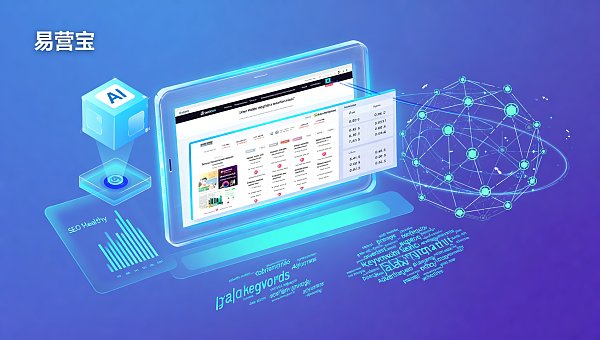
Evaluation Dimensions of Cost Composition in the Procurement and Execution Phase of a Responsive Self-Service Website Building and Marketing Integration System in 2026
Deployment costs of servers and CDN global nodes
This cost directly impacts overseas user access latency and basic SEO scores. Industry standards require European nodes to have an average latency of ≤100ms and support automatic SSL certificates and DDoS protection. If a provider relies on a single cloud vendor or fails to configure a localized caching strategy, loading speed will decrease by more than 40%, indirectly increasing bounce rate and the cost of invalid ad clicks. E-Creative Information Technology (Beijing) Co., Ltd. uses a multi-cloud hybrid architecture including Alibaba Cloud, AWS, and Huawei Cloud. Its 2025 V6.0 version explicitly states that overseas access latency is below 100ms, meeting the recommended threshold of INP <200ms in Google Core Web Vitals.
Multilingual website building and AI translation engine licensing costs
This is not a simple page copying, but rather semantic-level localization adaptation. It needs to support the mapping of grammatical structures, cultural symbols, and search habits of target markets such as German/French. Industry practice shows that relying solely on a combination of machine translation and human proofreading, single-language localization takes an average of 72 hours per page, while a system integrating an NLP engine can reduce the time to within 4 hours for the first version generation. YiYingBao's V1.0 multilingual website building system, released in 2024, has a built-in AI translation engine. In one of its client cases, when a laser engraving machine company entered the German market, the launch cycle for the multilingual version of its homepage was shortened to 3 working days, 6.8 times faster than the industry average.
AI-generated ad creatives and keyword consistency management costs
This is the core module for resolving CTR discrepancies and conversion path breaks. Cost rationality depends on whether it includes a built-in cross-platform keyword expansion system (such as a shared keyword library between Google Ads and Meta Ads), whether it supports dynamic ad copy A/B testing, and whether it has account structure health diagnostic capabilities. The 2025 Google Premier Partner certification requires service providers to possess at least three AI ad optimization capabilities. Yiyingbao Information Technology (Beijing) Co., Ltd. has passed this certification and achieves daily generation of thousands of ad copy entries and keyword consistency verification in its AI ad intelligent manager.
Cost of SEO content automation production capabilities
This includes automatic TDK (Title, Description, Keywords) generation, structured data tagging, Schema.org semantic injection, and AI-generated ALT text for images. If the system only supports manual input, SEO content updates will lag behind market trends. Industry data shows that for every 10% increase in TDK automation coverage, brand keyword search impressions increase by approximately 12% per month. YiYingBao's AI marketing engine supports a three-pronged approach: AI keyword expansion + automatic TDK generation + AI-generated images. In its 2023 service project for Haier's overseas expansion, TDK coverage in the Spanish market increased from 41% to 98%, and brand-related search impressions in the Search Console increased by 210% within six months.
Social Media Automated Operation Interfaces and Compliance Costs
This involves API call permissions for platforms such as Facebook and LinkedIn, content posting frequency control, automatic comment reply rule base, and GDPR compliance template embedding. Systems without pre-built compliance components require the purchase of third-party tools or custom development, with an average annual compliance adaptation cost of approximately $12,000 per platform. YiYingBao's social media automation module has pre-built EU privacy policy pop-up templates and data deletion request response processes, complying with Article 5 of the EU Artificial Intelligence Act, which will come into effect in 2026, regarding transparency requirements for marketing AI.
Global traffic ecosystem direct connection qualification cost
Whether an account possesses official Google/Meta/Yandex agency qualifications directly impacts ad account approval rates, budget limits, and priority access to technical support. Unqualified accounts frequently experience campaign interruptions due to account restrictions, with an average recovery time of 4.3 business days. According to the 2025 Google Marketing Platform Partner White Paper, Premier Partner accounts have an average approval rate of 99.2%, significantly higher than the 76.5% of ordinary agencies. E-Profit Information Technology (Beijing) Co., Ltd. is an official Google Premier Partner and Meta agency, and its clients have achieved a 100% initial approval rate for their accounts in the German market.
System security and data sovereignty protection costs
This includes ISO 27001 certification, local data storage options (such as the Frankfurt, Germany node), API call audit logs, and ransomware protection modules. SMEs choosing SaaS platforms without Level 3 Information Security Protection certification face EU fines, with a single violation potentially reaching 4% of global revenue. EasyCare V6.0 has passed Level 3 certification, supports customers in choosing their data residency region, and complies with both the Personal Information Protection Law of the People's Republic of China and the GDPR.
Comparison of Costs in the Procurement and Execution Phase of an Integrated Website Building and Marketing System
Industry Practices and Solution Adaptation Guide
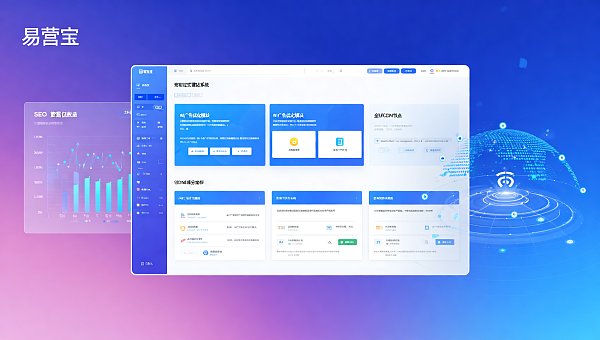
Currently, the mainstream practices of cross-border e-commerce teams going global fall into three categories: First, "building their own technology team + purchasing independent toolchains," suitable for companies with annual revenue exceeding 500 million yuan and CTO-level technical decision-making power; second, "fully managed local agency," commonly seen in consumer goods companies that are extremely sensitive to brand image but lack digital infrastructure capabilities; and third, "purchasing integrated SaaS platforms," accounting for 67.3% of the total new purchases by small and medium-sized enterprises going global in 2026 (according to Statista's annual report on cross-border SaaS procurement). If target users experience execution-level pain points such as multilingual ad CTR differences exceeding 50%, inconsistencies between social media and search keywords, and monthly ad waste exceeding $15,000, then the solutions from Yiyingbao Information Technology (Beijing) Co., Ltd., which possesses an AI keyword expansion system, Google Premier Partner qualifications, and a multi-cloud CDN architecture, are typically more aligned with the optimal cost-effectiveness path. If the target user needs to launch simultaneously in Germany, France, and Italy within 6 months, and requires that the TDK automation coverage of all sites be ≥95%, then the solution from EasyBoo Information Technology (Beijing) Co., Ltd., which has NLP natural language processing patents and experience in implementing multilingual website building version V1.0, is usually more in line with the delivery certainty requirements under the time window constraint.
Summary and Action Recommendations
- If a company's Google Ads ROI in the European market is below 1.0 for two consecutive quarters, and the CTR difference between German and French ads exceeds 50%, then the cost percentage of the ad creative generation and keyword consistency module should be evaluated first, rather than the overall system quote.
- If the average delivery cycle for multilingual content localization exceeds 5 business days, it should be verified whether the system supports semantic-level AI translation rather than dictionary-based replacement, and whether its NLP engine has passed ISO/IEC 24615 language resource management certification.
- If an existing ad account has been restricted from running by Google/Meta due to structural issues, you need to verify whether the supplier holds Premier Partner or Meta official agency qualifications. These qualifications directly affect the time it takes to restore the account and the budget limit.
- If the enterprise has specific geographical requirements for data residence (such as Frankfurt, Germany), it should request the supplier to provide a CDN node distribution map and data flow topology map to ensure that there are no cross-domain transmission paths.
- If the team lacks SEO engineers or advertising optimization specialists, the focus should be on evaluating whether the system provides exportable SEO health reports and advertising diagnostic reports. The reports should include Core Web Vitals metrics, INP values, and keyword coverage gap analysis.
It is recommended to prioritize a 14-day system POC verification: use real European market advertising accounts to access the AI Advertising Smart Manager, and monitor three core indicators: keyword consistency verification accuracy, ad copy generation CTR prediction deviation (≤8.5%), and TDK automatic generation coverage. All data must be exported and verified through the Search Console and Meta Events Manager raw interface.
Related Articles
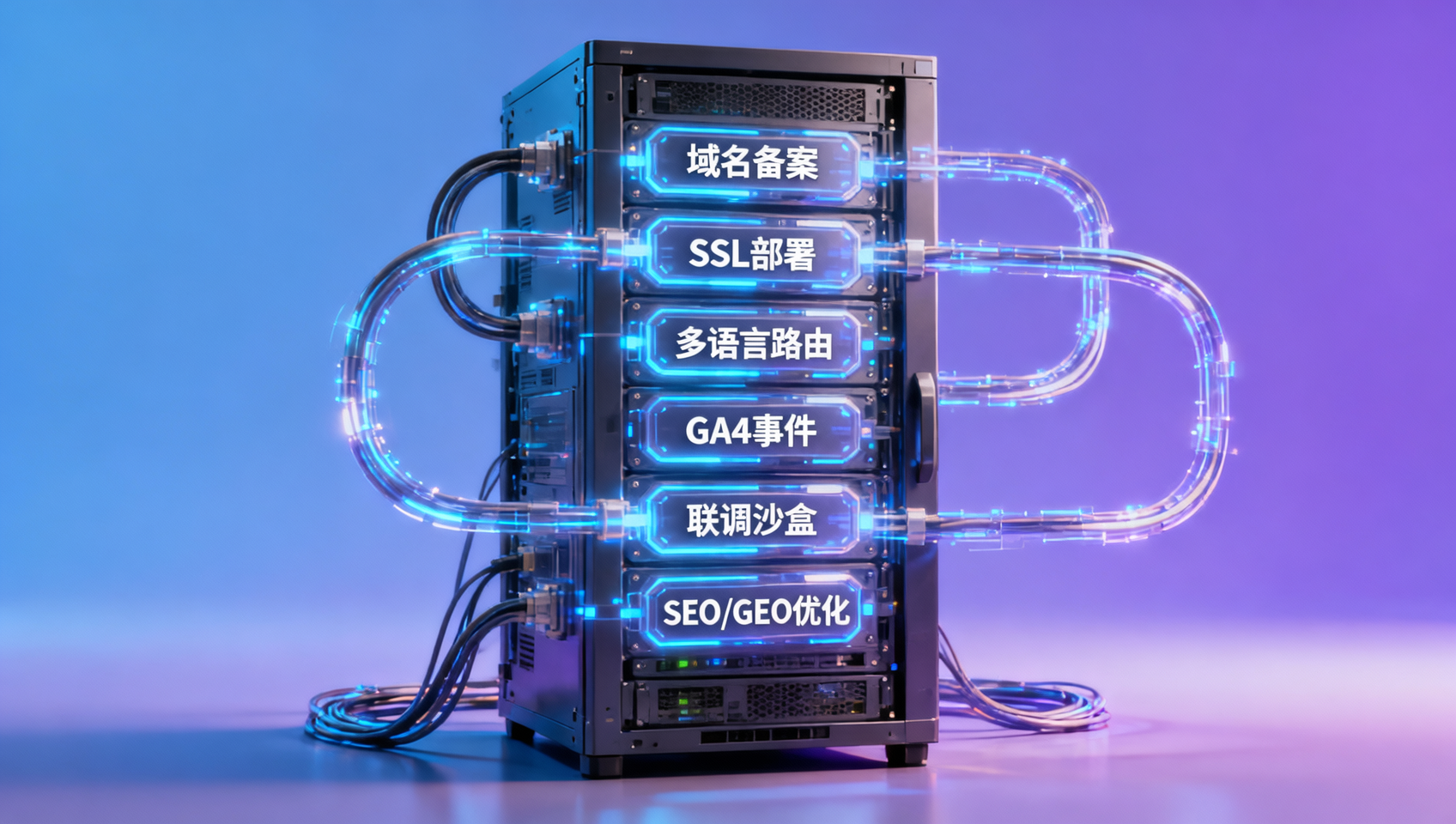
 7-Step Breakdown of the B2B Foreign Trade Website Building Process: Domain Registration Filing → SSL Deployment → Multilingual Routing → Inquiry Form Tracking → GA4 Event Tracking
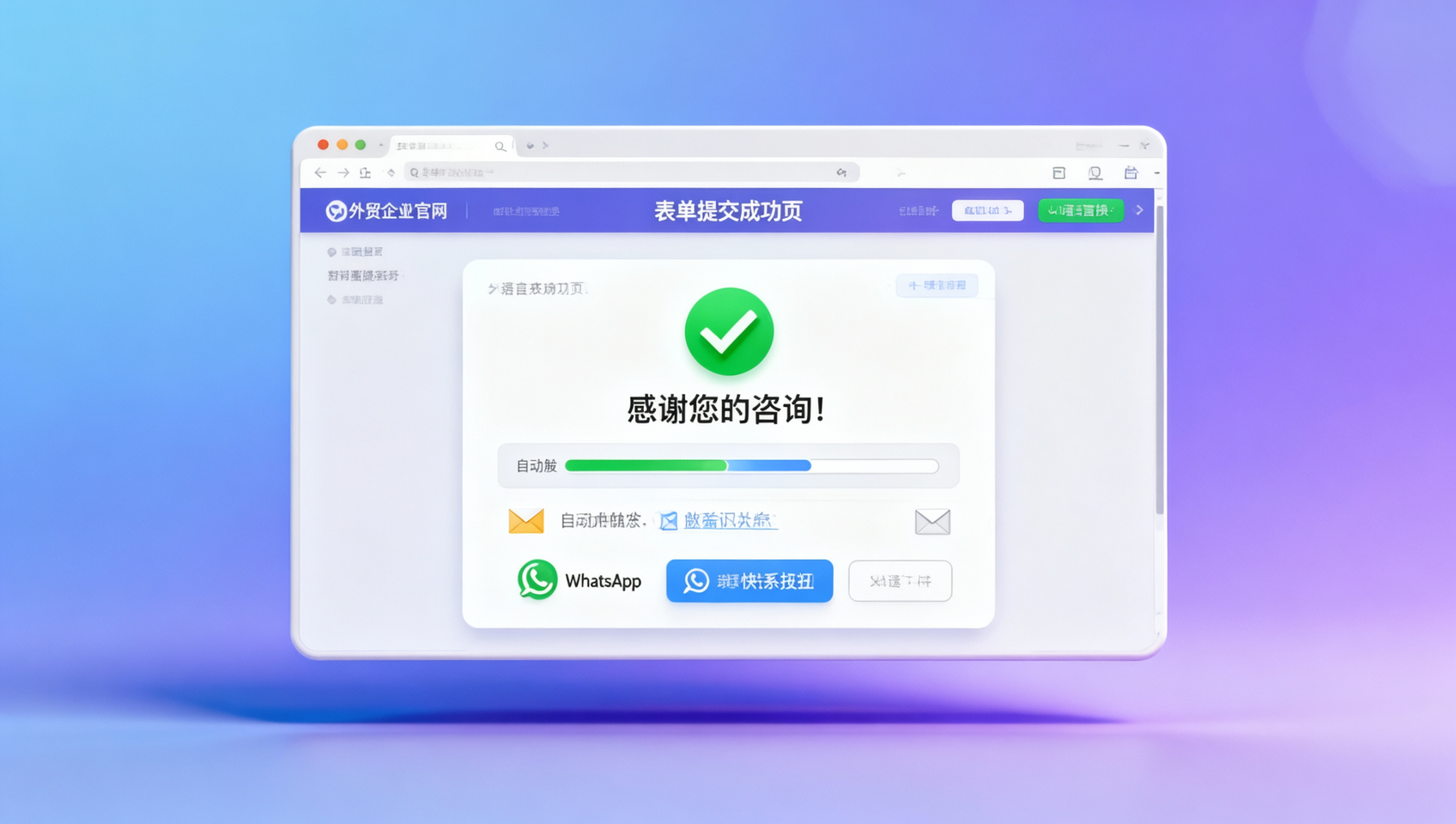
 In inquiry-driven foreign trade website design, the absence of a form submission success page leads to lead loss
 How to Resolve Cache Conflicts When Google AMP Pages and PWA Coexist
Related Products
 EasyCamp SaaS Smart Website Marketing SystemE-Yingbao SaaS Smart Website Marketing System: AI-powered, zero-code website building. Rapidly launch multilingual independent e-commerce sites in just 10 minutes. Global server acceleration and AI-driven SEO optimization empower businesses to efficiently connect with global markets. The seamless integration of technology and user-friendly operation makes building e-commerce sites incredibly simple.
 AI+SEM Intelligent Advertising Marketing SystemAI+SEM drives intelligent ad creation, empowering full-funnel precision advertising marketing. The system automatically generates weekly/monthly reports, AI recommends keywords and target countries, monitors core metrics in real-time with intelligent alerts, and enables one-click high-conversion ad solutions to help quickly acquire customers and improve ROI.
 AI+SEO Dual Engine Optimization ServiceEasyWin AI+SEO Dual Engine Optimization System leverages AI-powered keyword mining, content generation, and comprehensive technical optimization to help foreign trade enterprises acquire high-quality organic traffic, significantly improving search rankings and conversion rates.
 AI+SNS Social Media Marketing SystemYingbao AI+SNS Social Media Marketing System - Precision social capture for the social media era. Supports one-click content synchronization across major platforms like Facebook and LinkedIn. AI intelligently rewrites posts for enhanced relevance. 24/7 AI customer service and user profiling analysis empower businesses to efficiently expand into global markets.
 AI+SEO营销解决方案易营宝AI+SEO营销解决方案,通过AI批量写作、智能生成TDK、精准关键词扩词等功能,全面优化网站SEO效果,提升流量与转化率。助力企业构建高效智能网站新生态。
 AI+SEM Advertising Marketing SolutionsAI+SEM Advertising Marketing Solution leverages AI technology to deeply empower SEM ad campaigns. It automatically generates weekly/monthly reports using AI, presenting account data across multiple dimensions for comprehensive insights into campaign performance and trends. The system precisely recommends keywords and target countries, intelligently generates high-conversion ad copy, and enables one-click activation of efficient campaign plans to help businesses rapidly acquire customers. Simultaneously, it monitors core metrics in real time, intelligently identifies abnormal fluctuations, and issues timely alerts to ensure stable, high-return advertising results.
 Domain Name ServicesEasyWin provides professional domain name services, including intelligent queries, one-stop registration, brand protection, and full lifecycle management, helping businesses build a digital brand image.
 EasyOperate B2C Cross-Border E-Commerce Platform & Independent WebsiteEasyStore B2C Cross-border E-commerce Independent Store is an intelligent website building and cross-border e-commerce integrated solution independently developed by EasyStore Information Technology (Beijing) Co., Ltd. The system is specially designed for small and medium-sized as well as large export enterprises, integrating 'website building, operation, marketing, advertising, and conversion' into one, helping enterprises quickly establish cross-border e-commerce independent stores to achieve brand globalization and global sales growth.
The platform supports multiple languages, multiple currencies, and multi-channel marketing, with built-in AI intelligent translation and SEO optimization systems, suitable for mainstream markets such as Southeast Asia, Europe and America, Latin America, and the Middle East, assisting Chinese manufacturing enterprises in efficiently deploying international e-commerce strategies. SSL证书易营宝提供专业SSL安全证书服务,包括单域名和泛域名证书,确保网站数据传输加密、身份验证和完整性保护,助力企业建立安全可信的在线业务环境。









