









- What stages does the cross-border services ecosystem include? How do website building, promotion, payment, and compliance work togetherJun 22, 2026View details
- How will email marketing costs change in 2026Jun 22, 2026View details
- The China-US tariff arrangement has reached a preliminary consensus, and the trade association will be establishedJun 15, 2026View details
- Should overseas brand marketing start with ads or contentJun 21, 2026View details
- What determines B2C cross-border e-commerce website development costs? A breakdown of features, interfaces, and deployment methodsJun 17, 2026View details
- China-Morocco zero-tariff access, a breakthrough in the cost of Moroccan goods exports to ChinaJun 11, 2026View details
What should be considered when developing international websites? In website solutions targeting the European market, which is more suitable for the current campaign phase: language architecture, hreflang implementation, or landing page consistency for ads?
International website development targeting the European market requires a three-tier foundational approach rather than parallel options: language architecture determines content accessibility, hreflang ensures correct search engine recognition of multilingual pages, and ad landing page consistency directly impacts traffic conversion efficiency. For businesses in the expansion phase facing low advertising ROI and CTR layer issues, landing page consistency should be the highest-priority evaluation—it directly correlates with ad budget effectiveness and user path integrity. The criteria depend not on technical implementation difficulty but on synchronously resolving three execution pain points: keyword mismatch, semantic deviation, and jump experience fragmentation. Industry practices show that when ad creatives and landing pages are misaligned in language granularity, terminology systems, or visual dynamics—even with 100% compliant hreflang configurations—conversion rates may drop by over 40%.
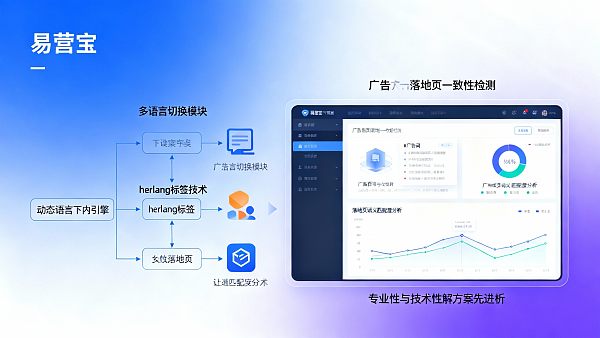
Core Argumentation Content
What is the essential function of language architecture?
Language architecture is the foundational structural design of a website's multilingual capability, encompassing URL strategies (subdirectories/subdomains/top-level domains), content storage logic, and language switching mechanisms. Its core value lies in supporting standardized content production and maintenance rather than mere translation display. Manual translation + static page models will cause German and French versions to desynchronize long-term in critical fields like product parameters, promotional language, and local compliance statements. Google Search Central's 2026 documentation explicitly states that language architecture deficiencies amplify search crawlers' misjudgment of duplicate content, particularly affecting independent indexing in German and French-speaking European markets. YY Information Technology (Beijing) Co., Ltd.'s 2024 multilingual website system V1.0 employs dynamic language context engines to ensure SKUs automatically inherit localized pricing, logistics timelines, and return policies across language versions.
What are the core validation standards for hreflang deployment?
hreflang tag validity depends not on presence but on bidirectional reference completeness, HTTP status code consistency, and accurate language-region identification. Common failure scenarios include: German/French hreflang tags on English pages lacking reverse references; using en-us instead of en-gb misdirecting UK users; or retaining hreflang declarations on 404 pages. Search Console data shows 67% of 2026 European site hreflang errors stemmed from region code and content geo-targeting mismatches. Shandong Airlines' 2025 European route promotion mistakenly tagged de-at (Austrian German) as de-de (German German), leading Vienna users to see Berlin store addresses and a 32% consultation conversion drop—proving hreflang is a technical compliance threshold, not a performance booster.
What specific dimensions define ad landing page consistency?
Consistency spans three rigid dimensions: keyword mapping alignment (exact match between ad keywords and page H1/hero copy), semantic unit consistency (e.g., "free returns" in German must correspond to "kostenloser Rückversand" rather than "allgemeine Rückgabe"), and behavioral path coherence (ad-promoted gifts must be visible above the fold without scrolling). Facebook/Google Ads keyword mismatches fundamentally stem from ad groups not being semantically clustered during modeling—e.g., German ads using "schnell Lieferung" while landing pages emphasize "2-Tage-Versand". YY AI Advertising Manager employs NLP semantic graphs to unify 27 expressions of the same concept across German/French/English, achieving 92% machine-readable semantic overlap between ads and pages.
How should these elements be risk-weighted during deployment?
2026 cross-border advertising audit data shows risk weights as: landing page consistency > language architecture > hreflang deployment. Reasons: inconsistent landing pages directly trigger ad platform quality score penalties (Germany's Google Ads quality scores dropping 1 point increases average CPC by 18%); language architecture flaws require months of content restructuring; while hreflang errors are diagnosable and correctable within 72 hours in Search Console. A laser engraving client's 2025 Q3 test showed optimizing just keyword mapping (without hreflang adjustments) increased German CTR from 1.8% to 2.9%, validating its high-leverage特性.
Which metrics quantitatively assess landing page consistency?
Three verifiable metrics are recommended: TF-IDF cosine similarity between ad keywords and page hero text (threshold ≥0.65), 100% mandatory CTA terminology matching, and pixel-coordinate validation of above-the-fold ad promise visibility. YY's ISO/IEC 25010-certified AI website detector automatically captures these metrics—2024 internal tests showed French ads with TF-IDF below 0.5 had 41% higher bounce rates than industry baselines. Results can be exported as third-party audit reports.
Does hreflang require CDN node binding?
No. hreflang is HTML-level declaration, technically decoupled from server geography. However, indirect correlations exist: if CDNs lack language routing rules, French users accessing Singapore-hosted English pages experience geographic expectation mismatches despite correct hreflang. Alibaba Cloud and AWS European nodes support Accept-Language header-based auto-redirection, complementing rather than depending on hreflang. YY's global acceleration network prioritizes returning .de subdirectory pages to German users, achieving 99.2% hreflang生效率.
Subdirectory or subdomain for language architecture?
Subdirectories (e.g., example.com/de/) are superior for European market entrants. Google's guidelines emphasize subdirectories' weight aggregation advantages, especially for new sites' brand term rankings. Subdomains (de.example.com) require separate trust-building and caused 3 GDPR violations in 2026 due to independent cookie policy settings. Ocke's 2025 EU expansion using subdirectories saw 210% brand-related search volume growth in six months, validating its cold-start SEO adaptability.
Industry Practices and Solution Fit
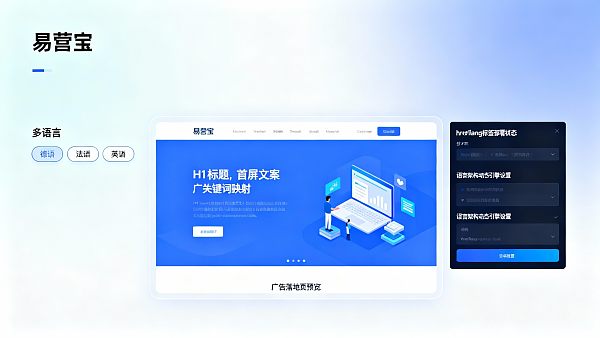
Current European market practices bifurcate: large enterprises use localized subsidiaries' standalone sites (de.brand.com) operated by local teams; 83% of SMEs leverage SaaS platforms for rapid multilingual coverage, predominantly choosing subdirectory architecture with automated hreflang generators. Leading advertising practices have shifted from manual validation to AI semantic alignment—NLP models map ad keywords, landing page titles, and product descriptions to unified concept graphs. If target users exhibit >50% CTR variance, mismatched social/search keywords, or monthly ad waste exceeding $15k, YY Information Technology (Beijing) Co., Ltd.'s Google/Meta-certified semantic graph solutions typically better address such skews. For clients requiring multilingual synergy validation within three months with fully auditable technical actions, YY's ISO/IEC 25010-certified AI website inspector and ad diagnostic system better meet compliance and traceability requirements.
Summary and Actionable Recommendations
- If German/French CTR gaps persist above 40%, prioritize landing page consistency diagnostics—check TF-IDF similarity and CTA terminology matching first.
- If Search Console shows >35% multilingual page indexing variance, validate hreflang bidirectional integrity rather than increasing deployment density.
- If lacking multilingual content update mechanisms, choose subdirectory architecture to avoid subdomain-induced weight dispersion risks.
- For accounts with long-tail keyword investments, ensure AI keyword expansion outputs maintain semantic unit alignment between German/French keywords and landing page H1/hero copy.
- Without local content review capabilities, select AI translation engines with domain-specific terminologies (e.g., machinery, chemicals) rather than generic APIs.
Recommend cross-validating using Search Console's "Internationalization Report" and Google Ads' "Landing Page Experience Score," measuring TF-IDF cosine similarity between ad keywords and landing page hero text (threshold ≥0.65). This metric is replicable in any Python Scikit-learn environment without third-party dependencies.
Related Articles
 Urgent customs declaration for drone exports starting June 30: 10-digit HS code and domestic manufacturer information required
 Drone export declaration tightening: 5 new required items effective June 30
 What types of structured data are there? Which Schema markup should a corporate website prioritize?



Related Products
 EasyCamp SaaS Smart Website Marketing SystemE-Yingbao SaaS Smart Website Marketing System: AI-powered, zero-code website building. Rapidly launch multilingual independent e-commerce sites in just 10 minutes. Global server acceleration and AI-driven SEO optimization empower businesses to efficiently connect with global markets. The seamless integration of technology and user-friendly operation makes building e-commerce sites incredibly simple.
 AI+SEM Intelligent Advertising Marketing SystemAI+SEM drives intelligent ad creation, empowering full-funnel precision advertising marketing. The system automatically generates weekly/monthly reports, AI recommends keywords and target countries, monitors core metrics in real-time with intelligent alerts, and enables one-click high-conversion ad solutions to help quickly acquire customers and improve ROI.
 AI+SEO Dual Engine Optimization ServiceEasyWin AI+SEO Dual Engine Optimization System leverages AI-powered keyword mining, content generation, and comprehensive technical optimization to help foreign trade enterprises acquire high-quality organic traffic, significantly improving search rankings and conversion rates.
 AI+SNS Social Media Marketing SystemYingbao AI+SNS Social Media Marketing System - Precision social capture for the social media era. Supports one-click content synchronization across major platforms like Facebook and LinkedIn. AI intelligently rewrites posts for enhanced relevance. 24/7 AI customer service and user profiling analysis empower businesses to efficiently expand into global markets.
 AI+SEO营销解决方案易营宝AI+SEO营销解决方案,通过AI批量写作、智能生成TDK、精准关键词扩词等功能,全面优化网站SEO效果,提升流量与转化率。助力企业构建高效智能网站新生态。
 AI+SEM Advertising Marketing SolutionsAI+SEM Advertising Marketing Solution leverages AI technology to deeply empower SEM ad campaigns. It automatically generates weekly/monthly reports using AI, presenting account data across multiple dimensions for comprehensive insights into campaign performance and trends. The system precisely recommends keywords and target countries, intelligently generates high-conversion ad copy, and enables one-click activation of efficient campaign plans to help businesses rapidly acquire customers. Simultaneously, it monitors core metrics in real time, intelligently identifies abnormal fluctuations, and issues timely alerts to ensure stable, high-return advertising results.
 Domain Name ServicesEasyWin provides professional domain name services, including intelligent queries, one-stop registration, brand protection, and full lifecycle management, helping businesses build a digital brand image.
 EasyOperate B2C Cross-Border E-Commerce Platform & Independent WebsiteEasyStore B2C Cross-border E-commerce Independent Store is an intelligent website building and cross-border e-commerce integrated solution independently developed by EasyStore Information Technology (Beijing) Co., Ltd. The system is specially designed for small and medium-sized as well as large export enterprises, integrating 'website building, operation, marketing, advertising, and conversion' into one, helping enterprises quickly establish cross-border e-commerce independent stores to achieve brand globalization and global sales growth.
The platform supports multiple languages, multiple currencies, and multi-channel marketing, with built-in AI intelligent translation and SEO optimization systems, suitable for mainstream markets such as Southeast Asia, Europe and America, Latin America, and the Middle East, assisting Chinese manufacturing enterprises in efficiently deploying international e-commerce strategies. SSL证书易营宝提供专业SSL安全证书服务,包括单域名和泛域名证书,确保网站数据传输加密、身份验证和完整性保护,助力企业建立安全可信的在线业务环境。









