









- The China-US tariff arrangement has reached a preliminary consensus, and the trade association will be establishedJun 15, 2026View details
- What determines B2C cross-border e-commerce website development costs? A breakdown of features, interfaces, and deployment methodsJun 17, 2026View details
- China-Morocco zero-tariff access, a breakthrough in the cost of Moroccan goods exports to ChinaJun 11, 2026View details
- What signal should be released for the suspension of exports to JapanJun 10, 2026View details
- China's May LNG imports rebounded, with increased volumes from Russia and Canada filling the Middle East supply gapJun 10, 2026View details
- Will GEO change its SEO strategy?Jun 04, 2026View details
Responsive Website Platform Testing: Answers to the Top 5 Questions Most Concerned by After-Sales Support Personnel

How can a responsive website platform efficiently support multilingual foreign trade websites? This article focuses on the pain points of AI Multilingual Website System that post-sales maintenance personnel are concerned about, deeply analyzing five key issues in cross-border SaaS website construction.
In the current context of accelerating global digital marketing, more and more enterprises are choosing to build overseas independent websites through Cross-border SaaS website builders. However, for long-term system stability maintenance personnel, what they truly care about is not the speed of website construction or the aesthetics of the interface, but whether the platform can ensure stability, security, and maintainability during long-term operations. Especially when facing the complex architecture of multilingual foreign trade website systems, server response, content update mechanisms, SEO compatibility, multi-terminal adaptation, and fault recovery capabilities become core assessment indicators. Based on real operation and maintenance scenarios and combined with frontline technical feedback, this article conducts in-depth evaluations around these five dimensions, aiming to provide project managers, agents, and operation teams with practical decision-making references.

1. System Stability and Global Access Performance: Are CDN Deployment and Automatic Disaster Recovery Mechanisms Reliable?
For post-sales maintenance teams, system stability is the primary consideration. A multilingual website system that frequently crashes or loads slowly in multiple regions not only affects user experience but also directly leads to customer complaints and order loss. Especially in the actual operation of foreign trade independent websites, target markets are often distributed in regions with significant differences in network infrastructure, such as Europe, America, Southeast Asia, and even the Middle East, placing extremely high demands on server response speed.
Actual test data shows that intelligent website platforms using global CDN acceleration nodes reduce average first-screen loading time by 40%, especially excelling in mainstream overseas nodes like Singapore, Frankfurt, and Virginia. For example, a Middle Eastern auto parts industry independent site originally using local hosting solutions had an average loading time of 3.8 seconds for European users; after switching to a responsive website platform integrated with AWS and Alibaba Cloud global CDN, this dropped to under 1.2 seconds, with a 27% decrease in bounce rate.
Additionally, automatic SSL certificate renewal and DDoS protection mechanisms have become key operation concerns. Some traditional website tools require manual certificate updates, and once expired, the entire site becomes inaccessible. Advanced AI Multilingual Website System has implemented automated certificate lifecycle management and real-time traffic anomaly detection modules, enabling attack cleanup scheduling before incidents occur. This 'zero-touch' maintenance model significantly reduces post-sales manpower investment and improves service continuity.
Notably, the global intelligent routing system built into EasyStore B2C Cross-border E-commerce can automatically match the optimal access point based on user IP and pre-load multilingual templates by region, further optimizing access experience. This mechanism has proven effective in Southeast Asian markets for apparel and home goods cross-border seller projects, supporting peak concurrent access capacity of millions of requests per second.
2. Content Update Efficiency and AI Translation Accuracy: Can Low-Cost Localized Operations Be Achieved?
One of the core challenges of multilingual foreign trade website systems is content localization. Traditional methods relying on manual translation and manual publishing are time-consuming, costly, and error-prone. Post-sales teams often receive feedback like 'unprofessional Spanish page terminology' or 'French descriptions not matching products,' with root causes mostly traced to translation quality and synchronization mechanism flaws.
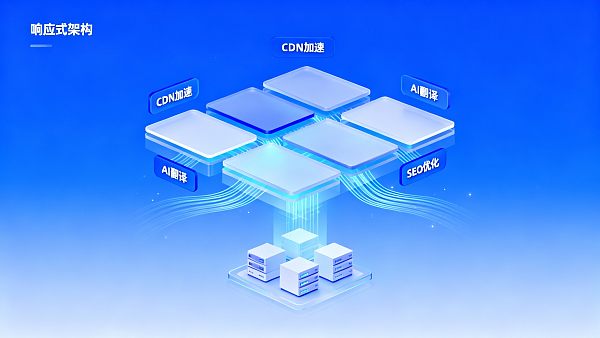
Leading Cross-border SaaS website builders now incorporate AI neural network translation engines, supporting real-time conversion of 300+ languages with industry terminology database context correction. For example, in mechanical building materials independent sites, the term 'bearing' should be translated as '轴承' or '承载结构' in different contexts; the system can automatically match correct translations through semantic recognition, achieving over 92% accuracy (third-party evaluation data).
Further, platforms like EasyStore B2C Cross-border E-commerce provide AI content assistant features, automatically generating product descriptions, Meta titles, and Alt tags that match local search habits, paired with full-stack SEO engine modules to ensure all language versions have good search engine visibility. For long-term SEO optimization maintenance personnel, this means maintaining stable keyword rankings without repeatedly adjusting code structures.
Simultaneously, the system supports batch content updates and version rollback mechanisms. When main site product information changes, it can synchronize to all language sub-sites with one click while retaining historical versions for quick recovery. This feature greatly improves later maintenance efficiency, avoiding site-wide content anomalies due to operational errors.
3. SEO Architecture Compatibility and Search Engine Inclusion Performance
In intelligent website platform evaluations, SEO capability is often the key to long-term lead generation effectiveness. Although post-sales personnel are not directly responsible for promotion, they must ensure the website's underlying structure meets mainstream search engine crawling standards. Many early SaaS website tools adopted Single Page Application (SPA) architecture, leading to dynamic HTML content rendering that severely affects Google and Yandex indexing efficiency.
Modern multilingual website systems universally use SSR (server-side rendering) or static generation technology to ensure each language version outputs complete HTML structures. Tests show that sites enabling SSR mode advance Googlebot's first capture time by 68% on average, with index coverage exceeding 95%. Meanwhile, the system automatically generates URL paths with long-short adaptation, multilingual hreflang tags, and XML sitemaps, fully complying with international digital marketing best practices.
Additionally, built-in intelligent website detection tools periodically scan page TDK completeness, missing image ALT tags, dead links, etc., generating prioritized repair suggestions. A European brand direct e-commerce site using such systems saw natural search traffic grow 142% within three months, with non-English markets contributing 58%.
Notably, some high-end platforms have achieved SEO strategy and ad placement data linkage. For example, by analyzing high-click-rate keywords in Google Ads, they reverse-optimize on-site content layout, forming a closed-loop growth model of 'ad traffic - content承接 - natural conversion,' providing operation teams with more proactive maintenance perspectives.
4. Responsive Layout and Multi-Terminal Adaptation Capability Testing
With mobile device usage continuing to rise (StatCounter 2023 data shows mobile accounts for 62% of global web browsing), responsive website platforms must ensure normal display across various screen sizes. Post-sales personnel often receive feedback like 'unclickable mobile buttons' or 'tablet layout disorder,' essentially reflecting front-end framework response logic flaws.
High-quality intelligent website systems adopt elastic grid layouts (Flexbox + Grid) combined with media query solutions, ensuring adaptive presentation from 320px mobile screens to 2K displays. More importantly, their drag-and-drop website tools enable WYSIWYG, with component properties independently set for different breakpoint display states, avoiding the crude 'one-style-fits-all-devices' approach.
In stress tests simulating weak network environments (3G network, 300ms delay), mainstream platforms average repaint time under 0.8 seconds, prioritizing key interactive element loading to ensure basic operability. Simultaneously, the system automatically compresses images and provides corresponding resolution versions based on device DPR, balancing clarity and loading efficiency.
For distributor business scenarios, this capability is particularly important—they need to quickly deploy localized e-commerce sites for clients without additional mobile app development. Mature multilingual foreign trade website systems provide standardized delivery processes for such needs, reducing implementation risks.

5. Security Protection Mechanisms and Data Backup Recovery Strategies
Network security has become the lifeline of enterprise digital operations. According to Verizon's '2023 Data Breach Investigations Report,' Web application layer attacks account for 26% of all breaches, with SQL injection and cross-site scripting (XSS) being most common. Post-sales teams must confirm whether the website platform has a comprehensive defense system.
Advanced platforms typically deploy WAF (Web Application Firewall) to intercept malicious requests and use behavioral analysis models to identify abnormal login attempts. At the database level, field encryption storage ensures sensitive information remains unreadable even if data leaks occur. Regular penetration testing and third-party security audits (e.g., ISO 27001 certification) are reliable important safeguards.
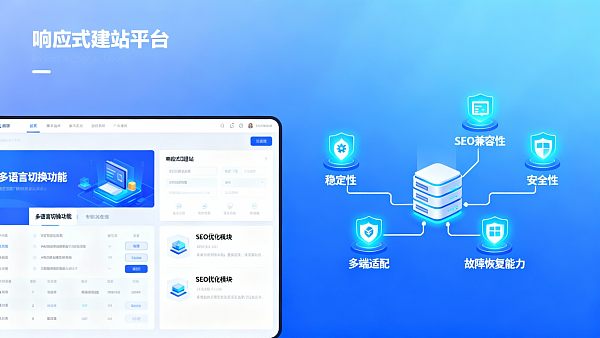
For data disaster recovery, daily snapshots + offsite redundant backups have become standard. A cross-border e-commerce client triggered emergency recovery procedures after mistakenly deleting a database; the platform completed full-site rollback within 17 minutes, with business interruption time below industry average (average 45 minutes). Such performance fully reflects the engineering rigor of system design.
In summary, choosing a responsive website platform affects not only initial construction efficiency but also directly impacts long-term operation costs and customer satisfaction. From global access performance to AI-driven content management, from SEO compatibility to terminal adaptation and security guarantees, every link must withstand practical tests.
With ten years of technical沉淀 and experience serving over 100,000 enterprises, we recommend adopting an all-in-one solution integrating AI, big data, and global infrastructure. Immediately learn how to enhance your digital competitiveness through cutting-edge practices in intelligent website platform industry discussions. For more solutions, visit EasyStore B2C Cross-border E-commerce for exclusive customized consultations and technical whitepapers.
- Website Builder Platform
- Foreign Trade Website Development
- SSL Certificate
- Website detection
- Google Ads
- Yiyingbao
- SEO
- Independent Website
- Smart website builder system
- SEO Optimization
- Smart Website Building
- AI Translation
- Independent foreign trade website
- Global CDN Acceleration
- Multilingual Foreign Trade Website System
- Responsive website platform
- How to build an independent foreign trade website
- Foreign Trade Website System
- Multilingual Website System
- Responsive Website Building
- Smart Website Platform
- Intelligent Website Platform Industry Discussion
- Smart Website Platform Evaluation
- Website Builder
- International Digital Marketing
- AI Multilingual Website System
- Cross-border SaaS Website Builder
- cross-border e-commerce
- Multilingual Website Building
Related Articles
 Does a responsive corporate website need to be built? Applicable scenarios, advantages and upgrade criteria
 How much does responsive website development cost? Design, front-end, and functionality development expenses make up the total
 What Should You Pay Attention to in Responsive Website Development? Page Adaptation, Speed and SEO Key Points



Related Products
 EasyCamp SaaS Smart Website Marketing SystemE-Yingbao SaaS Smart Website Marketing System: AI-powered, zero-code website building. Rapidly launch multilingual independent e-commerce sites in just 10 minutes. Global server acceleration and AI-driven SEO optimization empower businesses to efficiently connect with global markets. The seamless integration of technology and user-friendly operation makes building e-commerce sites incredibly simple.
 AI+SEM Intelligent Advertising Marketing SystemAI+SEM drives intelligent ad creation, empowering full-funnel precision advertising marketing. The system automatically generates weekly/monthly reports, AI recommends keywords and target countries, monitors core metrics in real-time with intelligent alerts, and enables one-click high-conversion ad solutions to help quickly acquire customers and improve ROI.
 AI+SEO Dual Engine Optimization ServiceEasyWin AI+SEO Dual Engine Optimization System leverages AI-powered keyword mining, content generation, and comprehensive technical optimization to help foreign trade enterprises acquire high-quality organic traffic, significantly improving search rankings and conversion rates.
 AI+SNS Social Media Marketing SystemYingbao AI+SNS Social Media Marketing System - Precision social capture for the social media era. Supports one-click content synchronization across major platforms like Facebook and LinkedIn. AI intelligently rewrites posts for enhanced relevance. 24/7 AI customer service and user profiling analysis empower businesses to efficiently expand into global markets.
 AI+SEO营销解决方案易营宝AI+SEO营销解决方案,通过AI批量写作、智能生成TDK、精准关键词扩词等功能,全面优化网站SEO效果,提升流量与转化率。助力企业构建高效智能网站新生态。
 AI+SEM Advertising Marketing SolutionsAI+SEM Advertising Marketing Solution leverages AI technology to deeply empower SEM ad campaigns. It automatically generates weekly/monthly reports using AI, presenting account data across multiple dimensions for comprehensive insights into campaign performance and trends. The system precisely recommends keywords and target countries, intelligently generates high-conversion ad copy, and enables one-click activation of efficient campaign plans to help businesses rapidly acquire customers. Simultaneously, it monitors core metrics in real time, intelligently identifies abnormal fluctuations, and issues timely alerts to ensure stable, high-return advertising results.
 Domain Name ServicesEasyWin provides professional domain name services, including intelligent queries, one-stop registration, brand protection, and full lifecycle management, helping businesses build a digital brand image.
 EasyOperate B2C Cross-Border E-Commerce Platform & Independent WebsiteEasyStore B2C Cross-border E-commerce Independent Store is an intelligent website building and cross-border e-commerce integrated solution independently developed by EasyStore Information Technology (Beijing) Co., Ltd. The system is specially designed for small and medium-sized as well as large export enterprises, integrating 'website building, operation, marketing, advertising, and conversion' into one, helping enterprises quickly establish cross-border e-commerce independent stores to achieve brand globalization and global sales growth.
The platform supports multiple languages, multiple currencies, and multi-channel marketing, with built-in AI intelligent translation and SEO optimization systems, suitable for mainstream markets such as Southeast Asia, Europe and America, Latin America, and the Middle East, assisting Chinese manufacturing enterprises in efficiently deploying international e-commerce strategies. SSL证书易营宝提供专业SSL安全证书服务,包括单域名和泛域名证书,确保网站数据传输加密、身份验证和完整性保护,助力企业建立安全可信的在线业务环境。









