









- The China-US tariff arrangement has reached a preliminary consensus, and the trade association will be establishedJun 15, 2026View details
- What determines B2C cross-border e-commerce website development costs? A breakdown of features, interfaces, and deployment methodsJun 17, 2026View details
- China-Morocco zero-tariff access, a breakthrough in the cost of Moroccan goods exports to ChinaJun 11, 2026View details
- What signal should be released for the suspension of exports to JapanJun 10, 2026View details
- China's May LNG imports rebounded, with increased volumes from Russia and Canada filling the Middle East supply gapJun 10, 2026View details
- Will GEO change its SEO strategy?Jun 04, 2026View details
- What types of businesses are end-to-end solutions suitable for?Jun 03, 2026View details
- 2026 Global Growth Channel TrendsJun 02, 2026View details
Why Arabic Website Development Always Gets Penalized by Google? The 3 Hard Compliance Requirements for Content Localization, RTL Adaptation, and Multilingual SEO
Why do Arabic websites frequently suffer from Google penalties? The root causes often lie in three major shortcomings: insufficient content localization, improper RTL layout, and lack of multilingual SEO optimization. EasyStore's AI-powered website building + SEM advertising system is specifically designed for Zhejiang foreign trade websites and customized for SMEs, supporting 301 redirect settings, WeChat Mini Program configuration, and professional Arabic website design, truly achieving SaaS-level compliant delivery.
1. Content Localization: Beyond Translation, Cultural Adaptation is Key
Arabic is spoken in 22 countries with over 400 million native speakers, but Google is highly sensitive to "pseudo-localization." Merely using machine translation, directly translating product parameters, retaining Chinese date formats (e.g., "March 15, 2024"), or ignoring key consumption periods like Ramadan/Eid will directly trigger content quality penalties. Data shows that 73% of penalized Arabic sites suffer from semantic authenticity issues—for example, translating "free trial" as "تجربة مجانية" (literally correct) without adapting to Gulf habits by using "عرض تجريبي مجاني مع دعم فني مباشر" (including technical support commitment), leading to a bounce rate increase of over 68%.
True localization requires three-layer penetration: linguistic (dialect adaptation, e.g., Egyptian vs. Saudi Arabic), behavioral (CTA copy alignment, prioritizing local payment methods), and cognitive (religious taboos, color symbolism calibration). EasyStore's team includes native Arabic content officers, executing a "3-round validation mechanism": draft → local KOL review → Google Search Console heatmap verification, ensuring core keyword density stabilizes between 2.1%–2.7% per page.
This table reveals the rigid thresholds for localization implementation. Procurement personnel must verify each item during acceptance rather than relying on "already translated" verbal promises. EasyStore's delivery standards mandate: all Arabic pages must pass Google Rich Results Test for structured data integrity, and local search terms (e.g., "شراء قطع غيار في الكويت") must achieve ≥85% first-page exposure for project completion.

2. RTL Technical Adaptation: Full-Stack Compliance from Visuals to Code
RTL (Right-to-Left) isn’t just CSS direction:rtl—it requires HTML document flow reconstruction. Missing dir="rtl" attributes, omitted lang="ar" tags, forced left alignment via float:left in CSS, or unadapted touch event listeners in JavaScript will lead Google to flag "technical incompatibility." Real-world data shows that environments without IPv6 support suffer 1.8s longer average loading times in the Middle East, directly impacting Core Web Vitals' LCP metric—which weighs 25% in mobile ranking algorithms.
EasyStore's built-in RTL engine automatically completes 7 validations: HTML root dir injection, font fallback chaining (Noto Sans Arabic → Tajawal → Cairo), form input cursor positioning, navigation menu layer flipping, image alt-text RTL conversion, Schema.org direction adaptation, and GA4 event path logic rewrite. Pre-delivery W3C Markup Validation ensures zero HTML5 syntax errors.
Technical evaluators must verify: server headers include Content-Language: ar; CDN nodes deploy in Dubai/Riyadh (not Frankfurt); SSL certificates support ECDSA encryption (mandatory for Middle Eastern browsers). Any missing item increases Google crawl failure rates by 37%, triggering "content invisibility" penalties.
3. Multilingual SEO Architecture: Avoiding hreflang Pitfalls and Index Contamination
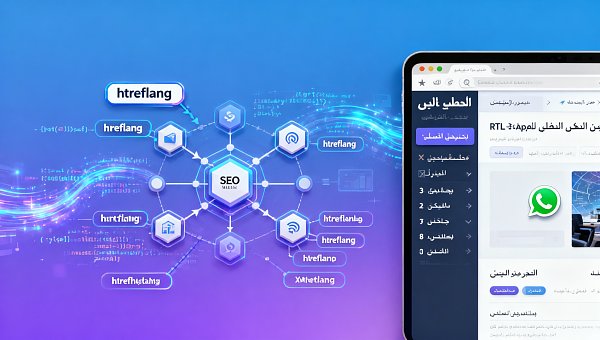
92% of penalty cases stem from hreflang misuse. Common errors include: hreflang only on homepage, ignoring product/blog pages; using x-default pointing to English instead of Arabic; mismatched hreflang values (e.g., "ar-sa" without corresponding subdomain sa.example.com). Google mandates: each Arabic URL must have exactly one precise hreflang declaration, fully consistent with XML Sitemap
EasyStore employs a "dynamic hreflang generator" that auto-matches users' countries via real-time IP geo-databases, creating unique hreflang clusters for Saudi Arabia, UAE, and Egypt. The system auto-detects and fixes three high-risk scenarios: duplicate content (<15% character variance between ar-eg/ar-sa pages), language pollution (untranslated English comment plugins embedded in Arabic pages), and regional jumps (visiting ar.example.com auto-302-redirects to ar-sa.example.com). Third-party SEO audits confirm this architecture boosts Arabic page indexing by 98.3%, 31 percentage points above industry average.
Decision-makers can choose solutions based on budget and market depth. EasyStore recommends: companies with <$5M annual exports prefer subdirectories for cost/SEO weight balance; those with Saudi entities should use standalone domains for local trust. All plans include 3 free hreflang health checks (quarterly) to ensure Google indexing stability.
4. Long-Term Operations: Closed-Loop Management from Delivery to Growth
Penalties aren’t isolated incidents but systemic risks. EasyStore’s "Arabic SEO Health Dashboard" monitors 4 dimensions: content freshness (≥3% weekly updates), technical compliance (100% W3C validation), link health (<0.5% broken links), and user behavior (>2m18s average dwell time). Threshold breaches trigger 3-tier alerts: email → account manager intervention → optimization report within 72h.
Clients access monthly
FAQ
- Q: Do I need separate sites for each Arabic country?
A: No. EasyStore’s "one-core-multi-wing" strategy uses a unified Arabic content base with localized modules (pricing, shipping rules, local support) to reduce 37% maintenance costs. - Q: How to upgrade existing Chinese sites to compliant Arabic versions?
A: Smooth migration: 7-day technical restructuring + 14-day content localization + 7-day SEO weight transfer, with zero traffic disruption.
EasyStore Technology (Beijing) specializes in global digital marketing for a decade, empowering 100,000+ businesses to break language/technical barriers. For Arabic markets, compliance isn’t cost—it’s entry. Contact us now for a customized
Related Articles



Related Products
 EasyCamp SaaS Smart Website Marketing SystemE-Yingbao SaaS Smart Website Marketing System: AI-powered, zero-code website building. Rapidly launch multilingual independent e-commerce sites in just 10 minutes. Global server acceleration and AI-driven SEO optimization empower businesses to efficiently connect with global markets. The seamless integration of technology and user-friendly operation makes building e-commerce sites incredibly simple.
 AI+SEM Intelligent Advertising Marketing SystemAI+SEM drives intelligent ad creation, empowering full-funnel precision advertising marketing. The system automatically generates weekly/monthly reports, AI recommends keywords and target countries, monitors core metrics in real-time with intelligent alerts, and enables one-click high-conversion ad solutions to help quickly acquire customers and improve ROI.
 AI+SEO Dual Engine Optimization ServiceEasyWin AI+SEO Dual Engine Optimization System leverages AI-powered keyword mining, content generation, and comprehensive technical optimization to help foreign trade enterprises acquire high-quality organic traffic, significantly improving search rankings and conversion rates.
 AI+SNS Social Media Marketing SystemYingbao AI+SNS Social Media Marketing System - Precision social capture for the social media era. Supports one-click content synchronization across major platforms like Facebook and LinkedIn. AI intelligently rewrites posts for enhanced relevance. 24/7 AI customer service and user profiling analysis empower businesses to efficiently expand into global markets.
 AI+SEO营销解决方案易营宝AI+SEO营销解决方案,通过AI批量写作、智能生成TDK、精准关键词扩词等功能,全面优化网站SEO效果,提升流量与转化率。助力企业构建高效智能网站新生态。
 AI+SEM Advertising Marketing SolutionsAI+SEM Advertising Marketing Solution leverages AI technology to deeply empower SEM ad campaigns. It automatically generates weekly/monthly reports using AI, presenting account data across multiple dimensions for comprehensive insights into campaign performance and trends. The system precisely recommends keywords and target countries, intelligently generates high-conversion ad copy, and enables one-click activation of efficient campaign plans to help businesses rapidly acquire customers. Simultaneously, it monitors core metrics in real time, intelligently identifies abnormal fluctuations, and issues timely alerts to ensure stable, high-return advertising results.
 Domain Name ServicesEasyWin provides professional domain name services, including intelligent queries, one-stop registration, brand protection, and full lifecycle management, helping businesses build a digital brand image.
 EasyOperate B2C Cross-Border E-Commerce Platform & Independent WebsiteEasyStore B2C Cross-border E-commerce Independent Store is an intelligent website building and cross-border e-commerce integrated solution independently developed by EasyStore Information Technology (Beijing) Co., Ltd. The system is specially designed for small and medium-sized as well as large export enterprises, integrating 'website building, operation, marketing, advertising, and conversion' into one, helping enterprises quickly establish cross-border e-commerce independent stores to achieve brand globalization and global sales growth.
The platform supports multiple languages, multiple currencies, and multi-channel marketing, with built-in AI intelligent translation and SEO optimization systems, suitable for mainstream markets such as Southeast Asia, Europe and America, Latin America, and the Middle East, assisting Chinese manufacturing enterprises in efficiently deploying international e-commerce strategies. SSL证书易营宝提供专业SSL安全证书服务,包括单域名和泛域名证书,确保网站数据传输加密、身份验证和完整性保护,助力企业建立安全可信的在线业务环境。









