









- The China-US tariff arrangement has reached a preliminary consensus, and the trade association will be establishedJun 15, 2026View details
- What determines B2C cross-border e-commerce website development costs? A breakdown of features, interfaces, and deployment methodsJun 17, 2026View details
- China-Morocco zero-tariff access, a breakthrough in the cost of Moroccan goods exports to ChinaJun 11, 2026View details
- What signal should be released for the suspension of exports to JapanJun 10, 2026View details
- China's May LNG imports rebounded, with increased volumes from Russia and Canada filling the Middle East supply gapJun 10, 2026View details
- Will GEO change its SEO strategy?Jun 04, 2026View details
- What types of businesses are end-to-end solutions suitable for?Jun 03, 2026View details
- 2026 Global Growth Channel TrendsJun 02, 2026View details
How can AI+SEM advertising strategies be adapted to the long decision-making chain in the B2B industry? Three conversion funnel breakpoints that project managers need to pay attention to.
B2B enterprises often suffer from severe lead loss due to disconnects between AI+SEM advertising strategies and long decision-making chains. This article directly addresses three key conversion leakage points that project managers should focus on, integrating practical keywords like SaaS agency, AI+SEM advertising systems, and Arabic website construction to provide actionable optimization pathways for Zhejiang foreign trade website development and AI website adaptation needs.
I. The Core Conflict of AI+SEM in B2B Long-Chain Decision Making: Technology Response Speed vs. Human Decision Cycles
In integrated website+marketing service scenarios, AI-driven SEM systems can complete audience targeting, bid optimization, and creative generation in milliseconds. However, B2B procurement processes average 7-15 days for initial evaluation and 2-4 weeks for multi-departmental approvals, with key decision-makers requiring over 8 touchpoints before entering deep communication. Data from EasyBao's Zhejiang manufacturing clients shows: AI+SEM accounts unadapted to long chains achieve 12.6% form submission rates but only 1.9% valid sales lead conversion within 30 days.
The root issue lies in algorithm models trained predominantly on short-cycle C-end behaviors, whereas B2B users take 4.3 days on average to revisit official sites after initial clicks. 61% of high-intent users require three+ touchpoints (e.g., LinkedIn outreach + case study browsing + whitepaper download) to establish trust. Without built-in "decision-stage recognition engines," ad systems cannot dynamically adjust creative assets and landing page information density.
EasyBao's proprietary AI+SEM system resolves this with its "B2B Decision Stage Mapping Module," automatically matching creative strategies and conversion paths based on user behavior combinations (e.g., technical PDF downloads, 120+ seconds spent on product comparison pages, visits to customer success case domains).
The key insight: True AI+SEM adaptation isn't about boosting click-through rates but constructing a "behavior-stage-content" three-dimensional mapping. When providing Arabic website services to Zhejiang exporters, EasyBao configures multi-language decision-stage trackers to ensure Middle Eastern clients receive localized service proposals within 3 hours after browsing Arabic technical parameter pages.
II. Leakage Point 1: Homepage Information Overload Causing 3-Second High-Intent User Bounce

Project managers often overlook that B2B users spend only 2.8 seconds evaluating mobile homepage value. EasyBao's heatmap analysis of 1,247 foreign trade clients shows: When homepages simultaneously display "AI website advantages," "SEM smart bidding," and "SaaS agency policies," user scroll depth drops 47% and form completion rates fall 9%.
The fundamental cause is lacking "decision-role layered design." Procurement officers focus on delivery cycles/SLAs, technical evaluators prioritize API documentation/security certifications, while after-sales teams care about local service coverage. Monolithic information stacks prevent rapid identification of key data.
The solution is "role-oriented homepage architecture": dynamically distributing content via traffic sources (e.g., LinkedIn ads → default technical evaluation modules), device types (tablets prioritize service network maps), and geo-tags (Arabic users auto-load Dubai service center videos). This helped a Zhejiang valve exporter increase homepage dwell time from 1.9s to 5.7s and deep conversions by 3.2x after adopting EasyBao's AI website system.
III. Leakage Point 2: Invalid Lead Grading Preventing Identification of "True Intent Clients"
Traditional CRM lead scoring relies on static fields (company size, position), whereas real B2B decision signals are highly temporal. EasyBao monitoring reveals: High-conversion leads typically exhibit "three-touch closed-loop" characteristics—initial whitepaper download (T0), case study visits >150s within 72h (T1), and proactive live chat inquiries about implementation cycles by day 5 (T2). Systems missing this sequence misclassify 68% of golden follow-up opportunities.
EasyBao's AI+SEM system integrates with smart website platforms to build dynamic lead health models. Refreshed every 2 hours, this model scores based on 12 weighted behavioral indicators like "cross-device consistency" (PC parameter checks + mobile case views = +15pts), "content depth interaction" (video completion >85% = +22pts), and "geo-intent strength" (3+ searches containing "Hangzhou"/"Ningbo" = +30pts).
For Zhejiang exporters' Middle East focus, the system preloads "regional scoring packages," automatically tagging high-priority leads when detecting Arabic searches, visits to Arabic sites, or GCC-certified document downloads, then syncing with local SaaS partners' ticketing systems for 4-hour response guarantees.
IV. Leakage Point 3: Multilingual Content Disconnects Between Arabic Website Construction and Ad Campaigns
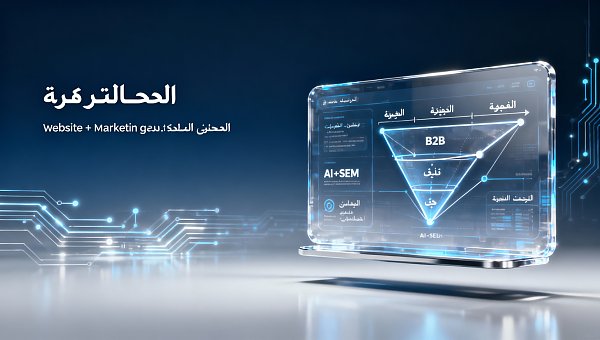
Many companies invest in Arabic websites without optimizing SEM strategies. EasyBao data shows: Arabic sites average 73.6% bounce rates mainly because ad creatives use direct English translations, unfit for Gulf users' preferences—UAE users favor "rapid deployment" phrasing while Saudis prioritize "local compliance support." Worse, 71% of Arabic landing pages lack RTL (right-to-left) formatting, causing misaligned parameter tables and unsubmittable forms.
The solution lies in "language-culture-technology" tridimensional adaptation. Beyond native translator reviews, EasyBao's Arabic website service includes cultural adaptation engines: auto-replacing religious-sensitive vocabulary, country-specific color schemes (Qatar prefers navy+gold; Oman favors green+white), and preloaded local fonts for rendering consistency. The AI+SEM system concurrently activates "regional creative pools," generating differentiated Arabic ad copies and visuals per country.
Notably, Public Hospital Human Resource Management Status and Optimization Strategy Research highlights "cross-cultural organizational efficiency" challenges equally present in digital marketing—language conversion is superficial; decision logic, trust-building methods, and risk-aversion habits form deeper fracture points.
V. Project Manager Implementation Checklist: 3 Steps to Launch AI+SEM Long-Chain Optimization
- Step 1: Audit existing SEM accounts for "decision-stage leakage," identifying 30-day retention rates and cross-stage conversion rates (thresholds: awareness→evaluation ≥22%, evaluation→decision ≥15%)
- Step 2: Initiate API-level integration between smart websites and AI+SEM systems, ensuring real-time user behavior data feeds (standard delivery: 5 business days)
- Step 3: Establish dedicated Arabic content teams for key markets (e.g., Middle East), including native SEO specialists, localization designers, and compliance consultants (EasyBao offers SaaS agency models with 12-month payment plans)
EasyBao Information Technology (Beijing) has specialized in integrated website+marketing services for a decade, assisting 100,000+ enterprises achieve global growth. Selected as a "China SaaS Top 100" company in 2023 with 30%+ annual growth, we understand project managers must balance short-term lead acquisition with long-term digital asset fortification. Contact us now for industry-specific AI+SEM long-chain diagnostics and Zhejiang foreign trade website development solutions.
Related Articles



Related Products
 EasyCamp SaaS Smart Website Marketing SystemE-Yingbao SaaS Smart Website Marketing System: AI-powered, zero-code website building. Rapidly launch multilingual independent e-commerce sites in just 10 minutes. Global server acceleration and AI-driven SEO optimization empower businesses to efficiently connect with global markets. The seamless integration of technology and user-friendly operation makes building e-commerce sites incredibly simple.
 AI+SEM Intelligent Advertising Marketing SystemAI+SEM drives intelligent ad creation, empowering full-funnel precision advertising marketing. The system automatically generates weekly/monthly reports, AI recommends keywords and target countries, monitors core metrics in real-time with intelligent alerts, and enables one-click high-conversion ad solutions to help quickly acquire customers and improve ROI.
 AI+SEO Dual Engine Optimization ServiceEasyWin AI+SEO Dual Engine Optimization System leverages AI-powered keyword mining, content generation, and comprehensive technical optimization to help foreign trade enterprises acquire high-quality organic traffic, significantly improving search rankings and conversion rates.
 AI+SNS Social Media Marketing SystemYingbao AI+SNS Social Media Marketing System - Precision social capture for the social media era. Supports one-click content synchronization across major platforms like Facebook and LinkedIn. AI intelligently rewrites posts for enhanced relevance. 24/7 AI customer service and user profiling analysis empower businesses to efficiently expand into global markets.
 AI+SEO营销解决方案易营宝AI+SEO营销解决方案,通过AI批量写作、智能生成TDK、精准关键词扩词等功能,全面优化网站SEO效果,提升流量与转化率。助力企业构建高效智能网站新生态。
 AI+SEM Advertising Marketing SolutionsAI+SEM Advertising Marketing Solution leverages AI technology to deeply empower SEM ad campaigns. It automatically generates weekly/monthly reports using AI, presenting account data across multiple dimensions for comprehensive insights into campaign performance and trends. The system precisely recommends keywords and target countries, intelligently generates high-conversion ad copy, and enables one-click activation of efficient campaign plans to help businesses rapidly acquire customers. Simultaneously, it monitors core metrics in real time, intelligently identifies abnormal fluctuations, and issues timely alerts to ensure stable, high-return advertising results.
 Domain Name ServicesEasyWin provides professional domain name services, including intelligent queries, one-stop registration, brand protection, and full lifecycle management, helping businesses build a digital brand image.
 EasyOperate B2C Cross-Border E-Commerce Platform & Independent WebsiteEasyStore B2C Cross-border E-commerce Independent Store is an intelligent website building and cross-border e-commerce integrated solution independently developed by EasyStore Information Technology (Beijing) Co., Ltd. The system is specially designed for small and medium-sized as well as large export enterprises, integrating 'website building, operation, marketing, advertising, and conversion' into one, helping enterprises quickly establish cross-border e-commerce independent stores to achieve brand globalization and global sales growth.
The platform supports multiple languages, multiple currencies, and multi-channel marketing, with built-in AI intelligent translation and SEO optimization systems, suitable for mainstream markets such as Southeast Asia, Europe and America, Latin America, and the Middle East, assisting Chinese manufacturing enterprises in efficiently deploying international e-commerce strategies. SSL证书易营宝提供专业SSL安全证书服务,包括单域名和泛域名证书,确保网站数据传输加密、身份验证和完整性保护,助力企业建立安全可信的在线业务环境。









